

The idea that all your US clinical experience “must match your chosen specialty” is wildly overstated—and honestly, it scares way more IMGs than it should.
You did US clinical experience (USCE) in a different field. Now you’re spiraling: “I want internal medicine but my month is in pediatrics… I’m applying psych with only FM letters… Will they secretly blacklist me? Does this make me look confused? Uncommitted? Unmatchable?”
Let’s unpack this like someone who has sat with way too many IMGs on ERAS eve, staring at their CV and wondering if they’ve already ruined everything.
The brutal truth: mismatched USCE is not what kills most IMG applications
If programs rejected people because their USCE was in a different specialty, almost every IMG who shadowed “anything they could get” would be dead in the water. That’s not what happens.
Programs care about three much more basic questions:
- Can you function safely in the US system?
- Will you show up, do the work, and not make their lives harder?
- Do your letters suggest you’re a decent human and a decent clinician?
Aligned specialty experience is nice. Not having it isn’t an automatic red flag.
Where you can absolutely get into trouble is this combo:
- No USCE at all
- Or only observerships with weak letters
- Plus no clear story for why you want the specialty you’re applying to
So if your fear is “I did pediatrics but I’m applying internal medicine, I’m screwed,” the honest answer: you’re not screwed. The bigger problem would be if you have literally nothing that looks like real US clinical work with patients.
Let’s be specific.
| USCE Type | Specialty Match Needed? | Impact for IMGs |
|---|---|---|
| Sub-internship | Helpful but not vital | Strong |
| Hands-on elective | Helpful but not vital | Strong |
| Observership | Specialty match helps | Moderate |
| Research-only | Specialty match helps | Weak alone |
| No USCE | N/A | Very harmful |
Do you see the pattern? Having USCE matters more than it perfectly matching.
The part that’s haunting you: “Will this make me look undecided or fake?”
Let me go straight to the nightmare scenario you’re probably running in your head:
You: “I’m very passionate about internal medicine.”
Interviewer, flipping through your CV: “So why is all your US experience in pediatrics?”
You: brain empties, soul leaves body
Here’s the thing: that question is totally survivable if you’ve actually thought through your answer. What hurts you is not the mismatch. It’s the awkward, panicked, “uhh I just took whatever I got” with no reflection, no logic, no connection.
There are three things you need to be able to do:
- Acknowledge the reality
Not, “I’ve always dreamed of IM and only IM” when your story clearly says you explored other things. Just own it. - Show insight
What did you learn from that other specialty that actually helps you be a better [insert your specialty] doctor? - Connect the dots
Why, after those experiences, are you choosing your current specialty now?
That’s it. If you can do that without sounding like you discovered internal medicine last Tuesday, your “mismatched” USCE stops being suspicious and just becomes part of your journey.
How to spin “wrong-field” USCE into something that actually helps you
Yes, I said spin. Not “deceive.” Spin. As in: extract actual meaning from your path instead of leaving it as random chaos on your CV.
Imagine these scenarios.
You did:
- 1 month USCE in pediatrics
- 1 observership in family medicine
- Now you’re applying internal medicine
You can either leave that as:
“I just took what I could get, please ignore this,”
or turn it into:
“I initially explored pediatrics and family medicine in the US to understand outpatient medicine here. Working with medically complex teenagers in peds actually pushed me toward adult medicine—I realized I was more drawn to long-term management of chronic conditions across decades, especially in adults with multiple comorbidities. That’s why I’m focusing on internal medicine now.”
See what changed? Same CV. Different story.
You did:
- Psych observership
- Now applying neurology
Try something like:
“During psychiatry, I was fascinated by how often neurologic and psychiatric conditions overlap—dementia, epilepsy, movement disorders. I found myself staying late with the neurology consult team and realized I was more pulled toward the diagnostic side of brain disease. That experience clarified that neurology was the better fit for me.”
The point: you don’t pretend the mismatched USCE didn’t happen. You use it as the thing that pushed you toward what you’re applying for.
Where mismatched USCE can hurt you (and how to not let that happen)
Let me be honest about the real traps, because there are a few.
1. All letters from a different specialty and zero letters in your chosen field
This is the one that genuinely stings.
If you’re applying psychiatry and all 3 letters are from surgery attendings, the committee will start wondering:
- Have you actually seen inpatient psych in the US?
- Do psych attendings not want to write for you?
- Do you even know what you’re signing up for?
Is it fatal? Not always. But you’re making life harder.
If this is you, your emergency plan:
- Get at least one letter from someone even tangentially close to your field if possible (FM for IM, neuro for psych, etc.)
- Or, if you truly can’t, make sure your personal statement and experiences section scream: “I actually understand and care about this specialty.”
2. Your application screams “I’ll go anywhere that matches me”
You apply:
- 100 programs in internal medicine
- 80 in family medicine
- 70 in pediatrics
And your USCE is all over the place with no clear center of gravity. You look like you’re not choosing a specialty—you’re shopping for a visa.
Programs hate feeling like they’re your backup plan.
If your USCE is scattered, your narrative cannot also be scattered. That means:
- One clear primary specialty in your story
- Maybe a believable secondary specialty if you’re dual-applying
- A reason that everything on your CV fits into that story somehow
You can’t fix how your past rotations look. But you can absolutely fix how you talk about them.
How to talk about your “wrong” USCE in personal statements and interviews
Let’s get practical, because vague encouragement doesn’t calm 3 a.m. ERAS anxiety.
In your personal statement
You don’t have to write: “I know my experience is in pediatrics but I swear I love internal medicine.” That sounds defensive and weird.
Instead:
- Mention the other specialty once, briefly, in service of your current choice
- Show what you learned that pushed you toward your chosen specialty
- Spend 90% of the space on your target field, not on apologizing for your path
Example framing line:
“During my pediatrics rotation at [Hospital], I learned how to communicate with anxious families and coordinate complex care. While I valued that experience, I found myself most engaged by the adult patients with chronic conditions seen in the transition clinic, which solidified my decision to pursue internal medicine.”
Done. You acknowledged it. You used it. You moved on.
In interviews
If they ask, “I see your USCE is in X, but you’re applying to Y—can you explain that?”
You want an answer that:
- Starts with a calm, “Yes, absolutely.”
- Gives 1–2 concrete things you gained from that experience
- Ends with a clear, confident statement of why you’re now choosing this specialty
What you don’t do:
- Trash the other specialty
- Ramble about visa issues and desperation
- Look surprised that they asked
You knew this question was coming. If you prep that answer once, you can stop replaying the nightmare version in your head every night.
The quiet advantage you’re ignoring: any USCE still proves you’re “trainable here”
This part never gets enough attention.
Even if your USCE is in a different field, it still proves:
- You’ve seen how US attendings document, staff cases, and think
- Someone in the US system supervised you and didn’t hate you enough to write a bad letter
- You know basic US hospital culture (pages, notes, sign-out, HIPAA, etc.)
Programs are terrified of taking someone who has never set foot in a US hospital. Because that person could be:
- Clinically fine but totally lost in workflow
- Struggling with language or communication
- Needing months of hand-holding they don’t have time to give
You having any USCE tells them: “This person has at least been reality-tested in our system once.”
That’s more reassuring than you think.
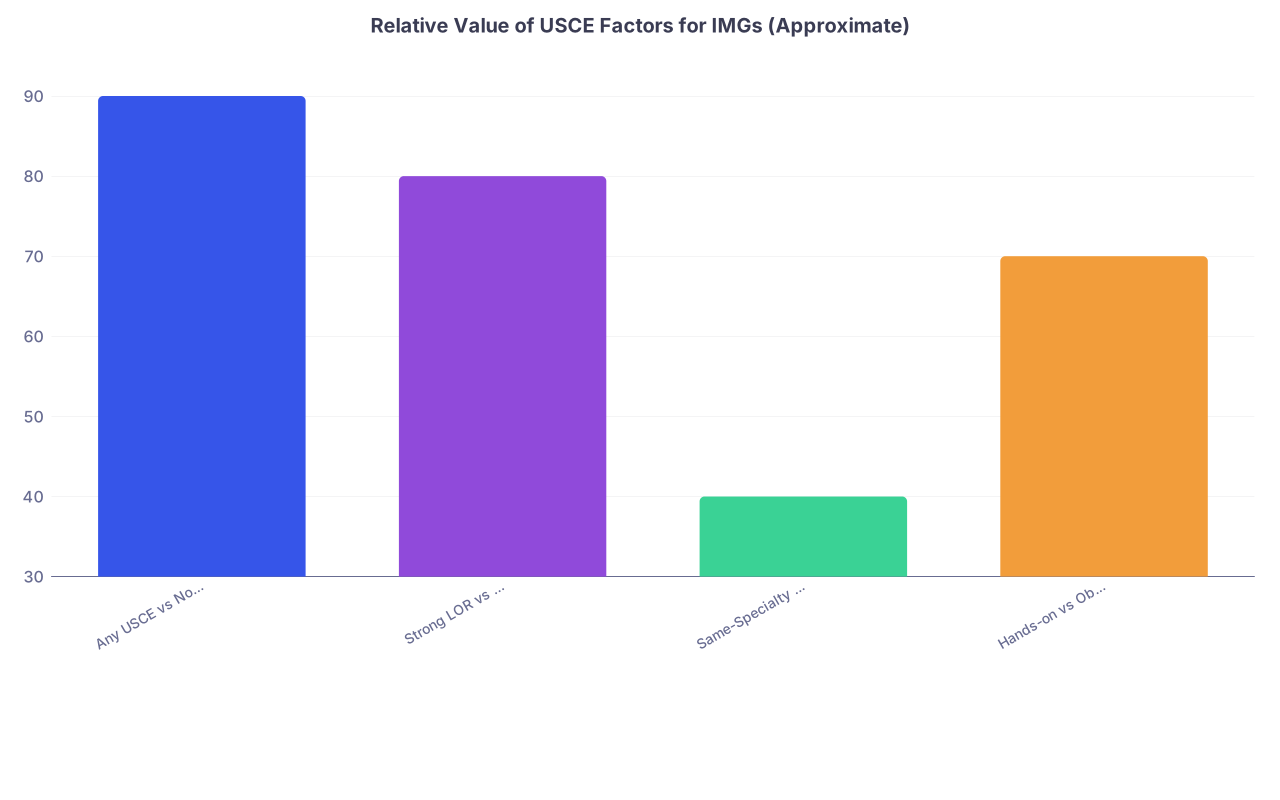
| Category | Value |
|---|---|
| Any USCE vs None | 90 |
| Strong LOR vs Weak | 80 |
| Same-Specialty vs Different | 40 |
| Hands-on vs Observership | 70 |
Translation of that rough hierarchy:
- Having some USCE vs none at all → huge difference
- Strong letter vs bland letter → big difference
- Same-field USCE vs different-field USCE → helpful, but not the main decider
You’re stressing about the third thing while ignoring that you already have the first two.
When you really should consider adding more aligned experience
There are situations where I’d tell you, bluntly: you should try hard to get specialty-aligned USCE if you still can.
For example:
- You’re applying to super-competitive specialties as an IMG (derm, plastics, ortho, ENT, etc.)
- You’re aiming for university programs in things like neurosurgery, radiation oncology, etc.
- You have time before applying and currently hold only unrelated, short observerships
That’s where the bar is stupidly high and lots of applicants do have perfectly aligned, hands-on rotations and research in the same field.
If you’re applying:
- Internal medicine
- Family medicine
- Pediatrics
- Psychiatry
- Neurology
- Pathology
- Even OB/GYN in many places
Mismatched USCE is far from fatal, especially if you’re not gunning only for top-tiers.
If you have time and money, sure, adding one aligned experience helps. But if you don’t? You’re better off strengthening:
- Step scores
- Step 3 (if done)
- A clear personal statement
- Clean, typo-free, coherent ERAS
than killing yourself trying to perfectly “specialty-match” everything.
How to stop catastrophizing this in your head
You’re probably doing the mental math: “One pediatrics, one FM, one psych = they’ll think I’m confused… one OB rotation = they’ll think I don’t know what I want… I’m doomed.”
Let me give you a more accurate way to look at your application:

| Step | Description |
|---|---|
| Step 1 | ERAS Opens |
| Step 2 | Check Scores and Attempts |
| Step 3 | High Risk |
| Step 4 | Review LOR and Comments |
| Step 5 | Interview Possible |
| Step 6 | Lower Priority |
| Step 7 | US Grad or IMG |
| Step 8 | Any USCE? |
| Step 9 | Specialty Fit Clear? |
Notice what’s not in that flowchart: “Reject if USCE is in different specialty.”
It just doesn’t work like that. It’s more: “Okay, IMG → Do they have any USCE → Are the letters good → Does their story make sense for this specialty?”
Your job isn’t to magically rewrite your past. It’s to make your story make sense.
FAQ (exactly 5 questions)
1. I did all my USCE in family medicine but I’m applying internal medicine. Do I need to apologize for that in my personal statement?
No. You don’t “apologize.” You briefly explain how those experiences strengthened skills that matter in internal medicine—continuity of care, chronic disease management, working with diverse adult populations. Then you shift quickly to why internal medicine specifically fits you. Keep it confident, not defensive.
2. I have only one month of USCE and it’s in a different specialty. Is that better than no USCE or does it look random?
It’s absolutely better than no USCE. One real, supervised US rotation—in any field—still proves you can function in the US system. It looks “random” only if you don’t connect it to your current choice in your application. If you show what you learned and why you’re now choosing your specialty, that month becomes an asset, not a liability.
3. My strongest letter is from a different specialty. Should I still use it?
Usually yes. A strong, detailed letter from another specialty (“hardworking, reliable, clinically sound, excellent communication”) is often more valuable than a weak, generic letter from your chosen specialty. Ideally you mix them: at least one from your target field if possible, plus your strongest letters overall. Strong > perfectly matched but bland.
4. Will programs think I’m not serious about their specialty because I also explored others in the US?
Only if your application reads like you’re applying to anything that moves. If your personal statement, experiences, and program list clearly center on one specialty, most programs interpret prior experiences in other fields as exploration, not lack of seriousness. Many US grads do rotations in multiple fields before deciding—they’re not punished for that, and you won’t be either if your story is coherent.
5. I can’t get specialty-aligned USCE before this match cycle. Should I delay applying a year?
Usually, no. Delaying a whole year just to swap “FM USCE” for “IM USCE” (or similar) is almost never worth it unless you’re also improving something big—like major score improvement, clearing attempts, solid research, or getting a visa that opens more doors. In most realistic IMG situations, applying with the USCE you already have, plus a strong narrative and good letters, beats waiting another year for a slightly more “aligned” CV.
Key takeaways:
- Having some US clinical experience—even in a different field—is far better than having none.
- What matters most is how you explain it and connect it to your chosen specialty, not that it matches perfectly.
- Stop fixating on the mismatch and focus your energy on scores, strong letters, and a clear, believable story about why you belong in the specialty you’re applying to.


