

The way most people talk about US clinical experience for IMGs completely ignores one reality: parents cannot disappear for 3–6 months to “grind observerships” like a single 24‑year‑old with no dependents.
If you're an IMG parent, your constraints are real. And they matter more than all the inspirational LinkedIn posts combined. You are not just trying to “get USCE.” You’re trying to protect your kids’ stability, stay married (or at least sane), and not blow your entire savings on one bad rotation.
Here’s how to structure US clinical time around family obligations without sabotaging your residency application.
Step 1: Get Brutally Clear on Your Non‑Negotiables
Before you look at a single observership listing or email any attendings, you need to decide what is not up for debate. If you skip this, you’ll say yes to something glamorous and destroy your home life for 4 weeks, then spend the next year trying to fix the fallout.
Write this down. Literally, on paper.
Common non‑negotiables for IMG parents:
- Maximum weeks you can be away from home in a year
- Whether you can bring your child(ren) with you
- Whether your partner can take time off or flex work
- Budget ceiling for all‑in costs per month (housing, childcare, transport, fees)
- Max daily hours you can realistically be in the hospital
Then refine it.
Instead of “I can’t be gone too long,” write: “I can be away from home a total of 8 weeks this year, no more than 4 weeks at a time, with at least 6 weeks in between trips.”
Instead of “we don’t have much money,” write: “We can spend $4,000 total on USCE this year. If something costs more than $1,500 per month just for fees, it’s off the table.”
You’re not being “weak” or “less dedicated.” You’re being strategic. Programs actually respect people who live in the real world.
Step 2: Decide Your USCE Strategy Type
There are three basic USCE patterns that I see IMG parents use. Only one of them usually works well.
| Strategy Type | Key Feature | Risk Level |
|---|---|---|
| Big Block | 3–4 months continuous | High |
| Split Blocks | 2–3 rotations split over year | Moderate |
| Local Hybrid | Local USCE + 1 away month | Low |
1. “Big Block” Strategy – Usually a Bad Idea for Parents
This is the “I’ll move to the US for 3–4 months, do back‑to‑back rotations, leave the kids with grandparents” plan.
Who this might work for:
- Single parent whose kids are safely with very stable, trusted caregivers
- Families with serious financial cushion and flexible schooling
- People with a guaranteed or near‑guaranteed research/clinical combo at one place
For most parents, it blows up because:
- Childcare is unpredictable. Sick kids, school events, emotional meltdowns. From another country or state, you can’t fix any of that.
- Marriages strain hard when one partner is solo‑parenting for months.
- You’re constantly half in USCE mode, half in crisis‑texting mode. Programs notice when you’re distracted.
Use this strategy only if your home support situation is rock solid and you’re getting something extra (e.g., paid research, strong letters from one department).
2. “Split Blocks” Strategy – Best Tradeoff for Most IMG Parents
Here, you do two or three separate months of USCE spread over 6–12 months: for example, April, July, and October. You come in, do a focused block, go home, regroup, then repeat.
Why this works better:
- Your partner and kids know there’s an end date coming soon.
- You can adjust between blocks. If one month nearly killed everyone at home, you shorten or move the next one.
- Financial hit is spread out across the year.
- You can course‑correct: if the first rotation is weak, you pick a stronger one next.
3. “Local Hybrid” Strategy – Underrated but Powerful
This is ideal if you already live in the US (on dependent visa, green card, etc.) or can stay with relatives in a US city.
You combine:
- Local or remote clinical exposure (telemedicine, free clinics, volunteer roles, shadowing) where your family lives or stays, plus
- One high‑impact away month at a program you’d seriously like to match at
Benefits:
- Your kids sleep in their usual beds most nights.
- You avoid multiple housing moves and repeated visa trips.
- You can pick a single “audition month” to align with when programs remember you (usually July–October for that specialty).
If you can pull this off, it’s often the smartest structure for parents.
Step 3: Align USCE With Your Family Calendar, Not the Other Way Around
Most IMGs do this backwards. They find a rotation, then panic‑fit their life around it. You will save yourself so much pain if you invert this.
Start by mapping your family’s year:
- School calendars (breaks, exams, graduation)
- Major religious or cultural holidays you won’t skip
- Known events: due dates, surgeries, parents traveling, visa expiration dates
- Your spouse’s crunch periods at work or study
Then layer residency reality on top.
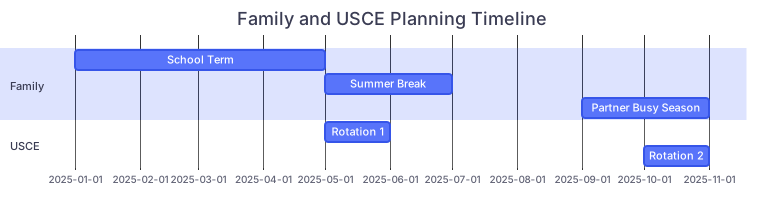
| Task | Details |
|---|---|
| Family: School Term | a1, 2025-01, 4M |
| Family: Summer Break | a2, 2025-05, 2M |
| Family: Partner Busy Season | a3, 2025-09, 2M |
| USCE: Rotation 1 | b1, 2025-05, 1M |
| USCE: Rotation 2 | b2, 2025-10, 1M |
Things to consider:
- If your child struggles with transitions, do your away month during a longer school break so routines can adjust more naturally.
- Avoid USCE during partner’s known busy season if they’ll be solo‑parenting.
- For Match‑cycle rotations (July–October), try to pick a month where home life is relatively quiet. You need to be sharp.
Then you email programs and say: “I am available for observerships/externships in [Month 1] and [Month 2]. Could you accommodate a 4‑week block in that time frame?”
You sound organized and professional. Not “difficult.”
Step 4: Choose Programs With Parent‑Friendly Logistics
You’re not just picking rotations for reputation. You’re picking them for survival.
Here’s what to look at beyond the usual “is this specialty‑relevant?” and “will I get a letter?” questions.
| Factor | Low Impact Choice | High Impact Choice |
|---|---|---|
| Housing | Onsite/near hospital | Long commute |
| Hours | 8–5 outpatient | 12+ hr inpatient |
| Cost | <$1500 rotation fee | >$2500 rotation fee |
| Location | Near relatives | Isolated city |
| Flexibility | Clear schedule, humane | Unclear, “depends” |
Red flags for IMG parents:
- “You must be available 6 days per week, including weekends, 6 a.m. to 7 p.m.”
- “Schedule is variable, depends on attending mood” (they don’t say “mood” but you can hear it between the lines).
- Zero clarity about rotation structure when you ask direct questions.
Green flags:
- Outpatient‑heavy rotations with predictable hours.
- Programs that answer questions about schedule and expectations without acting offended.
- Cities where you can stay with a cousin, old classmate, or friend—and they’re actually okay with kids in the house.
You’re not looking for “easy.” You’re looking for sustainable enough that you can be present at home calls and present on rounds.
Step 5: Design Your Weekly Structure Like a Working Parent, Not a Student
Once you know where and when, you plan the micro‑structure: days, hours, calls home, study time. This is where parents either pull it off or end up crying in a hospital stairwell between pages.
Here’s a realistic weekly template for a parent doing a 4‑week away rotation:
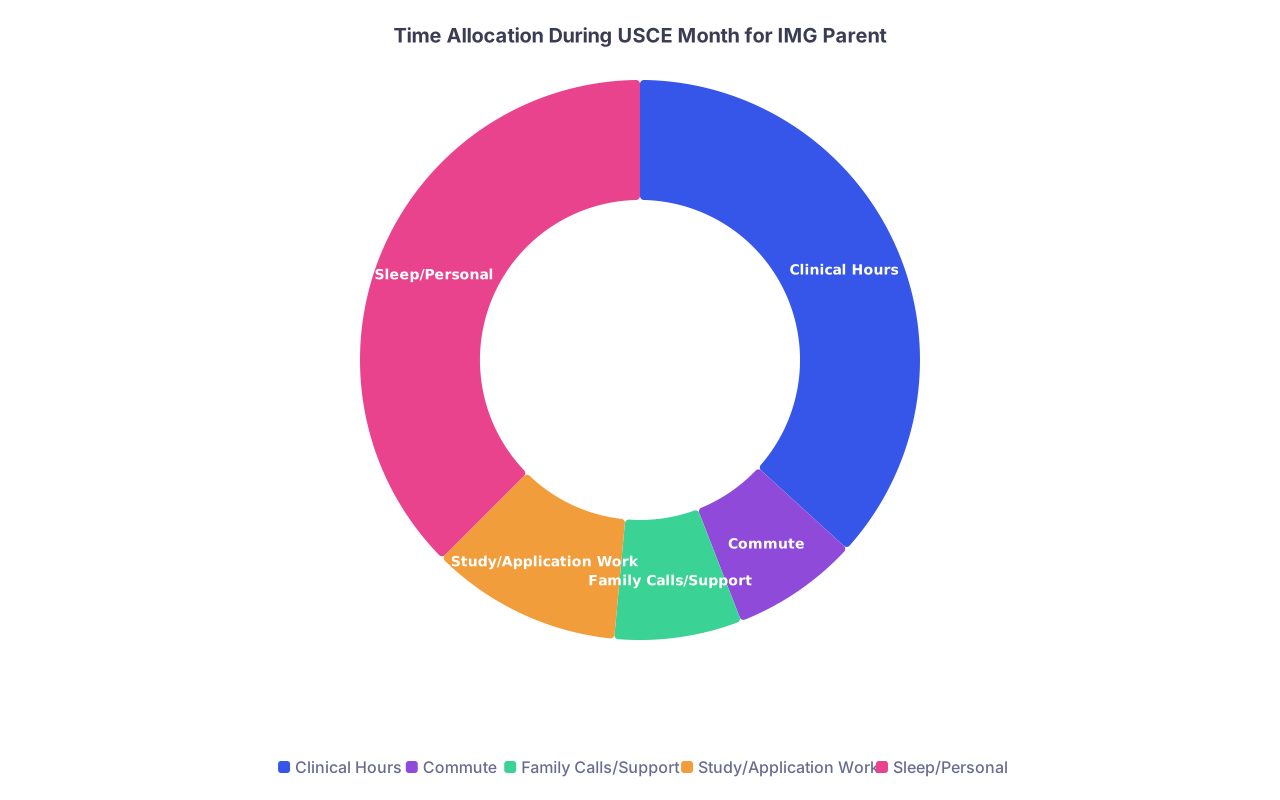
| Category | Value |
|---|---|
| Clinical Hours | 50 |
| Commute | 10 |
| Family Calls/Support | 10 |
| Study/Application Work | 15 |
| Sleep/Personal | 51 |
Let’s translate that into structure.
Daily anchors you protect:
- One fixed call time with your kid(s) every day (even 10 minutes)
- A short check‑in with your partner daily (voice, not just texts)
- A hard “shutdown time” at night—no more hospital chart reviews after, say, 11 p.m. unless a true emergency
Example weekday pattern:
- 6:00–7:00: Wake, quick breakfast, 10–15 min call home if time zones allow
- 7:30–5:30: Hospital (with 30–40 min lunch to quietly outline one patient note or read one article)
- 6:00–7:00: Commute + decompress (music, podcast, silence—not endless WhatsApp drama)
- 7:00–7:30: Call home, talk to kids, hear about their day
- 7:30–8:30: Dinner + basic life admin
- 8:30–10:00: Focused study/application work (personal statements, research a few program websites, review cases)
- 10:00–10:30: Wind down and bed
You cannot operate like a 25‑year‑old who lives on coffee and overnight study marathons. Your home life is already taking a hit. You owe them a parent who isn’t completely broken at the end of the month.
Step 6: Manage Guilt Before It Manages You
Let me just say this plainly: the parental guilt will be worse than the clinical workload.
I’ve watched brilliant IMG parents sabotage their own rotations because every quiet moment got swallowed by “I’m a terrible mother/father for leaving my kids.”
You need a plan for that too.
Concrete moves that help:
- Script what this month means to your kids. “I am doing this rotation so I can work here one day, so we can all live together and I can be home more in the future.” Repeat it. Kids need the story. You do too.
- Set clear time boundaries with extended family. If relatives keep saying “poor kids, abandoned by their parent,” you either limit contact that month or you say flat out: “I know this is hard. I need you to support this choice, not undercut it.”
- Pre‑plan 1–2 fun things for when you return. Let your kids pick an activity. It becomes a concrete point on the horizon, not some vague “someday.”
- Block guilt‑spirals during hospital time. If you catch yourself mentally rehearsing how you’re failing as a parent while pre‑rounding, you redirect: “This hour is for this patient. I’ll deal with parenting feelings at 9 p.m., not right now.”
You’re not just building a CV. You’re modeling perseverance and long‑term thinking for your kids.
Step 7: Extract Maximum Match Value From Minimal Time
Since you cannot do unlimited USCE, every week has to pull its weight for your residency application.
Your goals per rotation:
- 1–2 high‑quality letters of recommendation
- 1–2 strong faculty advocates who will reply to emails later
- Concrete bullet points for your CV and personal statement
- Clearer sense of: “Do I actually like how this specialty looks in the US?”
How to structure that in practice:
Week 1:
- Show up early, be prepared, ask smart questions, but don’t ask about letters yet.
- Identify attendings who actually watch you work.
Week 2:
- Tell one or two attendings: “I am an IMG planning to apply to [specialty]. I would appreciate any feedback on what I should focus on this month to be a strong applicant.”
- Note who gives real, specific advice. Those are your future letter writers.
Week 3:
- Ask your best attending: “If by the end of the rotation you feel you know my work well enough, would you be comfortable writing a strong letter of recommendation for residency?”
- If they hesitate or give vague answers, pivot to another attending.
Week 4:
- Get the logistics: “Would you prefer to upload your letter directly to ERAS, or should I have you send it to [letter service]?”
- Ask if you can email with occasional updates and questions as you prepare your application. Lock in permission now.
You cannot afford to spend a month “just observing” and then leave with no letters and no story. You need that rotation to show up in your Match file.
Step 8: Coordinate USCE Timing With Your Match Cycle
If you’re within 1 year of applying, timing matters for how programs perceive your experience and your letters.
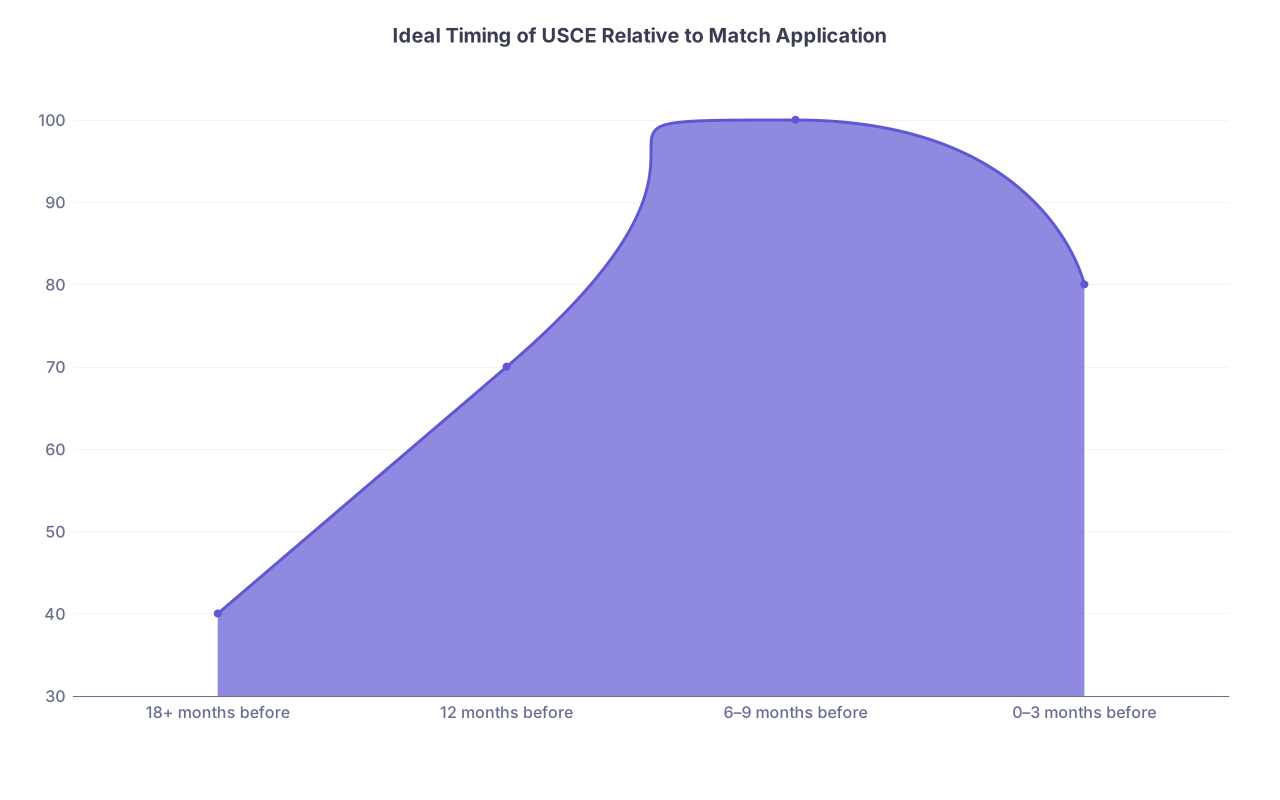
| Category | Value |
|---|---|
| 18+ months before | 40 |
| 12 months before | 70 |
| 6–9 months before | 100 |
| 0–3 months before | 80 |
(Think of that curve as how “fresh” and useful your USCE feels at application time.)
Practical guidance:
- 6–12 months before applying is your sweet spot for core USCE.
- If you’re an IMG parent, aim for one major away month between January–May before you submit ERAS in September.
- If your best letter writer sees you in March, their memory of you in August–September is still sharp enough to write something vivid.
Avoid:
- Doing all your USCE more than 2 years before applying with nothing recent to show—programs will assume skills are rusty.
- Doing a major USCE block after ERAS submission but before interviews if it prevents you from finishing applications or answering interview invites quickly. That tradeoff is rarely worth it for parents.
Step 9: Protect Your Family’s Immigration and Financial Reality
Some IMGs pretend this part is “just logistics.” It’s not. It dictates what you can actually do.
Questions to get hard answers for:
- What visa are you on? Can you legally do hands‑on USCE, or only observerships?
- How many times can you realistically enter and leave the US in a year with your status, your kids’ schooling, and your budget?
- Do you have emergency funds if a child gets sick while you’re away and you need to shorten the rotation?
Do the math before you commit:
- 4‑week rotation fee: $1,500
- Housing near hospital: $1,200
- Flights: $800
- Local transport + food: $600
That’s $4,100 for one month. If your total budget is $6,000, you get maybe one strong month + one cheaper option (tele‑USCE, local free clinic, remote research) instead of three expensive months you can’t fully fund.
For parents, it’s almost always better to do:
- 1 expensive, high‑impact, well‑chosen rotation
- 1 cheaper or local option
…than 3 mediocre, scattered observerships that drain your finances and family goodwill.
Step 10: Create a Communication Plan With Your Family
Do not wing this. “I’ll just call when I can” is how you end up with a resentful partner and clingy children by week two.
Set expectations before you go:
- How often you’ll call (daily? twice daily? once every 2 days if time zones are brutal?)
- Who handles what at home: school runs, bedtime routines, bills, medical decisions
- What counts as a “call me immediately, even if I’m on rounds” situation
With younger kids, visuals help. A simple calendar with “X” marks for each day until you’re back. Or a paper chain they remove one link from each night. It sounds corny, but it gives them something to do with separation.
Shared tools help too:
- Shared Google Drive folder or WhatsApp album for photos and school updates
- One WhatsApp group for “logistics only” (doctor appointments, bills, issues) so it doesn’t get lost between memes and forwarded videos
You’re not just surviving 4 weeks. You’re trying to keep your family functioning well enough that they’ll still support you doing this again if needed.
Step 11: Decide in Advance What You’re Willing to Give Up
You cannot have everything: perfect parent, perfect resident candidate, zero financial strain, zero emotional stress. That fantasy is for Instagram, not real life.
So decide consciously:
- Are you okay missing a birthday this year if it means a rotation in your dream specialty at your dream hospital?
- Are you okay delaying application by one year if it means your youngest will be old enough to handle your absence better?
- Are you okay focusing on community programs near relatives instead of “Top 10” university names, if it keeps your family intact?
Choosing late is just choosing by crisis. Better to decide now.
What To Do Today
Do this right now—no hand‑waving, no “I’ll think about it later”:
Take a blank sheet of paper and create three columns:
- “Family Non‑Negotiables”
- “Realistic USCE Windows (Months/Year)”
- “USCE Target Types (Outpatient/Academic/Local/Tele)”
Fill them in honestly.
Then circle one 4‑week window that looks doable for your first or next US rotation. That’s your anchor. Every email you send, every program you research, will hang on that one concrete decision.
You’re not just an IMG. You’re an IMG parent. Stop trying to copy strategies built for people without your responsibilities—and start building a structure that lets you become both the doctor and the parent you intend to be.


