Most residency program directors are not reading your personal statement. At least not the way you think they are.
They are not sitting with a cup of coffee, highlighter in hand, savoring every paragraph of your “patient who changed my life” story. They are triaging hundreds or thousands of applications at high speed, under time pressure, with competing clinical and administrative demands. Your essay is one more data point in a pile, not a cherished memoir.
That sounds harsh. It is. It’s also what the data and real-world behavior show.
Let’s break the myth cleanly and then talk about what actually happens and how you should respond.
What the Data Actually Shows About PD Behavior
We have two kinds of evidence: survey data and real-world constraints. Both point in the same direction.
Survey data: what PDs say they do
NRMP’s Program Director Survey (pre- and post–Step 1 pass/fail) consistently shows the same pattern:
- Personal statement is not a top-tier screening factor.
- It’s typically ranked below Step scores/COMLEX, clerkship grades, letters, and MSPE.
- It’s used more as a context or tie-breaker than a primary decision driver.
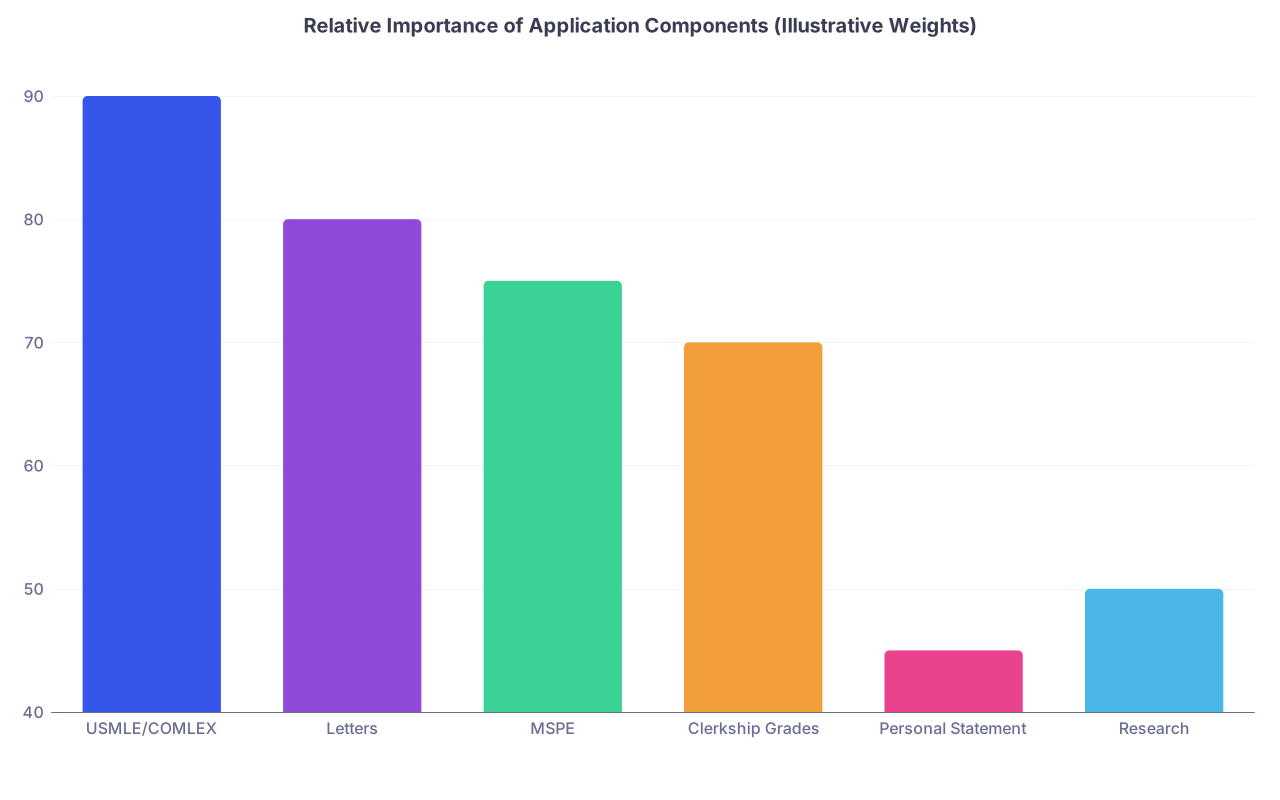
| Category | Value |
|---|---|
| USMLE/COMLEX | 90 |
| Letters | 80 |
| MSPE | 75 |
| Clerkship Grades | 70 |
| Personal Statement | 45 |
| Research | 50 |
Those numbers are illustrative, but they mirror the pattern in actual NRMP reports: personal statements matter, but they’re second-tier. And as the total application volume climbs every year, PDs don’t magically gain more time to read essays; they skim more, not less.
Now zoom out to what PDs admit privately at meetings or on panels when the microphones are off:
- “I only read statements for people we’re already interested in.”
- “I read them if I’m on the fence or something in the file is weird.”
- “Honestly, they all sound the same unless they’re terrible.”
I’ve heard almost that exact wording from internal medicine, EM, surgery, and peds PDs. Different hospitals. Same story.
Time constraints: the math doesn’t lie
Take a medium-sized internal medicine program:
- 12 categorical spots.
- 3,000+ applications.
- Let’s assume 600 of those get a real look.
- Even if they tried to read every PS carefully for those 600:
Say 5 minutes per personal statement (a generous assumption).
- 600 × 5 minutes = 3,000 minutes
- 3,000 minutes = 50 hours
Fifty hours. Just for the personal statements. On top of scores, letters, MSPE, committee meetings, and actual clinical work.
Now scale that up for EM, IM, psych, anesthesia, etc., where 3,000–6,000 applications is normal. Reading “all” personal statements is a fantasy.
So what happens in reality? They don’t read everything. They sample.
When Personal Statements Actually Get Read
“Do PDs read every personal statement?” No.
“Do PDs sometimes read yours when it matters?” Yes. Under specific conditions. Here’s when it moves from decoration to a decision tool.
1. You’re already above the bar, and they’re refining
Once you’re through the initial screen (scores, failures, visa status, obvious red flags), the file becomes a ranking problem, not a filtering problem.
At that point, PDs or faculty reviewers may:
- Glance at your PS to see if:
- You sound coherent and professional.
- Your stated interests align with what the program offers (academics vs community, underserved, research, rural, etc.).
- There’s anything obviously concerning (inappropriate content, arrogance, wild negativity).
But notice the order: you’re in the “maybe” or “probably” pile first. Then they check your statement. It’s confirmatory, not primary.
2. There’s something “off” or unusual in your file
This is where the PS actually gets read closely:
- Step failures or large score drops.
- Academic probation or professionalism concerns.
- Nontraditional path, career change, older applicant.
- Big gap in training.
- Switching specialties.
Here, PDs are looking for an explanation that:
- Makes sense.
- Shows insight and ownership.
- Demonstrates upward trajectory.
If you pretend nothing happened, you leave them guessing. They do not like guessing.
3. Borderline interview decisions
Some programs let faculty reviewers “sponsor” or argue for applicants. That’s when a strong, different personal statement can push someone over the line:
- Similar board scores and grades.
- One applicant has a generic “I love internal medicine because of continuity of care” essay.
- Another has a specific, grounded narrative that clearly links to that program’s strengths.
Guess who gets nudged up the list.
I’ve watched this play out in real time: one reviewer saying, “Her numbers are a bit lower, but if you read this, she’s basically built for our patient population.” The room listens. The PS did its job—not by being pretty, but by being relevant.
4. Holistic review programs (they exist, but don’t romanticize them)
Some specialties and some institutions genuinely lean harder on holistic review—family med, psych, peds, certain academic IM programs with explicit diversity/mission goals.
Even there, “holistic” doesn’t mean “we read 3,000 essays cover to cover.” It means:
- More structured rubrics.
- More attention to non-numeric data for a subset of applicants.
- More likely to use PS as a differentiator and as evidence of mission fit.
Still selective. Still limited by time.
How PDs Actually Use the Personal Statement
The myth is that the PS is your central storytelling document and that every word must be perfect because “this is how they get to know you.”
Reality: PDs use your personal statement more like a diagnostic test than a novel.
They’re not asking, “Is this inspiring?” They’re asking three very different questions:
Is there anything here that hurts this application?
The fastest, most common use-case. They scan for:- Red flags. Inappropriate content, unprofessional tone, oversharing trauma, blaming others.
- Signs you didn’t write it (AI-cloned clichés, bizarre phrasing, totally mismatched voice to the rest of your file).
- Sloppiness. Typos, poor grammar, wrong program or specialty name.
Does this statement support what the rest of the file is already saying?
They want consistency:- If you claim a passion for research but have almost none, they notice.
- If your ERAS experiences scream “rural underserved” and your PS never mentions it, that mismatch dilutes your brand.
- If you’ve done a ton of teaching and leadership, but your PS is a random patient vignette with no reflection, that’s a missed opportunity.
Does this help me remember you at 11:30 pm on rank list night?
The bar is low here. PDs are not looking for “unique snowflake.” They want:- One or two concrete, memorable details.
- A sense of who you’d be as a resident (reliable, curious, thoughtful, proactive).
- Something that makes it easier to talk about you in a meeting: “She’s the one who worked as a paramedic for years and wants to stay in the region,” not “He’s the one with a tragic-but-generic patient story #54.”
The worst mistake isn’t writing a “bad” personal statement. It’s writing one that is invisible and generic, so it does nothing for you when your file is in the gray zone.
Common Myths About Personal Statements That Need to Die
Let’s tackle a few persistent myths that waste applicants’ time and energy.
Myth 1: “PDs can tell who really wants their program from the PS”
Reality: most specialty-specific or program-specific “interest” paragraphs are transparently copy-pasted fluff.
PDs are not impressed by:
- “Your program’s strong emphasis on research and clinical excellence…” (You and 300 others wrote that.)
- Name-dropping random faculty you found on the website.
- Awkward “fit” lines that could apply to any hospital in the country.
They notice specific, credible alignment, such as:
- You did a sub-I or rotation there and reference concrete experiences.
- You tie clear past experiences to something their program is objectively known for (e.g., safety-net population, advocacy, rural outreach, global health track, simulation-heavy curriculum).
- You want to stay in the region for actually coherent reasons and it matches your story elsewhere in the application.
Anything else reads as noise.
Myth 2: “You must open with a gripping patient story or you’re dead”
Reality: almost everyone does this. PDs are numb to it.
I’ve heard versions of this from PDs in multiple specialties: “If I read one more story about Mrs. J clutching the student’s hand and saying thank you, I’m going to lose it.”
Narratives aren’t bad. They’re bad when:
- They’re melodramatic.
- The focus is on your feelings instead of what you learned or how you changed.
- They could be copied and used in anyone else’s application with minimal edits.
If you’re going to tell a story, make sure it actually explains something about your trajectory or values, not just that you once saw a sick person in a hospital. Shocking.
Myth 3: “The PS is where you show you’re ‘different’”
Reality: residency programs are not trying to fill a writing workshop. They’re trying to build a safe, functional, teachable team.
“Different” that helps you:
- Clear explanation of a nontraditional background.
- Mature reflection on adversity you’ve worked through (without trauma dumping).
- Credible, grounded goals that align with the program’s strengths.
“Different” that hurts you:
- Being edgy or controversial for attention.
- Long rants about what’s wrong with medicine.
- Sarcasm that doesn’t translate.
- Inappropriate attempts at humor.
You don’t need to prove you’re quirky. You need to prove you’ll be a good resident.
What You Should Actually Do With Your Personal Statement
You now know the core truth: many PDs won’t read your PS; those who do, often skim. So what’s the rational strategy?
1. Stop trying to impress; start trying not to hurt yourself
Your first job is do no harm:
- Clean, error-free, professional writing.
- No bizarre formatting, no cute fonts, no quotes from The Office.
- Avoid trauma porn, oversharing, and self-pity.
- No negativity toward other specialties, programs, or colleagues.
You would be shocked how many applicants fail at this low bar.
2. Make your statement consistent with the rest of your file
Think of your application as a single story:
- What are the 2–3 themes already present in your experiences and letters? (Teaching, QI, underserved care, advocacy, research, global health, leadership.)
- Use the PS to pull those threads together into a coherent narrative about:
- Why this specialty.
- What kind of resident you’ll be.
- Where you’re aiming long-term (in broad strokes).
If someone reads just your PS and your experiences section, they should feel like they’re looking at the same person, not two disconnected versions of you.
3. Give them one or two memorable anchors
You don’t have to be unforgettable. That’s marketing nonsense.
You just need:
- One or two concrete details that are easy to recall.
- An honest, grounded voice that doesn’t sound like AI sludge or committee-speak.
Examples of anchors that work:
- You grew up in a rural area and came back to work in similar communities during med school.
- You worked as an EMT/paramedic/scribe/engineer/teacher for years before medicine and can link skills from that world to residency.
- You had a serious setback (illness, academic issue) that you addressed, learned from, and recovered from with visible upward trend.
Those give PDs something to say about you in a meeting besides, “Generic good applicant #27.”
4. If you have a red flag, address it like an adult
Do not bury it. Do not hope they don’t see it. They see it.
Handle it in the PS (or in an addendum/ERAS text box if available) with:
- Brief context (not 8 paragraphs of backstory).
- Clear ownership (“I failed X because…” not “They were unfair.”).
- Concrete steps you took to fix the problem.
- Evidence of improvement (better scores, stronger clinical evals, extra support you sought).
Handled well, this can reduce the damage. Mishandled—or ignored—it lets their imagination run wild, and they assume the worst.
The Practical Role of the PS in the Bigger Application System
To really see where your statement fits, look at it next to the rest of your application.
| Component | Main Role in PD Decisions |
|---|---|
| USMLE/COMLEX | Initial screen, risk assessment |
| MSPE + Grades | Performance, consistency, professionalism |
| Letters of Rec | Work ethic, team fit, clinical skill |
| Personal Statement | Context, red-flag explanation, tie-breaker |
| Experiences | Trajectory, alignment with specialty/program |
| CV/Activities | Depth vs checkbox engagement |
The personal statement is mostly supporting evidence, not the star of the show. That should guide how much time you sink into perfecting it.
If you’re spending 80% of your application energy tweaking adjectives in your statement and 20% on targeted letters, smart program lists, and getting your Step 2 score in early, your priorities are backward.
Final Reality Check
Let me be blunt.
Most program directors are not reading every personal statement. Many will never read yours. Those who do will often skim it looking for red flags, consistency, and maybe one reason to move you slightly up or down a pile.
So your job is not to write the greatest essay of your life.
Your job is to:
- Avoid self-inflicted wounds with unprofessional, generic, or incoherent writing.
- Make your statement reinforce the story your whole application is already telling—especially if you’re nontraditional or have a red flag.
- Give reviewers who do read it one or two clear, grounded reasons to remember you as a safe, aligned, and purposeful future resident, not as “that personal statement with the dramatic ICU story that sounded like everyone else.”
That’s it. Stop worshipping the personal statement. Use it strategically, then move on to the parts of the application PDs actually live and die on.