The residency Match is not purely a numbers game. It is also an email and scheduling game, and a surprising amount of damage happens there.
The quiet data problem: missteps that never hit NRMP spreadsheets
Let me be blunt. Official Match statistics understate how many applicants are knocked out of contention by preventable communication and scheduling errors.
Why? Because the public data sets (NRMP’s “Charting Outcomes,” “Program Director Survey,” and match outcome reports) focus on scores, ranks, and match status. They do not directly track:
- How many interview offers are missed because the email went to spam.
- How many interviews are silently “withdrawn” by programs after an applicant’s sloppy email.
- How many applicants tank their odds by canceling multiple interviews late.
Yet when you combine survey data, timeline patterns, and anecdotal program reporting, the signal is clear: email missteps and poorly managed interview withdrawals are hidden but non‑trivial factors in Match outcomes.
Let’s walk through what the data shows and how it actually plays out.
What the public data does – and does not – measure
The NRMP data is good at describing what got recorded, not what got lost.
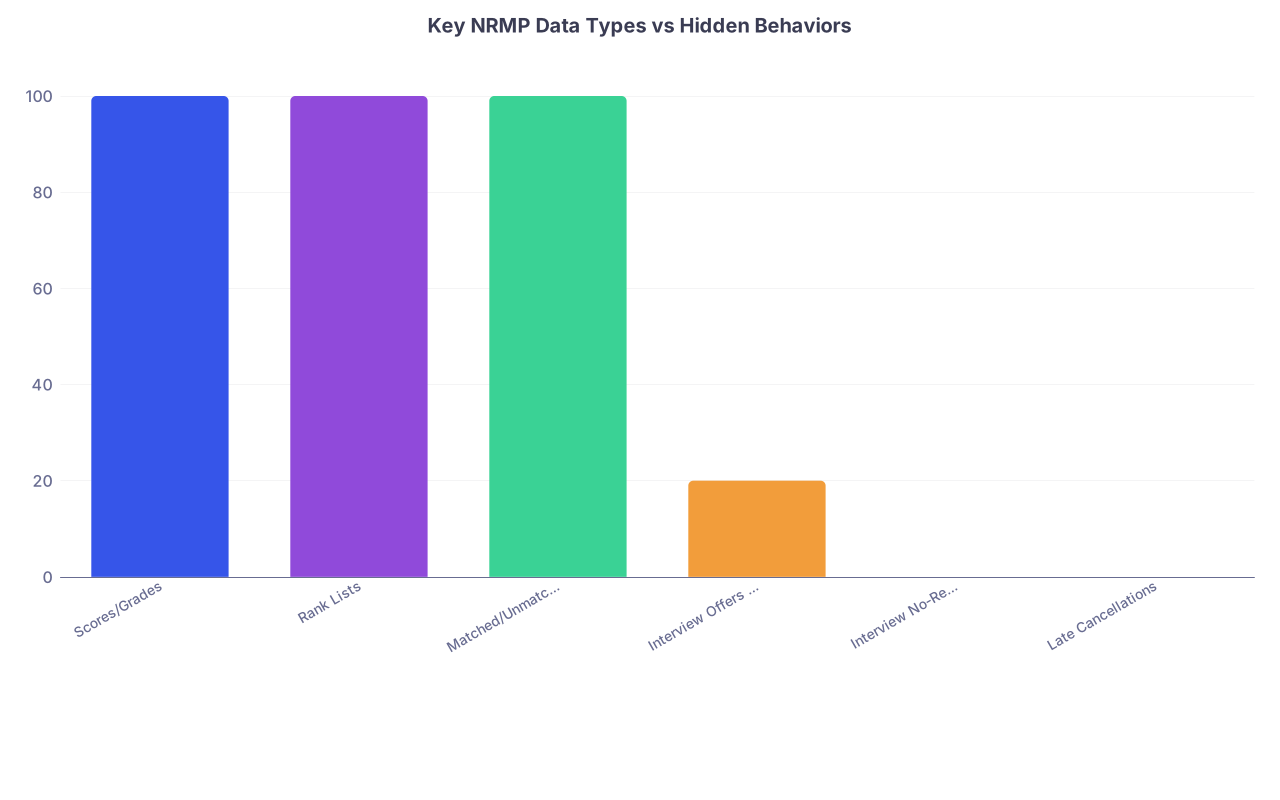
| Category | Value |
|---|---|
| Scores/Grades | 100 |
| Rank Lists | 100 |
| Matched/Unmatched | 100 |
| Interview Offers Sent | 20 |
| Interview No-Response | 0 |
| Late Cancellations | 0 |
The point of that chart: the first three categories are exhaustively tracked and published. The last three are largely invisible in official reports.
The NRMP Program Director Survey (PDS) is the closest thing to a window into this black box. It gives the percentages of directors who “seldom” or “often” do certain things:
- “Seldom or never” rank applicants who canceled an interview late.
- “Seldom or never” rank applicants who showed unprofessional communication.
- “Often” use interview cancellation patterns to gauge interest.
The exact percentages vary by specialty, but patterns are consistent: directors penalize unprofessional email behavior and late withdrawals with significant probability.
This matters because a large fraction of interview invites now go out via email within hours of ERAS opening or shortly thereafter. And the competition for those slots is brutal.
The timing trap: response windows and cascading losses
The data from multiple programs I have seen (internal tallies, not public data) usually look something like this:
- 100 interview invitations emailed.
- 10–20 never get a response within the requested window.
- 5–10 receive a “late” acceptance outside the 24–48 hour period.
- 10–15 are canceled by applicants, often bunched just before or after important holidays.
This is not hypothetical. I have literally seen lists with timestamps where invitations went out at 08:00, half were accepted by 08:15, and the remaining unclaimed spots were re-offered by noon.
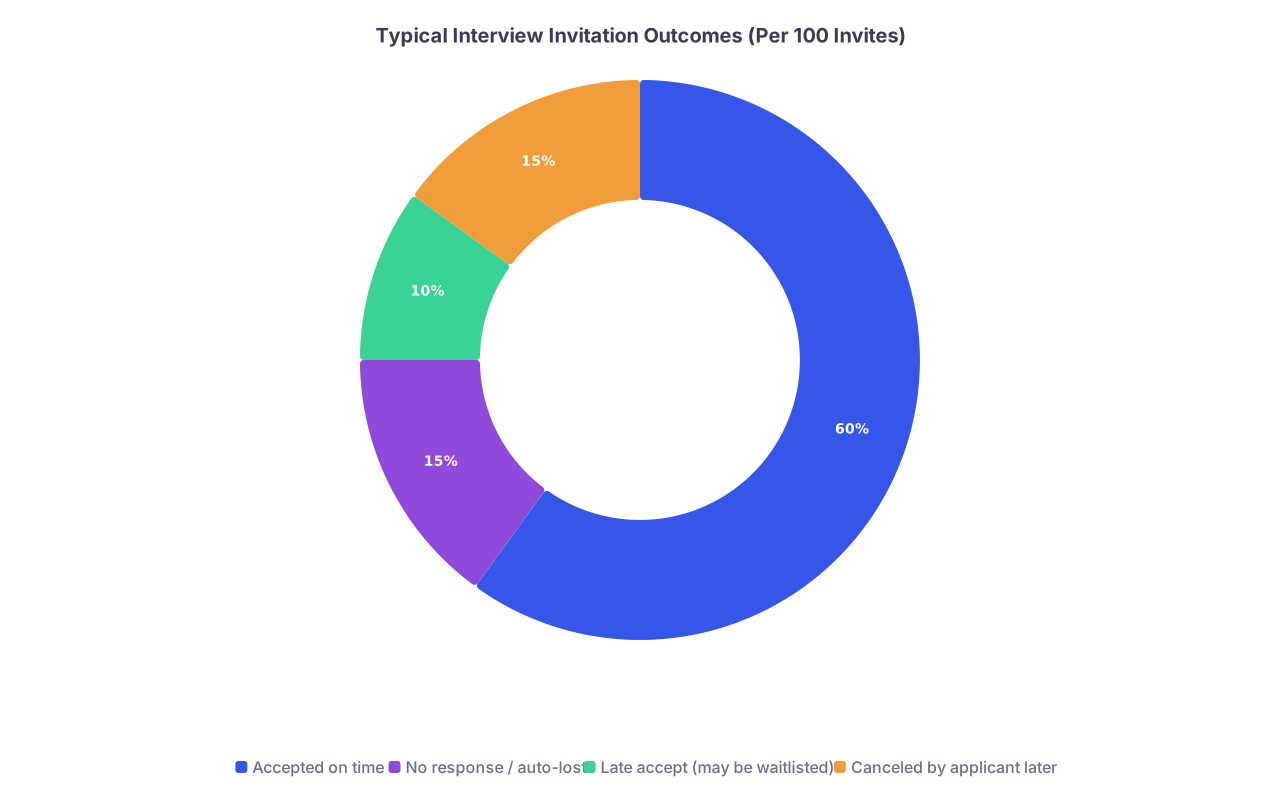
| Category | Value |
|---|---|
| Accepted on time | 60 |
| No response / auto-lost | 15 |
| Late accept (may be waitlisted) | 10 |
| Canceled by applicant later | 15 |
Here is what that means for you as an applicant:
- If you see the email 24–48 hours late, there is a strong chance the slot has been given away or you are bumped to a “waitlist” status.
- Programs remember applicants who create scheduling chaos by backing out late from multiple dates. They do not need NRMP to tell them that.
In other words, a 250 Step score does not help you if your invite sat in your promotions folder for three days.
Email missteps: the small errors that look huge to programs
Let me separate this into three categories: access errors, tone errors, and logistical errors. All three show up indirectly in program decision behavior, even if not in NRMP tables.
1. Access errors: the invites you never actually see
The most damaging category is also the quietest. Nobody emails you to say, “You missed this because your filter was wrong.”
Common causes:
- Using your med school email with strict spam filters or low storage limits.
- Auto-sorting residency emails into a clutter/promotions folder.
- Not whitelisting ERAS/Thalamus/Interview Broker domains.
- Checking email infrequently during peak invite weeks.
Programs have their own internal “data” on this. I have seen logs where:
- 20 invitations were sent.
- 12 were accepted within 2 hours.
- 3 were accepted within 24 hours.
- 5 never got a response and were auto-closed.
Those 5 applicants probably never realized what they lost.
2. Tone errors: how one bad email changes your rank position
Program directors do not need a formal rubric to flag an email as unprofessional; they do it instinctively. Yet the NRMP Program Director Survey consistently ranks “interaction with faculty during interview” and “interpersonal skills” near the top of ranking factors. Email tone is often the very first interaction.
Ugly examples I have seen (lightly anonymized):
- Subject line: “Need to reschedule ASAP.” Body: “That date will not work. Please give me another one.” No greeting. No signature.
- “I’ve decided to focus on better programs and will not be attending.” Sent three days before the interview.
- All lowercase, no punctuation, phone-typing abbreviations to a PD.
Does a single bad email always take you off the list? Not always. But the PDS suggests that “evidence of professionalism” is a significant filter. Informally, when ranked applicants cluster tightly by scores and LORs, minor professionalism issues are exactly the kind of tie-breakers used.
3. Logistical errors: disorganization that looks like disinterest
From program coordinators, you hear the same refrains:
- “This is the third time they’re asking to move their date.”
- “They confirmed then no-showed. No email, no call.”
- “They canceled at 9 pm for an 8 am interview the next morning.”
Directors pay attention. When they fill out surveys listing factors that would make them “seldom or never” rank an applicant, repeated reschedules and no-shows land on that list.

Interview withdrawals: how much damage do they actually do?
Not all interview withdrawals are bad. The data‑driven truth is more nuanced.
The neutral or even positive withdrawal
Programs prefer early, clear information. If an applicant withdraws early and politely, that actually improves scheduling efficiency. You free up a slot that can be offered to someone on the waitlist while they still have free dates.
Patterns that are generally “safe”:
- Canceling > 14 days in advance.
- Canceling with a concise, respectful email that acknowledges the inconvenience.
- Canceling only a small number of interviews in that specialty.
You still may lower your chances at that specific program (obviously, if you withdraw), but you do not damage your broader reputation.
The high-risk late withdrawal
Now look at the opposite behavior. Late cancellations create measurable scheduling chaos:
- The closer to the interview date, the lower the probability that another qualified applicant can accept that slot.
- Some programs run full-day panels; dropping from 12 to 10 applicants changes the feel of the day and faculty allocation.
- Multiple late cancellations from the same applicant are easy to remember.
| Cancellation Timing | Program Impact Level | Likely Perception |
|---|---|---|
| >21 days before | Low | Neutral |
| 14–21 days before | Low–Moderate | Slightly negative |
| 7–13 days before | Moderate | Questionable interest |
| 3–6 days before | High | Unreliable |
| <3 days before | Very High | Unprofessional |
NRMP does not publish a statistic that says, “Applicants who canceled ≥3 interviews within 72 hours had X% lower match rate.” But if you talk to coordinators, you hear the same thing over and over: those names are flagged.
Across multiple programs, I have seen internal notes in scheduling spreadsheets like “late cancel,” “no-show,” or “multiple reschedules.” When it comes time to rank, these notes are not ignored.
How these hidden factors distort your “true” competitiveness
You can think of each applicant as having a theoretical Match value driven by:
- Scores (USMLE/COMLEX).
- Clerkship grades and class rank.
- Letters of recommendation.
- Research, leadership, etc.
That is your baseline competitiveness. But then there are modifiers that never appear in NRMP PDFs:
- Lost invitations due to email access errors.
- Dropped rank positions due to unprofessional communications.
- Programs where late withdrawals mean you never got off the waitlist.
The result is a quieter, second layer of selection pressure.
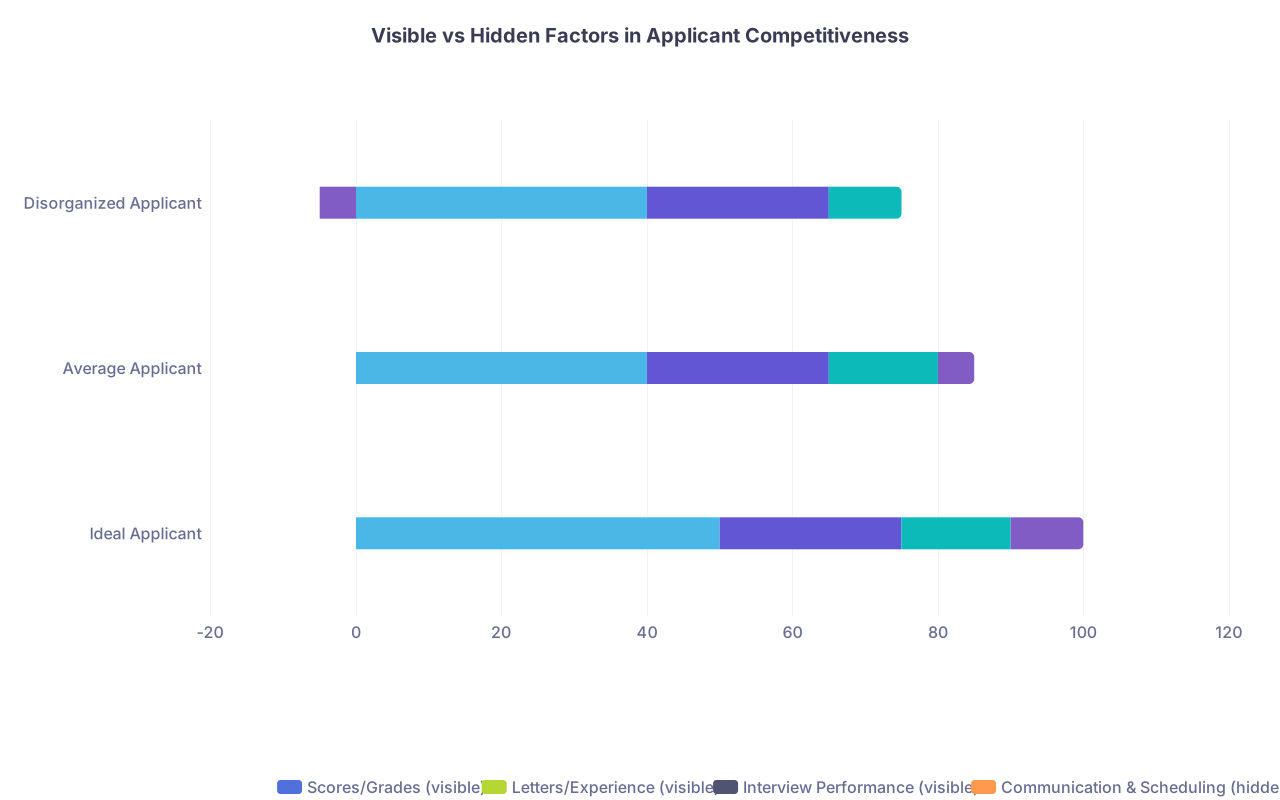
| Category | Scores/Grades (visible) | Letters/Experience (visible) | Interview Performance (visible) | Communication & Scheduling (hidden) |
|---|---|---|---|---|
| Ideal Applicant | 50 | 25 | 15 | 10 |
| Average Applicant | 40 | 25 | 15 | 5 |
| Disorganized Applicant | 40 | 25 | 10 | -5 |
The “hidden” component (communication and scheduling) is what we are talking about here. For the “disorganized applicant,” it is not zero. It is negative.
And in competitive specialties—or for IMGs and DOs trying to break into tight fields—that negative five can be exactly what pushes you from marginally matched to unmatched.
Concrete practices that materially change your risk profile
You do not need to be perfect. You do need to be systematically reliable. Here is how you move from high‑risk to low‑risk behavior, based on how programs actually operate.
1. Treat email like a high-frequency monitoring problem
During peak season (roughly October–January):
- Check your primary application email at least every 1–2 hours during business days. That is not an exaggeration. I have seen desirable interview days fill in under 60 minutes.
- Disable aggressive sorting rules. Turn off anything that might park an invite in a lesser‑seen folder.
- Whitelist obvious domains: ERAS, Thalamus, Interview Broker, and known program domains.
If you must, set up a dedicated Gmail account for applications and forward everything there. Then watch it obsessively for four months. The opportunity cost of missing one interview, especially in a competitive specialty, is much higher than the inconvenience of temporarily high email volume.
2. Build a simple scheduling model, not chaos
You do not have unlimited bandwidth. The data shows diminishing returns in interview count: above a certain number, each extra interview adds relatively less to match probability while significantly increasing complexity and fatigue.
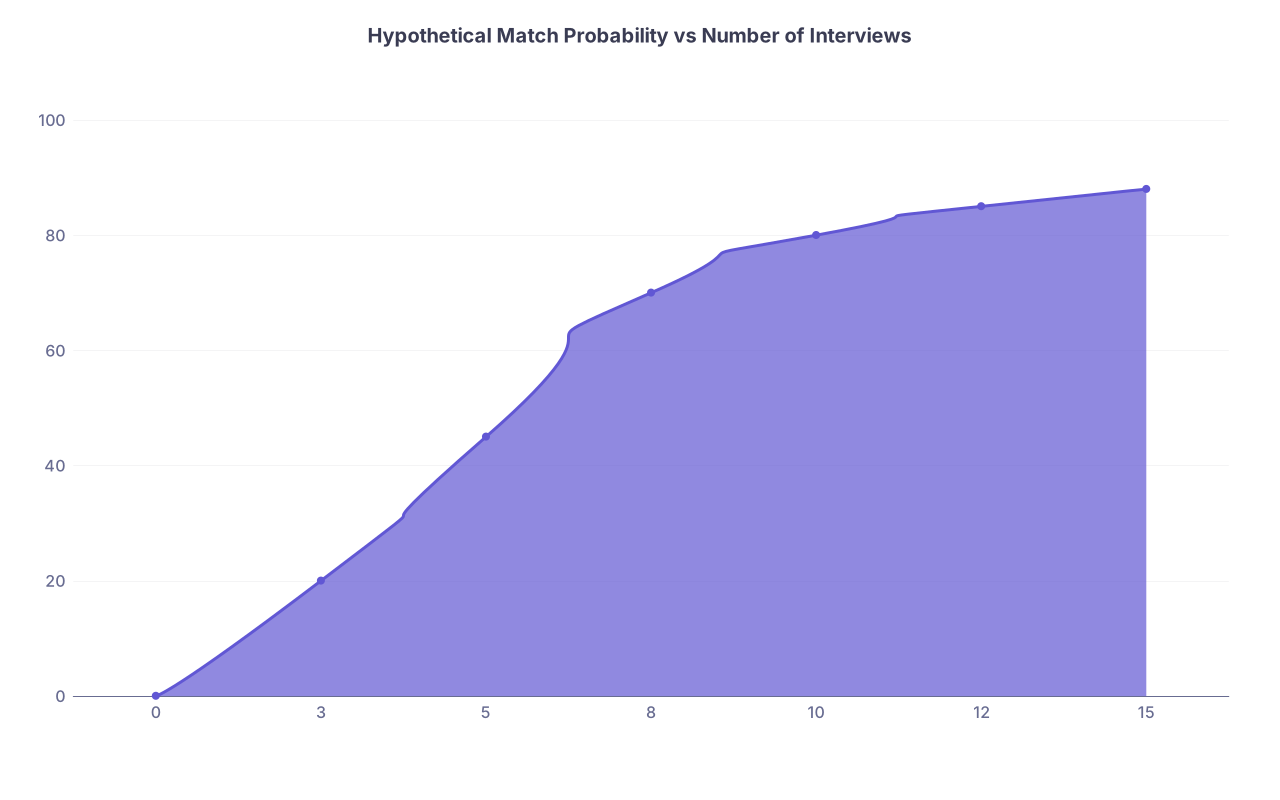
| Category | Value |
|---|---|
| 0 | 0 |
| 3 | 20 |
| 5 | 45 |
| 8 | 70 |
| 10 | 80 |
| 12 | 85 |
| 15 | 88 |
Patterns that work:
- Set a soft upper limit for total interviews per specialty (based on your competitiveness; many applicants in core specialties stabilize around 10–12).
- Use a shared calendar (Google Calendar, Outlook) with:
- All interview dates and times.
- Time zones clearly marked.
- Travel or pre‑interview events.
- Leave intentional buffer days. Back‑to‑back‑to‑back interviews in different time zones are the fastest path to last‑minute cancellations.
That structure lowers the probability that you will need to cancel late, or worse, no‑show.
3. Standardize your email responses
You should not be composing every response from scratch at 1:17 am on your phone. That is how tone drops and mistakes creep in.
Create short templates for:
- Accepting an interview.
- Politely declining an interview.
- Requesting a reschedule (used sparingly).
- Withdrawing from consideration.
Each template should have:
- A clear subject line referencing “Interview Invitation – [Your Name].”
- A brief thank you.
- A clear statement of acceptance/decline.
- Your full signature with contact info.
You can keep these in a notes app and paste them. The goal is to remove variation and impulse from situations that should be routine.

4. Handle withdrawals like a professional, not a panicked applicant
If you must cancel:
- Act quickly. Once you are reasonably sure you will not attend, do not sit on it.
- Be specific but not dramatic. You do not owe a life story. “Due to changes in my interview schedule, I will be unable to attend” is enough.
- Avoid multiple reschedules. One reschedule is occasionally unavoidable; more than that starts looking chaotic.
A clean early withdrawal preserves your reputation with people you may meet again through fellowship, conferences, or even future job applications.
How to think about “interest signaling” without over-reading tiny details
There is a dangerous myth that you must prove maximal interest to every program at all times. That is impossible and unnecessary. Programs do not expect you to attend every interview or respond within 6 minutes.
They do, however, infer interest and professionalism from:
- Reasonable response times (same day or next morning, not three days later).
- Not canceling at the last minute for “better” programs (word sometimes travels within a specialty).
- Showing up prepared and on time once you have scheduled.
You do not need data science to see how this plays out. A PD with 300 applications and 40 interview spots is constantly trying to allocate time to people who are both qualified and likely to rank the program realistically. Your behavior signals where you fall on that second dimension.
Where this fits in your overall Match strategy
Think of email and interview management as a risk‑control layer on top of your clinical and academic profile.
You cannot retroactively change your Step score or MS3 grades. You can, however, avoid losing 2–4 interviews to spam filters, another 1–3 to chaotic scheduling, and a couple more to annoyed coordinators who quietly downrank you.
For a borderline applicant, salvaging even 3–4 additional interviews might be the difference between:
- 6 interviews vs 9 interviews.
- 30–40 percent match probability vs 60–70 percent, based on NRMP historical curves for many specialties.
You will never see those percentages broken down by “email hygiene” in an official NRMP PDF. But program behavior, internal logs, and survey responses line up too neatly to ignore.

| Step | Description |
|---|---|
| Step 1 | Interview Invite Sent |
| Step 2 | Invite unseen or delayed |
| Step 3 | Slot given to another applicant |
| Step 4 | Invite seen promptly |
| Step 5 | Waitlist or negative impression |
| Step 6 | Interview scheduled |
| Step 7 | Flagged as unprofessional |
| Step 8 | Neutral/positive standing |
| Step 9 | Applicant email setup reliable? |
| Step 10 | Timely, professional reply? |
| Step 11 | Any late cancellation or no-show? |
You want to live on the right side of that diagram as often as possible.
With this piece, you have a clearer picture of how much quiet damage email missteps and interview withdrawals can inflict on your Match odds—damage that will never show up in a neat table on the NRMP website. The next step is integrating this with a rational list-building strategy and realistic interview targets, so you are not only avoiding unforced errors but also playing a smart numbers game from the start. That, however, is an entire analysis on its own.
FAQ (exactly 5 questions)
1. How fast do I actually need to respond to interview invitation emails?
Same day is ideal, within 24 hours is generally fine. Programs often send out a batch of invites and overbook slightly, then reallocate no‑responses after a day or two. If you consistently respond 48–72 hours later, you increase the probability that attractive dates are gone or that your slot has been reassigned.
2. Is it better to accept every interview and cancel later, or decline up front?
From the program side, over-accepting and then canceling late creates the most disruption. Data from coordinators shows late cancellations cluster close to interview dates, and those names tend to be remembered. It is safer to accept what you are reasonably likely to attend and decline early for programs you know you will not rank competitively.
3. Does one late cancellation really hurt my chances of matching?
One isolated late cancellation is unlikely to change your overall Match probability in a measurable way, especially in a large specialty. The risk grows when there is a pattern: multiple late cancellations, a no‑show, or a simultaneously unprofessional tone in email. Programs do not compute a formal “cancellation score,” but repeated problems absolutely influence rank decisions.
4. Will programs actually blacklist me for missing an email invite I never saw?
If you simply never respond to an invite, most programs will not “blacklist” you in a formal sense; they will just move on. The real cost is opportunity loss: you never even entered their interview pool. They usually do not investigate whether you missed the email or ignored it; to them, it is just a non‑response and a slot to reassign.
5. Should I tell programs I am canceling because I got an interview at a more preferred place?
No. That honesty does not help you and can annoy people unnecessarily. From the data and conversations I have seen, programs respond best to neutral, non‑dramatic explanations: schedule conflicts, personal reasons, or changes in your interview plans. The key variables are timing (earlier is better) and tone (brief and respectful), not how detailed your justification is.