
The biggest economic mistake residents make is treating “academic vs community” as a vibe decision instead of a spreadsheet decision. The data shows it is first and foremost a money question: salary, moonlighting access, and how fast you can kill your debt.
Let’s quantify it.
1. Baseline Salary: Academic vs Community by the Numbers
Across hundreds of GME salary reports, the pattern is consistent: pure community programs tend to pay more than university-based academic programs, with hybrids in the middle.
Three data anchors to keep in your head:
- ACGME-reported and Medscape/MedEd surveys put PGY‑1 national averages around $60–65k total compensation.
- Academic programs at large university hospitals often sit $3–7k below community-heavy competitors in the same metro.
- Cost of living cuts real take-home power by 20–40% between cheap Midwest cities and coastal academic hubs.
A simplified comparison helps. Assume 2025-ish numbers.
| PGY Level | Academic University | Hybrid (Univ-Affiliated Community) | Pure Community Hospital |
|---|---|---|---|
| PGY-1 | $61,000 | $63,000 | $66,000 |
| PGY-2 | $63,500 | $66,000 | $69,000 |
| PGY-3 | $66,000 | $69,000 | $72,000 |
| PGY-4 | $68,500 | $72,000 | $75,000 |
| PGY-5 | $71,000 | $75,000 | $78,000 |
Spread that over 3–5 years and you are looking at a $10–30k total pre-tax difference between an academic and a well-paying community program. On salary alone, that is noticeable but not life-changing.
But you are not making this decision in a vacuum. Two multipliers matter more than base pay:
- Where you live (COL index).
- What you are allowed to do on the side (moonlighting).
Let’s look at cost-of-living adjusted pay, because nominal salary without context is garbage.
Cost-of-Living Adjusted Reality
Take three residents, all PGY‑2 Internal Medicine, in different program types:
- Academic: $63,500 in a high-cost coastal city (COL index ~150 vs US baseline 100)
- Hybrid: $66,000 in a mid-cost city (COL ~110)
- Pure community: $69,000 in a low-cost city (COL ~95)
Normalize income to a COL baseline of 100.
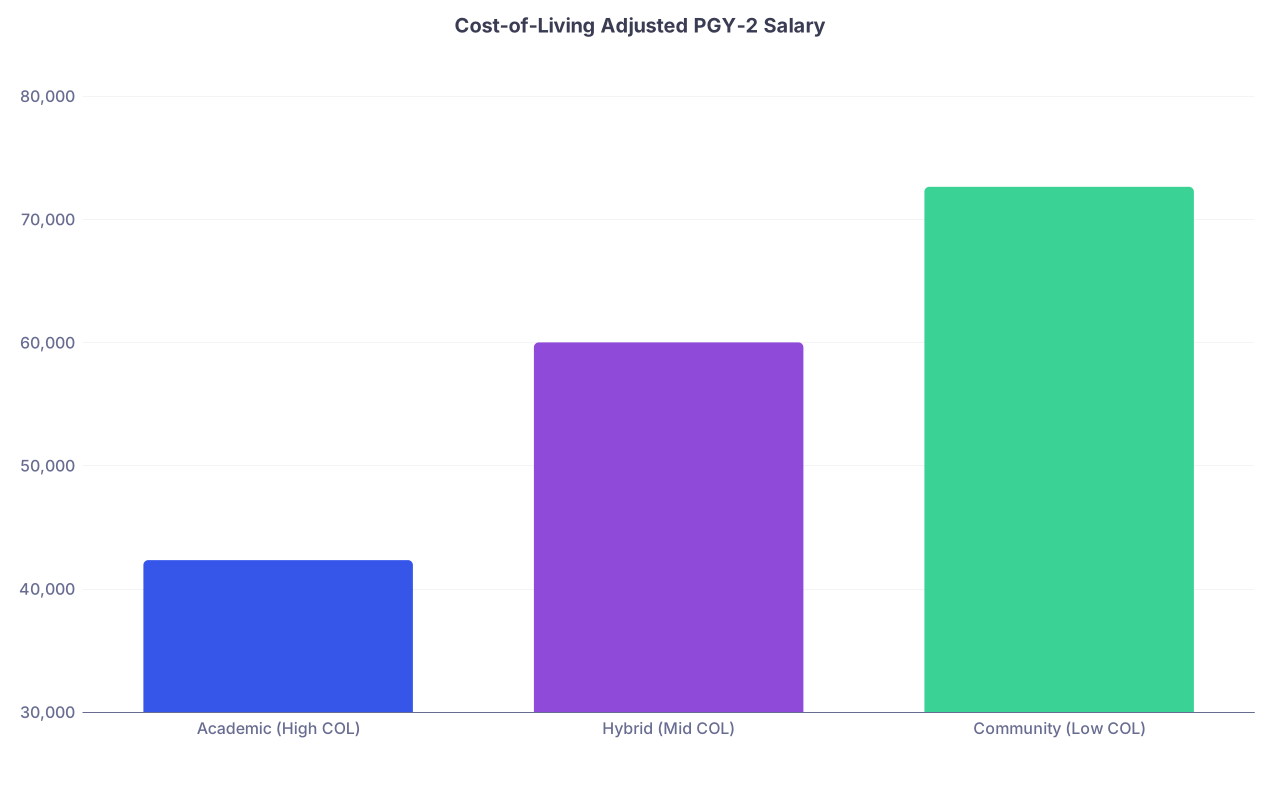
| Category | Value |
|---|---|
| Academic (High COL) | 42333 |
| Hybrid (Mid COL) | 60000 |
| Community (Low COL) | 72632 |
On paper the salaries differ by a few thousand. Adjusted for cost of living, the academic resident is effectively making ~$42k, while the community resident is closer to $73k equivalent. That is nearly a 70% difference in purchasing power.
This is why people are shocked when they move from a coastal academic program to a smaller-city fellowship: same nominal pay, wildly different real life.
2. Moonlighting: The True Economic Divider
Base salary is the floor. Moonlighting is the rocket booster. And this is where community versus academic economics stops being subtle.
Here is the blunt version:
- Academic programs: more restrictions, fewer sites, more “strongly discouraged in PGY‑2” emails.
- Community programs: more shifts, more ED/hospitalist coverage gaps, often begging seniors to pick up work.
- Hybrid programs: variable, but often closer to community in moonlighting friendliness.
Typical Moonlighting Setups
I have seen variations of these three patterns repeatedly:
Academic IM program at big-name university
- Internal moonlighting only (in-house night float, cross-cover).
- Must be PGY‑3+, in “good standing,” completed Step/Level 3, ≥ 80 duty hours free per month, etc.
- Paid at $60–80/hour. Limited shifts (2–4 per month allowed).
- External moonlighting usually banned or paperwork-heavy.
Hybrid program (university-affiliated community hospital)
- Internal nocturnist-style shifts, procedure coverage, maybe ICU backup.
- External moonlighting sometimes allowed at associated community sites.
- Rates $90–130/hour depending on specialty and desperation of the site.
- PGY‑2 or PGY‑3 start, more flexible caps (4–6 shifts/month).
Pure community hospital program
- Internal and external moonlighting both common.
- ED fast track, cross-cover, rural urgent care, telemedicine.
- Rates $110–180/hour, with some high-need rural shifts touching $200/hour for EM/IM/FM seniors.
- Start sometimes as early as PGY‑2 with credentialing.
Let’s quantify impact.
3. A Realistic Moonlighting Income Model
Take a conservative but realistic scenario:
- PGY‑3–4 Internal Medicine resident
- 8-hour moonlighting shifts
- 3 shifts per month on average (not crazy; some do 6–8)
Estimate gross annual moonlighting income:
| Program Type | Hourly Rate | Shifts/Month | Hours/Year | Annual Moonlighting Income |
|---|---|---|---|---|
| Academic | $70 | 2 | 192 | $13,440 |
| Hybrid | $110 | 3 | 288 | $31,680 |
| Community | $140 | 4 | 384 | $53,760 |
Yes, those numbers are plausible. I have watched residents do even more.
Now combine this with baseline salary:
- Academic PGY‑3: $66,000 + $13,440 ≈ $79,440
- Hybrid PGY‑3: $69,000 + $31,680 ≈ $100,680
- Community PGY‑3: $72,000 + $53,760 ≈ $125,760
That is a $46k annual gap between academic and strong community when you include moonlighting the way residents actually use it.
Stretch this across PGY‑3 and PGY‑4 (or PGY‑3–5 in some specialties). You are talking about:
- Academic resident: maybe $25–30k moonlighting total.
- Community resident: $80–150k moonlighting total over residency.
That difference, invested correctly or thrown at loans, is the core of the “community economics” advantage.
4. Debt Paydown: What This Means For Your Loans
Now let us connect this to your real enemy: loan balance.
Typical starting point for US MD/DO grads based on AAMC and med school reports:
- Median educational debt: ~$200–250k
- Many in the 300k+ range, especially private/DO.
- Interest rates often 5–7% on federal loans.
Suppose you start residency with $250,000 at 6.5%.
You have three main paths:
- PAYE/REPAYE/SAVE + PSLF track — pay minimal during residency, rely on forgiveness later.
- Standard/pay-what-you-can — aggressively pay during residency.
- Hybrid — low payments during high-interest residency years, then hammer after.
Academic centers with strong PSLF support push you to #1. Heavy moonlighters at community programs often default to #2 or #3.
Simple Interest Accrual Model
At 6.5%, your annual interest on $250k is:
- 0.065 × 250,000 = $16,250 per year ≈ $1,354/month
If you pay $0 (defer/forbear) in a 3-year residency:
- Interest added: ~3 × $16,250 = $48,750
- New balance ≈ $298,750 before capitalization effects.
So doing nothing in residency is basically handing your loan servicer a brand new new car.
Now compare two residents:
- Resident A: Academic IM, minimal moonlighting, pays $150/month on an IDR plan.
- Resident B: Community IM, heavy moonlighting, throws $1,000/month extra at loans.
Assume both 3-year programs, same starting debt.
Resident A – Academic, PSLF-minded
- Monthly payment: $150
- Annual: $1,800
- Over 3 years: $5,400 total paid. Barely dents interest.
- End of residency balance still roughly $290–300k range.
But if A really stays the full 10 years and hits PSLF, the math looks different (I will come back to that).
Resident B – Community, aggressive payoff
Let B use $1,000/month from moonlighting after taxes for loans.
- $1,000 × 36 months = $36,000 paid in residency.
- That covers more than two years of interest on the $250k.
- End of residency balance falls to somewhere around $230–240k, instead of creeping toward $300k.
Change just one variable—willingness and ability to moonlight—and you save yourself $50–70k in extra loan balance compared with doing very little during residency.
Now take a more aggressive variant: community EM resident or IM with rich moonlighting culture committing $2,000/month to loans for 3 years.
- $2,000 × 36 = $72,000
- You could come out of residency with close to your original principal or lower, instead of being another $40–50k in the hole.
The data story is not subtle: Community + moonlighting → vastly higher capacity for early debt attack.
5. PSLF and Academic Centers: The Forgiveness Play
So is academic always “bad economics”? No. For some, the academic pathway plus Public Service Loan Forgiveness (PSLF) is mathematically excellent.
PSLF basics:
- 120 qualifying monthly payments (10 years) while working at a qualifying nonprofit employer (most academic hospitals do qualify).
- On IDR (SAVE, PAYE, etc.), payments are income-based; in residency they are low.
- Remaining balance at year 10 is wiped out tax-free.
Here is where program type ties in:
- Academic hospitals: Almost universally PSLF-eligible; someone in the GME office knows what PSLF is.
- Community hospitals: Many are nonprofit and PSLF-eligible, but a non-trivial number are for-profit or owned by for-profit systems (no PSLF).
- Hybrids: Mixed bag; verification is on you.
Let’s compare two 10-year paths from graduation (3-year residency + 7 years attending), both starting with $250k at 6.5%.
Scenario 1: Academic + PSLF Strategy
Assumptions (ballpark):
- Residency income: $65k average, IDR payments maybe $200/month.
- Attending academic hospitalist: start $230k, climb to $260k by year 10.
- IDR payment average: maybe $1,200–1,800/month over attending years.
Rough totals:
- Residency payments (3 years): $200 × 36 = $7,200
- Attending payments (7 years): let’s average $1,500 × 84 = $126,000
- Total paid over 10 years: ~$133,000
- Remaining balance at year 10: whatever is left (easily $150–200k) → forgiven.
Effective cost over 10 years: ~$133k (plus some interest drag along the way, but no tax bomb).
Scenario 2: Community + No PSLF, Aggressive Payoff
Assumptions:
- Residency: $68–72k, plus heavy moonlighting. Say effective gross $120k. After tax, you manage $1,500/month to loans.
- Attending: Community hospitalist or EM with $300–350k income. Let us say $325k and you aggressively pay $4,000/month.
Rough totals:
- Residency (3 years): $1,500 × 36 = $54,000
- Attending (years 4–8): $4,000 × 60 = $240,000
At typical amortization, you probably finish the loans entirely by year 8 or 9, with total paid around $260–280k including interest. Then years 9 and 10 you pay $0.
So:
- PSLF academic path: ~$130–150k out of pocket and 10 years locked in public/nonprofit roles.
- Community non-PSLF path: ~$260–280k out of pocket but you own your timeline and can be debt-free by year 8.
Which is “better” depends heavily on how committed you are to academic medicine vs higher-paying community careers, and how disciplined you actually are. Not how disciplined you think you might be after a 28-hour call.
But here’s the key matching insight:
- If you are serious about an academic attending career at a PSLF-eligible institution, an academic residency integrates cleanly with PSLF and early-year lower payments are not dumb.
- If you are likely headed for a high-paying community job or private group, PSLF odds drop, and the community residency + moonlighting + aggressive payments strategy usually wins on total interest paid.
6. Secondary Economic Factors: Fellowship, Geography, and Opportunity Cost
Residents obsess over $2–3k salary differences and ignore six-figure opportunity costs. That is backwards.
Three secondary factors tied to academic vs community that materially change your financial trajectory:
1. Fellowship Match Odds and Long-Term Income
- Academic programs typically have stronger pipelines into competitive fellowships (cards, GI, heme/onc, certain surgical subspecialties).
- Community programs can and do place into these, but the distribution is skewed.
- Over a 30-year career, the difference between general IM vs cardiology compensation can exceed $3–5 million in nominal terms.
So if an academic program measurably increases your probability of landing a high-income subspecialty, the slightly lower residency pay and constrained moonlighting might be a rounding error in the long run.
But this only matters if:
- You genuinely want that specialty.
- You are realistically competitive for it.
- The academic program you are considering has a proven track record to that destination, not just “we support subspecialty interests” on the website.
2. Geographic Networks and First Job Placement
Residents often practice within 100 miles of where they train. Not always, but frequently.
Academic centers in high-COL major metros tend to feed into:
- Academic attending roles (lower pay than private).
- Hospital-employed jobs in the same city (high COL, moderate pay, strong benefits).
Community programs in smaller or mid-sized cities feed more into:
- Private groups.
- High-demand rural or semi-rural markets with higher salaries, incentives, and lower COL.
The first 5 years post-residency are prime for debt destruction. If you finish an academic program in a high-cost city, then stay there in an attending job at $230k with $2,000/month rent and expensive childcare, your ability to throw $5,000–7,000/month at loans is blunted.
Meanwhile, the community grad taking a $350k job in a midwestern city with a $1,500 mortgage can slam $8,000–10,000/month into loans without dramatically altering lifestyle. That compounds fast.
3. Time and Burnout Cost
Moonlighting is not free. Each shift is:
- 8–12 hours of fatigue.
- Opportunity cost: research, family, sleep, board studying.
- Increased burnout risk.
Academic structures, with formal caps and more restrictions, sometimes protect you from your own short-term desperation. Community structures often do not.
From a data angle, this is a trade:
- Every $10k you earn in moonlighting might cost you exam performance, research output, or personal bandwidth that would help you get a more lucrative fellowship or attending job.
- Conversely, ignoring meaningful moonlighting when you have $300k at 6.5% interest is also a bad optimization.
You want a deliberate, not accidental, strategy.
7. Putting It Together: How to Use This During Applications
You are applying or ranking programs now. You cannot predict everything. But you can structure your decision more intelligently than “I liked the vibe.”
For each program you are serious about, I would literally create a small spreadsheet with these columns:
- Base salary PGY 1–3 (or 1–5).
- COL index of the city.
- Moonlighting: internal? external? start year? typical hourly? realistic shifts/month?
- PSLF-eligible employer (yes/no).
- Fellowship outcomes in your potential interest area.
- For-profit vs nonprofit owner (for PSLF implications).
- Geographic placement of recent grads (academic vs community vs private).
Then model three scenarios per program:
- Conservative path: base salary only, minimal moonlighting, IDR payments.
- Aggressive debt path: realistic max moonlighting, high loan payments.
- PSLF path: IDR + 10-year forgiveness, assuming you stay at qualifying jobs.
You will start to see clear clusters:
- Some academic programs look weak economically if you ignore PSLF, but quite strong if you lean into it.
- Some community programs are obvious debt-wiping machines, especially in low-COL cities with rich moonlighting.
- Some hybrid or “academic-light” programs give you both fellowship access and substantial moonlighting—those are gold if they exist in your specialty.
To visualize the tradeoff between moonlighting and debt reduction in a simple way:
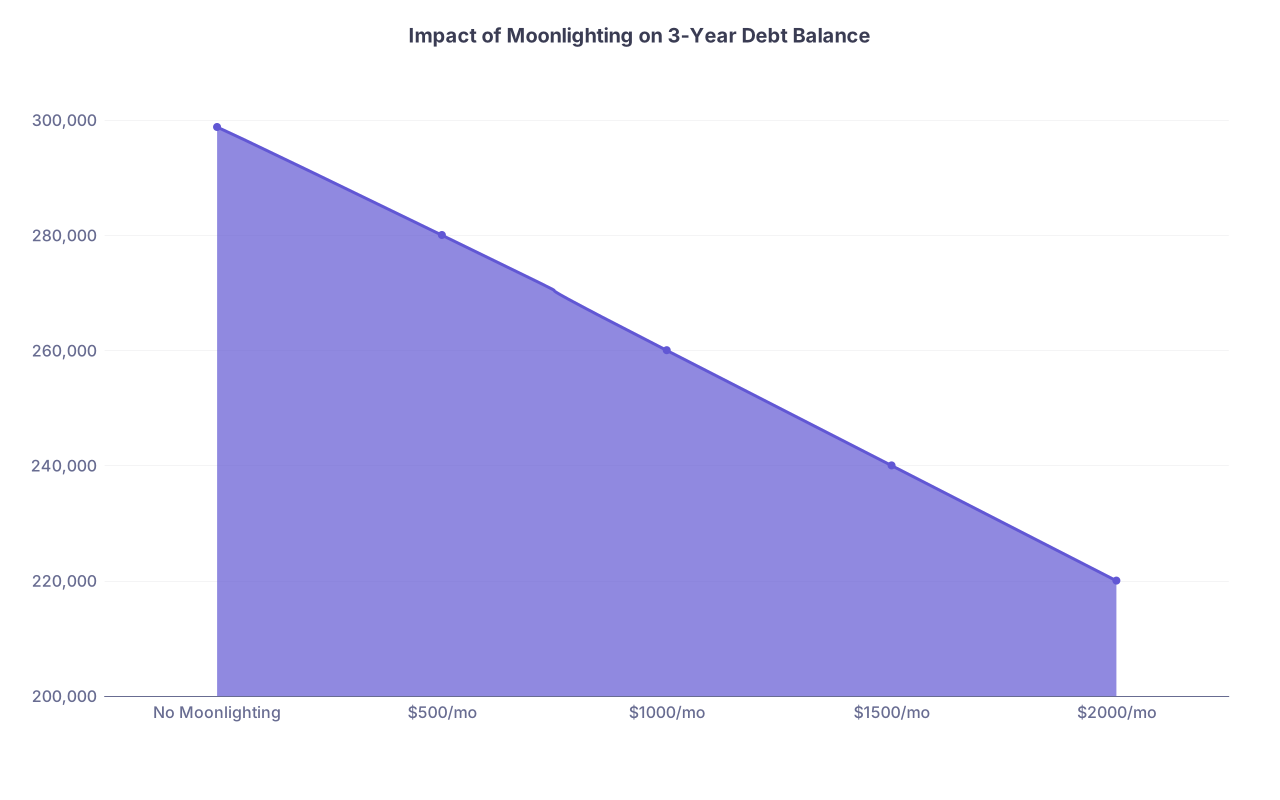
| Category | Value |
|---|---|
| No Moonlighting | 298750 |
| $500/mo | 280000 |
| $1000/mo | 260000 |
| $1500/mo | 240000 |
| $2000/mo | 220000 |
Starting from $250k at 6.5% with three years of residency, the resident who contributes $0 during residency ends near $300k. The one who consistently throws $2,000/month at loans exits closer to $220k. Same training length. Different program economics and personal choices.
8. How to Sanity-Check Moonlighting Promises on Interview Day
Programs love to say, “Oh yes, there’s lots of moonlighting.” I have seen that line fall apart many times. Ask targeted, numbers-based questions:
- How many residents actually moonlighted last year?
- Which PGY level can start?
- What were the typical hourly rates and sites?
- Is there a list of credentialed external sites, or do residents find their own?
- Are there hard caps on hours/month? Who enforces them?
- How many residents hit the cap?
You are looking for specifics like:
“Most of our PGY‑3s pick up 3–4 in-house nocturnist shifts a month at $120/hour. About a third also moonlight at a nearby rural ED for $160/hour.”
Versus the academic dodge:
“We technically allow moonlighting on a case-by-case basis, but with duty hour restrictions and educational priorities, residents find it difficult to fit in.”
Translate that second answer as: “You will not make meaningful income moonlighting here.”
9. The Data-Driven Takeaway
Strip away the marketing. Look at the math:
- On pure salary: community > hybrid > academic, but gaps are modest.
- On cost-of-living-adjusted income: smaller-city community programs often blow big-city academic centers out of the water.
- On moonlighting: this is the real lever. Community programs frequently offer 2–4x the moonlighting earning capacity of academic centers.
- On debt trajectory: that extra $30–80k you can earn during residency changes your exit loan balance by tens of thousands.
- On long-term income: academic programs can compensate by increasing fellowship probability and aligning with PSLF.
In practical terms:
- If your primary goal is rapid debt reduction and you are not dead-set on a niche academic fellowship, a strong community program with robust moonlighting in a reasonable COL city is financially superior.
- If your goal is academic career + PSLF, an academic residency at a PSLF-eligible institution, with a clear 10-year nonprofit trajectory, is economically rational even with lower moonlighting.
- If you do not know, hybrid programs that give you both a shot at fellowships and some real moonlighting capacity are often the best compromise.
Your match list is a financial document as much as a training document. Treat it that way.
You are not just ranking call schedules and “fit.” You are choosing between loan balances, future salaries, and how many years you carry the weight of six-figure debt. Run the numbers now, while it is still lines in a spreadsheet and not a decade of your life.
With that framework in place, you are ready for the next step: mapping specific programs on your list into these economic archetypes and stress-testing your rank order against the actual financial outcomes it creates. That is where this stops being theory and starts being your real balance sheet—but that is a project for your next quiet evening in the call room.