
You are about to finish pediatric residency, sitting in the call room between admissions, scrolling through fellowship websites. You hear a senior resident say, “NICU is impossible now unless you have a ton of research,” while someone else swears that peds heme-onc is “not that competitive if you are flexible on location.” You look at your ERAS draft and realize: you do not actually know how competitive NICU or heme-onc really are. Or how they compare to cards, GI, PICU, or the rest.
Let me be blunt: most people talk about pediatric subspecialty competitiveness with zero data and a lot of hearsay. I am going to break this down specialty by specialty, with actual patterns and what they mean for you if you want NICU, heme-onc, or one of the other “high-demand” fellowships.
Big Picture: How Competitive Are Pediatric Subspecialties Really?
Before we zoom into NICU and heme-onc, you need the frame.
Pediatrics is less numbers-obsessed than adult IM subspecialties, but the relative competitiveness between peds fellowships is very real. Some fill every spot with highly qualified applicants and still have unmatched people; others go partially unfilled, and programs scramble in the SOAP or informal post-Match recruitment.
At a high level, if you ask PDs and look at national match patterns, you get something close to this hierarchy:
| Tier | Subspecialties (approximate grouping) |
|---|---|
| Top | Cardiology, GI, NICU |
| Upper-Mid | Hematology-Oncology, PICU, Endocrinology |
| Mid | Pulmonology, ID, EM, Neuro, Rheumatology |
| Lower-Mid | Nephrology, Hospital Medicine, Adolescent |
| Lowest | Complex Care, some non-ACGME or new programs |
This is relative, not absolute. Every year is a little different. But the same names keep rising to the top: peds cards, GI, NICU. Heme-onc and PICU sit just behind them. And then there is the long tail where programs sometimes go unfilled.
Why those specific ones at the top? Three main reasons:
- Prestige and perceived complexity (cards, GI, NICU, heme-onc, PICU)
- Procedures and acuity (people want “real” interventions)
- Job market and salary (some subspecialties simply pay better and have more jobs)
Now let’s drill into the names you actually care about.
Neonatology (NICU): The “Hidden IM Cards” of Peds
Ask around and you will hear, “NICU is super competitive now.” That is not wrong.
What drives NICU competitiveness
NICU hits a lot of emotional and career buttons:
- High acuity plus life-and-death decisions
- Tech-heavy environment (vents, HFOV, ECMO in some units, TPN nuance, advanced imaging)
- Strong perceived prestige within pediatrics
- Higher compensation compared with many other pediatric subs (depending on group/practice)
- Jobs in both academic and large community settings
You get a self-selecting group of residents who like procedures, physiology, and critical care, but want younger patients and a more controlled OR-free environment compared with PICU or anesthesia.
Applicant profile that reliably matches NICU
If I look at the NICU fellows I have seen match at strong programs (top 30–40 children’s hospitals), you tend to see:
- Solid but not necessarily stellar Step/COMLEX scores (peds is less Step-driven, but low scores still hurt)
- Strong residency performance: top third of class, outstanding clinical evals
- At least one meaningful NICU research project (poster, publication, or at least an abstract)
- Letters from NICU faculty who actually know the applicant, with phrases like “functions at the level of a fellow” and “one of the top residents I have worked with in the last 5 years”
- Clear, focused fellowship personal statement emphasizing neonatology early in training
Programs that see NICU “as a calling” rather than “I liked my NICU rotation” tend to filter heavily based on your longitudinal exposure: multiple electives, QI projects, nighttime admissions with NICU team, etc.
What makes it feel “hard to match”
Here is where people get confused. NICU is not IM cardiology-level cutthroat. But:
- The applicant pool is very self-selected and motivated.
- Many apply to a similar cluster of big-name programs (CHOP, Texas Children’s, Boston, CHLA, Nationwide, etc.).
- A subset of applicants apply broadly yet rank only a narrow set of “big centers,” then go unmatched and tell everyone “NICU is impossible.”
You can absolutely match NICU with a strong, realistic application and broad list, especially if you are open to less famous but perfectly solid programs.
How programs actually screen NICU applicants
What NICU PDs quietly care about, beyond the usual:
- Your ability to tolerate nights, high-stress codes, and emotionally brutal cases (ELBW deaths, complex anomalies)
- How you perform during resuscitations and procedures, even if you are not the “primary”
- Your comfort with uncertainty and delayed outcomes (neonatal neurodevelopment is slow-burn)
- Whether you understand that NICU life is not “cute babies,” it is end-of-life and neurodisability discussions every week
The best way to show this: a sub-I or away in a busy level IV NICU, with a detailed letter that comments on your performance on the sickest babies, not just normal feeders and growers.
Pediatric Hematology-Oncology: Competitive, but with Nuance
Heme-onc is where perception and reality often diverge.
People imagine St. Jude, bone marrow transplants, targeted therapy, and heavy research. That part is real. But whether heme-onc is “super competitive” depends heavily on geography and academic focus.
Why heme-onc attracts a particular personality
This subspecialty attracts residents who:
- Like longitudinal relationships and continuity with patients and families
- Tolerate (or are drawn to) very high emotional load: death, relapse, chronic transfusion, sickle cell crises
- Appreciate complex diagnostic reasoning and guidelines-driven protocols
- Are comfortable with chemo regimens, clinical trials, and long inpatient stays
Strong heme-onc applicants often had an early oncology experience: a childhood friend with leukemia, research in med school, or a mentor in residency.
Competitiveness pattern in heme-onc
Here is the key: top-tier heme-onc programs are absolutely competitive. Mid-tier and lower-tier programs can be much less so. The variability is bigger than in NICU.
Top academic heme-onc divisions want:
- Real research productivity (first-author or at least strong middle-author work)
- Evidence you understand clinical trials, cooperative group protocols, maybe some basic biostats
- A clear plan for an academic career, not “I want to do private practice heme-onc somewhere”
But there are also smaller or less research-heavy programs that:
- Care more about solid clinical performance, reliability, and genuine interest in oncology
- Will interview candidates with minimal publications if the rest of the application is compelling
- Often struggle to fill all their positions some years
That is why you will hear both: “heme-onc is insanely hard” and “heme-onc went unfilled this year.” Both can be true, depending on specific programs.
Heme-onc applicant “types” that match well
I see three broad archetypes that consistently do well:
The Clinician-Researcher-in-Training
- Multiple oncology projects, maybe a master’s or at least research track in residency
- Wants an academic career, T32-type slots
- Targets big-name institutions
The Strong Clinician with Some Exposure
- Solid resident, strong letters, one or two heme-onc projects or QI projects
- Aware of the emotional and time demands
- Applies broadly, is flexible on location and prestige
The “Late Convert” who got very serious, very fast
- Initially thought about another subspecialty, then had a powerful oncology rotation
- Did 6–9 months of crash-course exposure and networking
- Relies heavily on performance and letters, often applies to a wide range of programs
All three can match. The first group tends to land in the top 10–15 programs. The second and third find strong training in many mid-tier academic centers.
How NICU vs Heme-Onc Compare to Other Competitive Peds Fellowships
You cannot really judge NICU or heme-onc in isolation. They live in a neighborhood with cardiology, GI, PICU, and a few others.
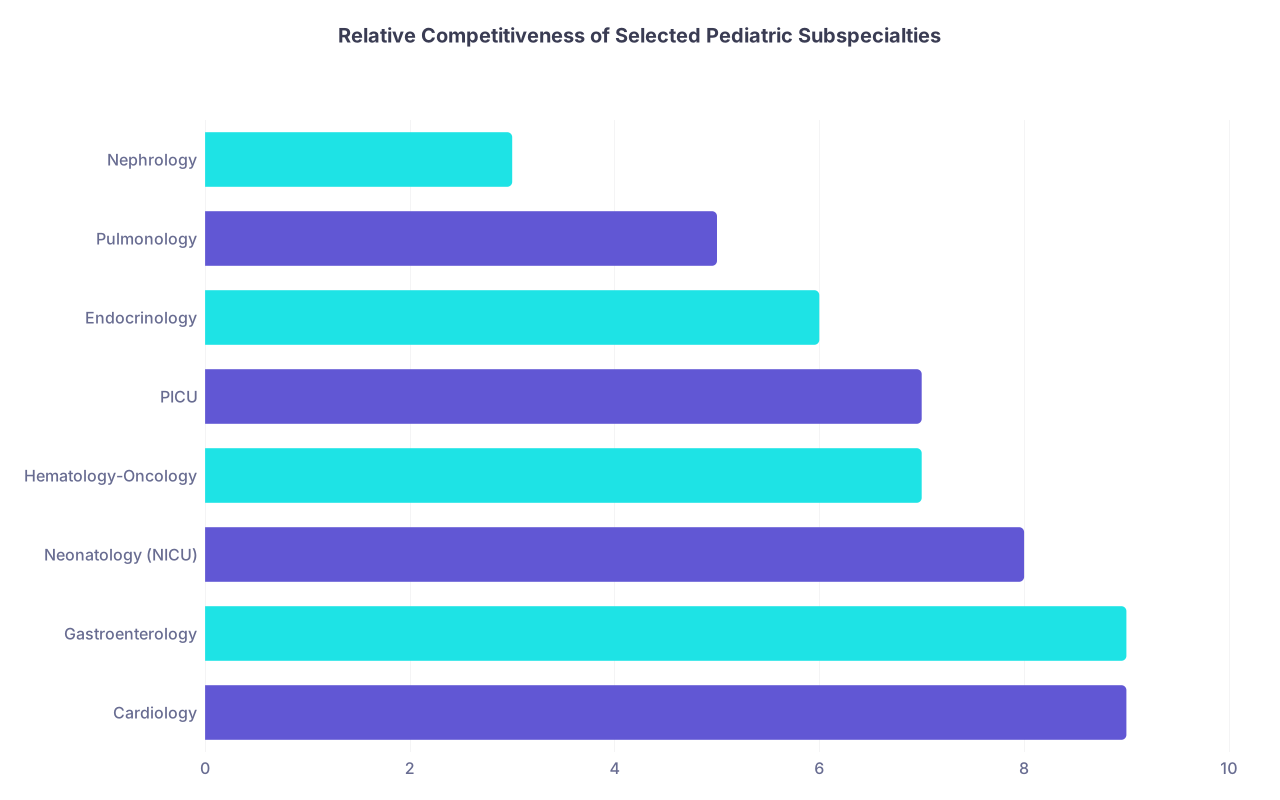
| Category | Value |
|---|---|
| Cardiology | 9 |
| Gastroenterology | 9 |
| Neonatology (NICU) | 8 |
| Hematology-Oncology | 7 |
| PICU | 7 |
| Endocrinology | 6 |
| Pulmonology | 5 |
| Nephrology | 3 |
(Scale 1–10, rough relative impression based on fill rates, applicant volume, and PD feedback.)
Cardiology and GI: The “Top of the Food Chain”
Peds cards and GI are usually sitting at or near the top. They combine:
- Heavy procedures and interventions
- Strong branding and prestige
- Decent pay relative to other peds subs
- Strong academic structures with well-established fellowships
If you are competitive for top NICU programs, you are probably at least ballpark competitive for many cards or GI programs, assuming you have aligned experiences. The big difference: cards/GI often expect a bit more quantitative or imaging-heavy focus and, in some places, more hardcore research.
PICU: Similar flavor, different lifestyle
PICU and NICU applicants overlap a lot. The split is usually about:
- Patient age preference (neonate vs all ages)
- Typical pathologies (congenital, prematurity vs trauma, sepsis, post-op surgery)
- Lifestyle feel: PICU can be more shift-like in some institutions; NICU often has a more variable call and rounding structure
Competitiveness-wise, good PICU programs are solidly upper-middle: not as cutthroat as top cards/GI, but not easy.
Endocrine, Pulm, Others
These sit in the “upper-middle to middle” group. They are not uncompetitive, but if you are a legitimate contender for NICU or heme-onc, you are usually well-positioned for these, assuming you show genuine interest.
What Actually Moves the Needle for Competitive Peds Fellowships
Let me be very clear: for NICU, heme-onc, and other competitive subs, Step scores alone will not save you. And a generic “I liked my NICU rotation” statement will sink you.
Here is what consistently matters.
1. Research and Scholarly Activity
For NICU and heme-onc, research is not optional at strong programs. The question is how much, and of what type.
NICU programs like:
- BPD outcomes, VLBW cohort studies, QI around CLABSI or VAP
- Nutrition, TPN optimization, feeding protocols
- Neurodevelopmental follow-up, HUS/MRI, cooling outcomes
Heme-onc programs like:
- Leukemia or solid tumor outcomes
- Sickle cell work (pain, VOC, hydroxyurea adherence)
- Late effects, survivorship, palliative integration
- Lab/bench work if you are at that level (flow, immunotherapy, etc.)
You do not need Nature papers. But you need something that says: “I can ask a question, use data, and finish a project.”
2. Letters of Recommendation: Subspecialty and PD
For competitive fellowships, the “hierarchy” of letters usually looks like this:
- Subspecialty letter from someone who knows you well and is known in that field
- Another subspecialty or strong clinical letter commenting on your work ethic and clinical reasoning
- PD or APD letter summarizing your trajectory and reliability
The fatal mistake: having no letter from the field you are applying to. Applying NICU without a NICU letter or heme-onc without a heme-onc letter signals dabbling rather than commitment.
3. Program Reputation and Training Environment
Let me be honest: training at a large academic peds residency with a busy NICU or heme-onc service and in-house fellows gives you a leg up. Not because PDs worship “prestige,” but because:
- You see high complexity cases and can be evaluated in that context.
- You have built-in research pipelines and mentors.
- Your letters come from people fellowship PDs already know by name.
That said, I have seen residents from smaller community programs match NICU or heme-onc at solid institutions. They just had to be more deliberate about:
- Doing away electives at big centers
- Finding mentors at those sites
- Producing at least one strong project to offset the “less famous” training environment
Application Strategy: If You Want NICU or Heme-Onc
Now to the part you actually need when ERAS opens.
Timeline and preparation
Use your PGY-2 year intelligently. A rough outline:
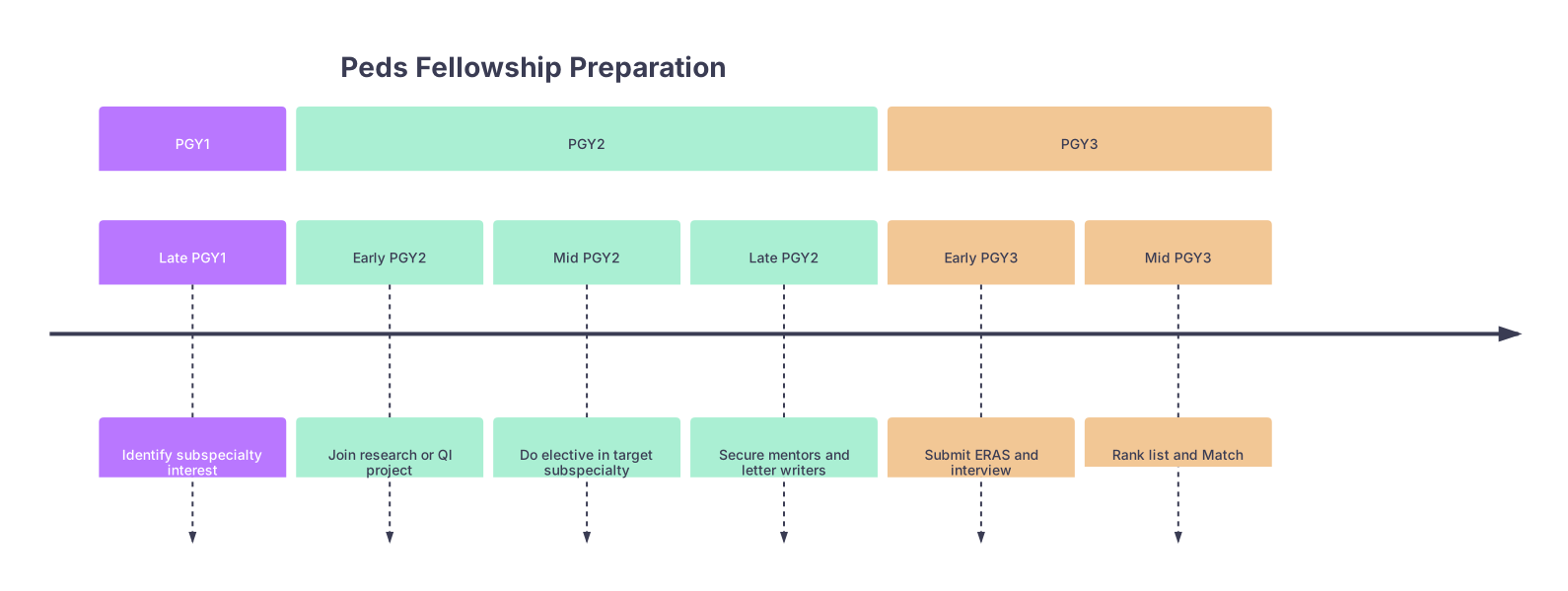
| Period | Event |
|---|---|
| PGY1 - Late PGY1 | Identify subspecialty interest |
| PGY2 - Early PGY2 | Join research or QI project |
| PGY2 - Mid PGY2 | Do elective in target subspecialty |
| PGY2 - Late PGY2 | Secure mentors and letter writers |
| PGY3 - Early PGY3 | Submit ERAS and interview |
| PGY3 - Mid PGY3 | Rank list and Match |
If you are late to the party (deciding mid-PGY-3), it is still possible, but you will be leaning heavily on:
- Clinical excellence and letters
- Very careful program list construction
- Sometimes a “gap” chief or hospitalist year to build your CV, then apply
Building your program list strategically
Do not just apply to every name you recognize. Think in tiers.
For a typical strong applicant (good but not elite research, strong clinical evals):
- 3–5 “reach” programs (top research powerhouses, name brands)
- 10–15 “target” programs (busy academic centers, solid reputations)
- 5–10 “safety-ish” programs (less famous/name-rec, but good training; often in less competitive cities/regions)
And then be honest with yourself: if your application is weaker (limited research, average evals), you must shift more of your list into the target/safety range, and consider less saturated regions.
Interviews: What PDs are actually fishing for
Standard questions for NICU and heme-onc interviews tend to fall into a few themes:
NICU:
- “Tell me about a difficult family meeting in the NICU.”
- “How do you handle overnight stress and prolonged uncertainty?”
- “What role do you see yourself playing in delivery room resuscitations as a fellow?”
Heme-Onc:
- “How have you processed grief or loss in your training so far?”
- “Tell me about a time you had to deliver bad news or support a family.”
- “Where do you see yourself in 10 years: research, clinical leader, both?”
They are assessing not just what you say, but:
- Affective maturity — do you understand what you are signing up for?
- Self-awareness — can you articulate your limitations and how you are growing?
- Fit — are you someone they want to work 24-hour calls with?
Job Market and Lifestyle Realities: NICU vs Heme-Onc vs Others
You are not just matching into a fellowship. You are signing up for a career.
NICU jobs: Generally decent, geography matters
Most regions have demand for neonatologists. Patterns I keep seeing:
- Large community hospitals: strong need, sometimes higher pay, more service-heavy, less research.
- Academic centers: more competition, more research expectations, sometimes lower starting salary but better academic support.
- Lifestyle: shift-like in some groups (in-house nights with post-call days), others use 24-hour call models. It is not lifestyle-dermatology.
Heme-onc jobs: Mixed, very location- and research-dependent
The heme-onc market is:
- Strong if you want academic roles, are flexible on city, and can bring research or program-building skills.
- Tougher if you want a big-name coastal city with pure clinical work and little academic expectation.
- Emotionally heavy — high burnout risk if your group is short-staffed or poorly supported.
In many children’s hospitals, heme-onc faculty are doing a combination of clinic, inpatient service, consults, and academic responsibilities. Workload can be significant.
Comparison to other subs:
- Cards/GI: Often good job prospects but highly regional; big cities saturated, mid-size cities hungry.
- PICU: Generally decent job market, again with big regional variability.
- Endo/pulm/nephro: Some markets oversupplied, others desperate, especially for nephrology.
Concrete Moves If You Are PGY-2 or Early PGY-3 Right Now
If you want NICU:
- Get on at least one NICU-focused research or QI project this year. Even if it is “small,” get it moving.
- Do a NICU elective in a high-acuity unit. Ask explicitly for feedback and be proactive.
- Identify 1–2 NICU attendings who can realistically write detailed, comparative letters.
- Be honest with yourself if your application is “big-center competitive” or “mid-tier plus broad list competitive.”
If you want heme-onc:
- Align yourself with an oncologist who actually publishes or runs trials, if possible.
- Get exposure to both inpatient and outpatient heme-onc; do not be the person who has seen only leukemias but no sickle or benign heme.
- Have at least one meaningful scholarly product (onc or benign heme), even if modest.
- Prepare to articulate why heme-onc, and how you deal with repeated exposure to death and serious illness.
If you are not sure between NICU, PICU, heme-onc, or cards:
- Do rotations in each by early PGY-2 if humanly possible.
- Pay attention to which attendings you naturally gravitate toward — style, thinking, values.
- Look at your own behavior: what do you read about at home without being forced? That is usually your subspecialty.
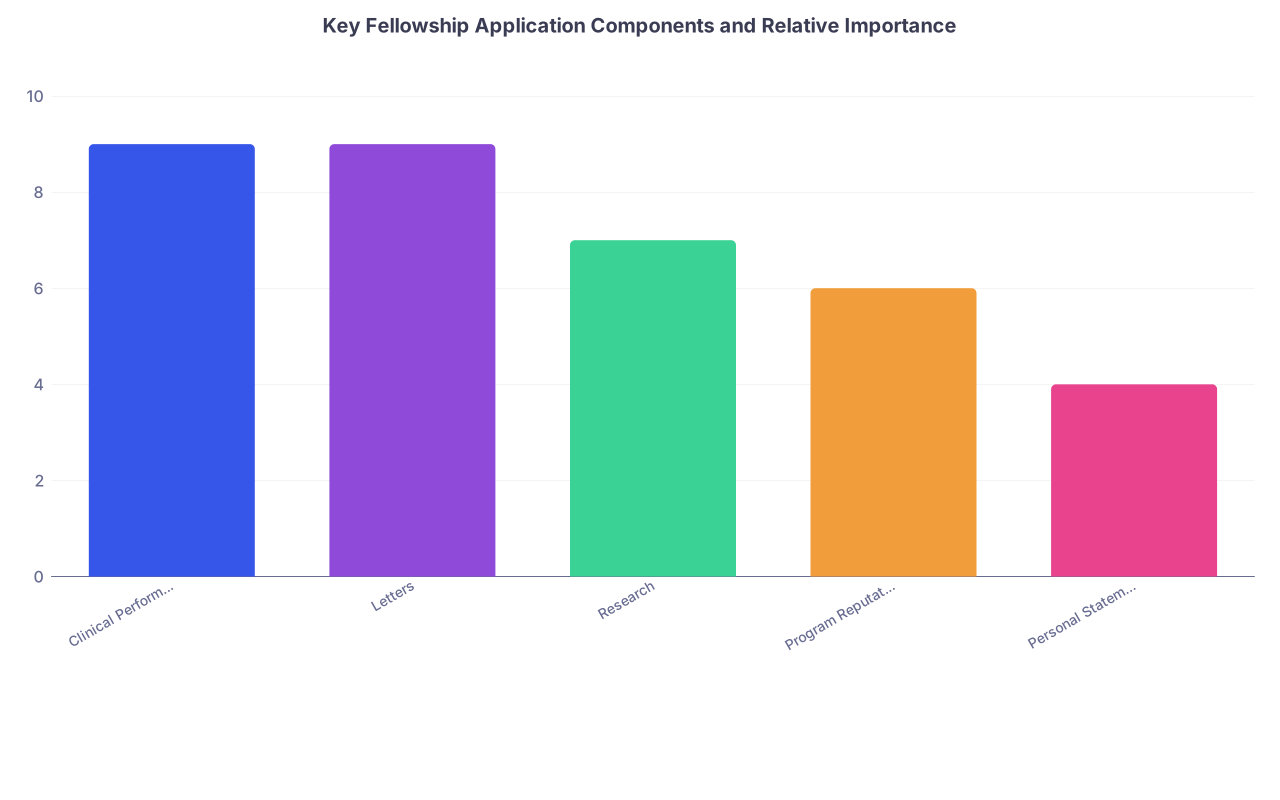
| Category | Value |
|---|---|
| Clinical Performance | 9 |
| Letters | 9 |
| Research | 7 |
| Program Reputation | 6 |
| Personal Statement | 4 |
FAQs
1. Do I absolutely need research to match NICU or heme-onc?
For the top academic programs, yes. For mid-tier and some smaller programs, you need at least some scholarly activity, even if it is a single QI project or retrospective review with an abstract. A completely research-free application is at a major disadvantage in both NICU and heme-onc. But you do not need an R01.
2. I am at a smaller community peds program without fellows. Can I still match NICU or heme-onc?
Yes, but you have work to do. You will likely need: an away elective or two at larger centers, deliberate networking with subspecialty faculty, and a project that ties you visibly to the field. I have seen community residents match at strong NICU and heme-onc programs using exactly that playbook. You just cannot be passive.
3. Is it easier to match if I apply to multiple subspecialties at once?
Usually not. It makes you look unfocused when PDs talk, and they do talk. Applying NICU and heme-onc simultaneously, for example, raises red flags unless your story is extremely well thought-out and your materials are cleanly separated. You are almost always better off committing to one and building a coherent narrative.
4. How much do fellowship programs care about Step 1/2 scores?
Less than you think, but not zero. Very low scores (or multiple failures) can hurt you in competitive fields, especially when programs have many qualified applicants. But a 250 does not guarantee NICU or heme-onc, and a 220 does not automatically block you. Clinical evaluations, letters, and subspecialty engagement usually matter more than raw test scores.
5. Will doing a chief resident year help my fellowship chances?
Sometimes. A chief year can help if: you need time to build your research portfolio, you want stronger letters, or you come from a smaller program and need added visibility. It does not magically override a weak record. For NICU and heme-onc, I see chief year as a “plus” when used to enhance an already decent application, not as a rescue parachute.
6. How many programs should I apply to for NICU or heme-onc?
For most applicants: somewhere in the 20–30 range for competitive subspecialties is reasonable. If your application is weaker (minimal research, average letters), leaning toward 30+ and broad geographic flexibility is safer. Applying to 10 “top name” programs only is a great way to end up unmatched and bitterly telling everyone the field is impossible.
Key points: NICU, heme-onc, and a few others (cards, GI, PICU) are the real competitive end of pediatric subspecialties, but they are not black boxes. Strong clinical performance, subspecialty-specific letters, and at least modest research are what separate match from struggle. And you absolutely can get there from a non-elite background—if you stop relying on vague advice and build a focused, realistic application strategy early.