
The prestige hierarchy of specialties is outdated. If you ignore SOAP risk, you are playing a different game than the programs are.
Program directors in competitive fields are running one hard constraint: do not end Match Week with unfilled positions. The specialties that flirt the closest with that edge—high unmatched applicant rates plus non-trivial SOAP exposure—are exactly where applicants should be the most careful.
This is a data review of those “danger zones.”
I will lean on NRMP Charting Outcomes, NRMP Results and Data, and NRMP Program Director Survey patterns from recent cycles (2018–2024 era). Specific percentages shift by year, but the rank order and risk profile patterns are remarkably stable.
1. How SOAP Risk Actually Works (And Why Competitive Fields Are Exposed)
SOAP risk is simple mathematically:
SOAP Risk for a specialty =
(Probability an applicant in that specialty goes unmatched) × (Probability the specialty has unfilled positions)
Applicants usually obsess about the first term (their personal unmatched risk) and almost ignore the second (whether their chosen specialty tends to create SOAP chaos).
The data show three overlapping high-risk configurations:
- High applicant-to-position ratio (lots of people chasing few spots).
- Programs heavily favor top-tier candidates (Step scores, AOA, research), creating a steep drop-off for “average” applicants.
- Some programs chronically miscalibrate their rank lists and end up in SOAP despite being “competitive on paper.”
The specialties that consistently sit in this danger band:
- Orthopedic Surgery
- Plastic Surgery (integrated)
- Otolaryngology (ENT)
- Dermatology
- Neurosurgery
- Diagnostic Radiology and Interventional Radiology (integrated)
- General Surgery (categorical, particularly for weaker applicants)
- Emergency Medicine (for a different reason: recent volatility and misforecasting)
Not all of these have the same flavor of risk. Some are “brutally selective but fill almost completely.” Others swing between full and SOAP-heavy years.
2. Match Metrics: Where Unmatched Rates and SOAP Actually Hit
Let’s anchor this in actual patterns, not vibes.
2.1 Unmatched Rates for US MD Seniors by Specialty Tier
Across recent cycles, US MD seniors show a relatively stable structure:
- Low-unmatched “safe-ish” fields (FM, IM categorical, peds, psych, neurology, pathology) often have unmatched rates in the mid-single digits or lower.
- Moderately competitive fields (anesthesiology, EM, OB/GYN) sit in the mid single to low double digits, with some year-to-year noise.
- High-stakes, prestige specialties regularly show unmatched rates north of 20% for US MDs when self-selected applicants overshoot.
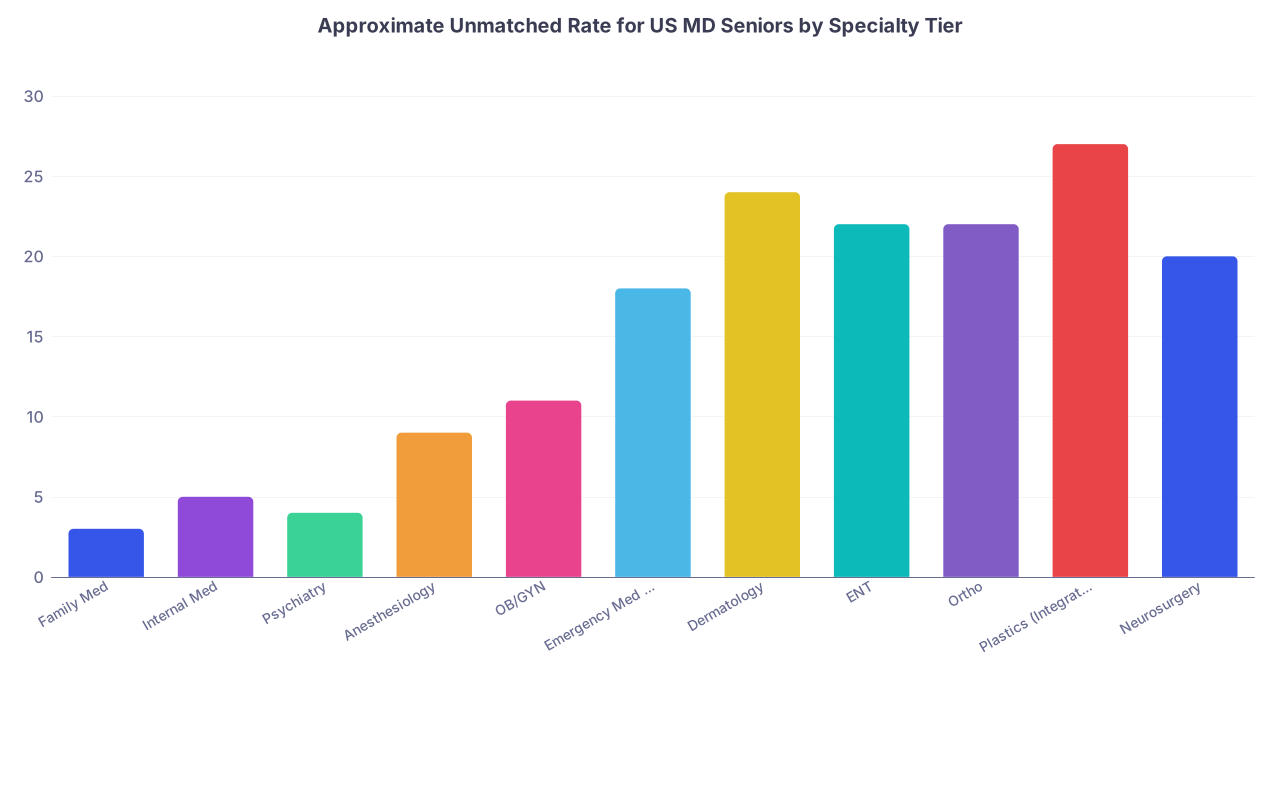
| Category | Value |
|---|---|
| Family Med | 3 |
| Internal Med | 5 |
| Psychiatry | 4 |
| Anesthesiology | 9 |
| OB/GYN | 11 |
| Emergency Med (recent) | 18 |
| Dermatology | 24 |
| ENT | 22 |
| Ortho | 22 |
| Plastics (Integrated) | 27 |
| Neurosurgery | 20 |
These are rounded pattern estimates, not single-year exact figures, but the ranking is consistent across multiple NRMP cycles.
Two distinct risk stories emerge:
- Dermatology / Plastics / ENT / Ortho / Neurosurgery: High unmatched rates, but almost no SOAP positions in many years (they just fill). So if you miss, you miss hard and go shopping in SOAP for something entirely different.
- Emergency Medicine and sometimes General Surgery: Material unmatched rates and meaningful SOAP positions in bad years. That creates both opportunity and chaos.
3. Competitive Specialties with the Highest SOAP Exposure
Now let us layer SOAP data on top of competitiveness. We care about specialties that are both:
- Highly competitive (strong applicants, high score thresholds, low margins for error), and
- Non-trivially present in SOAP in at least some cycles.
3.1 The Classic Elite Fields: High Unmatched, Low SOAP
Some specialties are almost allergic to leaving positions unfilled. They over-rank and cast a wide net. Their SOAP risk (for programs) is low, but applicant SOAP risk is gigantic, because there is basically nothing left at 11 a.m. Monday.
The big four in this category:
- Dermatology
- Plastic Surgery (integrated)
- Otolaryngology
- Neurosurgery
| Specialty | Typical US MD Unmatched Rate | Unfilled Positions at Match (Most Years) | SOAP Positions Typically Available | Applicant SOAP Outcome Profile |
|---|---|---|---|---|
| Dermatology | ~20–25% | Near 0–1% | Almost none | Pivot to prelim/IM/FM in SOAP |
| Plastics (Int) | ~25–30% | Near 0–1% | Almost none | Forced into backup specialty |
| ENT | ~20–25% | Near 0–2% | Very few | Rare ENT SOAP options |
| Neurosurgery | ~15–20% | Near 0–1% | Almost none | Change field or research year |
SOAP risk here is asymmetric:
- Programs: Low risk. They almost always fill.
- Applicants: Extreme risk. If you fail to match, you are not “SOAPH-ing into another derm program.” You are bailing into prelim medicine/surgery, TY, or completely different specialties.
From a data-analyst standpoint, the decision problem is binary:
- Either you are in the top decile of the applicant pool for these fields (scores, institutional pedigree, research density, strong specialty letters), or
- You need a serious parallel plan in a less competitive specialty.
“I’ll SOAP into a spot in my field” is fantasy for these four.
3.2 Orthopedic Surgery: High Competition, Sporadic SOAP Shockwaves
Orthopedic surgery sits in an odd middle ground:
- Historically: Near-dermatology-level competitiveness. High Step cutoffs, strong research, high unmatched rates for weaker applicants.
- Yet in certain recent cycles, orthopedics has seen clusters of unfilled programs, especially in community or lower-prestige locations.
That combination—high bar plus sporadic unfilled positions—creates meaningful SOAP dynamics.
Orthopedic SOAP positions tend to cluster in:
- Community programs
- Newly accredited or smaller-volume programs
- Less geographically popular regions
Here is the approximate pattern the last few cycles have followed:
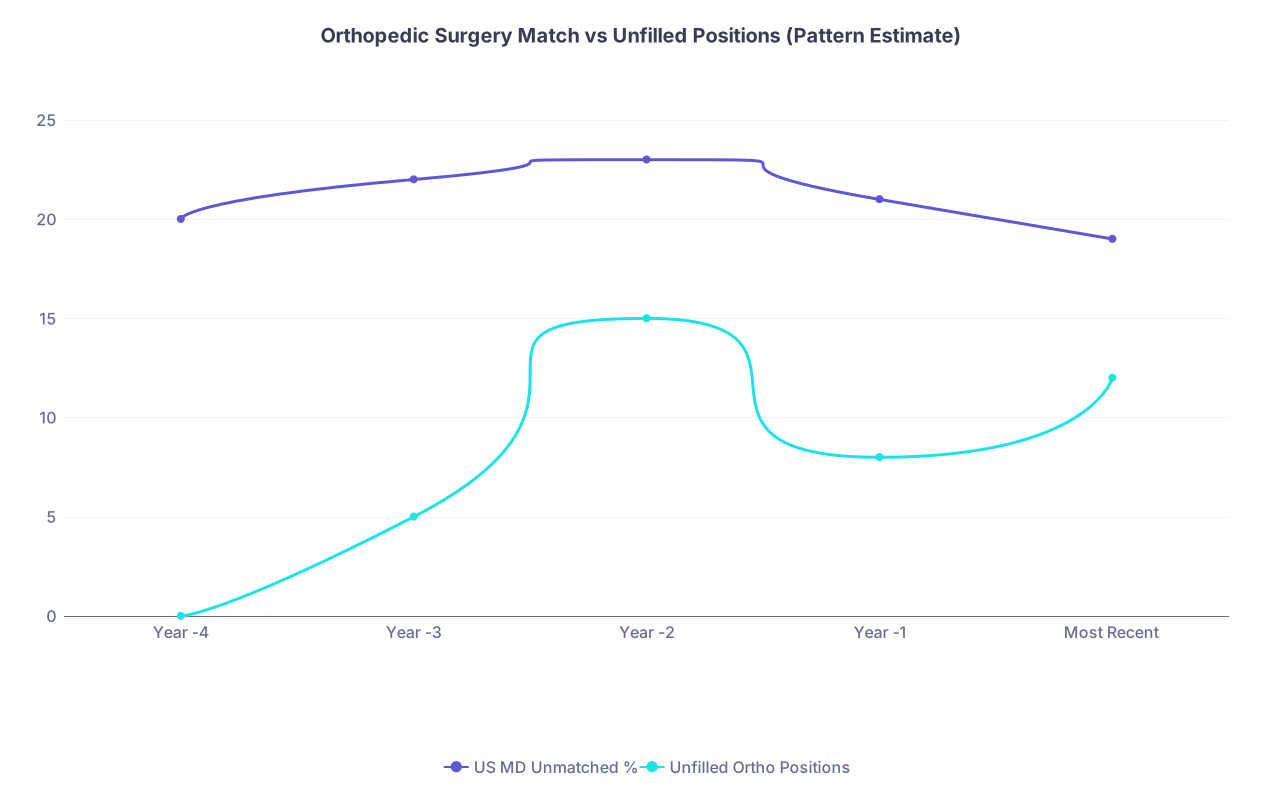
| Category | US MD Unmatched % | Unfilled Ortho Positions |
|---|---|---|
| Year -4 | 20 | 0 |
| Year -3 | 22 | 5 |
| Year -2 | 23 | 15 |
| Year -1 | 21 | 8 |
| Most Recent | 19 | 12 |
The risk story in orthopedics:
- For strong applicants: Ortho is still dangerous but survivable with enough breadth in the rank list (not just 8 academic powerhouses). The existence of SOAP positions provides a lose-less option if you are flexible on geography and program type.
- For borderline applicants (lower Step 2, average school, modest research): This is one of the highest SOAP-risk fields, because your chance of not matching is non-trivial, and your chance of landing a SOAP ortho position is concentrated in programs many applicants did not seriously consider initially.
I have seen this pattern: applicant with 245–250 Step 2, mid-tier MD, 5–6 ortho interviews only at mid/low-tier programs. They rank them all, come up unmatched, then scramble into an unexpected community program in SOAP. It works out sometimes. Sometimes it does not.
3.3 Diagnostic Radiology & Interventional Radiology Integrated: Quietly Risky
Radiology lost some shine after the 2010s boom, then rebounded as lifestyle and compensation data filtered down. The result:
- Applicant numbers recovered.
- Programs in less desirable locations had more trouble filling.
- Integrated IR added a hyper-competitive micro-market on top.
Pattern:
- Diagnostic Radiology: Moderate to high competitiveness, with non-trivial unfilled positions in specific years, often at smaller programs.
- IR (Integrated): Very competitive with high unmatched risk, but very few unfilled slots. True SOAP opportunities in IR are rare.
From a SOAP perspective:
- DR: Reasonable chance of a SOAP rescue for flexible applicants who will go anywhere.
- IR: Same structural problem as dermatology/plastics—miss the match and you are likely pivoting back to DR or another field, not SOAP-ing into IR.
3.4 General Surgery Categorical: Mid-High Unmatched + Real SOAP Volume
General surgery is the classic “competitive but accessible” specialty. That accessibility creates complacency.
The data pattern:
US MD unmatched rate: Often hovering around 10–15% for categorical surgery.
Meaningful unfilled positions in some cycles, typically at:
- Community programs
- Newly accredited programs
- Geographically unpopular regions
For SOAP, that means:
- There is genuine opportunity for unmatched applicants from more competitive fields (ortho, ENT, urology) to pivot into categorical general surgery in SOAP if they have strong surgery letters and a believable narrative.
- There is also genuine risk for borderline general surgery applicants who overshoot (only rank high-prestige academic programs, limited list length) and find that the SOAP options are mostly programs they never looked at or did not rotate at.
3.5 Emergency Medicine: The Case Study in Systemic Miscalculation
Emergency medicine is the poster child for SOAP volatility.
What happened:
- Program expansion + misreading of workforce data + changing applicant preferences led to overcapacity.
- Several cycles saw dozens to hundreds of unfilled EM positions.
- Meanwhile, applicant interest in EM dipped for lifestyle and job market reasons in some regions.
The data show:
- US MD unmatched rates that are not crazy-high by themselves.
- But an explosion in unfilled EM positions in less desirable locations and newer programs.
- SOAP became saturated with EM positions, some going unfilled even after SOAP.
From an applicant standpoint:
- For strong EM applicants who applied broadly, SOAP is less a “risk” and more a safety valve—they can often pick up positions in SOAP if they miscalibrated their list.
- For marginal applicants targeting only brand-name urban EM programs, there is a paradox: you can go unmatched at the top end while hundreds of unwanted positions sit in SOAP.
So EM is high-SOAP-volume, but not in the way derm or ortho are high-risk. It is more of a market mismatch than pure competitiveness.
4. Correlating Competitiveness Metrics with SOAP Risk
Let me formalize the risk landscape. The data show three useful quantitative markers:
- Applicant-to-position ratio (APR)
- US MD unmatched rate
- Percent of positions unfilled by specialty
If we approximate across multiple recent cycles:
| Specialty | Approx APR | US MD Unmatched % | Unfilled % (Positions) | SOAP Exposure Category |
|---|---|---|---|---|
| Dermatology | 1.7–2.0 | 20–25 | 0–1 | High applicant risk, low SOAP |
| Ortho Surgery | 1.6–1.8 | 20–23 | 1–4 | High applicant + moderate SOAP |
| Plastics (Int) | 2.0+ | 25–30 | 0–1 | Extreme applicant risk |
| ENT | 1.7–2.0 | 20–25 | 0–2 | High applicant risk |
| Neurosurgery | 1.4–1.6 | 15–20 | 0–1 | High applicant risk |
| Gen Surg Cat | 1.2–1.4 | 10–15 | 2–5 | Moderate applicant + real SOAP |
| EM | 1.0–1.3 | 8–15 | 5–15 (recent volatile) | High SOAP volume |
You can visualize the structure as a scatter: x-axis = competitiveness, y-axis = SOAP exposure.
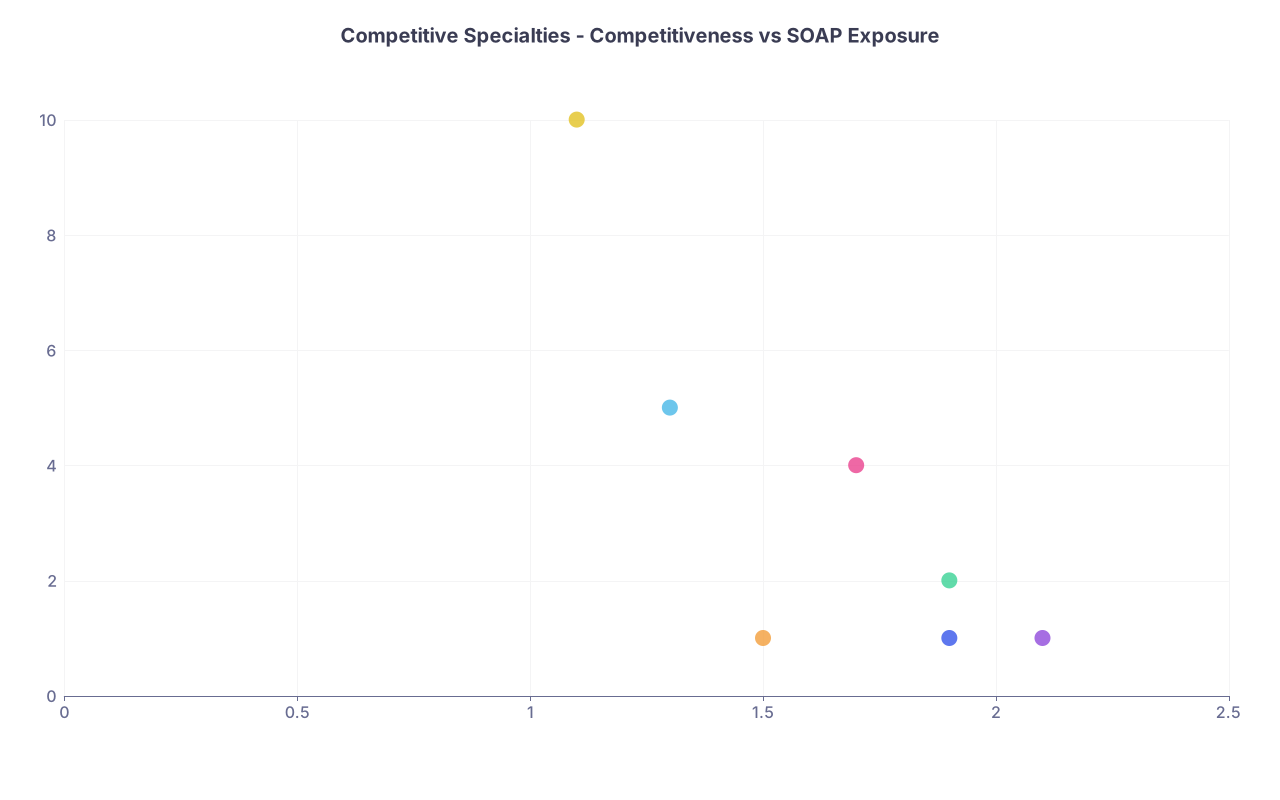
| Category | Value |
|---|---|
| Derm | 1.9,1 |
| Plastics Int | 2.1,1 |
| ENT | 1.9,2 |
| Neurosurgery | 1.5,1 |
| Ortho | 1.7,4 |
| Gen Surg | 1.3,5 |
| EM | 1.1,10 |
(Here x = APR, y = approximate average unfilled %; the exact numbers are illustrative.)
The dangerous corner for individuals is the upper-right: high APR and non-trivial unfilled percentage. Orthopedics and general surgery creep closest to that. Dermatology and plastics live in the “you miss, you’re out” upper-left.
5. The Backup Illusion: What Actually Happens in SOAP
Let us talk about behavior, not just numbers. There are three recurring SOAP scenarios I keep seeing in competitive fields.
5.1 The “No Parallel Plan” Trap
Profile:
- 250+ Step 2, AOA, MD at a good school.
- 12 integrated plastics / ENT / derm interviews.
- Zero backup applications.
- “I’ll be fine. And if I am not, I’ll SOAP into something.”
Failure scenario:
- Goes unmatched.
- SOAP spreadsheet Monday: zero plastics / derm / ENT slots, maybe one neurosurgery in a place they never considered.
- Realistic SOAP choices: prelim medicine/surgery, TY, maybe categorical IM/FM/psych.
- Result: emotional crash + unplanned specialty pivot under 48-hour time pressure.
The data reality: in the hyper-competitive elite fields, SOAP is not your backup specialty. SOAP is your exit from limbo into anything that still exists.
5.2 The “Aggressive but Flexible” Ortho / Gen Surg Candidate
Profile:
- Step 2 in the 240s; strong ortho or surgery letters; solid school.
- Applied widely: mix of academic and community programs.
- 8–10 interviews, some at less desirable locations.
Outcome variance:
- Matches late on their list into a community or mid-tier academic program. Fine.
- Or goes unmatched and lands an ortho or categorical general surgery position in SOAP at a smaller program that scrambled.
Here SOAP actually functions as an extension of the match. But only because the applicant treated non-brand-name programs as real options, not second-class citizens.
5.3 The EM “Location or Bust” Applicant
Profile:
- Wants big-city EM only.
- Applies to 20–25 programs, all in high-demand metros.
- Ignores or under-ranks dozens of solid but less glamorous programs.
In a volatility year:
- Some of those preferred programs fill easily.
- Many less popular programs go into SOAP with multiple positions.
- Applicant can end up unmatched despite the specialty being “underfilled” nationally.
SOAP outcomes:
- Often lands EM, but in a location never considered during the main match.
- Occasionally fails to land EM even with open spots if letters or application do not support the story (poor SLOEs, professionalism flags).
The core point: SOAP is not a transparent “second match.” It is a fast market with incomplete information and heavy institutional biases.
6. Strategy: Minimizing SOAP Risk in High-Competition Fields
Let me translate the data into actionable principles.
6.1 Quantify Your Personal Risk, Not the Specialty Average
The average unmatched rate in ortho or derm tells you almost nothing about you. Your risk is conditional.
Variables that shift you:
- Step 2 CK relative to matched median in that specialty
- Institutional reputation (home program in the field vs none)
- Number of specialty-specific letters from well-known faculty
- Research output density (posters, pubs, dedicated research years)
- Interview count and spread (only elite programs vs inclusive list)
A 240 Step 2 MD from a newer school with no home ortho program is not playing the same game as a 260 Step 2 MD at an ortho powerhouse. Treating their SOAP risk as identical because “ortho unmatched rate is 22%” is mathematically lazy.
6.2 Build a Real Parallel Plan in the Right Risk Bands
For the highest-risk specialties (derm, plastics integrated, ENT, neurosurgery), a parallel plan is not optional unless you are in the top tier.
Reasonable parallel pairings (data-backed from cross-matches we see every cycle):
- Dermatology → internal medicine with an eye toward rheum, allergy, heme/onc, academic tracks.
- Plastics (integrated) → general surgery categorical with interest in plastics fellowship, or possibly ENT.
- ENT → general surgery or sometimes neurosurgery, depending on profile.
- Neurosurgery → neurology or general surgery, with a believable narrative.
The key: programs in your backup specialty need to see serious intent before SOAP. That means:
- A meaningful number of applications in the backup specialty.
- At least one rotation and strong letters.
- An honest explanation of interest during interviews.
“I’ll just flip to IM in SOAP with zero IM letters” is not a strategy. It is a hope.
6.3 Use Intermediates like TY/Prelim Deliberately
In data terms, transitional year and prelim medicine/surgery are shock absorbers in the system. They hold unmatched applicants while they regroup for a later cycle.
You use them when:
- You are deeply committed to a hyper-competitive field and willing to reapply with stronger credentials.
- You have a realistic path to strengthen your file (research, new letters, improved Step 2 or Step 3, additional rotations).

| Step | Description |
|---|---|
| Step 1 | Choose High-Risk Specialty |
| Step 2 | Apply only to target specialty |
| Step 3 | Add backup specialty |
| Step 4 | SOAP to TY/Prelim or switch field |
| Step 5 | SOAP to backup or TY/Prelim |
| Step 6 | Matched - proceed |
| Step 7 | Top-tier applicant? |
| Step 8 | Unmatched? |
| Step 9 | Unmatched? |
I have seen TY/Prelim years work well for motivated reapplicants. I have also seen them turn into “lost years” where nothing meaningful is added to the CV. The former group has a plan before SOAP. The latter group makes it up while panicking.
6.4 Respect Geographic and Program-Tier Reality
SOAP data show a consistent pattern: unfilled positions in competitive specialties cluster in:
- Less popular geographic regions (rural, Midwest, Deep South, Rust Belt, etc.).
- Newer or lower-tier programs away from major academic centers.
If you are not willing to train in those settings, your true SOAP options in that specialty shrink to almost zero. Be honest with yourself:
- If your real preference is “ortho only in coastal metros,” your risk of total mismatch is much higher than the broad ortho numbers suggest.
- If you are fully geographic-agnostic, your ability to use SOAP as a safety net within the field increases.
6.5 Understand That Programs Also Fear SOAP
One subtle point the NRMP Program Director Survey makes clear: PDs hate SOAP. It is time-compressed, chaotic, and risky from their perspective.
That drives behaviors that affect you:
- Many competitive programs comparatively over-rank to avoid unfilled positions. That means a longer tail of seemingly “borderline” applicants do match.
- Some programs in lower-demand areas still misjudge applicant preferences and end up under-ranked, landing in SOAP despite decent reputations.

That is your leverage point: if you are willing to rank broadly and include non-elite programs, you lower your personal SOAP risk even in competitive specialties.
7. What the Data Actually Say You Should Do
Summing the patterns across specialties:
- The highest SOAP-risk competitive specialties from the applicant perspective are:
- Dermatology
- Plastic Surgery (integrated)
- Otolaryngology
- Neurosurgery
- Orthopedic Surgery
- Categorical General Surgery (for borderline applicants)
- Emergency Medicine (because of system-level volatility, not pure difficulty)
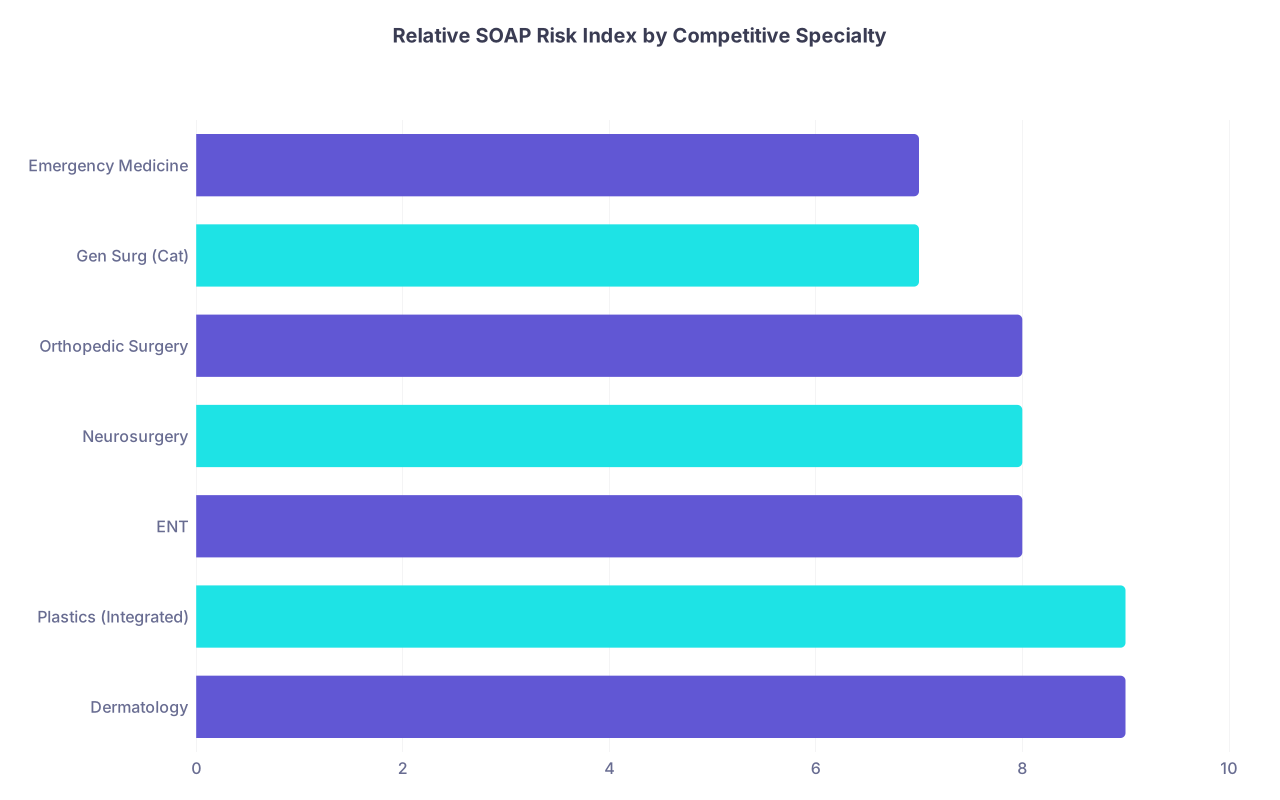
| Category | Value |
|---|---|
| Dermatology | 9 |
| Plastics (Integrated) | 9 |
| ENT | 8 |
| Neurosurgery | 8 |
| Orthopedic Surgery | 8 |
| Gen Surg (Cat) | 7 |
| Emergency Medicine | 7 |
(Scale 1–10; combines competitiveness, unmatched rates, and SOAP exposure.)
- For the elite micro-fields (derm, plastics integrated, ENT, neurosurgery), SOAP will not save you within the specialty. If you miss, you are almost certainly changing fields or taking a holding pattern year.
- Orthopedic surgery and general surgery categorical sit in a true danger band: high enough unmatched risk to worry, but enough SOAP activity that applicants build illusions of rescue that may or may not materialize.
- Emergency medicine’s issue is not that you cannot get a spot; it is that misalignment between applicant preferences and program locations creates unpredictable SOAP dynamics.

If you want to stay out of the worst SOAP scenarios, orient your behavior around three concrete points:
- In hyper-competitive fields, either be in the genuinely strong tier or build a real parallel specialty plan with letters, interviews, and ranked programs—not just a fantasy about SOAP.
- In mid-high competitive surgical fields and radiology, spread your risk across program types and geographies, and be genuinely willing to go where the SOAP openings cluster.
- Stop treating the specialty-wide unmatched percentage as your personal risk. Your individual risk is a function of your specific metrics, school, letters, research, and list strategy.

Key points to remember:
- Competitive specialties split into two camps: those that fill completely (derm, plastics, ENT, neurosurgery) and those that spill meaningfully into SOAP (ortho, gen surg, EM). Your risk profile is very different in each.
- SOAP is not a second full match; it is a compressed market dominated by geography and program tier. In the most competitive fields, it rarely offers same-specialty salvation.
- The data reward applicants who are brutally honest about their competitiveness, build intentional backup paths, and use rank lists—not SOAP—as the primary tool to manage risk.