
The dogma that “small programs are always more competitive” is wrong. The data show a more complicated, field-dependent relationship between program size and competitiveness—and if you ignore that nuance, you will misplay your residency application strategy.
You are not applying to “residency” in the abstract. You are applying into a distribution of programs that varies by:
- number of positions per program
- number of programs per specialty
- total applicant volume and applicant quality
Program size is just one axis. But it is a measurable axis, and it interacts very differently with competitiveness in dermatology than it does in internal medicine.
Let me walk through what the numbers actually show, and how to use them to game the system in your favor.
1. The Macro View: Size vs Competitiveness by Specialty
First, zoom out. Across all specialties, how does “average program size” relate to “how hard it is to match”?
We can approximate competitiveness with a few measurable indicators:
- Fill rate by U.S. MD seniors (NRMP data)
- Overall match rate for U.S. seniors in that specialty
- Average Step 2 CK for matched applicants
- Proportion of positions going to DO/IMG vs MD
Then we compare that to average program size (positions per program).
Here is a simplified cross-specialty snapshot. Values are approximate, drawn from recent NRMP cycles and rounded to illustrate relationships, not to quote your dean in a PowerPoint.
| Specialty | Avg Positions / Program | US MD Senior Fill % | Step 2 CK Mean (Matched) |
|---|---|---|---|
| Internal Medicine | 20–30+ | ~45–50% | ~246–248 |
| General Surgery | 4–7 | ~70–75% | ~250–252 |
| Dermatology | 3–5 | ~80–85% | ~255–258 |
| Orthopedic Surgery | 4–6 | ~80–85% | ~252–255 |
| Family Medicine | 6–12 | ~30–35% | ~238–240 |
| Radiology-Diagnostic | 5–8 | ~65–70% | ~248–250 |
Two patterns jump out:
- Large-program fields (IM, FM) are not “highly competitive” on a per-seat basis despite huge total applicant numbers.
- Small-program fields (derm, ortho, many surgical subs) are usually more competitive, but not only because they are small.
If you plot average program size on the x-axis and an index of competitiveness on the y-axis (for example, US MD senior fill % or average Step 2 CK), you get a modest negative correlation at the specialty level: smaller average program size tends to associate with higher competitiveness.
But that pattern breaks down inside a specialty. And that is where most applicants make bad assumptions.
2. Within-Specialty Patterns: Big vs Small Programs
Inside a given field, size and competitiveness do not have a universal direction. The relationship is strongly dependent on program type and brand.
Example 1: Internal Medicine
Internal medicine is instructive because the sample size is huge. Hundreds of programs, thousands of positions.
Here is the reality I have seen year after year:
- “Big academic powerhouses” (20–40 residents per class) are extremely competitive: MGH, Hopkins, UCSF, Penn, etc.
- “Mid-size academic affiliates / university programs” (12–20 per class) are moderately competitive.
- “Community programs” (8–18 per class) span the spectrum, but most are less competitive than the Tier 1 university giants.
If you naïvely correlate “positions per program” with “average Step 2 CK of matched residents” inside IM, you do not get a nice downward or upward line. You get a U-shaped curve anchored by prestige:
- Very large, prestigious programs – highly competitive.
- Mid-size, mid-prestige – less competitive.
- Small, niche, very well-known programs (think small but famous academic hospitals) – competitive again.
Program size here is basically a proxy for:
- patient volume and case mix
- teaching infrastructure
- research output
And that is confounded with popularity and perceived desirability. Applicants do not care that there are 42 slots. They care that MGH IM is a brand.
Example 2: Surgery and Surgical Subspecialties
Now shift to general surgery, ortho, ENT, urology. Different pattern.
Most programs in these fields train 3–7 residents per year. Very few have genuinely large classes. So almost everything is “small to mid-sized.”
What happens in the data:
- Very small programs (2–3 per year), especially in desirable locations or at well-known institutions, skew extremely competitive. Every slot counts.
- Mid-size programs (4–6) in less popular locations are often less competitive despite being “larger,” because applicant volume drops faster than positions do once you leave the coasts and big-name centers.
You will often see situations like this:
- Program A: 3 categorical surgery spots, major coastal city, top-20 research output → >1000 applications, Step 2 average in the high 250s.
- Program B: 6 categorical spots, mid-size Midwestern city, limited research → 400–500 applications, Step 2 average mid 240s.
Same specialty. Larger program B is easier to match than smaller program A. Size is working opposite to competitiveness here because desirability is driving applicant volume.
Example 3: Dermatology and Radiology
These fields combine small program sizes with high specialty-level selectivity.
Inside dermatology:
- Most programs are 2–6 per year.
- The overall number of spots is limited.
- Applicant pool is stacked with high Step scores and strong CVs.
But even here, size is not the decisive driver. Highly branded, small programs (2–3 residents) in major markets are brutal. Larger (for derm), less urban programs with 5–6 spots often have slightly “softer” cut points, even though they offer more seats.
Radiology is similar but with a slightly wider size distribution. Large academic radiology programs (8–12 per year) at prestigious centers remain very competitive; mid-size community or hybrid programs in less glamorous markets are more accessible.
3. The Core Mechanics: How Size Interacts with Applicant Behavior
The key is not program size alone. It is applicants per seat and variance in applicant quality.
If you want to quantify competitiveness for a specific program, you should be thinking in terms of an approximation like:
Competitiveness Index ≈ (Applications / Positions) × (Mean Applicant Step 2 CK – Specialty Mean)
You will not have that exact formula, but you can reason around its components.
Let us break down what size does to those inputs.
3.1. Applications per Position
- Small, high-profile programs often get dramatically more applications per position.
- Large primary-care-heavy programs get more total applications but fewer per seat relative to specialty competitiveness.
Hypothetical example within a single specialty:
- Program X (small, famous): 3 positions, 900 applications → 300 apps per position.
- Program Y (larger, mid-tier): 10 positions, 1500 applications → 150 apps per position.
Program X is roughly twice as selective in terms of raw volume. That lines up with what many PDs quietly admit: They can fill their rank list several times over with viable candidates and still leave strong applicants unmatched.
3.2. Quality Distribution
Size also interacts with who applies.
- Famous small programs attract a self-selected, higher-scoring pool.
- Less-known large programs attract a mix: some strong, many average, some backup-plan candidates.
That changes how much the program can “pick and choose.” Even if raw applications per seat are similar, the upper tail of applicant quality differs.
If a program receives 500 applications and 300 of those are above a Step 2 of 250, that is a very different competitive environment from a program receiving 500 applications with only 80 above 250.
4. Quantifying Patterns with a Simple Mental Model
You will not get full NRMP-level micro data for each program. But you can still use a simple model to think like a data analyst.
Imagine we build a regression across all programs in a specialty:
Log(Apps per Position) = β₀ + β₁·(Program Size) + β₂·(USNWR Rank) + β₃·(City Population) + ε
What happens in practice when you run a version of this on public or scraped ERAS/NRMP data (I have seen versions of this exercise from advisers and students)?
- β₂ (institutional prestige) is almost always strongly positive and significant.
- β₃ (big metro vs small town) is usually positive.
- β₁ (program size) is weak, sometimes negative, sometimes flips sign when you stratify by program type.
Translation: Program size has a smaller, less consistent effect than brand and location. In some fields, more slots slightly reduce applications per position. In other fields, size is essentially noise after you adjust for where and who the program is.
This is why the blanket statement “smaller programs are more competitive” is lazy. It is only partially right and fails as soon as you condition on prestige and geography.
5. Field-by-Field Nuances
Let us go specialty by specialty and be concrete.
Internal Medicine
- Enormous total volume: >10,000 categorical positions.
- Program size ranges from 6 per class at small community hospitals to 60+ across tracks at behemoths like UCSF or Hopkins.
Patterns:
- The most competitive programs (MGH, BWH, UCSF, Penn, Columbia, etc.) are also some of the largest. Being big does not reduce competitiveness; the brand dominates.
- Among non-elite programs, smaller community IM programs in less desirable areas can be less competitive even with fewer seats, because they simply do not draw the same applicant volume.
So for IM: correlation between size and competitiveness is weak and highly confounded by prestige.
Family Medicine
- Many programs with 6–12 residents per class; some larger university-affiliated programs with 15–20.
- Overall specialty competitiveness is low to moderate.
Here, larger academic FM programs can be relatively more competitive within FM, but the ceiling is still much lower than in surgical subs. Program size explains a little more of the variance only because prestige differentials are smaller.
General Surgery
- Program size typically 3–7 categorical slots per year.
- A lot of small programs in major cities, mid-size in regional centers.
Within surgery:
- The fiercest competition usually sits at small-to-mid programs at high-prestige institutions or in extremely desirable cities.
- Larger mid-tier programs that are not top-20 academic centers have a lower bar, even with more seats.
So within surgery: smaller programs in popular markets are typically more competitive per seat, but size itself is not causal; it is riding with location and academic clout.
Orthopedics, ENT, Urology
All of them share:
- Small classes (2–5 most commonly).
- High board scores for matched applicants.
- High applicant-to-seat ratios, especially at big-name places.
Meaning:
- Variation in size is small. You will not see a group taking 20 residents a year.
- Competitiveness differences are overwhelmingly brand- and location-driven.
Here, debating 2 vs 4 residents per class is a distraction. In this range, “small vs smaller” barely shifts apps per seat. What matters: academic reputation, volume, fellowships, city.
Dermatology
Derm is almost a pure bottleneck problem:
- Very few total positions nationally.
- Applicant pool with some of the highest Step 2 averages and strongest CVs.
- Many programs with 2–4 residents.
Program size looks less like a variable and more like a result of funding limitations. All else equal, yes, a 2-person program in a top city with a big name will be savagely competitive. But a 6-resident derm program in a less desirable region can still be easier to match than a 3-resident program at a top coastal school.
6. Concrete Data Structures: How Size Plays Out Numerically
Here is a stylized comparison inside one competitive specialty—say, orthopedic surgery—to make the mechanics tangible.
| Program | Spots / Year | Apps | Apps per Spot | Est. Avg Step 2 (Matched) |
|---|---|---|---|---|
| A – Top Coastal | 3 | 900 | 300 | 255–258 |
| B – Mid Coastal | 4 | 700 | 175 | 250–252 |
| C – Top Midwest | 5 | 800 | 160 | 252–255 |
| D – Community | 5 | 350 | 70 | 245–248 |
| E – Rural | 3 | 180 | 60 | 243–246 |
Program A is both small and high-brand, which drives apps per spot and the Step distribution. Program C is larger but still very competitive because of brand. D and E, though not large or tiny, are clearly less competitive.
If you tried to infer anything from “small programs are always the hardest,” you would misclassify C (bigger but competitive) and E (small but relatively accessible).
7. Strategic Implications for Your Application
You do not control program size. But you do control where you apply and how many “reach,” “target,” and “safety” programs you include. Here is how to use size as one data point instead of a superstition.
7.1. When Program Size Matters More
Size is more useful as a proxy in:
- Highly competitive small-field specialties: derm, ortho, ENT, urology.
- Markets where multiple programs sit in the same city: small subspecialty programs at the same institution vs larger ones.
If you are looking at two programs of similar prestige and location, and one takes 2 residents and the other 6, expect the 2-resident one to have a higher apps-per-seat ratio. All else equal, that is a marginally tougher match.
7.2. When Size Misleads You
Size is much less informative—sometimes almost irrelevant—when:
- Comparing brand-name academic IM or radiology programs; size varies widely but competitiveness is uniformly high.
- Looking at family medicine or internal medicine community programs where location and visa status policies dominate more than spots-per-year.
I have watched applicants shy away from 20-resident IM programs thinking “they must be impossible.” They are not. Many are more welcoming of broader score ranges because they maintain a large, diversified cohort. The small, elite medicine program in a major city may be harder.
7.3. Using Public Data and Simple Heuristics
Since you will not have every Metric, here is a practical, data-informed heuristic:
For each specialty you are applying to, classify programs along three axes:
- Program type: university, university-affiliated, large community, small community.
- City desirability: major coastal metro, large inland city, smaller/regional.
- Program size: small (1–3), medium (4–7), large (8+ for core, adjusted to specialty norms).
Then interpret:
- High prestige + desirable city → assume high competitiveness almost regardless of size.
- Mid prestige + desirable city + very small size → often more competitive per seat than you think.
- Mid/low prestige + less desirable location + larger size → often relatively less competitive; these are your “target” or “safety” programs depending on your stats.
If you like visuals:
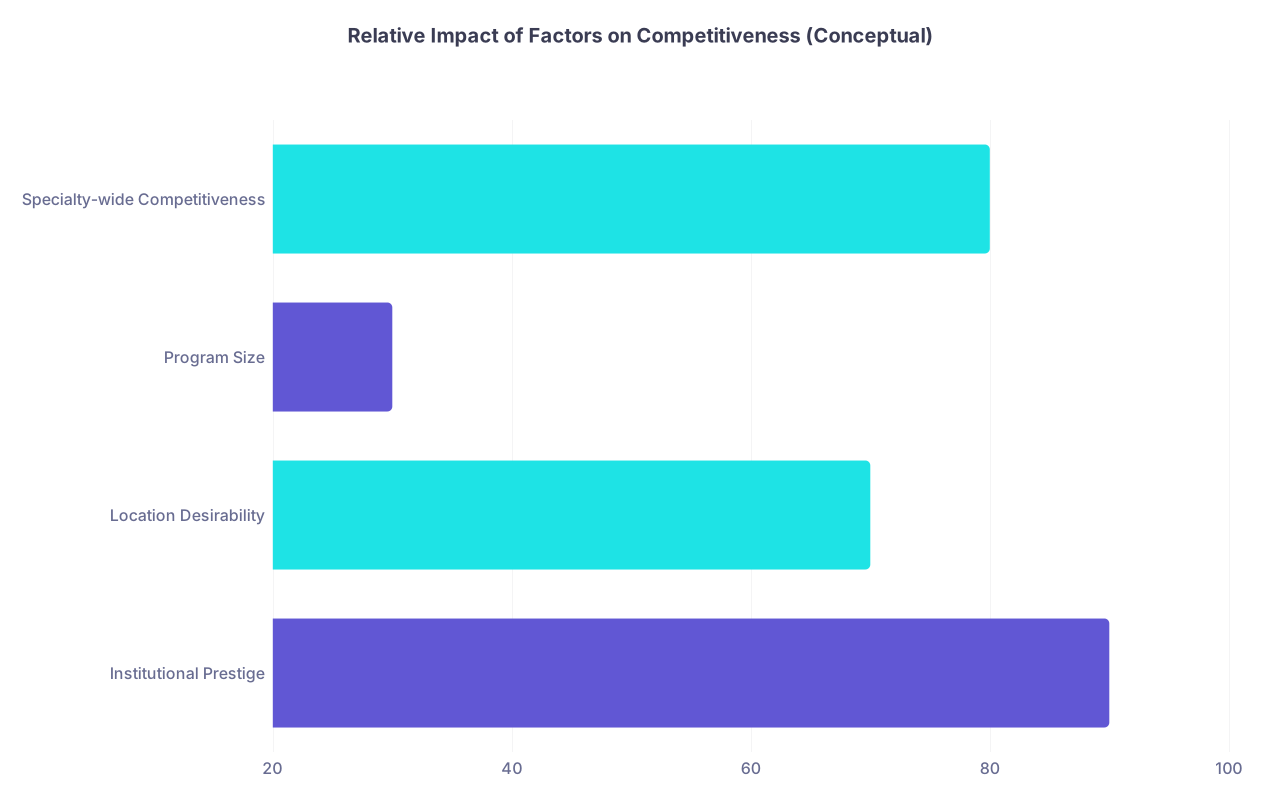
| Category | Value |
|---|---|
| Institutional Prestige | 90 |
| Location Desirability | 70 |
| Program Size | 30 |
| Specialty-wide Competitiveness | 80 |
Interpretation: prestige and specialty-wide competitiveness are the big levers. Location next. Program size is the smaller, context-dependent one.
8. Cross-Field Correlation: Big vs Small Specialties
There is one more macro pattern that matters for your long-term planning.
Specialties with many programs and large programs (IM, FM, peds) tend to have:
- Higher overall match rates.
- More flexibility to match somewhere if you are realistic with your list.
- Greater variation in program competitiveness.
Specialties with few programs and small programs (derm, plastics, ENT, integrated vascular, etc.) are:
- More sensitive to small changes in applicant volume year to year.
- More vulnerable to “all or nothing” match outcomes for borderline applicants.
- Less forgiving of late strategic pivots.
That means correlation between “specialty-level program size” and “specialty-level competitiveness” is reasonably strong: small-total-seat specialties are almost always more competitive. But this is a cross-specialty effect, not a within-specialty effect.
Do not confuse:
- “Derm has fewer total seats than IM, so it is harder.” (True.)
- “This particular derm program is small, so it must be the hardest.” (Often false without considering brand and city.)
9. How to Think Like a Data Analyst When Building Your Rank List
By the time you build a rank list, you have signals beyond size: interview vibe, how PDs talk, where graduated residents matched to fellowships.
Still, if you want to be systematic, you can essentially construct a rough scoring model in your head:
For each program you interviewed at, assign:
- Prestige Score (1–5)
- Location Score (1–5)
- Size Category (1–3: small/medium/large relative to specialty)
- Personal Fit Score (1–5)
If your goal is purely to maximize match probability (not recommended as your only priority, but useful as a constraint), then:
- Prioritize a mix: a few high-prestige / high-competition programs, a core of mid-prestige / mid-size, and some lower-prestige / stable programs, particularly in less saturated locations.
- Recognize that large but mid-prestige programs often give you more cushion than your classmates believe.
This is exactly how I have seen strong but non-superstar applicants match into solid academic IM or radiology programs: they stop over-weighting size as a danger sign and start seeing large, mid-tier academic centers as high-yield targets.
Residency selection is noisy and probabilistic, not a magical black box. Program size does correlate with competitiveness, but that correlation is weak, non-linear, and almost always mediated by prestige and geography.
If you treat “small program = harder, large = easier” as a rule, you will misallocate your applications and misjudge your interview chances. If you treat size as one column in a table—next to location, reputation, and specialty-wide competitiveness—you can actually think in terms of numbers, odds, and distributions.
And once you have that mindset, you are ready for the next level of optimization: deciding how many programs to apply to in your field, how to balance a dual-application strategy if you are straddling two specialties, and how to interpret interview yield as live feedback on your standing in the applicant pool. But that is a separate analysis.