The belief that “competitive specialties are the same everywhere” is wrong. The data show that specialty competitiveness shifts meaningfully between urban and rural programs—and ignoring that is how otherwise strong applicants end up unmatched.
You are not applying to “orthopedic surgery” or “family medicine” in the abstract. You are applying to orthopedic surgery in a Midwestern community hospital, or family medicine in a New York academic center, or radiology in a mixed urban–rural system. Geography changes the numbers: Step scores, fill rates, unmatched risk, and how programs weigh your application.
Let me walk through what the numbers actually say.
1. What “competitiveness” really means in this context
Before drawing urban–rural lines, you need a concrete definition. Competitiveness is not “hard to get” in some vague sense. It is measurable.
The four signals I watch:
- Match rate for applicants (specialty-specific, and when possible, stratified by region).
- Program fill rate (how many positions filled in the main Match vs SOAP).
- Applicant crowding (apps per position, interview inflation, geographic clustering).
- Applicant quality metrics (median Step 2, AOA, research volume where available).
Urban vs rural shifts those variables in different ways.
Urban vs rural: structural differences that matter
Urban programs (especially in large metros and coastal academic centers) tend to have:
- Higher application volume per spot.
- More students with high Step scores and strong research.
- More “prestige-seeking” behavior, with applicants overreaching.
- More institutional name-recognition that attracts out‑of‑region applicants.
Rural programs tend to have:
- Fewer total applications per position.
- More regional applicants with strong geographic ties.
- Historically lower average board scores in some fields, but surprisingly competitive in shortages like EM and anesthesia in some regions.
- Higher emphasis on “will this person stay here?” rather than marginal Step differences.
So the same specialty can be numerically brutal in an urban academic center and statistically forgiving in a rural or micropolitan program.
2. Baseline: specialty competitiveness nationally
To understand geographic variation, anchor with the national picture first. Numbers here are illustrative composites based on recent NRMP trends, not a single-year snapshot.
| Specialty | Fill Rate (US MD) | Step 2 25–75th (US MD) | Apps per Position (All) |
|---|---|---|---|
| Derm | 98–99% | 255–265 | 70–90 |
| Ortho Surgery | 98–99% | 250–260 | 60–80 |
| Radiology | 97–99% | 245–255 | 45–65 |
| EM | 90–94% | 235–245 | 35–50 |
| IM | 97–99% | 235–250 (academic) | 30–45 |
| Family Medicine | 92–96% | 225–238 | 20–30 |
Those are national aggregates. They hide a critical point: the competitiveness spread inside a single specialty can be as large as the spread between two different specialties—once you layer geography on top.
3. How urban vs rural shifts competitiveness by specialty
3.1 Internal medicine: academic coastal vs rural community
Internal medicine is the best example of “same specialty, different planet.”
- Large urban academic IM programs (think Boston, NYC, Bay Area) behave like high-mid-tier competitive specialties. High Step 2 medians, stacked CVs, heavy research.
- Rural community IM programs behave more like stable backup options for mid-range applicants.
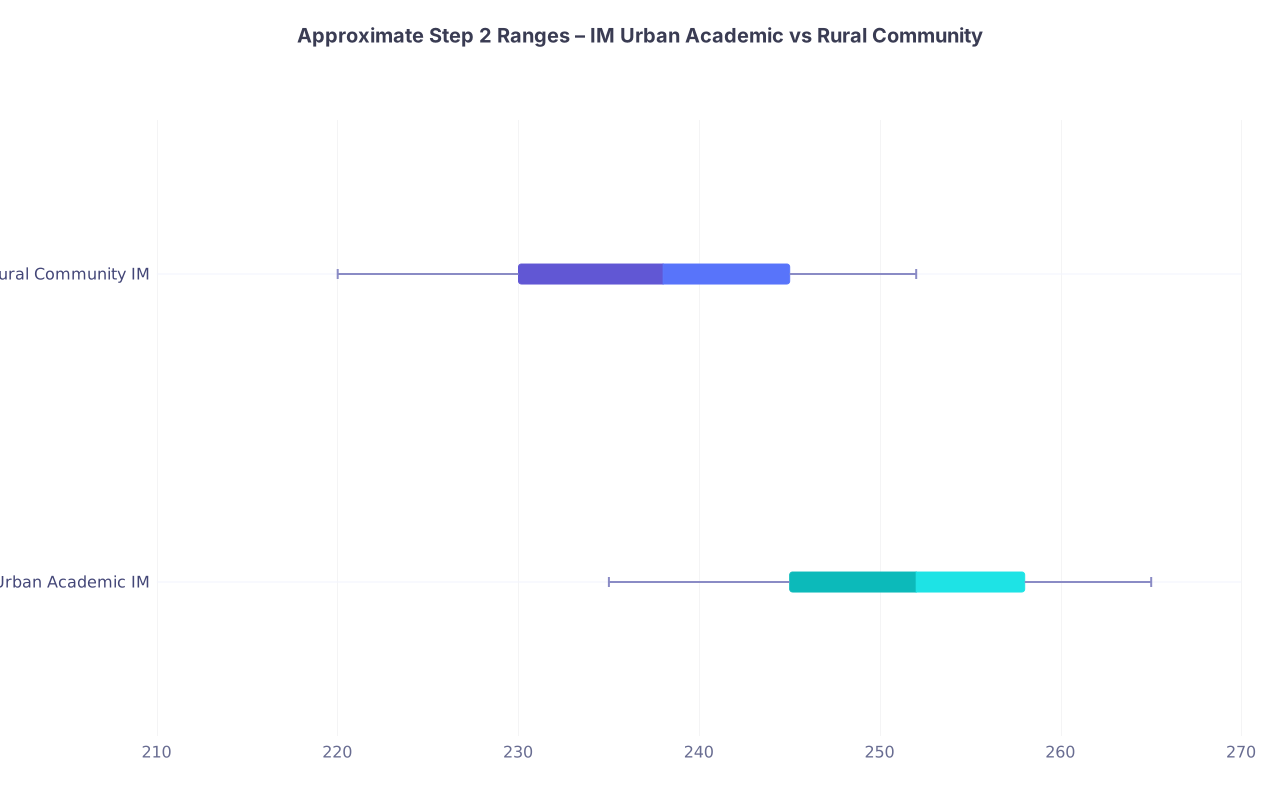
| Category | Min | Q1 | Median | Q3 | Max |
|---|---|---|---|---|---|
| Urban Academic IM | 235 | 245 | 252 | 258 | 265 |
| Rural Community IM | 220 | 230 | 238 | 245 | 252 |
What I see looking at program-level data:
Urban academic IM:
- Interview pools clustered around Step 2 scores in the 245–255 range.
- Research heavy: multi‑pub applicants are common, and first‑author is a plus.
- High proportion of categorical spots filled by home or regional schools.
Rural community IM:
- Interview pools broader, often 225–245 Step 2.
- Less emphasis on research; more on continuity clinic, communication, and “fit.”
- Strong preference for applicants with local roots or evidence they will tolerate limited subspecialty exposure or limited fellowship options on site.
Competitiveness conclusion: If your Step 2 is 240 with limited research, you are near the margin for big‑city academic IM, but comfortably above the median for many rural community IM programs. Geographically smart ranking can convert a “borderline” profile into a high-match-probability outcome.
3.2 Family medicine: rural “need” vs urban brand
Family medicine flips a common assumption. Many students think “I’ll just match FM anywhere.” Not in NYC or San Francisco.
What the data show:
- Urban academic FM (large coastal centers): far more applications per spot, higher Step medians, more lifestyle‑driven applicants.
- Rural FM: more positions, often fewer applications per position, and still unfilled slots in some regions—despite offering solid training.
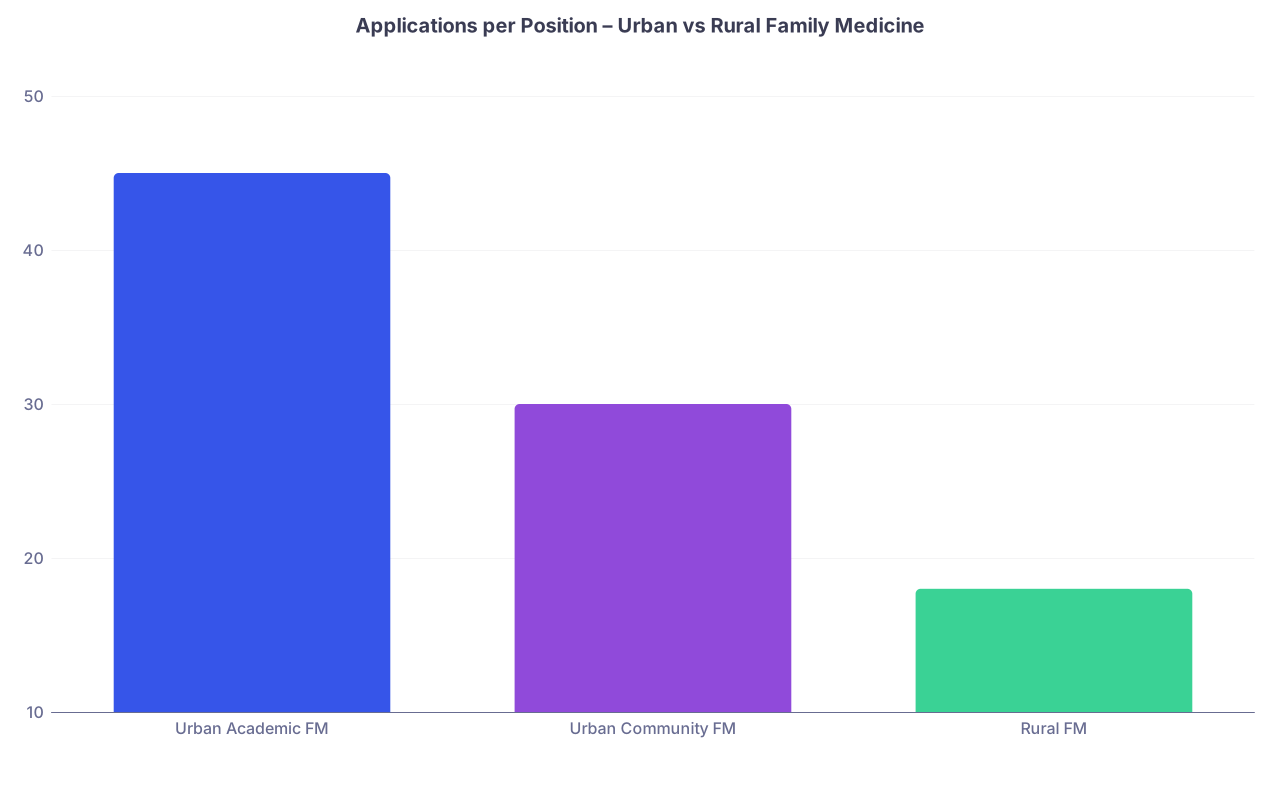
| Category | Value |
|---|---|
| Urban Academic FM | 45 |
| Urban Community FM | 30 |
| Rural FM | 18 |
The irony: the places with the greatest primary care need (rural) often have more open doors, but fewer students who are willing to go.
Urban FM programs in high‑cost metros tend to attract:
- Graduates with broader specialty options who choose FM intentionally.
- Applicants with 235–245 Step 2, strong letters, good narratives around primary care, and substantial underserved experience.
- Many couples match applicants who cluster where both partners have options.
Rural FM programs often:
- Interview aggressively when they see genuine geographic commitment or rural background.
- Are more flexible on scores; Step 2 in the 220s may still be fine with strong clinical performance.
- Value procedural interest, obstetrics comfort, and long‑term retention.
Competitiveness conclusion: FM is not “non‑competitive” in general. Urban vs rural distribution matters. If you rank only urban FM programs in a major city with a mid‑range application, your risk of a surprise unmatched result is very real.
3.3 Emergency medicine: regional volatility and rural leverage
Emergency medicine has been in flux. Some urban regions have seen over‑production of EM grads and saturated markets. Meanwhile, rural hospitals still scramble for stable EM coverage.
Practically:
- Urban academic EM: still high applicant volume, but programs are more selective on perceived “fit,” resilience, and long‑term career viability.
- Rural EM tracks or community EM‑heavy programs: often struggle to recruit, especially for true rural locations or small towns.
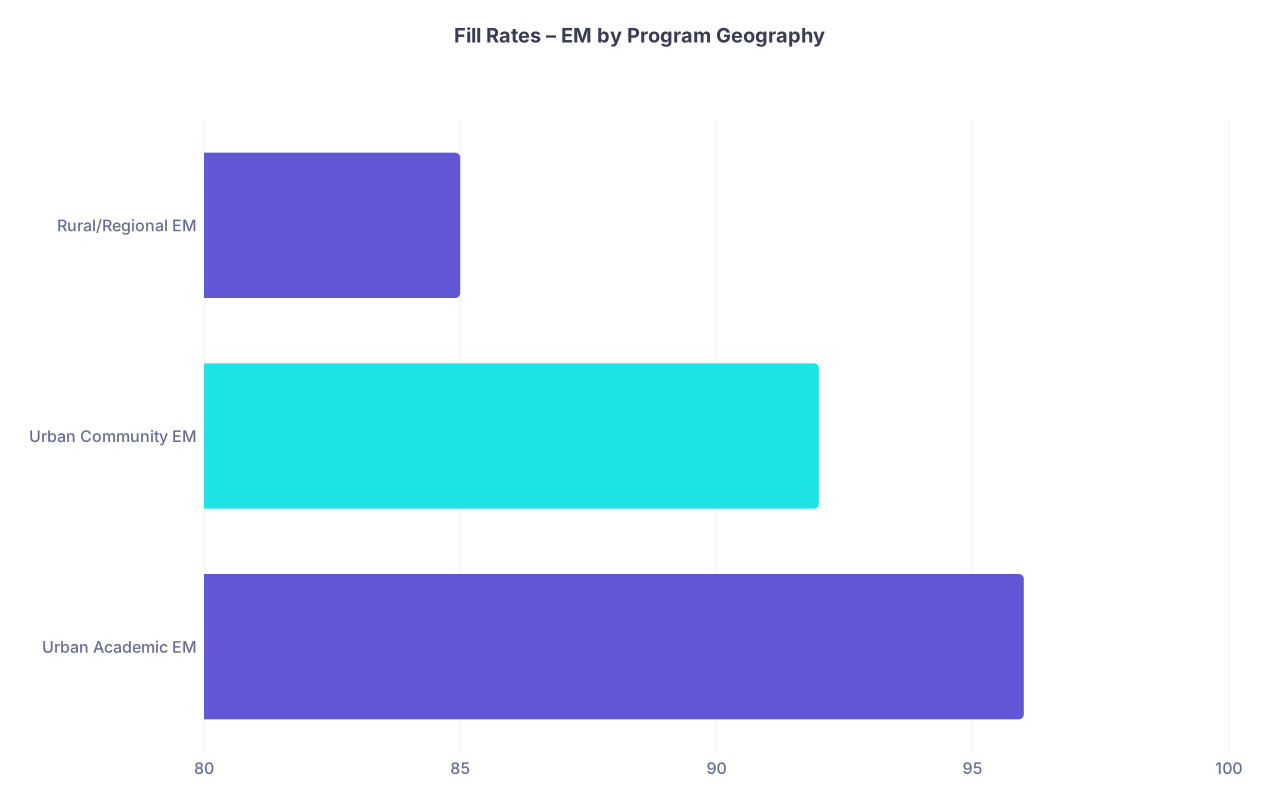
| Category | Value |
|---|---|
| Urban Academic EM | 96 |
| Urban Community EM | 92 |
| Rural/Regional EM | 85 |
That “85%” type fill rate for rural/regional EM usually means:
- A chunk of positions go unfilled in the main Match.
- SOAP fills some, but programs remain under‑subscribed compared with urban EM.
Applicant behavior matters here. Many EM‑leaning students want urban trauma centers, “exciting” cases, and big‑city life. So they crowd into the same 30–50 programs, leaving rural or mid‑size city programs relatively under‑applied.
Competitiveness conclusion: geography is leverage in EM. A mid‑tier applicant applying broadly, including rural or regional programs, can secure several interviews. The same applicant applying only to big‑city Level I centers may sit staring at an empty calendar.
3.4 Radiology and anesthesia: hidden rural opportunity
Radiology and anesthesia are classic high‑pay, OR/procedure‑heavy fields. Predictably, urban programs draw disproportionate interest.
When you look at program‑level data:
Urban academic rads/anesthesia:
- Very high Step 2 medians (often 245–255+).
- Heavy emphasis on school pedigree and letters from known attendings.
- Large percentage of home‑institution matches.
Rural or micropolitan rads/anesthesia:
- Lower application volume per spot.
- Slightly lower score thresholds (e.g. 235–245).
- Heavy interest in applicants who will thrive in smaller departments and potentially stay.
| Program Type | Step 2 Median | Apps per Position | Unfilled Risk |
|---|---|---|---|
| Urban Academic | 250 | 60–70 | Very low |
| Urban Community | 245 | 40–50 | Low |
| Rural/Micropolitan | 240 | 25–35 | Moderate |
Competitiveness conclusion: if your metrics put you at the 40–60th percentile nationally for rads or anesthesia, you may be at the 25th percentile for urban academics but the 70th percentile for rural programs. That changes everything about your rank strategy.
4. Why rural can be “more competitive” than you think
Sometimes the rural vs urban narrative gets twisted into “rural is always easier.” That is wrong in specific contexts.
There are three mechanisms that can make certain rural positions effectively more competitive:
- Very few spots in a highly desirable lifestyle area (e.g., “outdoor paradise” rural West).
- Hybrid community‑academic programs that promise solid fellowship placement plus lower cost of living.
- Programs with strong reputations in a niche (regional trauma referral, particular fellowship pipeline).
You can see this in some rural EM and anesthesia programs attached to well‑resourced regional referral centers. They may receive applications at or above the national average per position, because they hit a sweet spot: good pathology, reasonable lifestyle, lower living costs, and a clear fellowship path.

But these are exceptions. The most common rural profile is under‑applied compared with national averages, especially in primary care and some IM community settings.
5. Applicant strategy: how to use the geography data
Now the part that actually affects your match result: what to do with all this.
5.1 Targeting by competitiveness band
You can think in “bands” rather than rigid cutoffs. Example for a US MD with Step 2 = 238, okay but not stellar CV:
Urban Academic IM:
- You are below the median at many coastal flagship programs.
- Realistic chance only if you have strong home‑institution support and research.
Urban Community IM:
- You are near the median; viable, especially in non‑coastal cities.
Rural Community IM:
- You are above the median at most programs; you look relatively strong.
Apply accordingly:
- Do not build a list of 25 mostly big‑city academic IM programs and assume “IM is safe.”
- Mix: some academic, more community, and include rural/regional programs where you can actually stand out.
5.2 Geographic ties as a competitiveness multiplier
Rural programs are obsessed (rationally) with retention. So geographic ties function like an extra 5–10 “points” in their mental scoring.
If you grew up in a rural area, went to undergrad in that state, or have family near a rural program, you are not just “another applicant.” You are a lower‑flight‑risk investment.
I have seen this play out in the data:
- Applicants with mid‑range scores but strong ties to rural states snag multiple interviews where higher‑scoring, coastal‑only applicants are quietly filtered out.
- Conversely, no‑ties applicants who spray rural programs with generic applications get very little response.
Your personal takeaway:
- If you genuinely can live in a rural or small‑city area, emphasize those ties hard in your personal statement and program‑specific communications.
- Do not assume objective metrics alone will carry you in urban markets that are flooded with applicants.

| Step | Description |
|---|---|
| Step 1 | Assess Scores and CV |
| Step 2 | Include urban academic and community |
| Step 3 | Prioritize community and rural |
| Step 4 | Highlight ties in personal statement |
| Step 5 | Focus on realistic urban and small city programs |
| Step 6 | Balanced rank list |
| Step 7 | Above national median? |
| Step 8 | Any geographic ties to rural areas |
6. Urban vs rural in SOAP and unmatched risk
The NRMP data around unfilled positions and SOAP paints a very clear pattern:
- Urban academic programs in competitive specialties almost never enter SOAP.
- Urban community programs in primary care or IM rarely have large numbers of unfilled spots unless there is a local problem (new program, accreditation issues).
- Rural and small‑city programs dominate the pool of unfilled positions, especially in FM and some IM.
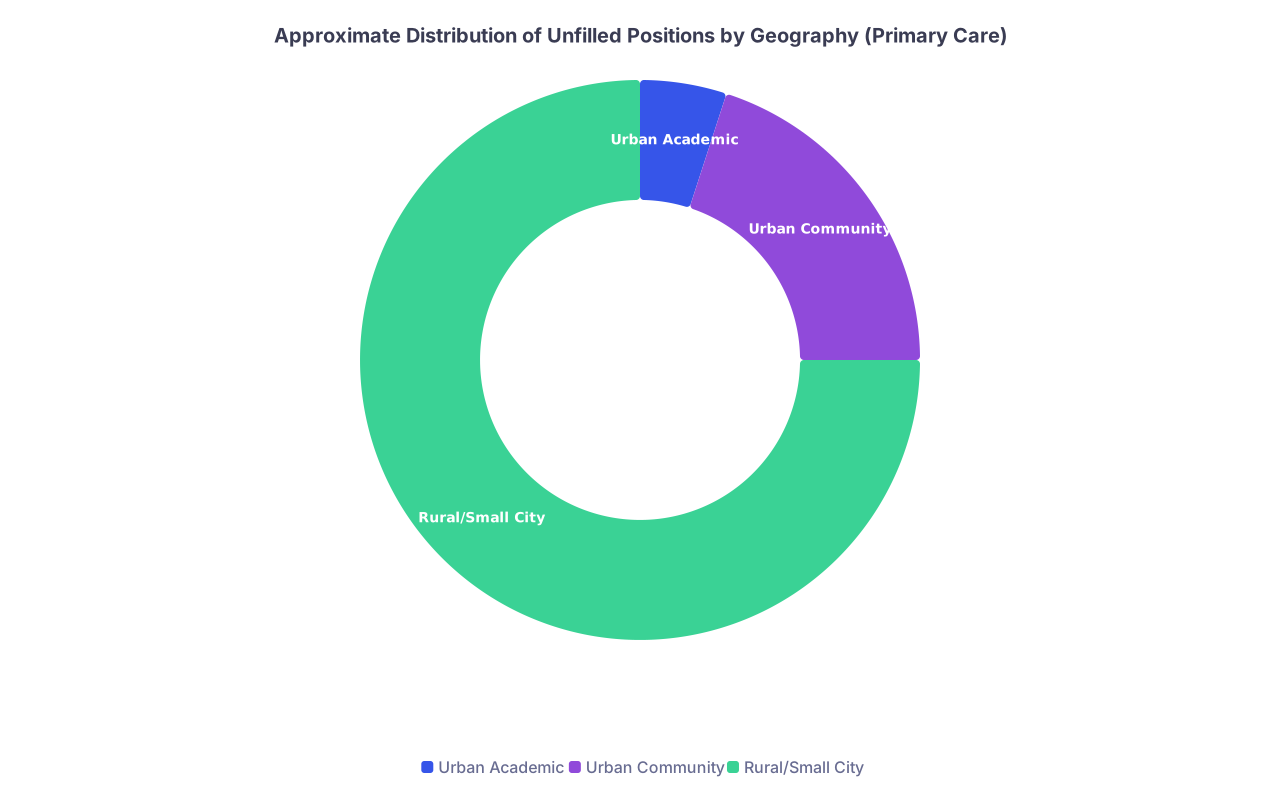
| Category | Value |
|---|---|
| Urban Academic | 5 |
| Urban Community | 20 |
| Rural/Small City | 75 |
What that means for you:
- If your list is heavily skewed toward competitive urban programs, your probability distribution is bimodal: match high, or fall all the way into SOAP with limited, less‑desirable options.
- If you build a geographically balanced list that includes rural/undersubscribed programs, you have a smoother distribution: fewer chances at the extreme top, but a much lower chance of complete non‑match.
In other words, geography is a tool for risk management. You are not just deciding where you want to live; you are deciding what level of match volatility you are willing to accept.
7. Concrete examples by profile
Let me ground this with three typical scenarios I have seen:
Case 1: Borderline competitive for radiology
- US MD, Step 2 = 241, mid‑tier school, one radiology research project, no AOA.
- Wants rads but only applied to 20 urban academic programs in major metros.
Result pattern I have seen:
- Few interviews, mostly home or regional safety nets.
- High stress about matching; ends up ranking a small list.
Same applicant, smarter geographically:
- Applies to 45–50 programs, including 10–15 rural or micropolitan programs and several non‑coastal cities.
- Interview volume climbs, more diversity in program types.
- Final rank list has 12–15 solid rads options, including some rural systems where they are clearly above the median applicant.
Case 2: Family medicine with strong primary care story
- US DO, Step 2 = 228, extensive community outreach and longitudinal clinic work.
- Only applied to FM programs in three major cities “for lifestyle reasons.”
Observed result:
- Interviews, but fewer than expected. Several urban programs triage by Step 2 and school prestige; DO status hurts at some places.
- Unmatched risk higher than the applicant understands.
Alternate strategy:
- Add 10–15 rural or small‑city FM programs in regions they could tolerate.
- Leverage community and primary care experience; highlight any rural background.
- Interview yield improves markedly; some rural programs view them as a top‑tier recruit.
Case 3: EM applicant in a saturated market
- US MD, Step 2 = 236, mixed clinical comments, no red flags.
- Applies almost exclusively to urban Level I EM programs based on perceived “excitement.”
Result in recent cycles:
- Interview scarcity. These sites are still competitive even amid broader EM concerns.
- Ends up with a shorter rank list than expected.
Alternate:
- Expand list to include regional Level II centers, small‑city EM programs, and a few rural‑adjacent hospitals.
- Better interview coverage and more balanced rank list.
8. Key implications for your planning
The data point to three blunt conclusions:
- Geographic variation in competitiveness is not a side note. It is a core driver of match outcomes.
- Urban academic centers inflate competitiveness even in “less competitive” specialties. Rural and small‑city programs often soften it—even in relatively competitive ones.
- Strategic use of rural and regional programs can convert borderline profiles into safe matches, especially in IM, FM, EM, anesthesia, and radiology.
If you ignore geography, you are flying blind.
If you quantify it—by scores, fill rates, apps per position—and then build your list accordingly, you are making the Match work for you, not against you.
FAQ (exactly 5 questions)
1. Are rural programs always easier to match than urban ones?
No. Most rural programs in primary care and some IM settings are less competitive numerically, but there are exceptions. Rural programs in popular lifestyle regions or strong regional referral centers in EM, anesthesia, or rads can be as competitive as mid‑tier urban programs. You need to look at program‑specific fill history and applicant volume, not just the word “rural.”
2. How can I tell if a specific program is more or less competitive?
Look at several proxies: historical fill status (did they go to SOAP often), number of positions vs total applications (sometimes reported on program websites or by mentors), and the caliber of current residents (school list, typical profile). Talking to recent grads from your school who matched there will give you a real‑world competitiveness sense much faster than guessing from reputation alone.
3. Do program directors in rural areas care less about Step scores?
They generaly have wider acceptable ranges, but they do not ignore scores. A 220 vs 250 may matter less than your demonstrated likelihood to stay in the region and function well in a smaller system. Scores are still a filter, but commitment, communication skills, and fit carry relatively more weight than they would in a crowded urban program that can just take the top 10% numerically.
4. Is it risky to rank rural programs high if I ultimately want a competitive fellowship?
Less than most students think. Many rural or small‑city IM and FM programs have solid fellowship placement, often via strong regional networks. What matters is the program’s actual fellowship track record, not its zip code. Check where their graduates go; some “no‑name” rural IM programs reliably place into cardiology, GI, or critical care if they have the right mentoring and case mix.
5. How many rural or small‑city programs should I include for safety?
There is no universal number, but pattern‑wise, applicants in mid tiers who want to minimize unmatched risk often include 20–40% of their rank list as community or rural programs they would genuinely attend. If all your top choices are urban academic centers, ensure that your mid and lower ranks include programs where you are clearly above the median applicant—often those are in smaller cities or rural regions.