
The loudest voice in your specialty decision is usually not your own. And that’s the real problem.
You’re trying to think about board scores, away rotations, letters, interview caps…and at the same time you’ve got your dad saying, “Why don’t you just do family medicine, it’s easier to match,” and your aunt sending you articles about burnout in surgery at 11:37 PM. It’s like trying to pick a door on Match Day while your entire extended family is shaking your arm.
Let me say this clearly: “Less competitive” is not a magic safety net. And “more competitive” is not a selfish fantasy. Your family is oversimplifying a system that’s already complicated enough to wreck your sleep.
You’re not crazy for feeling trapped between what you want and what everyone else thinks is “realistic.”
What’s Actually Going On When Family Pushes “Less Competitive”
Most families aren’t trying to crush your dreams. They’re trying (badly) to manage their own fear.
You say: “I’m thinking derm/ortho/ENT/EM/neurosurgery/anesthesiology.”
They hear: “I might not match. I might end up with $300k+ of debt and no job.”
So they default to this:
- “Just pick something guaranteed.”
- “We didn’t come this far for you to gamble it away.”
- “Your cousin did internal medicine and he’s very happy. Why can’t you do that?”
They only see two categories:
- “Safe” specialties (usually primary care, psych, maybe path)
- “Scary competitive” specialties (anything you had to Google the match data for)
Reality is more nuanced and more brutal than that.
| Specialty Type | What Family Thinks | Actual Reality Snapshot* |
|---|---|---|
| Family Med | Easy, guaranteed | High match rate but not automatic |
| Internal Med (categorical) | Safe-ish | Wide range: community vs top academic is night and day |
| Psych | Chill, easy | Becoming more competitive every year |
| EM | Stable, fun | Market saturation in some regions, match not a cakewalk |
| Derm/Ortho/ENT/Plastics | Unrealistic dream | Extremely competitive, but doable with right profile |
*Reality depends on year and region; this is directional, not exact.
They’re not wrong that risk exists. They’re wrong that:
- “Less competitive = guaranteed”
- “More competitive = irresponsible”
- “If you miss the first specialty, your career is over”
But you’ve probably internalized their panic and turned it into this little loop in your head:
“What if they’re right and I shoot for something competitive, don’t match, and disappoint everyone and can never recover and end up as That Story people tell about the kid who didn’t get a residency?”
Yeah. That spiral. I know it.
Step One: Get Your Own Numbers (Before Their Opinions)
You can’t respond to pressure if you don’t even know where you stand.
Before you have another specialty argument at the dinner table, you need:
Your current stats:
- Step 1 (even if P/F, how strong were your pre-clinicals?)
- Step 2 score or practice trajectory
- Class rank/AOA status (or at least rough quartile)
- Clinical evals: mostly honors? high pass? mixed?
Your application strength:
- Research: any pubs/posters, or basically none?
- Letters: do you have or can you realistically get strong ones in your desired specialty?
- Home program: do you have one in that specialty, or will you be an orphan applicant?
Here’s the thing: you might actually be a strong candidate for that “scary” specialty. Or you might not, yet. But that decision should be data-driven, not uncle-driven.
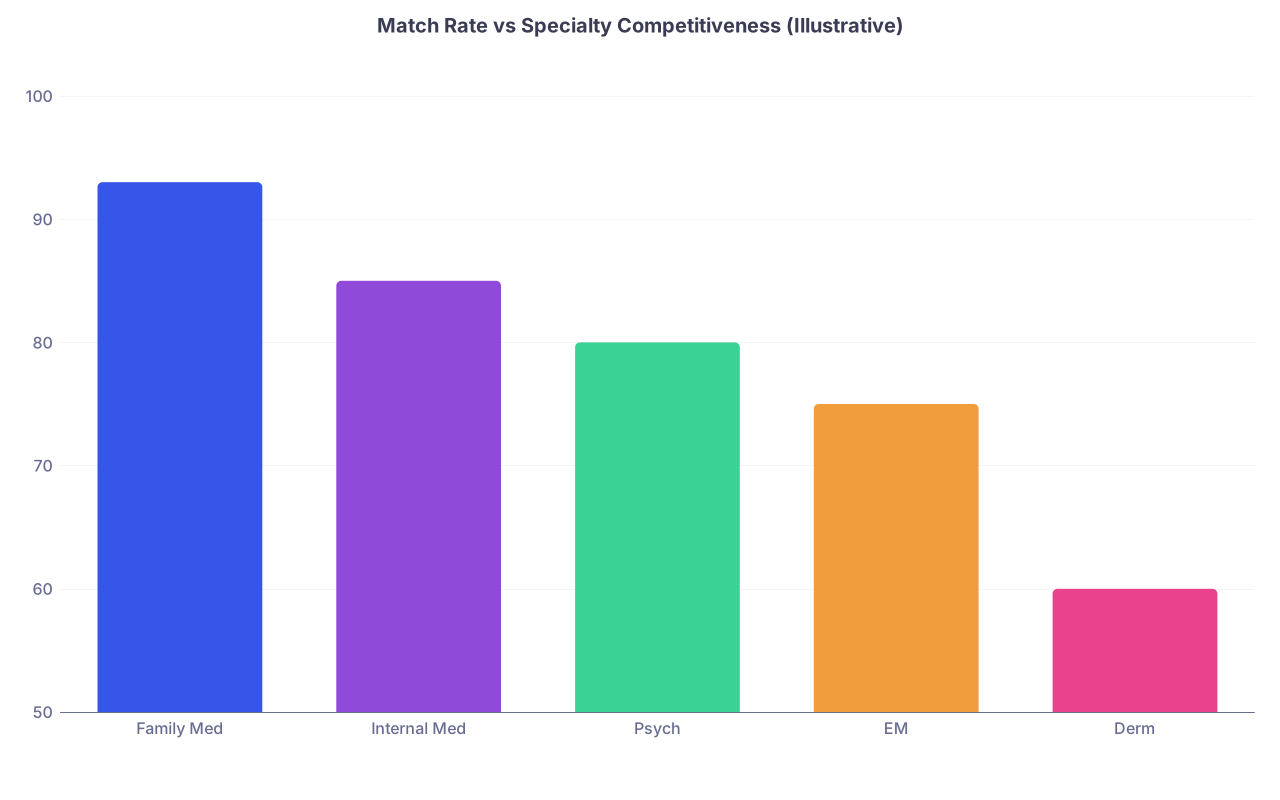
| Category | Value |
|---|---|
| Family Med | 93 |
| Internal Med | 85 |
| Psych | 80 |
| EM | 75 |
| Derm | 60 |
Those numbers are made up for illustration, but the pattern is real: some specialties are harder to match. That doesn’t mean you can’t. Or that you must flee to “easy.”
So before you emotionally commit to anything just to get your family off your back, talk to:
- A PD or associate PD in your dream specialty
- A senior resident who recently matched there
- Your school’s dean or advising office (the brutally honest one, not the vague cheerleader)
Ask one direct question:
“With my current stats and timeline, what range of programs in [specialty] is realistic, and what safety specialty would you pair it with if I dual apply?”
Now we have something concrete. You can’t negotiate with family feelings. You can negotiate with numbers.
Step Two: Separate Their Fears from Your Actual Risk
Right now everything’s tangled:
- Their fear of you not matching
- Your fear of disappointing them
- Your genuine fear of ending up specialty-locked into something you kind of hate
Untangle it.
Their fears (usually unspoken)
- “We don’t understand this system and it feels like a casino.”
- “We’re scared you will end up broke and ashamed.”
- “We need to believe your career is ‘safe’ because we’ve already told everyone you’re going to be a doctor.”
Your actual risks (that matter more)
- Probability of not matching if you go all-in on one hyper-competitive specialty
- Probability of matching but into a program/location that makes you miserable
- Probability of burning out in a specialty you picked just to reassure people
Those are not the same thing. At all.
I’ve seen people cave to pressure and pick what their parents wanted:
- The med student who wanted EM but was nagged into IM because “more flexible” and then sat in clinic thinking “I hate this” three days a week
- The student who wanted OB/GYN but picked peds because “kids are safer than surgery” and ended up reapplying 3 years later
You know what’s worse than explaining an unmatched year to your family?
Explaining that you want to switch specialties after residency because you forced yourself into the wrong one from the start. That conversation is nuclear.
Step Three: Decide Your Strategy Before You Talk to Them
If you go into the family conversation with: “I don’t know, I just really like derm,” they’ll destroy you. Not because they’re evil, but because you’re unprepared.
You need a plan that sounds like it came from a PD, not a daydream.
Option A: All-in on competitive specialty (high risk, high reward)
You choose: “I will do whatever it takes to match [ortho/derm/ENT/plastics/neurosurg]. If I don’t, I accept the consequences and reapply or pivot later.”
This makes sense if:
- Your metrics line up reasonably well
- You have or can get solid research and letters
- You’re willing to tolerate a higher chance of SOAP or a gap year
Option B: Dual apply (the anxiety special)
You choose: “I’ll apply to my dream specialty plus a more attainable one that I can genuinely live with.”
This makes sense if:
- Your stats are borderline for your dream field
- You’re not the type who handles ‘all or nothing’ well
- You have some genuine interest in your backup, not just “I guess I could survive it”

| Step | Description |
|---|---|
| Step 1 | Assess Stats and Interests |
| Step 2 | Plan dual apply |
| Step 3 | All in on competitive specialty |
| Step 4 | Meet faculty advisors |
| Step 5 | Finalize application list |
| Step 6 | Strong for dream specialty |
| Step 7 | Risk tolerance high |
Option C: Pivot intentionally (not out of fear)
You choose: “I love [competitive specialty], but looking at my numbers and life priorities, I’m going to go for [less competitive but still interesting field] on purpose.”
This is not “giving up.” It’s actually more mature than blindly charging into a 30% match rate with no backup plan.
The key difference: you’re picking it for you, not for your mom’s blood pressure.
Decide which of those three you’re aiming for before you ever sit down with your family to “discuss options.”
Step Four: How to Actually Talk to Your Family Without Melting Down
Let’s script this a bit, because those conversations can derail fast.
1. Start with reassurance, not defiance
They’re braced for: “I’m doing something risky, leave me alone.”
Give them: “I have a plan and I’m not gambling.”
Something like:
“I know you’re worried about me matching. I’m worried about that too. I’ve talked to my school advisors and a program director in [specialty], and I want to walk you through what this will actually look like.”
You’re signaling: “The adults who know this system already spoke to me. You’re not my only lifeline.”
2. Bring data, not vibes
If you can, bring:
- A printout or screenshot of NRMP data for your specialty
- An email summary (de-identified) of what your advisor said
- A simple chart you made yourself of “Plan A vs Plan B”
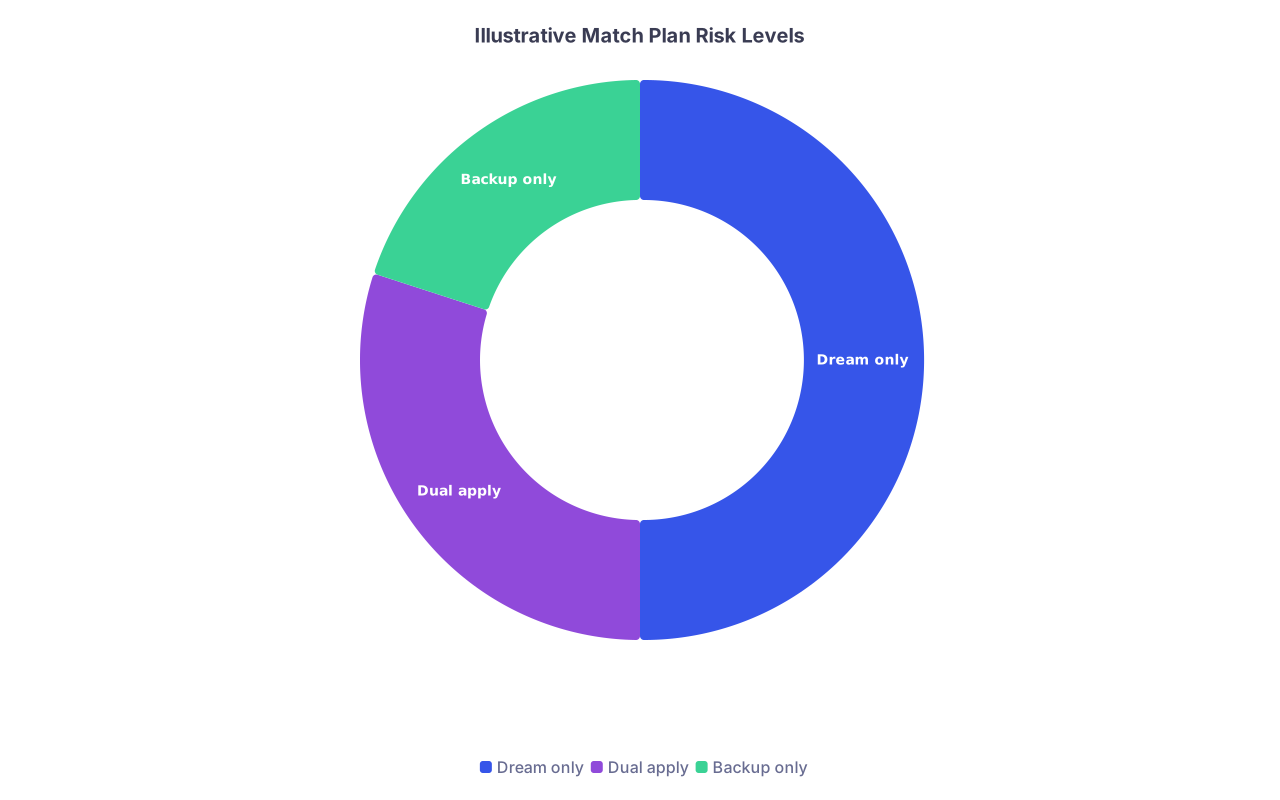
| Category | Value |
|---|---|
| Dream only | 50 |
| Dual apply | 30 |
| Backup only | 20 |
You might say:
“Based on my board scores and experience, my advisor thinks I’m a reasonable candidate for [specialty] at mid-tier and some community programs. To be safe, I’m also applying to [backup specialty] at a wide range of programs.”
Now it doesn’t sound like you’re gambling. It sounds like a resident-level risk management strategy.
3. Name their fear out loud
This diffuses so much tension.
“I know what you’re really scared of is that I won’t match at all and will end up stuck with huge loans and no job. I think about that too. That’s why I’m not being reckless about this.”
You’re telling them: “Your fear is valid. I’m already carrying it. You don’t have to scream it at me every night.”
4. Draw the boundaries gently but firmly
At some point, you have to say no. Not dramatically. Just…no.
For example:
“I really hear that you’d feel better if I just picked the ‘safest’ option. But that specialty isn’t a good fit for me long-term. I’ve talked with mentors, and my plan is [X]. I need you to trust that I’m making an informed decision, even if it feels scary.”
If they keep pushing:
“I understand you’re worried. I’m not going to change my specialty choice based on this conversation, but I’m happy to keep you updated as I get interview feedback and advisor input.”
Repeat as needed. “I’m not going to change my specialty choice based on this conversation” is a complete sentence.
Step Five: Handling Worst-Case Scenarios (Because That’s What’s Keeping You Up)
Let’s go straight into the dark places your brain is probably visiting at 2 AM.
What if I go for a competitive specialty and don’t match?
You:
- SOAP into something you didn’t plan
- Or take a gap year (research, prelim year, or different role)
- Or switch entirely into a different specialty next cycle
Brutal? Yes. Fatal? No.
Plenty of attendings quietly had a SOAP year or a pivot. You won’t see it on their hospital badge, but it’s there in their story.
You’ll have to deal with:
- Shame conversations with family
- That one relative who will say “I told you so”
- Watching classmates move on while you’re stuck in limbo
You know what’s weirdly protective? If from the start you’ve framed things to your family like:
“There’s always a chance I don’t match on the first try. That’s true for everyone, not just me. I’m building backup plans now so if that happens, it’s a detour, not a dead end.”
You’re pre-normalizing the idea of uncertainty. Then you’re not “the failure”; you’re “someone whose Plan B is now active.”
What if I cave to pressure, pick something less competitive, and hate my life?
This is the scenario no one in your family is gaming out. But you are.
Switching specialties after residency is possible. But it’s logistically and emotionally expensive. It often means:
- Extra training time
- Financial hit
- Needing new letters and networking from scratch
So the real question is: can you see yourself in that “backup” specialty, on your worst day, and still not resent everyone who pushed you into it?
If the honest answer is “no way,” that’s your sign that “safety” is not actually safe for you.
A Quiet Test for Yourself
Here’s something you can do tonight that doesn’t involve NRMP tables or advisor meetings.
Picture two futures:
You go for the competitive specialty, don’t match first round, scramble, feel humiliated, take a detour year, but eventually end up doing something that lights you up most days.
You pick the “safe” specialty right now, match easily, everyone is proud, but every time you walk into work, a little part of you thinks, “I settled because I was scared.”
Which version of pain could you live with more?
That answer matters more than your uncle’s opinion about orthopedics.
FAQ (Exactly 5 Questions)
1. Should I tell my family I’m dual applying, or will that just confuse them more?
If your family is already spiraling about risk, dual applying can actually calm them down—if you present it clearly. Frame it like: “Primary goal is [X]. Backup that I can be happy in is [Y]. I’ve worked this out with my advisors.” If they tend to catastrophize every detail, you can keep it simpler: “I’m applying broadly to maximize my chances of matching somewhere that fits.”
2. What if my stats are mediocre for my dream specialty—am I being delusional?
“Delusional” is ignoring every advisor and applying only to the top ten programs in the country with a below-average Step score and no research. “Realistic but hopeful” is: apply broadly, include community programs, do away rotations strategically, and maybe dual apply. Ask a PD-level person, “If you were me, what would you do?” and then actually listen.
3. How do I handle relatives who compare me to other med students in the family?
Call it out directly and calmly: “I’m happy cousin Sam found something that worked for him. Our situations and interests are different. My advisors and I are building a plan for my stats and my goals.” If they keep pushing, change the topic or literally say, “I’m not going to discuss my specialty choice in comparison to other people anymore.”
4. Is it ever smart to just pick the least competitive specialty to avoid stress?
If you genuinely like that specialty and can see yourself there long-term, sure. If you’re picking it purely to stop feeling anxious right now, that’s emotional pain relief, not a career decision. Med school and residency are temporary; specialty is forever-ish. Don’t trade 30–40 years of work for 3–4 months of reduced family nagging.
5. How much should I tell my family about match risks and odds?
Enough that they understand “no specialty is 100% safe,” but not so much that they start acting like your personal NRMP dashboard. A simple version works: “Everyone has some risk. My advisors think my plan is reasonable and includes backups. If things change—if I don’t get enough interviews, for example—I’ll adjust my strategy with them.” You don’t need to crowdsource your rank list at Thanksgiving.
Open a blank page or notes app right now and write three columns: “Dream specialty,” “Acceptable backup,” “Absolutely no way.” Be brutally honest. That’s your starting point. Then tomorrow, email one advisor and one resident in your dream field with your stats and ask their honest take. Don’t argue with family until you’ve armed yourself with that.