
You are sitting at your desk in July. ERAS opens next month.
Your friends going into family medicine and pediatrics have their personal statements done, LORs requested, rotations nicely aligned. You, on the other hand, just realized you actually want dermatology. Or orthopedics. Or another specialty that everyone keeps calling “unrealistic” this late in the game.
Here is the uncomfortable truth: you are behind.
Here is the second truth: you are not dead in the water.
If you stop flailing and start executing a focused, ruthless plan, you can still make a viable run at a competitive specialty—or, at the very least, protect your career from blowing up if it does not work out this cycle.
This is the playbook I wish more students had three to six months before ERAS when the “late interest in a competitive specialty” panic hits.
Step 1: Get Brutally Honest About Your Starting Point
Before you do anything flashy—emails, away rotations, research—get a clear, unsentimental picture of your competitiveness today.
A. Know your raw numbers
You need this written in front of you:
- Step 1: Pass date, any marginal pass, any retake
- Step 2 CK: exact score (or best estimate of when you will have it)
- Preclinical performance: mostly pass, or lots of honors?
- Clinical grades: how many honors vs high pass vs pass, especially on core rotations
- Class rank / quartile if your school provides it
Then map your numbers against your specialty of interest.
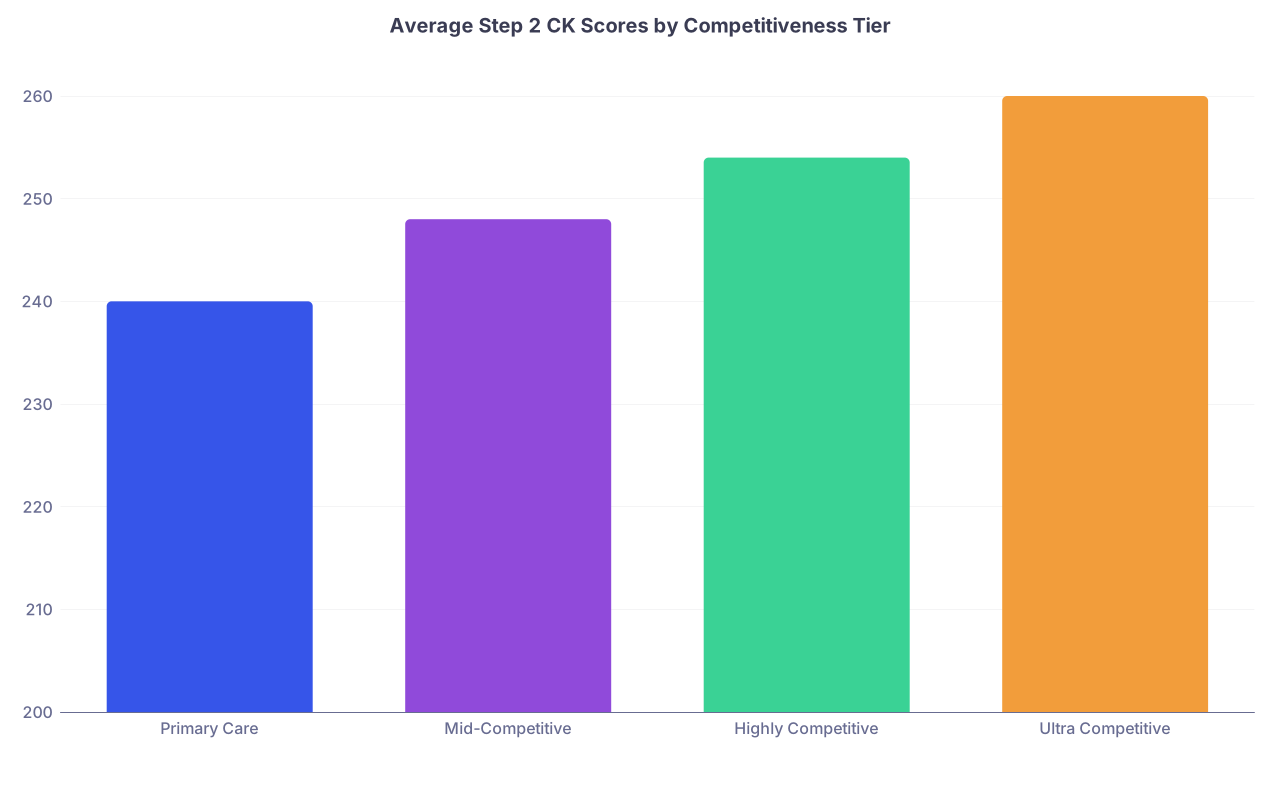
| Category | Value |
|---|---|
| Primary Care | 240 |
| Mid-Competitive | 248 |
| Highly Competitive | 254 |
| Ultra Competitive | 260 |
If you are talking about:
Dermatology, Plastic Surgery, Neurosurgery, Ortho, ENT, IR, Rad Onc
You are aiming at the top end of that chart.EM, Anesthesiology, General Surgery, OB/GYN, Radiology
More in the middle but still score-conscious.FM, IM, Psych, Peds
You have more margin, but top academic programs are still selective.
B. Reality check your CV
Write short bullets under each:
- Research: number of projects, first-author / middle-author, any pubs, posters, or abstracts in the target field or adjacent field
- Leadership: positions with real responsibility vs resume fluff
- Specialty exposure: actual rotations, electives, shadowing in the new specialty
- Red flags: leaves of absence, failures, professionalism issues
Now ask yourself, bluntly:
If a PD in this specialty read my application in 90 seconds, what is the story?
- “A late but convincing pivot with momentum”
- Or “Unclear interest, no track record, average scores.”
You are aiming for the first, but right now you are probably closer to the second. Good. That means you know what you must fix.
Step 2: Decide Your Risk Level and Backup Strategy
You cannot plan this in isolation. You have to decide how much risk you are willing to carry.
A. You must choose one of these three tracks
| Track | Primary Goal | Backup Plan |
|---|---|---|
| All-in | Match this specialty now | Very weak backup |
| Split | Strong attempt + real backup | Double apply |
| Deferred | Build now, apply next year | Planned gap year |
All-in
- You apply only to the competitive specialty now.
- Useful if: strong Step 2, decent research, at least some exposure, and you simply started focusing late.
- Risk: if you do not match, SOAP may not save you where you want to be.
Split (double-apply)
- You apply to the competitive specialty and a realistic backup (often IM, prelim surgery, transitional year, etc).
- Useful if: borderline scores, limited research, and you cannot stomach going unmatched.
- Risk: programs can smell a “backup” application. You must still look committed to each specialty.
Deferred (planned gap year)
- You do not apply in the competitive specialty this year (or you apply very lightly), and you consciously plan 12 months of research, additional rotations, and score improvement to come back stronger.
- Useful if: numbers and CV are clearly below the specialty norm.
- Risk: time, money, and you have to follow through aggressively.
If you are more than 20–25 points below the Step 2 mean for your target specialty with no relevant research and no rotations in it, you are likely in “Deferred” or at best “Split” territory, not “All‑in.”
You cannot salvage everything. But you can salvage your future if you choose the right track now.
Step 3: Manufacture Specialty Exposure Fast
Programs hate guessing whether you understand what their specialty actually does. Your job is to erase that doubt as quickly as humanly possible.
A. Get yourself physically in the room
You want to get onto:
- A home elective in that specialty
- Or, if your home program does not have it, a related service (surg onc for surg, rheum for rheum, etc)
- Or a late away rotation, even if it is not “top tier”; a solid mid-tier program that knows you beats a top-tier that has never heard your name
Email the rotation coordinator and the PD or clerkship director today. Example structure:
- Subject: “MS4 Seeking Late [Specialty] Elective – [Your School]”
- Briefly state: who you are, why you are pivoting, that you understand the late timeline, and that you are willing to be flexible with dates and location (off-site, satellite hospital, etc).
You want face time with attendings who can eventually say, “Yes, they came in late, but they worked like hell and fit our field.”
B. Be the ridiculous superstar on that rotation
You do not have the luxury of being average now.
On that elective:
- Pre-round early. Know your patients better than the intern.
- Read every night. Use one main text or question bank in that specialty.
- Ask for feedback in week 1 and 2. Then actually fix what they mention.
- Signal interest clearly but professionally: “I know I came to this specialty late, but working with your team has confirmed this is what I want to do.”
You want at least one attending to think, “I would vouch for this person.”
Step 4: Create Last-Minute Research and Scholarly Activity
You will not become first-author in NEJM in two months. Stop dreaming. But you can create credible, specialty-linked academic activity that PDs respect.
A. Target low-friction, high-yield projects
You are trying to maximize right now, not build a decade-long research career.
Options that can realistically move in 2–6 months:
- Case reports, brief clinical images, or short reviews
- Retrospective chart reviews where the data set is already collected or partially collected
- Quality improvement projects linked to the specialty
- Helping senior residents or fellows finalize existing manuscripts (data already done, help with writing and formatting)
Your first conversation to faculty should be:
“I have a late but committed interest in [specialty]. I know I am short on time. Do you have any small or ongoing projects where an extra pair of hands could help push it across the finish line?”
Then do not disappear. I have seen students blow this by “expressing interest” and then vanishing for two weeks.
B. Document output aggressively
You are aiming for:
- Submitted abstracts (even if the conference is after ERAS)
- In-press or accepted papers
- Posters at local or regional meetings
- At worst: “Project in progress with Dr. X, [Institution]” with a concrete goal and timeline
If you will realistically submit something by ERAS, you can list it as “submitted” with the appropriate status. No fabrication. Ever. PDs talk.
Step 5: Extract Powerful Letters of Recommendation Quickly
You do not have time for four slow, lukewarm LORs. You need 2–3 that are either in the specialty or from big-name people who can comment on your clinical horsepower.
A. Who to target
Priority list:
- Faculty in your new specialty at your home institution who have seen you work
- Faculty at away rotations where you crushed it
- Department leadership in related fields who know you well
- Research mentor in the specialty, especially if known in the field
When you ask, do it clearly and directly:
“Would you be comfortable writing me a strong letter of recommendation for [specialty] residency?”
If they hedge, thank them and move on. A neutral letter is a quiet rejection.
B. Make it easy for them to advocate for you
Send a letter packet:
- Updated CV
- Step scores and transcript
- Draft personal statement
- Brief bullet list: “Key points that might be helpful to highlight,” including:
- Your late but real commitment
- Specific examples of your performance they saw
- Anything that counters your weaknesses (work ethic, resilience, rapid improvement)
Good attendings appreciate having this context. It also shapes your narrative: “This student decided late, but they moved fast and worked extremely hard.”
Step 6: Build a Coherent Story in Your ERAS Application
Your application cannot look like you spun a wheel and landed on this specialty last week. You must build a story that connects your past to this new direction, even if it clicked relatively late.
A. Personal statement: late pivot, not random whim
Structure it roughly like this:
- A concrete clinical moment or pattern that hooked you into the specialty
- A brief comment that your interest sharpened later in training (own it, do not hide it)
- Specific experiences—electives, research, mentors—that confirmed you understand the field
- The skills and traits you bring that fit the specialty’s demands
- A nod to your growth trajectory: “I moved quickly to align my rotations, research, and mentorship with this goal”
What you avoid:
- “Ever since I was a child…”
- Vague, interchangeable lines you could recycle for three specialties
- Over-explaining your lateness defensively. Two sentences, done.
B. Experiences: prune the noise
On ERAS, your experiences must support your current narrative.
- Highlight roles with procedural work, critical decision-making, chronic disease management, whatever fits your field.
- For unrelated activities, rewrite the descriptions to emphasize transferable skills: leadership, teamwork, problem-solving.
- Mark 2–3 “Most meaningful” that align with your new specialty whenever possible.
Do not let 10 random experiences dilute the message. PDs skim. Give them a story they can grasp in 60 seconds.
Step 7: Be Strategic Where You Apply (Not Just How Much)
Late pivots often overcompensate by applying everywhere. That is lazy strategy.
A. Target tiers you can actually hit
You need to be blunt about where your application might reasonably stick.
Step 2 CK 260 with new derm interest and 1–2 derm case reports?
You can still aim for some academic programs plus a broad net of community programs.Step 2 CK 235 and average clinical grades with late interest in ortho and no prior ortho research?
You are fighting uphill. You probably need a strong backup or a research year.
You want a spread:
- Some reach programs (within shouting distance of your stats)
- A big middle of realistic fits
- A subset of lower-visibility or newer programs that still train well but get fewer applications
Dig into program websites and NRMP data. Look at:
- Typical Step 2 ranges
- Whether they take many IMGs/DOs, if that is you
- How many residents per year (small programs are more idiosyncratic)
Step 8: If You Double-Apply, Do It Without Looking Disingenuous
Double-applying is not a moral failure. It is risk management. The mistake is doing it sloppily so both specialties doubt your commitment.
A. You need two parallel, honest narratives
Example: Late interest in dermatology, backup in internal medicine.
- For dermatology: emphasize your late clinical exposure, emerging research, and long-term interest in complex chronic disease and procedures.
- For internal medicine: emphasize your broad diagnostic interest, your core clerkship performances, and an openness to subspecializing (including rheum, allergy, etc, which subtly overlaps with derm thinking).
You do not have to hide that you like derm from IM programs. Just do not make IM sound like a consolation prize.
B. Letters and PS must be specialty-specific
- You cannot use the exact same PS for both specialties with the names swapped. Programs notice.
- Try to have at least 2 letters clearly for Specialty A and 2 for Specialty B, even if one or two mentors submit to both.
If you are applying to a prelim or transitional year while aiming for a competitive advanced specialty (like derm, radiology, anesthesia), you can be explicit:
“I aim to pursue dermatology following a strong preliminary medicine year, where I can deepen my inpatient skills and develop as a clinical thinker.”
That is honest and acceptable. You are not the first to do this.
Step 9: Use Every Remaining Week Before ERAS Like a Sprint
You have a finite number of weeks. You need a concrete schedule, not vague intentions.
Here is a focused 8-week template you can adapt:

| Step | Description |
|---|---|
| Step 1 | Week 1 - Reality Check |
| Step 2 | Week 2 - Secure Rotations |
| Step 3 | Week 3 - Start Research Project |
| Step 4 | Week 4 - Draft Personal Statements |
| Step 5 | Week 5 - LOR Requests and Follow up |
| Step 6 | Week 6 - Polish ERAS and Continue Research |
| Step 7 | Week 7 - Mock Interviews and Final Edits |
| Step 8 | Week 8 - Submit ERAS Early in Cycle |
Week 1–2
- Finalize which track you are on (All-in, Split, or Deferred)
- Confirm at least one rotation in the new specialty
- Start outreach for research
Week 3–4
- Lock down research roles and tasks
- Start personal statement drafts (one per specialty if double-applying)
- Identify potential LOR writers and give them your timeline
Week 5–6
- Get serious PS feedback from at least one mentor in the specialty
- Complete ERAS entries, especially experiences and activities
- Make progress on research deliverables (draft sections, data analysis)
Week 7–8
- Final PS and ERAS polished
- Make sure letters are uploaded (or at least confirmed)
- Submit ERAS as early as your situation allows
If you are already within 2 weeks of ERAS opening, compress this. You do not have time for perfect. You have time for focused.
Step 10: Prepare to Explain Your Late Interest Without Sounding Flaky
You will be asked, in some form:
“Why this specialty, and why so late?”
Your answer cannot be defensive or rambling. Use a three-part formula:
What changed or crystallized
- “I always liked complex medical problem-solving, but during my [X] rotation I realized that the types of patients and procedures in [specialty] matched my strengths better than I had appreciated earlier.”
What you did about it
- “Once that became clear, I restructured my schedule to add a [specialty] elective, joined Dr. Y’s project on [topic], and sought mentorship in the department.”
What you learned from actually doing the work
- “Those experiences confirmed that I enjoy the day-to-day workflow, including [specifics], and that I fit well with the culture of [specialty].”
Short, calm, direct. No drama about “soul searching.” Programs want to hear that you can recognize new information, recalibrate, and then act decisively.
When the Answer Is: “You Are Too Late For This Cycle”
Sometimes, even with all of this, your numbers and the calendar do not match the specialty. I am not going to sugarcoat it. If you are:
- An MS4 in October
- With Step 2 < 230
- No specialty rotations in your new competitive field
- And no specialty research
You are not “salvaging” a derm or ortho application this ERAS in any realistic way.
Your options then:
Planned research / enrichment year
- Full-time research in the specialty at a respected institution
- Aim for 1–3 abstracts, posters, and a paper
- Add rotations with that department, gain letters, and come back next cycle with a coherent story
Go all-in on a realistic specialty now and build a great career there
- Plenty of physicians end up deeply satisfied in a “less competitive” field they previously underrated.
Both paths are legitimate. What is not legitimate is pretending you are competitive where you are not and then acting surprised in March.
FAQs
1. Is it “dishonest” to double-apply to a competitive and a less competitive specialty?
No. It is only dishonest if you lie. Applying to two specialties is strategic risk management in a broken system. You must:
- Tailor your personal statements honestly for each
- Own your primary goals when asked (e.g., “I am aiming for dermatology long term, but I know a strong medicine year will make me a better dermatologist.”)
- Avoid pretending to be “lifelong passionate” about both in exactly the same way
Programs care more about whether you will work hard, learn quickly, and fit the team than about you having a perfectly linear interest timeline.
2. If I take a research year, does that “fix” a mediocre Step 2 for a hyper-competitive specialty?
It helps, but it does not magically erase weak scores. A strong research year can:
- Show commitment to the field
- Get you powerful letters from well-known faculty
- Generate enough academic output to stand out among mid-range applicants
But if your Step 2 is, say, 220 and the typical matched applicant is around 255, you are still on the outer edge. You will need to compensate with:
- Exceptional clinical rotations in the specialty
- A very strong research portfolio
- Willingness to apply broadly and realistically, including community and newer programs
A research year is a tool, not a guarantee.
3. How do I know if I should just commit to a less competitive specialty now instead of taking extra time?
Ask yourself three concrete questions:
- If I ended up in this less competitive specialty for life, could I see myself satisfied, challenged, and proud of my work?
- Am I willing to spend 1–2 extra years (research, prelim, second application cycle) chasing the more competitive specialty, with no guarantee?
- Do my metrics put me within range for the competitive specialty with additional work, or am I 30+ Step 2 points and an entire CV away?
If you answer “yes” to #1 and “no” to #2, you are probably better off going all-in now on the less competitive field and building an excellent career there.
Today, do something specific:
Pull up a blank document and write, in one page, your actual current profile: scores, rotations, research, letters, and target specialty. Then label yourself clearly as All-in, Split, or Deferred.
Until you make that decision, everything else is just noise. Once you do, the path in front of you becomes much easier to execute.