
What do you actually do when your family needs you home, your loans are suffocating, and you still want dermatology, plastics, ortho, or neurosurgery?
Not in theory. In real life. With real parents, real kids, real debt, and a match list that could blow up your whole support system.
Let’s walk through it like an actual triage: what’s urgent, what’s flexible, and what you need to accept you cannot have all at once.
Step 1: Get brutally clear on the real constraints
Most people in your situation stay stuck because they describe their problem too vaguely.
“Family pressure.”
“Money stress.”
“Competitive specialty.”
That’s not actionable. You need specifics.
Start by defining three things in plain language:
- What exactly your family situation is.
- What exactly your financial situation is.
- How competitive your current specialty target actually is given your stats and application.
A. Family constraints: write them like consult orders
Example scenarios I’ve actually seen:
- You’re the only adult child within 200 miles, and your mother has moderate dementia and cannot live alone safely.
- Your spouse has a stable job in one city and cannot easily move. You have a toddler and another baby on the way.
- You send $800/month to your family overseas, and if that stops, they literally cannot pay rent.
Write down:
- Who depends on you (names, not “my family”).
- What they depend on you for (money, physical care, emotional support, immigration sponsorship, etc.).
- How location-dependent that support is (can be done from anywhere vs must be in a certain city).
- How time-sensitive it is (urgent now vs can change in 1–3 years).
If you can’t say, “My father needs someone to be at his house daily for medication management and meals,” you’re not at the level of clarity you need.
B. Financial constraints: numbers, not vibes
You’re not “broke.” You either have:
- X in federal loans
- Y in private loans (different beast)
- Z in other debt (credit card, car, etc.)
- A minimum monthly payment if you go on REPAYE/SAVE or other IDR plans
- Your expected PGY-1 salary range by region
Make a quick snapshot:
| Item | Example Number |
|---|---|
| Federal loan total | $280,000 |
| Private loan total | $40,000 |
| Minimum IDR monthly payment | $450 |
| Credit card / other debt | $8,000 |
| PGY-1 salary (local region) | $62,000 |
Now ask:
- Could you survive 3+ years at that salary in a high COL city with your obligations?
- How much money do you actually need to send home monthly if you’re supporting family?
This matters when comparing competitive specialties that cluster in high-cost cities (academic derm, plastics, neurosurg) vs less competitive or more widely distributed ones.
C. How competitive is your goal… for you?
Do a reality check with numbers, not self-esteem:
Step 2:
- 260+ with strong research: highly competitive file for derm/plastics/ortho/neurosurg.
- 245–259: viable with strong rest-of-application, but not slam dunk.
- <245: you’re uphill in most of those ultra-competitive specialties.
Research:
- Derm/plastics: often 5–10+ pubs/abstracts/posters, often in-field.
- Ortho/neurosurg: serious research is expected at many programs.
Letters:
- In these specialties, a truly strong letter from a well-known name can move the needle.
- Generic “hard-working, pleasant” letters won’t.
Once you have your personal competitiveness sketched out, you can stop playing pretend. Sometimes the right move is not “give up your dream,” it’s “you cannot be both ultra location-restricted and in the top 2 most competitive specialties.”
Step 2: Separate non‑negotiables from preferences
You can’t solve a puzzle if every piece is labeled “must have.”
There are only three main levers in residency applications:
- Specialty competitiveness
- Geography constraints
- Program type (academic vs community, prestige level, etc.)
You can be rigid on one, maybe two, but not all three. If you think you can, the match will teach you otherwise.
Make two short lists:
- Non‑negotiables (2–3 max)
- Strong preferences
Examples of valid non‑negotiables:
- “I must be within 45 minutes of my mother who cannot live alone.”
- “I must be in the same metro area as my spouse’s job.”
- “I cannot afford an unpaid research year because of private loans.”
Examples of preferences (even if they feel like needs):
- “I want a top‑10 academic name.”
- “I prefer the coasts.”
- “I want the most prestigious fellowship pipeline.”
If your list of non‑negotiables is 7 items long, you’re not being honest. That’s just a wish list.
Step 3: Map possible paths – not just “all or nothing”
Here are the actual paths people in your situation usually end up choosing. You’re not reinventing the wheel.
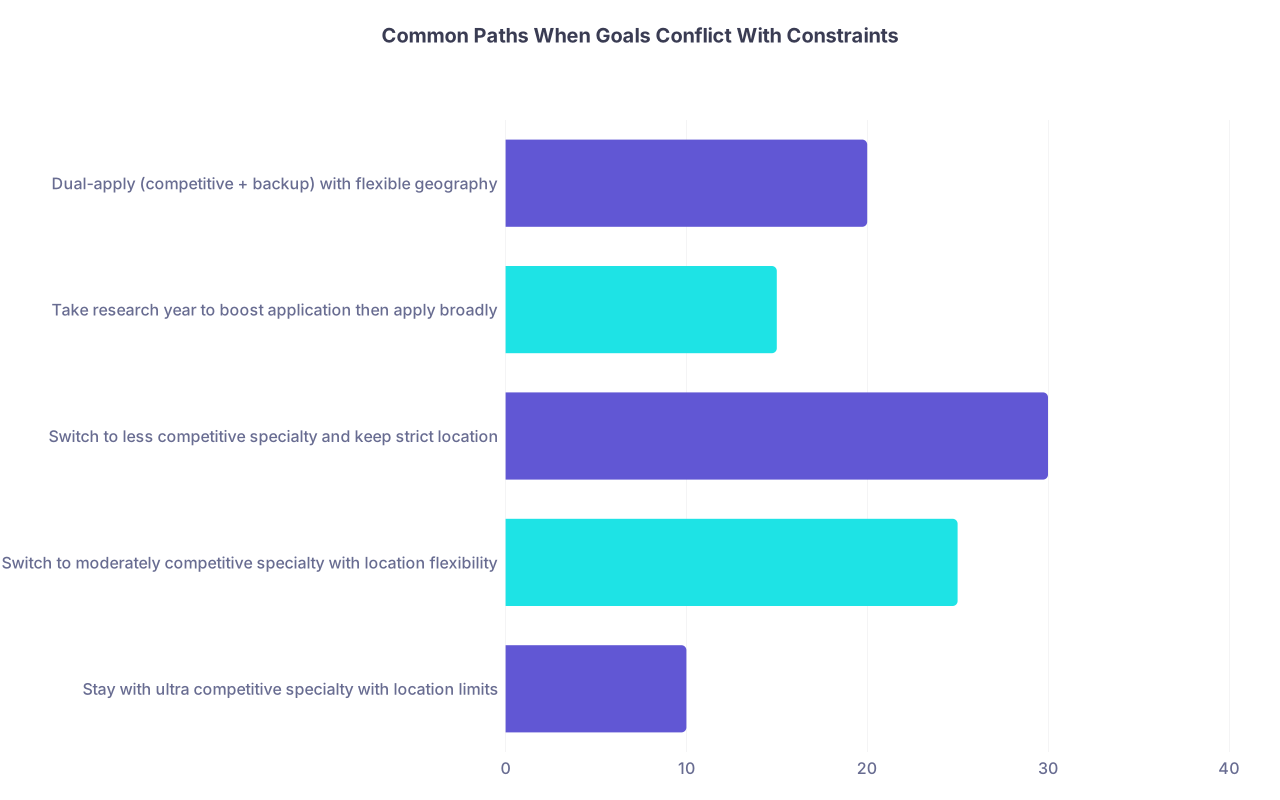
| Category | Value |
|---|---|
| Stay with ultra competitive specialty with location limits | 10 |
| Switch to moderately competitive specialty with location flexibility | 25 |
| Switch to less competitive specialty and keep strict location | 30 |
| Take research year to boost application then apply broadly | 15 |
| Dual-apply (competitive + backup) with flexible geography | 20 |
Path 1: Stay with ultra‑competitive specialty, relax geography
You keep derm/plastics/ortho/neurosurg as your target. You accept:
- You may be in a different state from family.
- Financial pressure might mean living cheap, doing long-distance, traveling home on rare golden weekends.
Who this works for:
- Family support is emotional/financial more than physical.
- Your family wants you to chase the high‑prestige path once they understand the tradeoffs.
- You have strong numbers and a realistic shot.
What you need to do:
- Sit down with family and explain the match reality like you would explain bad imaging findings to a patient: clear, kind, direct.
- Show them: if I restrict to City X only, my chance of matching this specialty plummets.
- Agree on minimum visit frequency / financial support and plan it into your budget.
Path 2: Switch to a moderately competitive specialty with better geographic flexibility
You drop from, say, derm → radiology, anesthesia, EM (variable), general surgery, or even IM with a subspecialty plan.
Why this can be smart:
- Many of these fields are still well‑paid, intellectually complex, with reasonable fellowship options.
- There are far more programs scattered across more cities, including community programs closer to home.
Examples:
- A student wanting ortho but absolutely locked to a mid‑sized city might pivot to anesthesia or rads and still match locally.
- Someone dead‑set on derm salary and lifestyle might shift to rads with a plan to focus on outpatient neuro or MSK.
What you actually do:
- Meet with specialty advisors in both fields.
- Ask: “If I insist on staying within this metro area and apply strongly, what are my realistic odds?”
- Decide by early fall of MS4, not two weeks before rank list.
Path 3: Switch to a less competitive specialty and keep strict geography
This is family-first, geography-first. Things like:
- IM, FM, psych, peds, sometimes OB/Gyn depending on area.
You’re saying:
“I will prioritize location stability and family support now, and I’ll build the career I want within that framework.”
Who this is for:
- You’re a primary caregiver.
- Family literally cannot function if you leave.
- Or your visa/immigration/family health situation makes moving risky or impossible.
This path is not failure. It’s triage. You can still:
- Become highly sub-specialized (cards, GI, heme/onc, etc.).
- Build a niche (pain, interventional psychiatry, procedural IM).
- Make serious money and have real autonomy.
Path 4: Take a research year to keep your competitive specialty alive
This is useful if:
- You’re somewhat location-flexible but need to be more competitive.
- You cannot afford a catastrophic no‑match; you need to be solid on paper.
But: you said financial pressure is an issue. A research year might not be feasible.
If you even consider this, calculate:
- Will you be paid (research fellowship, grant, etc.) or is it unpaid?
- Can you live on that stipend in the city you’re in?
- Can your loans stay in deferment or on IDR?
I’ve seen people take a “prestige research year” in an expensive city, run up more debt, and then still have to loosen geography later. That’s a dumb combo if money and family are already tight.
Path 5: Dual‑apply with a backup that works better for your constraints
For example:
- Primary: ortho with broad geography
- Backup: general surgery or IM within your home region.
Or:
- Primary: derm
- Backup: medicine or peds in your home city.
This is not cowardly. It is risk management.
If you do this:
- You must build a real application for both—not just lip service.
- That means at least one rotation and strong letters in your backup specialty.
Step 4: Talk to your family like they’re adults (because they are)
Too many students try to protect their family from the stress by oversimplifying. That backfires.
You want something like this conversation:
“Here’s what I’m up against:
- If I want dermatology and stay only in City X, my chance of matching might be 5–10%.
- If I apply across the country, it might be 50% or more.
- If I switch to internal medicine and stay in City X, my chance is >90%, but I give up that original specialty goal.
What matters more to you: me being physically nearby for the next 3–5 years, or me maximizing this career path?”
Then shut up and actually listen.
Important: don’t just accept the first thing they say. A parent’s initial: “No, you must stay near us” response is often fear talking. Once they understand you might go unmatched—or end up scrambling somewhere random—they sometimes soften.
Step 5: Use programs/location strategically without sabotaging yourself
You can’t magically manifest derm in a rural town that doesn’t have a derm program. But you can be strategic inside your constraints.
A. Look at program type by city
Big academic centers tend to host:
- Derm
- Plastics
- Ortho
- Neurosurg
- ENT
- Rad onc
- Ophtho (SF match but same idea)
But not every city has all of them. If your family is in a mid‑sized city with only a community IM/FM/psych program, you’re not matching derm there because it does not exist.
Sometimes the play is:
- Move your family with you (if possible) to a city that has both your specialty and their needed resources.
- Or accept that this phase means some distance, with a long‑term plan to come back post‑residency/fellowship.
B. Consider community vs academic tradeoffs
Many competitive specialties increasingly have community or hybrid programs. These may:
- Be closer to your family.
- Have slightly less brutal research expectations.
- Still produce strong graduates.
You sacrifice:
- Immediate name prestige.
- Sometimes the density of fellowship options.
But for a lot of people with real constraints, this is a smart compromise.
Step 6: Financial triage if you’re chasing a competitive specialty anyway
If you decide: “I’m going after ortho/derm/plastics/etc. despite family and financial pressures,” then you have to tighten up everything else.
Run a bare‑bones resident budget for high‑COL cities.
Housing, food, transportation, minimum loan payments, family support. Be ugly honest.Learn loan options now, not as a PGY‑2 with defaults looming:
- Federal IDR (SAVE)
- PSLF possibilities (if you end up at a 501(c)(3) institution)
- Refinancing timelines (probably after training)
Do not assume attending income will “fix it all.”
Those first 5 years out can disappear fast with lifestyle creep and helping family. Be the person who has a plan, not the person who wakes up at 40 furious and stuck.
Step 7: If you’re truly stuck—what to do this year
Let’s say your situation is:
- Family absolutely needs you in one metro area.
- Money is tight.
- You want a top 3 most competitive specialty.
- Your application is decent but not God‑tier.
Here’s the no‑BS playbook for this application cycle:
Have an honest, specific meeting with:
- Your home specialty advisor (for your dream specialty).
- One neutral advisor (student affairs, IM chair, etc.)
Ask them directly: “If I only apply in this metro area, what is my realistic chance of matching in [specialty] this year?”
If they say “very low” or “near zero,” you:
- Decide if you’re willing to:
- Widen geography this year, or
- Switch specialty now, or
- Delay and do something else (research, prelim year, etc.)
- Decide if you’re willing to:
If you stay locked geographically and your target is ultra competitive, you should strongly consider:
- Dual‑apply with a realistic backup in your city.
- Or full‑on pivot to a specialty that has multiple local programs.
Your worst outcome isn’t “not derm.” It’s “no match, more debt, more stress, still no derm, and worse relationship with your family.”
Visual: How priorities shift the likely outcome

| Step | Description |
|---|---|
| Step 1 | Competitive specialty goal |
| Step 2 | Apply broadly in specialty |
| Step 3 | Very high risk of no match |
| Step 4 | Reasonable match chance locally |
| Step 5 | Consider switch or dual apply |
| Step 6 | Higher match likelihood |
| Step 7 | Family and specialty both possible |
| Step 8 | Strict location? |
| Step 9 | Highly competitive field? |
FAQs
1. Is it “selling out” to switch from a super competitive specialty because of family or money?
No. It’s called being an adult. You’re not picking between “life of greatness” and “life of mediocrity.” You’re picking between multiple good careers under real constraints. I’ve watched former “failed derm applicants” become insanely strong cardiologists, GI docs, anesthesiologists, and psychiatrists who are respected, well‑compensated, and actually like their lives. Prestige chasing is loud in med school. Real satisfaction is quieter and longer term.
2. Should I consider doing residency away and coming back for fellowship to my home area?
Yes, that’s often the smartest middle ground. Example: you go do gen surg in a different state with a strong program, then come back to your home city for colorectal, MIS, or surgical oncology fellowship—or for a job. Or you match IM elsewhere, then come back for cards or GI. That buys you training quality and later geographic freedom, at the price of a few years of distance. Run that tradeoff explicitly with your family; many will accept short‑term distance for a credible long‑term plan.
3. How do I know if I’m being “too idealistic” about my chances in a competitive specialty?
Use this checklist:
- You’re insisting on both: ultra competitive specialty + one city only + top‑tier academic name.
- Multiple advisors have used phrases like “long shot,” “high risk,” or “I’d be nervous.”
- You haven’t done away rotations or do not have top-tier letters in the field.
- You’re not willing to dual‑apply, do a prelim year, or adjust geography.
If that’s you, then yes, you’re being too idealistic. You don’t need to give up your dream entirely, but you do need to adjust something—specialty, geography, timeline, or your risk tolerance.
Key points to walk away with:
- You can’t lock all three: ultra-competitive specialty, single-city location, and prestige. You get to pick maybe one firmly and negotiate the others.
- Treat family and money constraints like real clinical data, not background noise. Build your application and specialty choice around that reality, not around what your class group chat worships.
- The “wrong” specialty with a livable life beats the “perfect” specialty that detonates your family, finances, or mental health. You’re building a career, not winning a contest.