What happens when you apply to “orthopedic surgery” or “dermatology” as if all programs are interchangeable—and discover, too late, that half your list was never going to rank you?
Let me be blunt: ignoring program type is one of the fastest ways to sabotage a match in a competitive specialty. Not because you are a bad applicant. Because you are a misaligned applicant.
I have watched objectively strong candidates in ortho, plastics, ENT, derm, and neurosurgery go unmatched while less “impressive” classmates matched easily. The difference was not Step scores or number of publications. It was who understood program types—and who blasted out applications blind.
You are not just applying to a specialty. You are applying to:
- Academic versus community versus hybrid programs
- University-based “name brand” versus lower-profile but high-yield places
- Programs that want future researchers versus programs that want workhorses who stay local
- Places that prize AOA and 260+ versus places that quietly care more about being normal and teachable
If you ignore that, you are gambling your match on hope instead of strategy.
Let’s prevent that.
The Core Mistake: Treating All Programs in a Specialty as the Same
The mistake looks like this:
- You want dermatology.
- You pull the full list of derm programs from FREIDA / ERAS.
- You apply to 80+ without distinction: big academic centers, small community programs, hybrid, new programs, old prestige monsters.
- Your filters: “location I like” and “reputation I have heard of.”
Then you panic when:
- You get 2–3 interviews.
- People with “worse” stats get 10+ interviews.
- You realize too late that half of your list was basically out of reach or a poor fit the whole time.
The error is not “not applying broadly enough.”
The error is applying broadly without regard to program type.
That is how people waste:
- Money
- Time
- Emotional bandwidth
- And, biggest cost, an entire application cycle
You are not competing for one monolithic pool of “derm spots” or “ortho spots.” You are competing for narrower sub-pools:
- Research-heavy academic derm programs
- High-volume community ortho joints/trauma shops
- Hybrid IM programs with quasi-academic flavor but community expectations
- Safety, reach, and unrealistic long-shot programs
If you do not distinguish these, you end up with a dangerous mix:
- Too many “reach” academic programs that were never going to touch you
- Too few realistic community/hybrid programs that actually match people like you
- No coherent story of why you fit that program type
Result: Unbalanced interview list. Which turns into an unbalanced rank list. Which too easily turns into “We regret to inform you…”
Know Your Enemy: The Major Residency Program Types
Stop thinking only in terms of “competitive specialty.” You also need to think in terms of “competitive program type.”
1. Academic / University-Based Programs
These are the big institutional names:
Mass General, Hopkins, Mayo, UCSF, Penn, Duke, Michigan, etc.
Typical profile:
- Heavy research expectation
- Subspecialty fellowships on-site
- Many residents aiming for academic jobs or fellowships
- Often higher Step cutoffs for screening, especially in competitive fields
What these programs quietly prioritize:
- Significant research in the specialty (not just a summer poster)
- Home institution students or rotators known to the department
- Strong letters from recognizable names in the field
- Often AOA / high class rank / strong MSPE language
- Clear interest in academic career path
Who gets burned here?
- Students with decent but not stellar scores (e.g., Step 2: 232 for ortho) who apply to every top-20 name they know
- People without substantial research who still pack their list with research-heavy institutions
- Applicants from lower-profile schools who have zero ties or away rotations at those places
You can love academic medicine and still be realistic. Do not fill 70% of your list with places where you match 5% of their usual profile.
2. Community Programs
These are often non-university hospitals or regionally focused systems.
Examples (varies by region):
- Large regional hospitals with strong clinical volume but less research
- Systems like HCA, regional Catholic or nonprofit systems, county hospitals not tied to a med school
Typical profile:
- Less emphasis on research
- Heavy emphasis on clinical volume and service
- Faculty may have trained at a mix of programs, not just Ivy-heavy backgrounds
- Often emphasize “fit,” humility, work ethic, and likelihood you will stay in the area
What they care about:
- Will you show up and be a reliable, teachable resident?
- Do you want to practice in this region or similar?
- Can you handle a high clinical workload?
- Do your letters describe you as a team player, not just “brilliant”?
Big mistake here:
- High-achieving applicants who openly act like community programs are “backup options” and then are surprised when those programs do not rank them high
- People who apply to community programs but submit a personal statement that reads like a manifesto for an NIH-funded research career at a top-5 academic center
Community programs detect when you do not actually want to be there. They are not stupid.
3. Hybrid Programs (Community-Academic Blends)
These are underappreciated—and often golden.
Examples:
- University-affiliated community hospitals
- Regional medical centers with academic ties but non-ivory-tower culture
- Programs that send a decent number to fellowships but also produce solid generalists
Profile:
- Some research, but not mandatory for everyone
- Strong clinical training with moderate academic opportunities
- Mixed resident goals: some fellowship, some community practice
- Often less “prestige pressure” but still high quality
These are where many smart applicants match well—if they understand what the program really is.
The classic error:
- Lumping these into “community” and dismissing them, or
- Applying to them but only talking about research and R01 mentors, making yourself look misaligned
You should be asking:
“Does this program’s actual output (jobs/fellowships) match what I want?”
Not just: “Have I heard of this hospital?”
How Ignoring Program Type Blows Up Competitive Specialty Applications
Let’s make this tangible.
You are applying to orthopedic surgery. Step 2 is 244. You have:
- 1 ortho research project, maybe a poster
- No home ortho program, did 2 aways at mid-tier places
- Solid clinical grades, no red flags
Reasonable target? Yes. Top-10 academic-only list? No.
Here is what happens when you ignore program type.
Mistake Pattern 1: Overloading on Academic “Brand Names”
Your list:
- 60% big-name academic programs (Hopkins, HSS, Mayo, Hospital for Special Surgery, top UC schools, top Big Ten, etc.)
- 25% academic hybrids you do not really understand
- 15% true community / new programs
You tell yourself: “I am applying to 80 programs, so I am playing it safe.”
Reality:
- Many of the 60% academic giants filter by higher Step 2 thresholds or look heavily at research / home ties. You are functionally noncompetitive at a chunk of them.
- You may only be truly competitive at a fraction of your list—especially the hybrids and community programs.
- Your interview yield ends up something like 8–10 total, mostly from places you viewed as backups.
Then you discover that a classmate with a 236 but 3 aways at realistic programs plus clear regional ties got 15+ interviews and matched comfortably.
They understood program type. You did not.
Mistake Pattern 2: Ignoring Community Programs Until It Is Too Late
Another scenario. Dermatology.
You love research. You want fellowship. You apply mostly to:
- Research-heavy university programs
- Major academic centers with NIH funding
You throw in a handful of community derm programs as an afterthought. Your personal statement screams: “I want a major NIH-funded academic career at a top program.”
Guess what the community programs think:
- “We are a good derm program. We train strong clinicians. We are not your consolation prize.”
- “You are using us as backup. If you get into your dream academic program, you will forget we exist.”
- “You will be unhappy here. Why should we invest 3 years in you?”
You might not get their interviews. Then you panic and start cold-emailing PDs in November. It usually does not work.
Mistake Pattern 3: Region + Prestige, Zero Thought to Fit
I see this constantly in ENT, plastics, urology, neurosurgery.
The filter:
- “I only want to be in California / NYC / Boston / Chicago.”
- “I will only be happy at [big-name university].”
You ignore:
- Excellent hybrid and community programs in less glamorous cities that actually match your profile
- Your lack of ties to the ultra-competitive locations you are fixated on
- The fact that big coastal academic institutions are flooded with top-of-class, AOA, 260+ applicants with deep research
Result: Hyper-competitive geography + hyper-competitive program type = brutal match odds.
You built yourself a trap.
How to Actually Use Program Type to Your Advantage
You cannot change your Step score or retroactively create three years of research. You can match your profile to the right mix of program types.
Step 1: Profile Yourself Honestly
No fantasy version. The real you.
Ask:
- Are my stats top-tier, above-average, or modest relative to this specialty?
- Do I have serious research in this field (multi-year, publications, strong mentor), or token research?
- Do my letters support an academic path, a clinically strong path, or both?
- Where do I realistically want to end up: fellowship-heavy academic career, mixed, or community practice?
Now—based on that—decide:
- What percentage of my applications should be to:
- Big academic programs
- Hybrids / academic-affiliated community
- Mostly clinical community programs
For many competitive specialty applicants who are “solid but not superstar,” a sane distribution looks more like:
| Applicant Profile | Academic | Hybrid | Community |
|---|---|---|---|
| Top-tier (AOA, high Step, research) | 60% | 30% | 10% |
| Strong but not superstar | 35% | 40% | 25% |
| Borderline for the specialty | 15% | 35% | 50% |
People get into trouble when they act like they are in the top row but are clearly in the middle one.
Step 2: Sort Programs by Type and Output, Not Just Name
You have tools:
- FREIDA: check size, affiliations, fellowship placements
- Program websites: look at:
- Current residents’ backgrounds (medical schools, research, AOA)
- Recent graduate destinations (fellowships vs community jobs)
- Research expectations / protected time
- PubMed / faculty pages: do they live on research, or is it mostly clinical?
Ask:
- Do their recent grads mostly do fellowships at brand-name places? → More academic.
- Do half their grads go straight into community practice in-state? → More community oriented.
- Are most residents from top-20 med schools and AOA? → Your competition profile.
- Are there multiple residents from DO / IMG / lower-profile schools? → Different profile; often more open to a range.
Do not trust vibes. Look at actual output.
Step 3: Match Your Story to the Program Type
This is where most applicants fail even after identifying program types.
You cannot send the same personal statement and same narrative to:
- An NIH-obsessed research machine
- A high-volume community trauma shop
- A hybrid program that cares about teaching and fellow placement
Tailor without being fake.
For academic-heavy programs:
- Emphasize: research continuity, academic curiosity, teaching, interest in subspecialty fellowship
- Show: clear evidence of academic follow-through, not just buzzwords
For community programs:
- Emphasize: patient care, teamwork, long-term clinical career, interest in region/underserved populations
- Show: stability, humility, evidence you can grind and not complain
For hybrids:
- Blend: commitment to strong clinical training + openness to academic pursuits, flexible tone
If your entire application screams “I only value prestige and research,” community programs will smell it. If you write: “I am drawn to high-level clinical training and see myself thriving in a busy, patient-centered environment where faculty know me well,” that is a much better fit for many hybrids and community programs.
Red Flags That You Are Ignoring Program Type
If any of these sound like you, fix it now:
- Your spreadsheet has 60+ programs, and the “type” column is blank or just says “ortho” or “derm.”
- You cannot articulate in one sentence why a specific “backup” community program would actually be good for you.
- You have never looked at residency graduate destinations for the programs you applied to.
- Your personal statement is copied word-for-word to every program regardless of their culture.
- You insist on applying to top-10–only academic centers in a competitive specialty with an average or below-average profile “because anything else would be settling.”
That last one is how people end up unmatched, scrambling, or reapplying.
How Competitive Specialties Magnify This Error
In family medicine or psych, ignoring program type hurts less. You are more likely to match somewhere. Not always, but often.
In these specialties, it is brutal to ignore program type:
- Dermatology
- Plastic surgery
- Orthopedic surgery
- Neurosurgery
- ENT
- Urology
- Radiation oncology (because of the small numbers)
- Certain fellowships later on (GI, cards, heme/onc)
Why?
- Applicant pools are dense with high-achieving people
- Certain academic programs are flooded with 3–5× more “fully qualified” applicants than they can even interview
- Community and hybrid programs may be more willing to take a chance—but not on someone who clearly does not want them
So, if you build a list that is mis-weighted toward unrealistic programs, you are done before interview season starts. You just will not know it until November.
A Simple Sanity Check Before You Submit ERAS
Do this 2–3 days before you click submit.
- Put all your programs in a spreadsheet.
- Add a “Type” column: Academic / Hybrid / Community.
- Add a “Realistic Competitiveness” column: Reach / On-target / Safety.
- Based on your honest profile, check proportions.
Use something like:
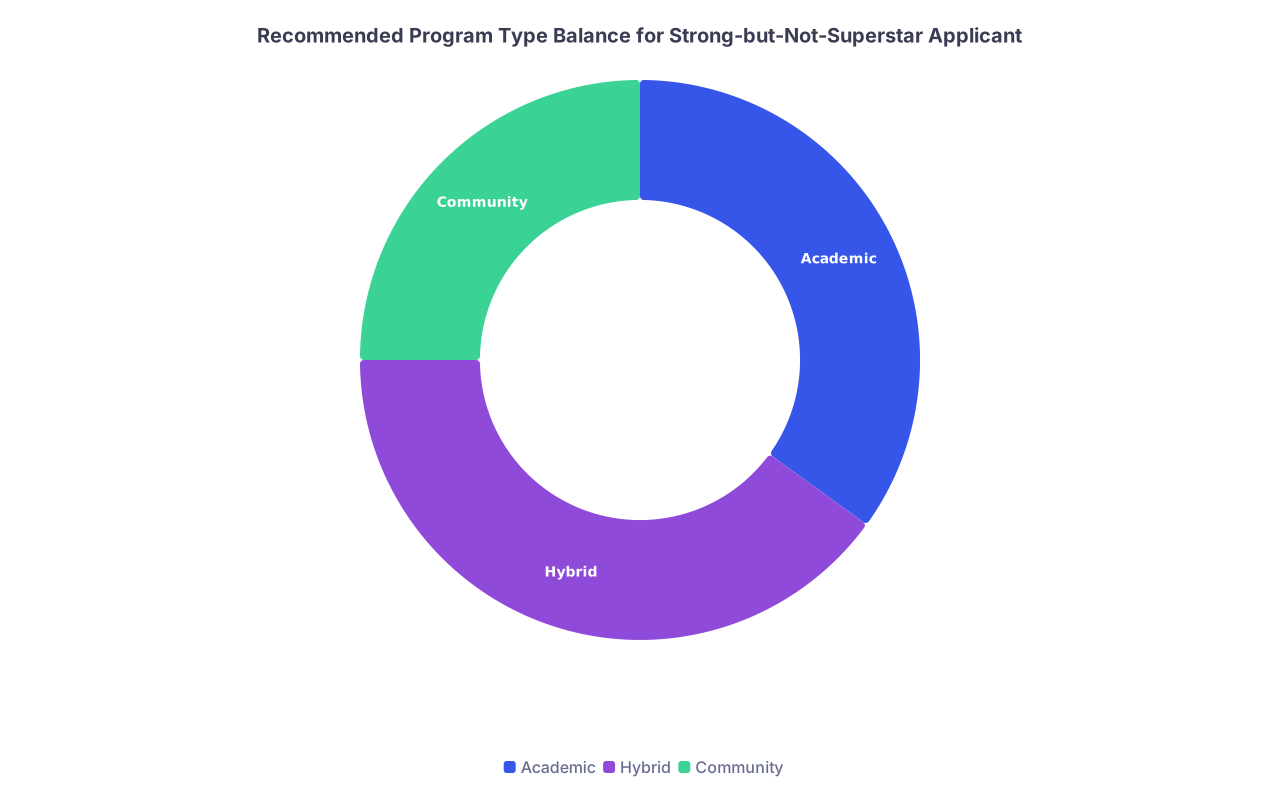
| Category | Value |
|---|---|
| Academic | 35 |
| Hybrid | 40 |
| Community | 25 |
If your chart is 70%–80% academic and you are not clearly top-decile for the specialty, you are playing the lottery, not doing a strategy.
Then ask:
- Can I name 1–2 specific reasons each of my community/hybrid programs would be a genuinely good fit?
- Do I have any geographic / personal ties that strengthen my case there?
- Have I contacted or rotated at programs that match my actual profile, not my ego?
If the answer is no, your biggest risk is not “being too safe.” It is being wildly unrealistic about program type.
FAQ (Exactly 3 Questions)
1. How do I figure out if a program is truly “academic” versus “community” if their website is vague?
Look at outcomes, not marketing language. A program can call itself “university-affiliated” and still be functionally community. Check:
- Where graduates go (fellowships at big centers vs local practice)
- How much research residents actually produce (search PubMed for residents’ names)
- Whether there is protected research time or a published expectation of scholarly work
- The proportion of faculty who are clinician-educators versus heavy researchers
If most graduates go straight to community jobs, research output is minimal, and the hospital serves mainly regional needs without a major research institute, treat it as community or hybrid.
2. I want an academic career but my application is not competitive for top academic programs. Should I still focus on academic programs only?
No. That is a classic self-sabotage move. Many residents build academic careers from non-elite or hybrid programs if they find mentors, do solid work, and pursue fellowships. You are far better off:
- Matching at a strong hybrid/community program and proving yourself
- Then doing a good fellowship at an academic institution
Than going unmatched chasing top-10 programs that were never realistic for your profile. Academic careers are built over a decade, not only at the residency match step.
3. Is it “dishonest” to write different personal statements for academic versus community programs?
No, it is smart. Dishonest would be fabricating interests. Tailoring is about emphasizing real parts of yourself that align with the program. For academic programs, you highlight your genuine interest in research and teaching. For community programs, you highlight your genuine satisfaction in clinical work, continuity, and patient care. If you cannot sincerely write a statement that fits a program type, you probably should not apply there.
Key Takeaways
- You are not just competing for a specialty; you are competing within specific program types that want different things.
- Overloading your list with unrealistic academic programs in a competitive specialty is one of the fastest paths to going unmatched.
- Build a deliberate mix of academic, hybrid, and community programs that fits your actual profile and tailor your story to each type—or you will pay for this mistake later.