The obsession with stacking away rotations is quietly ruining a lot of otherwise competitive applications.
You’ve been told the opposite. “Do as many aways as you can.” “You need to be seen.” “Four is standard now.” That’s how people talk on Reddit, in GroupMe, even in some advising offices that should know better.
I’ve watched that mindset backfire. Repeatedly.
This isn’t about doing zero away rotations. It’s about the very real point where “more” turns into “worse” — especially in competitive specialties.
Let me walk you through where people screw this up, how programs actually interpret your away-heavy schedule, and the quiet costs you don’t see until it’s too late.
The Hidden Myth: “More Aways = More Interviews”
The most dangerous assumption in competitive matches is also the simplest:
“If one away rotation is good, four must be better.”
No. Past a certain point, extra aways don’t scale. They dilute.
Here’s what actually happens when you overload:
- Your performance drops on each individual rotation.
- Your letters become weaker or generic.
- Your home program gets less of you and writes a more cautious letter.
- Your Step 2 CK score or research suffers because you were always on the road.
- Burnout shows up in your interviews and behavior.
Programs notice. They may not say it on Zoom, but they talk about it in the conference room:
“They rotated here and at three other places and still didn’t get a strong letter? Hmm.”
“Why didn’t their home program letter sound more enthusiastic if they’re so set on this specialty?”
The belief that “many aways proves commitment” is usually wrong. One or two strong aways with excellent performance demonstrate commitment. Four mediocre ones scream something else: poor judgment.
Where Overloading Starts to Backfire (By Specialty)
Let’s be specific. Different specialties have different norms and different thresholds where “more” turns into “too much.”
| Specialty | Common Away Range | Where It Often Backfires |
|---|---|---|
| Orthopedic Surgery | 2–3 | 4 or more |
| Dermatology | 1–2 | 3 or more |
| Neurosurgery | 2–3 | 4 or more |
| Otolaryngology (ENT) | 1–3 | 4 or more |
| Plastic Surgery | 2–3 | 4 or more |
| Emergency Medicine | 1–2 | 3 or more |
| Anesthesiology | 0–1 | 2 or more (for most) |
Notice what’s missing: no field where “5+ aways” is standard or necessary.
Yes, there are edge cases: couples match, red flags, no home program, major geographic constraints. But most students pushing for 4–5 aways don’t fall into those categories. They’re just scared. And fear is a terrible scheduler.
The Three Most Damaging Consequences of Too Many Aways
You don’t feel the damage right away. During fourth year, overloading on aways feels “productive.” You’re always doing something. Always somewhere. That’s the seductive part.
The fallout comes later.
1. Mediocre Performance Everywhere
You cannot be at your best 4–5 months in a row in unfamiliar hospitals, learning new EMRs, new cultures, new workflows, new teams.
You start strong on away #1 or #2. By #3, you’re:
- Physically exhausted from travel
- Emotionally drained from constantly “being on”
- Less sharp on presentations and operative planning
- Shorter with nursing, weaker with consult etiquette
- Just a little slower to pre-round, to read, to follow up
On a competitive service — ortho, neurosurg, derm, plastics — they see the difference between the student who is fresh, prepared, curious… and the one who is just trying to survive their fourth straight month on away from home.
And the eval reflects that difference.
2. Weak or Redundant Letters
The worst trap: you imagine four aways = four powerhouse letters.
Reality? I’ve seen the following pattern over and over:
- One strong letter (“Top 10% of students”)
- One generic letter (“Performed at expected level… pleasant to work with”)
- One blandly positive (“Would do well in residency”)
- One that’s so vague it might as well say, “I barely remember this person”
Programs are not dumb. When they see:
- You did an away there,
- You didn’t submit a letter from them,
they infer something: that letter would not help you.
Even worse is when your uploaded letters themselves expose the issue. Two letters saying “outstanding” and two saying “solid” create a stark internal ranking you probably didn’t intend.
3. Opportunity Cost: What You Didn’t Do
You only get so many months in MS4. Overcommitting to aways blocks out time for things that quietly matter a lot:
- Step 2 CK prep: I’ve watched people trade a 10–15 point score bump for another away. Programs cared way more about the Step 2 score.
- Home institution exposure: Residents and faculty at your own program are the ones who will actually vouch for you to their friends at other programs. If you’re never around, that network doesn’t develop.
- Research follow‑through: Manuscripts die because people are on the road and “too busy.” Then you apply with “projects in progress” instead of accepted papers.
- Actual rest before interview season: If you run at max tilt until November, your interview month energy is flatter, your answers are duller, and your enthusiasm is harder to fake.
You traded all of that for a month somewhere that never even offered you an interview.
How Programs Really Read Your Away Rotations
This is where applicants consistently misjudge the game.
Programs don’t see:
“Wow, five away rotations — so dedicated!”
They see these patterns:
Overcompensation
“Why did they need that many aways? Are they worried about their app?”Lack of home program support
“Why aren’t they doing more at their home place? Something off there?”Risk of burnout
“We saw them on rotation #4 — they looked tired. That’s not the resident we want at 2 a.m.”Strategic confusion
“They rotated at a community-heavy program, a research powerhouse, and a private hospital, all in different regions. Do they even understand what they’re looking for?”
Here’s the quiet truth:
Strong applicants do 1–2 well-chosen aways, crush them, and then go home and get a monster home letter and a solid Step 2 score.
The “5 aways” crowd usually looks more desperate than impressive.
The Point of an Away Rotation (That People Forget)
If you don’t understand the real purpose, you’ll misuse the tool.
An away rotation is mainly for:
Auditioning at a small number of programs you’re genuinely willing to rank very highly
Not “maybe I’d go if they’re my only option.” Top 3–5 on your list type of places.Getting 1–2 high-impact letters from people with:
- A strong reputation in the field
- A track record of writing detailed letters
- Enough interaction with you to judge your work
Expanding your network
Not “knowing more people in more places,” but building a few mentored relationships that can pick up the phone or send an email for you.Confirming fit
You want to learn:- Do you actually like a high-volume trauma program?
- Can you tolerate that call schedule?
- Does the culture match your learning style?
Notice: none of those goals require 4–5 rotations.
Specific Ways Overloading Hurts Competitive Specialty Applicants
Let’s drill down by specialty type, because the mistakes are slightly different.
Surgical Subspecialties (Ortho, Neurosurg, ENT, Plastics)
I’ve seen this exact disaster:
- Student lines up 3 away surg subs in a row.
- Rotations 1 and 2 go well — strong work ethic, good cases, lots of reading.
- Rotation 3? They’re visibly fried. A bit slower, a little checked out post-call, not staying quite as late.
- That third program’s feedback: “Hard working, but not among the strongest students this year.”
That one line sinks interviews elsewhere when programs compare notes.
Surgical programs want:
- Consistency over time
- Stamina that doesn’t look frayed after one month
- Enthusiasm that isn’t obviously forced
Stacking away after away makes it easy for them to catch you at your worst, not your best.
Dermatology
Derm is letter- and research-heavy. Overdoing aways here is especially misguided.
Mistake pattern:
- Student does 3 aways.
- Their research productivity flatlines because they’re on service all the time.
- They end up with 2–3 “nice” letters and no new pub submitted before September.
- Their Step 2 score is fine, not stellar, because they never sat down and studied hard.
Programs would rather see:
- One carefully chosen away
- One outstanding letter from that away
- One very strong home letter
- A new first- or second-author paper submitted or accepted
- A Step 2 that shows upward momentum
More rotations don’t replace missing academic substance.
Emergency Medicine
EM is the field where over-rotation used to be almost normalized. “Just do three SLOEs, be safe.”
That’s changed.
Current red flag:
Applicants with 3 EM rotations and no clear “superstar” SLOE. All “above average,” none “outstanding.” That’s almost worse than 2 excellent ones.
On top of that, EM is very sensitive to:
- Team behavior
- Morale at 3 a.m.
- How you treat nurses and techs
Spread yourself too thin, and the night shift sees the tired, snappy version of you — not the teammate they want.
A Smarter Framework: How Many Aways Do You Actually Need?
Let’s be systematic instead of anxious.
Start with 3 questions:
- Do you have a strong home program in your specialty?
- Do you have any significant red flags?
(Step failure, big gap, professionalism issue) - Do you have extreme geographic constraints?
(Partner’s job, kids, visa issues, etc.)
Here’s the rough matrix:
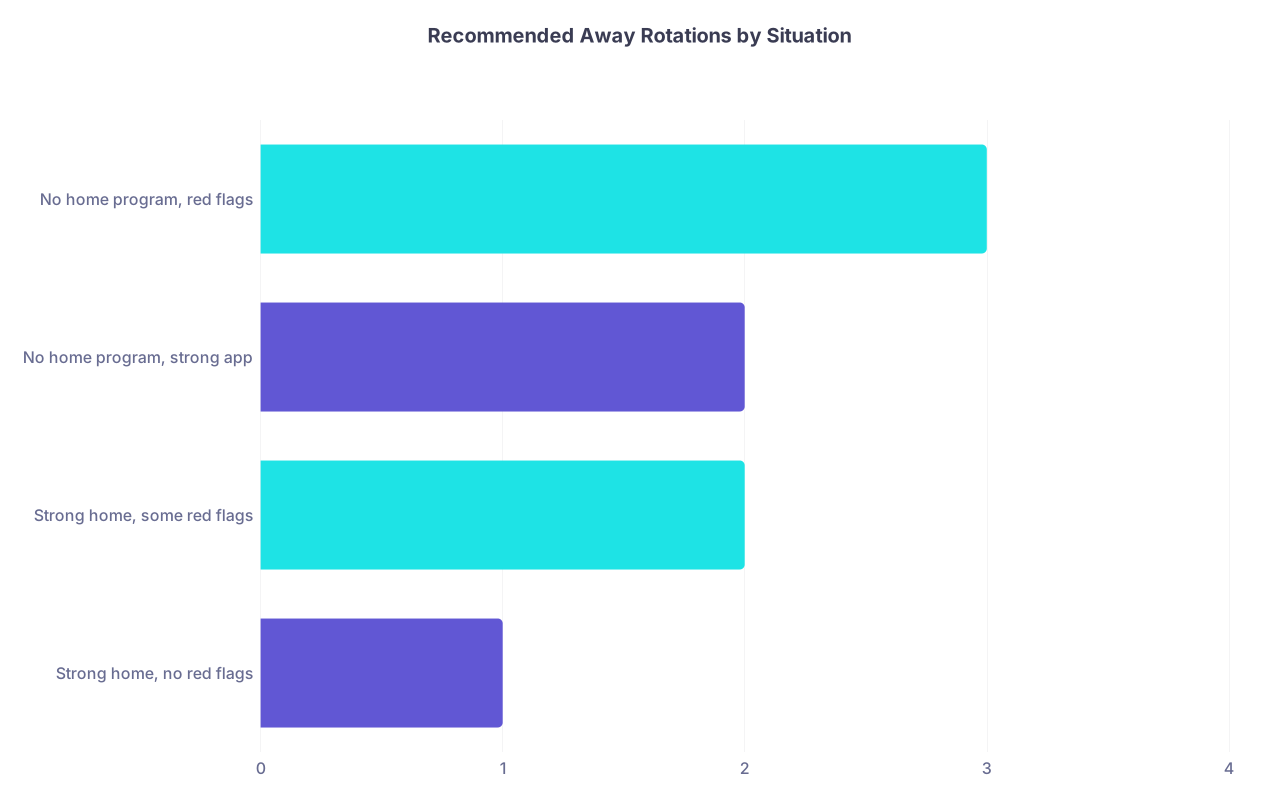
| Category | Value |
|---|---|
| Strong home, no red flags | 1 |
| Strong home, some red flags | 2 |
| No home program, strong app | 2 |
| No home program, red flags | 3 |
General rule of thumb (yes, there are exceptions):
- Strong home, no red flags
- Competitive surgical or derm: 1–2 aways
- EM: 1–2 EM rotations (usually including home)
- Strong home, some red flags
- 2 aways targeted at programs known to be holistic/friendly to your profile
- No home program, strong app
- 2 aways to establish letters and show you “exist” in the field
- No home program, red flags
- 2–3 aways, but hyper-targeted and realistic — not “spray and pray”
More than that is rarely a performance booster. It’s usually a stress multiplier.
Planning Without Burning Yourself Down
If you want to avoid the overloading trap, you need to plan like an adult, not like a panicked group chat.
1. Anchor with Home Institution First
Your best letter often comes from:
- Someone who’s seen you over months, not four weeks
- Someone who can say, “I watched this person grow”
- A PD or chair who can call colleagues directly
Do not sacrifice this by being gone for half the year. Make sure you:
- Do a robust home sub‑I in your specialty
- Are physically present enough for faculty to know you
- Follow up with them post-rotation (email updates, etc.)
2. Schedule Aways When You’re Sharp, Not Destroyed
Common mistake: stacking aways back‑to‑back June–October.
Better strategy:
- Place your highest-priority away first or second, when you’re still fresh.
- Avoid having your dream program be away #4 when you’re running on fumes.
- Leave one lighter block (elective/research/vacation) before interviews begin.
Think of yourself as an athlete peaking for a race. You cannot PR every weekend.
3. Pick Programs for Fit, Not Fear
People overbook aways because they’re terrified of “not enough options” and end up picking:
- Random famous names that don’t match their profile
- Places with completely different case mix than they actually want
- Cities they’d never realistically live in
Better selection approach:
- Target programs where your Step scores and CV are realistic for interviews.
- Consider where your med school already has match pipeline.
- Choose a mix: one “reach,” one “solid fit.”

| Step | Description |
|---|---|
| Step 1 | Identify Specialty |
| Step 2 | Plan 1 Home Sub I |
| Step 3 | Identify Regional Targets |
| Step 4 | Assess Competitiveness |
| Step 5 | Plan 1 to 2 Aways |
| Step 6 | Plan 2 to 3 Targeted Aways |
| Step 7 | Leave Time for Step 2 and Research |
| Step 8 | Have Home Program |
| Step 9 | Any Major Red Flags |
If your away schedule doesn’t survive that flowchart, you’re probably overdoing it.
Red Flags That You’re Already Overloaded
If any of this sounds familiar, you’re in the danger zone:
- You’re debating a fifth away “just to be safe.”
- You have no clear reason why each program is on your list besides “it’s good” or “it’s high volume.”
- You catch yourself thinking, “I’ll study for Step 2 on nights and weekends during aways.”
- Your advisor looks uncomfortable when they see your schedule.
- You’re already mentally tired just looking at the upcoming months.
One of the smartest moves you can make is to cancel an away before it starts. I’ve seen that decision salvage Step 2, restore sanity, and lead to a better match outcome.
Programs don’t penalize you for not doing extra aways. They never even know the ones you quietly drop.
What To Do Instead: High-Yield Strategy Without Overkill
Here’s the approach that works far more often than the “5 away” panic plan.
Lock in 1–2 aways at programs you’d truly be thrilled to match at.
Not “it’s fine,” not “it’s big-name,” but places that fit your personality, geography, and career goals.Go absolutely all-in on performance at each away.
- Know every patient on your list better than anyone else
- Read daily on their conditions and surgeries
- Show up early, stay appropriately late
- Be relentlessly kind to staff
Cultivate 1–2 strong letter writers per away.
- Identify early who’s seeing your best work
- Ask explicitly and early enough: “Would you feel comfortable writing a strong letter of recommendation for me?”
Protect time for Step 2 CK and at least one research deliverable.
Trade one extra away for:- A stronger score that gets you through more filters
- A finished paper/poster that signals follow-through
Stay visible at home.
- Show up to conferences when you can
- Present at grand rounds or journal club
- Keep your home PD/mentor updated about your away experiences and interest
That’s the profile that matches well. Not the person who lives out of a suitcase for six months.
FAQ (Exactly 4 Questions)
1. I’m applying ortho and everyone in my class is doing 3–4 away rotations. Will I look weak if I only do 2?
No. You’ll look weak if you do 3–4 and are average on all of them. Two strong aways plus a robust home sub‑I and good Step 2 score beats four “fine” aways every single time. Programs talk about the quality of your performance, not the raw count of your rotations.
2. I don’t have a home program in my specialty. Doesn’t that mean I need 4–5 aways to be seen?
You need enough exposure to generate 2–3 strong letters and show up on some PDs’ radar, not to visit half the country. For most students without a home program, 2–3 strategically chosen aways is appropriate. Beyond that, the marginal benefit drops fast while the fatigue and opportunity cost climb.
3. Will doing an away at a program guarantee me an interview there?
Absolutely not. Plenty of students rotate and never get invited back. Aways increase your chance at that specific place if you truly impress them. Overloading doesn’t multiply that; it just increases the number of places that can decide you’re “fine but not outstanding.”
4. My Step 1 is pass/fail and my Step 2 is average. Should I add more aways to compensate?
More aways rarely fix a merely average academic profile. You’re better off using that time to push Step 2 higher (if you haven’t taken it), strengthen research, and secure one or two truly excellent letters. Programs are far more impressed by clear improvement and depth than by a long list of short stints on their ERAS transcript.
Keep this simple:
- Aways are scalpels, not hammers — use them precisely, not repeatedly.
- One or two stellar rotations plus strong home support beat four tired, average performances every time.