
The obsession with matching the “most competitive” specialty is wrecking a lot of good careers.
Let me be direct: chasing competitiveness stops making sense the moment it starts contradicting who you are, how you want to live, and what you can realistically achieve without burning yourself to the ground.
You’re not picking a trophy. You’re picking 30–40 years of daily work.
The Core Question: What Are You Actually Optimizing For?
Most med students and applicants will not say this out loud, but I’ve heard it in quiet conversations after rounds: “I just don’t want to feel like I wasted my potential.” That’s usually code for “I want something prestigious and competitive so people know I’m smart.”
Here’s the problem. You’re probably optimizing for at least five different things at once:
- Intellectual challenge
- Lifestyle (hours, call, flexibility)
- Income
- Geography/family priorities
- Status/competitiveness/ego
Those are all valid. Yes, even ego. But they don’t have equal weight.
Chasing competitiveness stops making sense when:
- The prestige factor is driving the bus, and
- The cost to your mental health, relationships, and long-term satisfaction is insanely high, and
- You have other specialties that clearly fit you better but you’re ignoring them because they’re “less competitive.”
If that describes you, you’re no longer making a career decision. You’re playing status games.
A Simple Framework: 3 Tests To Know You’ve Gone Too Far
Here’s the decision framework I use with students who are stuck on this.
Test 1: The “Day After Match” Test
Imagine it’s Match Day. Two possible universes:
- Universe A: You match into the ultra-competitive specialty you’ve been chasing (say, derm, ortho, plastics, neurosurgery) in a decent but not dream location.
- Universe B: You match into a moderately competitive or less “prestigious” specialty (IM, peds, psych, FM, anesthesia, EM, etc.) at a strong program, in a city or region that actually works for your life.
Now look at the day after Match. Not the bragging rights. The reality. Ask yourself:
- Which version of your daily life do you actually want?
- Which call schedule? Which clinic load? Which OR days?
- Which patient population and pathologies?
If, stripped of status, you’d pick Universe B, but you’re still forcing Universe A because “I’ve always said I’d be a surgeon/derm/ENT/whatever” — that’s the first sign competitiveness is driving you past the point of sense.
Test 2: The “Person vs Numbers” Test
Look at how you’re thinking and talking about your application.
If your internal dialogue is:
- “My Step scores and publications make me ‘good enough’ for X, so I should aim there.”
- “It would be a waste to go into Y with my stats.”
- “I need at least one ‘top-tier’ thing on my CV.”
Then you’re treating yourself like a set of numbers trying to be maximally spent, instead of a human who has to live this career.
Flip it:
- “What specialty fits how I think, how I like to work, and the life I want?”
- “Given that, how can I make myself competitive enough for that path?”
Once the numbers and brand of the specialty become more central than the work itself, you’ve crossed the line.
Test 3: The “Cost of the Chase” Test
Look at what the chase is costing you right now:
- Are you applying insane broad (80–100+ programs) out of fear, wiping out your finances?
- Are you committing to a research year or extra degree you do not actually care about just to signal competitiveness?
- Are you miserable on rotations you need for your target specialty but find yourself counting minutes?
If the “investment” for a competitive specialty is draining your energy and curiosity rather than sharpening it, that’s a red flag.
Here’s where I draw the line: If you have to fundamentally contort your personality, priorities, and mental health for a shot at a badge-of-honor specialty, the competitiveness isn’t worth it.
Reality Check: What Are You Trading, Exactly?
Let’s zoom out and look at the trade-offs between “highly competitive” and “moderately or less competitive” specialties in concrete terms.
| Factor | Highly Competitive (e.g., Derm, Ortho, Plastics) | Less Competitive (e.g., IM, FM, Psych, Peds) |
|---|---|---|
| Step Scores | Typically higher | More forgiving range |
| Research | Often heavy, multi-year, multiple pubs | Helpful but less make-or-break |
| Geographic Control | Lower (you go where you match) | Higher on average |
| Lifestyle Variability | Wide; some great, some brutal | Wide; many more lifestyle-focused options |
| Prestige Signaling | High | Variable; more dependent on what you build |
The key phrase: “more dependent on what you build.”
You can create a high-prestige, high-impact career in so-called “less competitive” fields by:
- Subspecializing (cards, GI, heme/onc, interventional, critical care, child psych, etc.)
- Doing strong academic work
- Becoming the go-to expert in a niche area
- Building a powerful local or national reputation in quality, advocacy, or education
But you can’t create daily happiness in a field you never liked just because it was competitive.
When It Does Make Sense to Chase Competitiveness Hard
I’m not saying: “Never chase a competitive specialty.” That would be just as stupid as chasing it blindly.
It makes sense to lean hard into a competitive specialty when:
You genuinely love the work.
You light up in those clinics, ORs, labs. You like those attendings’ lives. You don’t fantasize about being elsewhere when you’re there.Your application is plausibly competitive with a realistic plan.
Your Step scores, clinical performance, letters, and potential research are in a range that, with effort, put you in the ballpark — maybe not Harvard Mass Gen level, but matchable somewhere.You’re willing to accept the risk profile.
Meaning: You’re okay with SOAPing into a backup or taking an extra year if you swing and miss. Not thrilled. But okay.You can describe Plan B without shame.
Example: “If I don’t match into ortho, I’d be honestly happy in anesthesia or PM&R, and I’d give those careers as much respect.”
If you can’t say that — if not matching into your dream competitive field feels like career death — you’re over-attached to the status, not the work.
When the Data Is Telling You to Stop
At some point you have to stop asking “Is this specialty competitive?” and start asking “Am I competitive enough for it to be a good bet?”
Look at your numbers and profile honestly:
- Step 2 below average for the hyper-competitive field you’re chasing
- No meaningful research in that specialty while peers have several pubs
- Middling or lukewarm clinical evaluations in that area
- Advisors gently nudging you toward backup plans (this is not random)
That combination should trigger a serious conversation with yourself.
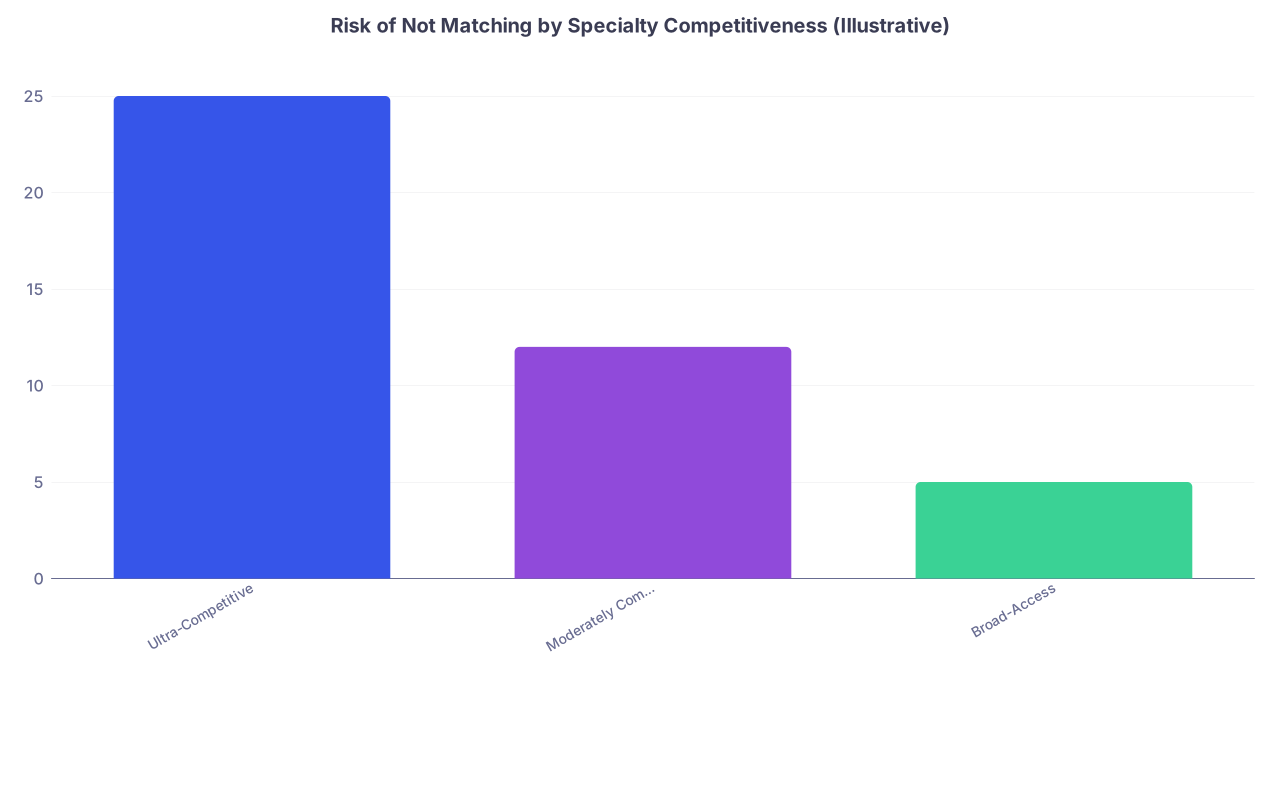
| Category | Value |
|---|---|
| Ultra-Competitive | 25 |
| Moderately Competitive | 12 |
| Broad-Access | 5 |
If your risk of not matching at all is climbing into double digits, at some point the math just fails. Especially if there are other specialties where you’d be happy and far more likely to match well.
The moment your realistic match odds in a field drop low enough that you’re risking:
- Not matching at all
- Ending up in a program or city that will make you miserable
- Burning another year in limbo
…that’s when continuing to chase competitiveness becomes a bad strategic move.
How To Re-Center on Fit (Instead of Status)
Here’s how to bring the decision back to reality.
Step 1: Define Your Non-Negotiables
Answer these without naming a specialty:
- How much do I care about strict clinic schedules vs procedural time vs OR?
- How many nights/weekends am I actually willing to give up long term?
- How important is geographic flexibility (partner’s job, kids, family)?
- What level of acuity do I want day to day?
- How much indefinite training (fellowships, extra years) am I realistically willing to do?
Write those down. Then see which specialties and sub-specialties align. Many people discover they’ve been chasing something totally misaligned with what they wrote.
Step 2: Talk to Attendings Living the Life You Think You Want
Not the star PD at a top-5 program. The regular mid-career attending at an average hospital.
Ask them:
- “What part of your job would you give up first if you could?”
- “If your kid were a med student with your personality, would you recommend your field?”
- “What are you jealous of in other specialties?”
You’ll hear a lot of derm people jealous of procedures in plastics, surgeons jealous of anesthesia schedules, hospitalists jealous of outpatient control, everyone jealous of someone.
That’s your reality check. No field escapes trade-offs.
Step 3: Make a Realistic A/ B/ C Strategy
A healthy application plan looks like:
- A: Your top-choice specialty (maybe competitive, maybe not), where you’re realistically in range
- B: A closely related backup specialty you can see yourself actually enjoying
- C: A clear plan if neither works (extra year, research, prelim year with path to re-apply, etc.)
Chasing competitiveness stops making sense when you refuse to have a B or C because it feels like “giving up.” That’s ego, not strategy.

| Step | Description |
|---|---|
| Step 1 | Assess True Interests |
| Step 2 | Check Realistic Competitiveness |
| Step 3 | Refocus on Better Fit Fields |
| Step 4 | Apply With Backup |
| Step 5 | Build Strong Application in Fit Field |
| Step 6 | Love Work in Competitive Field? |
| Step 7 | Reasonable Match Odds? |
The Hard Truth About Prestige
Here’s the thing most people realize 3–5 years out of training:
- Patients do not care if your specialty was competitive.
- Your income will be more affected by practice setup, region, and business skills than by the average competitiveness of your Match year.
- Fulfillment comes from autonomy, colleagues you respect, patient relationships you value, and work that fits how your brain functions.
Prestige feels amazing in your 20s and early 30s. By your 40s, chronic resentment about your lifestyle or boredom with your daily work will drown that out.
You don’t have to pretend prestige doesn’t matter. Just refuse to let it overrule everything else.
FAQs
1. How do I know if I’m “good enough” for a competitive specialty?
Look at recent NRMP data and your own profile:
- Step 2 score compared to matched ranges
- Honors in core rotations relevant to the field
- Strong, specific letters from that specialty
- At least some research that touches the field (for the really competitive ones)
Then run it by a brutally honest advisor in that specialty. If they’re using phrases like “reach,” “long shot,” or “hedge your bets,” you need a robust backup plan.
2. Is it a waste to go into a less competitive specialty if I have high scores?
No. That’s a narrative med students tell each other. High scores give you options — better programs, academic careers, competitive fellowships. Using them to get the best possible position in a “less competitive” field you actually like is smart, not wasteful.
3. Should I ever do a research year just to be more competitive?
Sometimes, but only if two things are true:
- You genuinely like the specialty and can see yourself there long term.
- The research year will move you from “unlikely” to “realistic shot,” based on honest feedback from faculty.
Doing a research year because you’re chasing a brand or too proud to consider other fields is a bad trade.
4. How many programs should I apply to if I’m going for a competitive specialty?
Enough to realistically capture your match odds without financial self-harm. For ultra-competitive fields, that may be 60–80+ programs. But the key is having a backup specialty where you also apply enough programs, rather than blowing everything on one hail-mary list.
5. What if I like two fields equally, but one is much more competitive?
Then the tie-breaker is risk tolerance and lifestyle alignment.
If your life circumstances (debt, family, visas, geography) make not matching a disaster, favor the less competitive field. If you can tolerate higher risk and you truly like the work more in the competitive one, go for it — with a genuine backup.
6. Will I regret not going for the most competitive field I can possibly reach?
You might briefly, especially if you’re surrounded by people bragging about their matches. Long term, most regret I hear is from people who did chase competitiveness and ended up hating their daily work. Regret about “not flexing my scores enough” fades quickly once you’re living a life that actually fits you.
7. What are the biggest signs I’m chasing prestige instead of fit?
Common ones:
- You feel defensive when anyone suggests a different field.
- You can’t explain what you like about the daily work beyond “it’s competitive” and “it’s cool.”
- You’d rather match your prestige specialty anywhere than your backup in a city or setting that actually suits your life.
- You’re more excited about telling people your specialty than imagining a normal Tuesday in it.
If that sounds like you, it’s time to re-center on the work, not the label.
Bottom line:
- Competitiveness is a data point, not a career goal.
- The chase stops making sense when prestige starts overruling fit, risk, and your actual life.
- Build a strategy around the work you want to do for decades, not the flex you want on Match Day.