
The biggest lie in residency advising is that “moderately competitive” actually feels moderate on the ground. It usually does not.
You see that NRMP table that says “Neurology – moderate competitiveness” or “PM&R – moderate competitiveness” and you relax a bit. Then you start applying in your region and it feels like you picked dermatology by mistake.
Let me break down why that happens, how to recognize you are in one of those hot local markets, and what to actually do about it instead of just panicking and adding 40 more programs at 1 a.m. on ERAS day.
1. The Myth of “Moderately Competitive”
National data is real. Your lived reality is local.
On paper, a “moderately competitive” specialty usually means:
- Fill rate high but not 100%
- A step score profile in the 230–240 (old Step 1) or mid–220s–230s (Step 2 CK) range for matched applicants
- A mix of community and university programs
- Reasonable interview counts for average applicants
Then you talk to students at your school:
- “Everyone who applied to that specialty this year had >250 on Step 2.”
- “She had three first-author publications and still scrambled.”
- “Our home program filled with only AOA students.”
What is going on?
Three big forces distort the idea of “moderate”:
Regional clustering of programs and applicants
Some specialties are highly concentrated in specific cities or academic hubs. That creates local bottlenecks.Applicant self-selection
Strong students often “downshift” into moderately competitive specialties to feel safer. So the average applicant quality locally can be higher than national numbers suggest.Local prestige inflation
Certain specialties hold disproportionate prestige at specific institutions. Internal medicine at MGH is not the same market as internal medicine at a small community program. Same label, completely different game.
So yes, national charts are useful. But they are a floor, not a ceiling.
2. How “Moderately Competitive” Turns Ultra-Competitive Locally
Let us get concrete. I am going to walk through patterns I have repeatedly seen in neurology, PM&R, anesthesia, EM, and even “regular” internal medicine.
A. Regional supply-demand mismatch
You care about your geographic window: where you are willing to train and where programs actually exist.
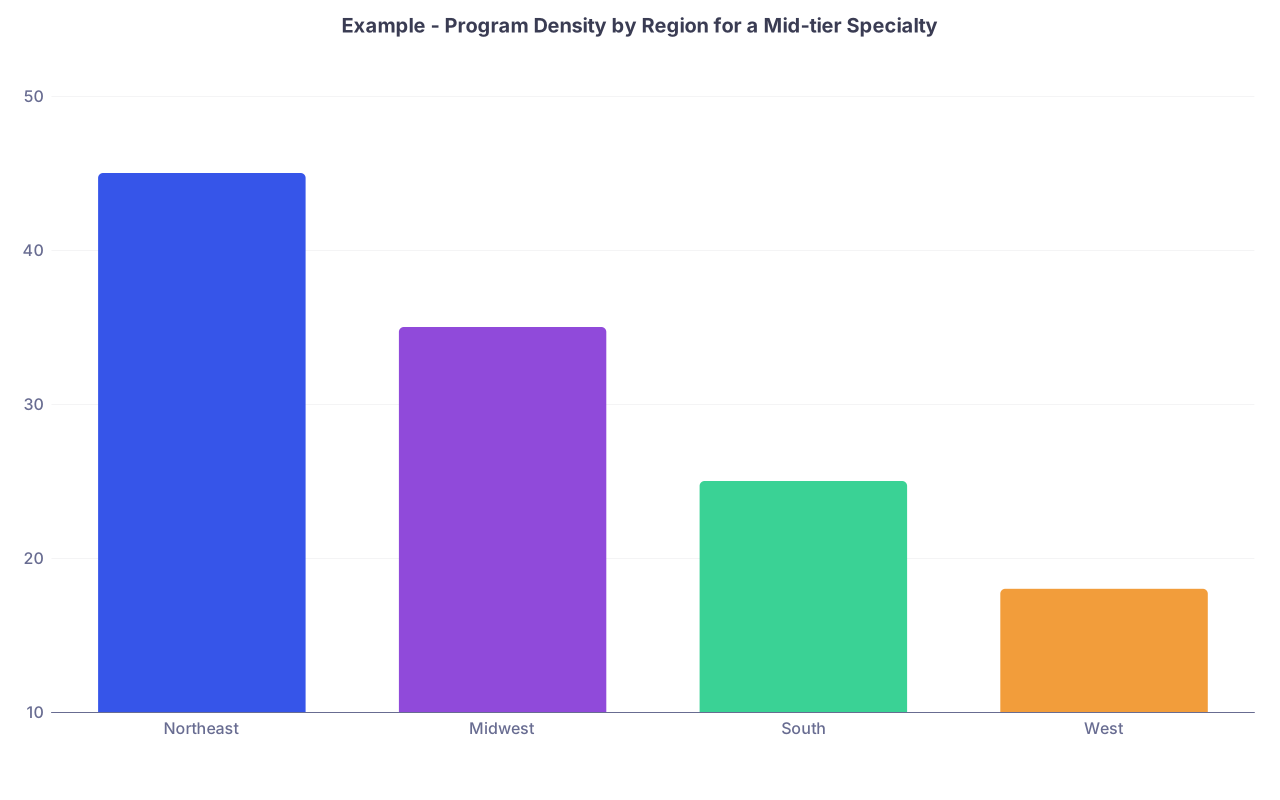
| Category | Value |
|---|---|
| Northeast | 45 |
| Midwest | 35 |
| South | 25 |
| West | 18 |
If you are:
- From the West Coast
- With strong family ties
- Unwilling to move to the Midwest or South
…then “moderately competitive” specialties with few Western programs become brutal. There might be:
- 3–5 realistic programs in California
- 1–2 in the Pacific Northwest
- A ton of highly qualified applicants from 4–5 local med schools feeding into the same limited spots
I have watched this play out in:
- PM&R on the West Coast – 2–3 “big name” programs, extremely high bar locally
- Neurology in certain metro areas – 1 flagship academic program, hyper-saturated with local applicants
- Anesthesiology in lifestyle cities – San Diego, Denver, Austin; “moderate” specialty becomes functionally surgical-level selective
The national data do not reflect the regional traffic jam. It is supply-demand, not Step score curves.
B. Home program distortion
If your school has a beloved, high-prestige department in a “moderately competitive” specialty, the local reality changes.
Here is the pattern:
- Big academic center with a strong department reputation
- Department takes 4–8 residents per year
- 20+ internal applicants from the same med school plus a few strong away rotators
Now overlay faculty bias:
- They know their own students deeply
- They have limited spots
- They want the absolute top of the class, because they can
Result:
At that one institution, “moderate” slides into “upper-level” selectivity. You will hear things like:
- “Our neurology program usually only interviews AOA or near-AOA.”
- “Our anesthesia spots basically go to people with research in our department or very strong home evals.”
Your classmates feel this. Then they extrapolate. And suddenly the entire specialty feels impossible.
C. Branding and lifestyle halo
Some specialties have an inflated reputation in specific cities because of local history, personalities, or lifestyle mythology.
Examples I have personally seen:
- A mid-size city where EM is “the cool specialty,” so every high-achieving M3 wants EM at the one big county hospital.
- A region where anesthesia is heavily marketed as high-income, controllable lifestyle, so top quartile students who might have aimed for ortho or GI instead decide “I will just crush anesthesia.”
- A place where PM&R is tied to a famous sports team or rehab hospital, and suddenly it is a magnet for high-end applicants.
Once a department becomes “the thing,” the quality of applicants spikes locally, even if the specialty is not derm or ortho nationally.
D. The IMG and DO compression effect
Even when a specialty looks “moderate” for MD seniors, it can be near-closed for DOs and IMGs in certain regions.
| Applicant Type | National Access | In Certain Hot Regions |
|---|---|---|
| US MD | Broad | Narrowed but viable |
| US DO | Selective | Very constrained |
| US-IMG | Limited | Nearly closed |
| Non-US IMG | Very limited | Functionally zero |
So on your campus, where there are a lot of DOs or IMGs, you will hear horror stories. To them, the specialty is ultra-competitive because regionally, it is.
3. Spotting When Your Local Market Is Hotter Than the National Data
You cannot fix what you do not see. Here is how to diagnose that you are in a locally overheated environment.
A. Look at historical match lists with a cold eye
Do this systematically, not anecdotally.
Ask: Over the last 3–5 years, for my school:
- How many students applied to this specialty each year?
- How many matched at our home program?
- How many matched in region vs out of region?
- What was the rough profile (top quartile, mid-class, research heavy)?
If you see patterns like:
- The home program takes 1–2 of your students out of 15 applicants yearly.
- Most of your classmates go out-of-state for that specialty.
- A surprising number end up SOAPing to very different specialties.
Then you are not in a “moderate” local market, no matter what NRMP says.
B. Analyze interview yield stories
Listen carefully to M4s a year ahead of you:
- “I applied to 45 programs and got 8 interviews, mostly in the Midwest. None on the West Coast.”
- “All my strong interviews were far from home. Local programs ghosted me.”
- “Step 2 of 245, good letters, 1 publication, but no love from [hot local academic program].”
A reasonable interview yield for a genuinely moderate specialty (for a solid but not superstar applicant) might look like:
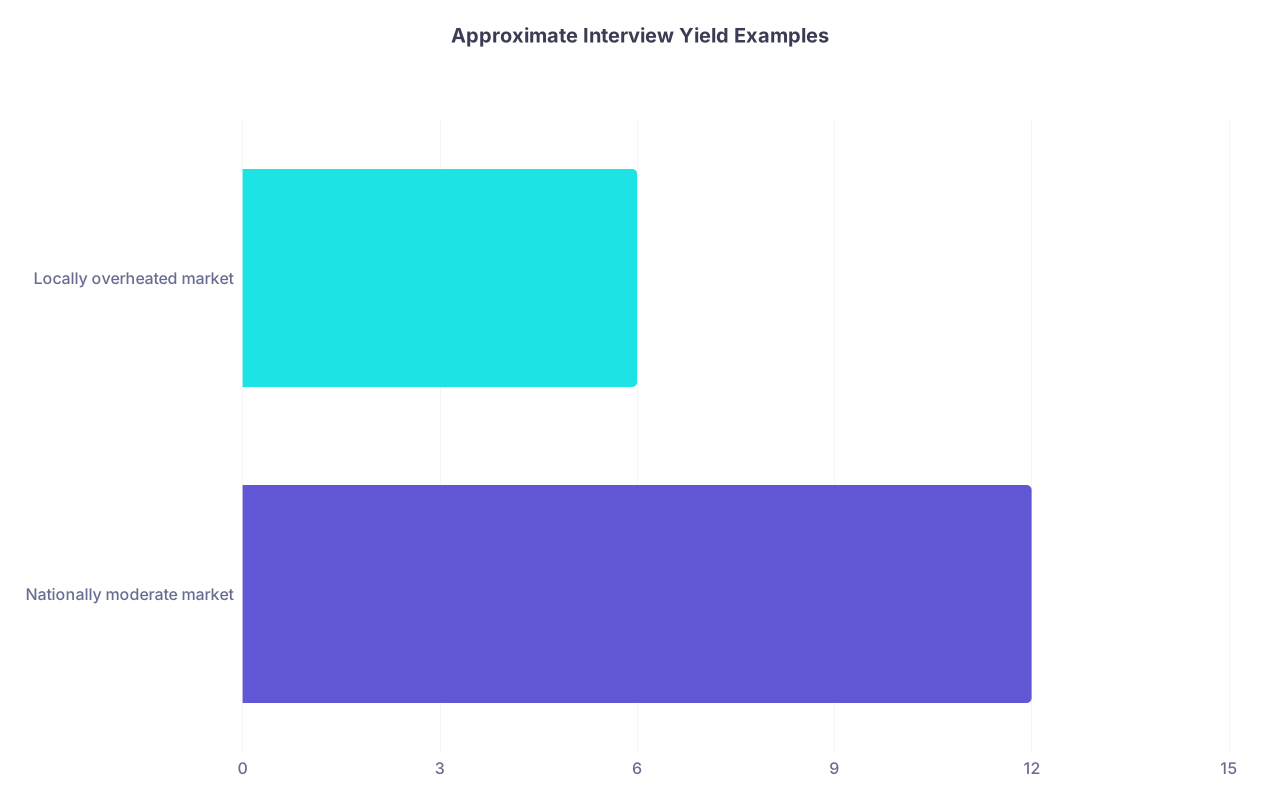
| Category | Value |
|---|---|
| Nationally moderate market | 12 |
| Locally overheated market | 6 |
Same applicant profile, different geography.
C. Check who your advisors cite as “typical matches”
If every example your advisor gives you for your specialty is:
- AOA or top 10%
- Multiple publications
- High Step 2 CK
- Strong personal connections
…that is not a “moderate” local market. That is a signal that the local standard is far above the national average.
4. Tactical Response: How to Apply When Your Local Market Is Irrational
You cannot cool the market. You can modify your strategy.
A. Separate “where I want to live” from “where I can realistically match”
First, be honest about non-negotiables:
- Absolute constraints: spouse job, immigration issues, health, caregiving responsibilities.
- Strong preferences: coasts, climate, distance from family.
Then create two buckets:
- Primary target geography – where you would actually prefer to end up.
- Safety geography – regions where the specialty is less saturated and your application is more competitive.
The trap I watch students fall into:
- 80–90% of their list is in very hot geographic zones (California, big NE cities).
- They underestimate how heavily those programs lean toward high-end applicants and home students.
For “moderate” specialties that feel hot locally, I like to see something closer to:
- 40–50% in preferred regions
- 50–60% intentionally pushed into less overrun regions (Midwest, some Southern programs, smaller cities)
Not glamorous. But much safer.
B. Over-apply strategically, not indiscriminately
You do not fix a local problem by adding 20 more programs in the same hyper-competitive region.
You fix it by:
- Adding mid-tier programs in other regions.
- Including community programs, not only big names.
- Looking at places with:
- Less name recognition
- Less “lifestyle city” buzz
- Fewer home applicants from giant academic centers
Think specifically:
- Neurology: add midwestern university affiliates and solid community programs.
- Anesthesia: include smaller metro or regional hospitals not attached to brand-name medical schools.
- PM&R: do not only apply to the 5 famous rehab names every student talks about; add the quietly solid programs.
C. Aggressively build geographic and program-specific signal
When the home region is hot, you must stand out as more than “another generic applicant who wants to stay local.”
You do that by stacking real signals:
- Targeted away rotations in your priority geography.
Not just prestige aways. Places that actually take rotators seriously in their rank lists. - Strong, specific letters that can be used to tailor your application:
- “Dr X from Program Y directly mentioned wanting to recruit you” is a different level of signal than “Good team player.”
- Pre-ERAS outreach that is not cringe:
- Evidence-based emails: short, faculty-appropriate, mentioning a genuine alignment (clinical interests, prior rotation exposure, mentor connections), not begging for an interview.
When I have seen students punch above their weight in overheated local markets, it is usually because PDs or key faculty knew their name before the ERAS file even arrived.
D. Decide early whether your priority is specialty or location
This is the brutal question most students avoid until February. You need to address it in M3.
Ask yourself:
- Would I be willing to move 1–2 time zones away to do this specialty?
- Or would I rather stay near home in a different specialty?
There is no universally correct answer. But the strategy changes completely:
- If specialty > location:
Broaden geography consistently. Accept that you may train far from home but in the field you want. - If location > specialty:
Consider whether a less hot specialty locally (e.g., IM, peds, FM, even psych in some areas) will give you a better life overall.
The disaster scenario is pretending you are specialty-first, only applying locally, and discovering in March that you are actually location-first but now sitting in SOAP with limited choices.
5. Adjusting Your Application Profile for Hyper-Local Competitiveness
If you are early enough (late M2, early M3), you can shift your profile to better survive local chaos.
A. Play to local strengths of your institution
Every med school has “darling departments.” You know them:
- They have more research funding.
- Students are always talking about “amazing mentorship.”
- Their residents look reasonably happy at 2 a.m.
If your chosen specialty at your institution is a darling, life is easier. If not, you have work to do.
Practical moves:
- Join departmental projects early (before MS4 ERAS season).
- Ask directly: “What differentiates students who match here from those who do not?”
- Volunteer for the unglamorous work (retrospective chart reviews, database cleaning). Faculty remember that.
B. Optimize Step 2 and clinical performance realistically
In a locally overheated market, your Step 2 and clerkship performance get scrutinized against your own class, not the national cohort.
Things I have personally seen on selection committees:
- “We had 20 local applicants in anesthesia. We interviewed 8. All had Step 2 ≥ 245.”
- “For our home students in neurology, we typically look at top half of the class minimum. Below that, we are reluctant.”
You cannot retroactively change your rank, but you can:
- Maximize any remaining clerkships that matter to the specialty (medicine for neuro, surgery/anesthesia for gas, etc.).
- Crush your sub-I at home or on aways. Sub-I evals often carry more weight than generic M3 evals when we know the attending.
C. Use honest, local feedback early
Do not guess. Get real reads.
By end of M3, ask at least two people who actually sit in selection meetings in your target specialty:
- A PD or APD
- A senior faculty member who is on the rank committee
And ask blunt, specific questions:
- “If I applied here, given my current record, would I realistically be in your interview pool?”
- “For someone in my position, would you advise applying broadly geographically, or do you think I am competitive enough to be more regionally focused?”
Ignore vague smiling. Push for concrete phrases: “I think you will be a strong candidate for our program,” vs “you never know,” “we look at the whole person,” etc. The latter usually means “borderline.”
6. Mental Friction: Surviving When Everyone Around You Is Panicking
There is a psychological side to this that no one talks about.
When your classmates applying to the same “moderate” specialty are:
- Doing 3 away rotations
- Applying to 70+ programs
- Re-writing their personal statement 9 times
- Checking Interview Broker like it is a cardiac monitor
…you will feel like you are under-preparing, even if you are being rational.
A few guardrails:
Decide on a range of programs with an advisor, then stop fiddling.
Endless tweaking of 5–10 extra programs rarely changes match outcomes. But it burns mental energy.Do not trust hallway anecdotes more than multi-year data.
One person with a high score who did not match locally is not a dataset.Remember national vs local reality.
You can be unwanted at your home program and still be a great catch for 80% of the country.Protect your bandwidth in interview season.
Overbooking interviews across too many regions can lead to burnout and poor performance. You are not obligated to attend every low-yield interview if it jeopardizes high-yield ones.
7. A Quick Reality Check by Specialty
Let me sketch what “moderate nationally, hot locally” can look like in a few specific fields. These are composite patterns, but they will sound familiar.
Neurology
Nationally:
Growing field, reasonable number of spots, historically mid-range competitiveness.
Locally overheated version:
- One powerhouse academic neuro program in a large city.
- Heavy emphasis on research and neuroimaging / stroke trials.
- Local med schools pumping out strong research-oriented students who all want that program or city.
- PDs preferring PhDs, MSTPs, or heavy research experience.
Result: Your 240–245 Step 2 with decent research might be bottom-middle locally but top third nationally.
Anesthesiology
Nationally:
Historically cyclical but often “moderate” overall.
Locally overheated version:
- High cost-of-living cities with strong lifestyle appeal.
- Every applicant who wanted surg or ortho but did not have the numbers “defaults” to anesthesia.
- Strong emphasis on letters from anesthesiologists and strong surgical clerkship performance.
Result: In San Diego / Denver / Austin equivalents, gas looks like ortho-lite. In many midwestern cities, it is still pretty reasonable.
PM&R
Nationally:
Moderate; relatively small field but expanding.
Locally overheated version:
- One famous rehab institute or sports/SCI center in your region.
- Every student with an MSK/sports interest plus lifestyle goals plus “I don’t want to do primary care” pivots into PM&R.
- Heavy competition for a very small number of spots (often 4–6 per program).
Result: You might be far more competitive for IM, peds, or psych at your home institution than for PM&R.
Emergency Medicine (with recent instability)
Nationally:
Right now, EM is going through a weird period with job market concerns and volatile match numbers.
Locally overheated version:
- Single big-name county program in a major city.
- EM is seen as “the” identity specialty at your school; a lot of your strongest classmates want it.
- Faculty heavily favor home and rotator students, making it feel like a closed system.
Result: EM as a field looks less competitive in NRMP data right now, but your target program may still be extremely selective.
8. Putting It All Together: A Concrete Planning Framework
Let me give you a structured way to operationalize all of this for a rising M4.

| Step | Description |
|---|---|
| Step 1 | Choose Specialty |
| Step 2 | Review National Data |
| Step 3 | Analyze Local Match History |
| Step 4 | Broaden Geography |
| Step 5 | Standard Strategy |
| Step 6 | Clarify Specialty vs Location Priority |
| Step 7 | Targeted Aways and Signals |
| Step 8 | Finalize Program List |
| Step 9 | Interview Season Management |
| Step 10 | Local Hot Market? |
Step-by-step:
Choose specialty
Or narrow to top two.Review national data
NRMP charts, specialty-specific match guides, program fill rates.Analyze local match history and applicant profiles
3–5 year lookback, with attention to who matched where and with what kind of application.Diagnose if your region is hot
Look for: low local match rates into the specialty, home program skewed to top-of-class, heavy competition stories among recent grads.Decide specialty vs location priority
Write it down. You will forget when panic sets in.Design application strategy based on that choice
- Specialty-first: broader geography, more diverse program tiers.
- Location-first: consider alternative specialties, or accept much higher risk.
Construct program list with advisor sanity check
Include:- A spread of geographic regions.
- A spread of competitiveness tiers.
- At least a few true “safety-ish” programs (as much as that exists).
Execute with discipline
Then stop futzing with the plan every time your class GroupMe blows up over a single unmatched story.
FAQ (exactly 6 questions)
1. How many programs should I apply to in a “moderately competitive” specialty if my region is hot?
For an average-strength US MD in a locally overheated market, I typically advise the higher side of the usual range. For example, if the national norm is 25–35, think 35–50, with most of the extra programs in less saturated regions. For DOs and IMGs, those numbers may bump up further depending on specialty and geography. The key is not just the count, but the mix: more true mid-tier and community programs, fewer redundant super-hot city applications.
2. Is it a bad idea to dual-apply if my specialty feels ultra-competitive locally?
Dual-applying is a tool, not a solution. It makes sense if: (a) you are specialty-flexible, and (b) your advisors think you are genuinely at risk in your primary field, especially locally. It is not worth it if you will not seriously rank the second specialty. Each additional specialty splits your time, dilutes your narrative, and can irritate departments if it is obvious you are not committed.
3. Can a strong away rotation overcome a weaker overall application in a hot local market?
Sometimes, but you should not bet your entire strategy on it. A truly outstanding away—where attendings go out of their way to advocate for you—can lift you into interview range at that specific program even if your Step score or class rank is middling. But it rarely erases major gaps across multiple programs in the same region. Away rotations are scalpel tools, not sledgehammers.
4. How do I know if my home program is realistically within reach?
Ask directly. Bring your full CV and score profile to someone on the selection committee and say, “If I applied here today, where would I stand relative to your typical interview invitees?” If they say things like “on the bubble” or “hard to say,” treat that as “do not count on us.” If two different people independently describe you as “someone we would likely interview,” you can include them as a realistic target but still avoid over-relying on them.
5. I am hearing conflicting stories from classmates about how competitive my specialty is. Who do I trust?
Trust multi-year data and people who see rank lists. Recent grads see one match cycle and personal anecdotes. PDs and core faculty see 5–10 years of patterns. Review your school’s match lists, talk to advisors in the specialty, and discount the extremes (the superstar with 10 offers and the one catastrophic unmatched story) when assessing typical competitiveness.
6. What if I absolutely must stay in one city but my chosen specialty is locally overheated?
Then you are facing a genuinely high-risk scenario. Your realistic options are: (a) accept a significantly increased chance of not matching that specialty and plan for SOAP or a research year, or (b) strongly consider a less competitive specialty locally that still gives you a career you can live with. In these rare non-negotiable-location cases, I advise brutal honesty and early contingency planning rather than magical thinking.
When “moderately competitive” feels like a blood sport where you live, you are not misreading the room. You are bumping into regional economics, institutional quirks, and applicant self-selection. Once you see that clearly, you can stop obsessing over abstract competitiveness labels and start making adult decisions: where you are willing to go, what risks you accept, and how much you are prepared to invest in signaling and strategy.
Get those pieces aligned now, and you will walk into ERAS with a plan instead of vibes. The next move after that is learning how to convert those interviews into actual rank list leverage—but that is a separate game, and a separate conversation.