
The fear that disclosing a mental health condition will destroy your medical career is massively overstated—and sometimes flat-out wrong.
Not made up. Not “don’t worry about it” hand‑waving. I’m talking about what the data, the actual licensing questions, and court decisions show when you look past the rumor mill that lives in call rooms and Reddit threads.
You’ve probably heard some version of: “Never tell anyone. Never seek care. If you say ‘depression’ you’ll lose your license.” I’ve watched residents repeat this to each other with absolute certainty while filling out credentialing forms they never actually read carefully.
Let’s burn down the myths and replace them with what actually happens.
What The Data Actually Shows About Licensure and Mental Health
First, some facts that should reframe the whole conversation.
A series of studies (including work published in NEJM, JAMA, and Mayo Clinic Proceedings) have shown three consistent patterns:
- States that ask broad, “have you EVER had a mental illness” questions have higher reported physician distress and reluctance to seek care.
- The number of physicians who actually get disciplined solely for having a treated mental health condition is tiny—vanishingly small.
- The legal and regulatory trend over the last decade is away from asking about history of mental illness and toward current impairment.
In other words: the main risk to your career is usually untreated, impairing illness that leads to bad outcomes, not the fact that you saw a therapist.
Let me show you how licensing questions have changed.
| Category | Approx. % of States (2017 → 2024) |
|---|---|
| Asked about any past mental health diagnosis | 40% → ~15% |
| Asked broadly about “mental disorder” without time limit | 28% → ~10% |
| Focused on current impairment or current conditions affecting practice | 60% → ~85% |
| Explicitly compliant with ADA guidance | ~25% → ~60% |
Those percentages are approximate, but they mirror the direction shown in multiple policy reviews: fewer “have you ever” questions, more “are you currently impaired” wording.
It’s not perfect. Some states are still in the dark ages. But the trajectory is unambiguous.
What Boards Actually Care About (Spoiler: Not Your Therapist)
Boards are not primarily in the business of policing your private psyche. They are in the business of protecting patients from impaired practice.
There’s a critical distinction most people completely miss:
- “Do you have a history of depression?”
vs. - “Do you currently have a condition that impairs your ability to practice safely?”
Those are not the same thing, and legally, they’re treated very differently.
Many states now explicitly model their language on this idea of impairment. A typical modern question looks something like:
“Do you currently have any condition, including mental health or substance use, that impairs or is likely to impair your ability to practice medicine with reasonable skill and safety?”
That wording:
- Focuses on current functioning
- Doesn’t force you to list every diagnosis you’ve ever had
- Is much more defensible under the Americans with Disabilities Act (ADA)
Why? Because the ADA doesn’t let licensing boards discriminate against you simply for having a diagnosis. They can regulate impairment, not the existence of depression, anxiety, ADHD, or PTSD in your chart.
If you’re stable on treatment, functioning well, and your condition doesn’t impair your practice, you typically answer “No” to that question honestly—even if you have a diagnosis. That’s the part almost no one says out loud.
Where the Real Risk Lies: Impairment, Not Disclosure
Here’s the uncomfortable truth: the biggest licensure danger isn’t that you disclosed a mental health condition. It’s that untreated illness leads to events that force disclosure in the worst possible way:
- Repeated absences, charting failures, or patient complaints
- Serious boundary issues or erratic behavior
- DUI or other substance-related legal charges
- Sentinel patient events linked to your impairment
Those are what get the board’s attention. And at that point, your mental health status is dragged into the process whether you ever checked a box on a form or not.
This matches what discipline statistics show: most serious actions involving physicians with mental health or substance use issues are triggered by:
- Criminal charges (especially DUIs and diversion)
- Hospital or employer reports
- Clear practice impairment
Not, “you admitted you were treated for an episode of depression 5 years ago.”
Boards are far more likely to get involved if you’re not in ongoing care and something goes wrong, than if you quietly saw a psychiatrist and got better.
The Big Myth: “If You Disclose, You’ll Lose Your License”
Let’s dissect this properly.
The myth says: any disclosure of mental health treatment = your license is at risk. The evidence says something very different.
What typically happens if you disclose a mental health history in a modern, impairment-focused state:
- If the question is “current impairment” and you’re stable and functioning, you don’t usually have to disclose the diagnosis at all.
- If the question is broader and you answer “Yes,” you might be asked for:
- A letter from your treating clinician
- A brief explanation (dates, treatment, stability)
- Possibly periodic updates for a while
In practice, I’ve seen this play out like this:
A resident with well-controlled bipolar disorder applies for initial licensure in a moderately conservative state. She discloses a past hospitalization and ongoing treatment. The board asks for a psychiatrist’s letter. The letter states she’s adherent, stable, and not impaired. The board issues an unrestricted license.
Was it annoying? Yes. Endangering her license? No.
Here’s the key: boards punish risk manifested in behavior, not diagnoses sitting quietly in a chart with good treatment.
Where you can get into real trouble:
- You lie or omit material history on the form, and it’s discovered later.
- You refuse to comply with reasonable requests for evaluation after a serious concern is reported.
- Your condition is actually impairing your practice, and you keep denying it.
Ironically, the “never disclose, never seek help” culture increases the odds you’ll end up in that disaster category.
The ADA Reality Check: You Have More Protection Than You Think
The Americans with Disabilities Act applies to physicians. That means state boards and hospitals have legal limits on how far they can go with intrusive mental health questions.
The U.S. Department of Justice has already pushed states to change. There have been investigations and consent agreements where boards had to:
- Remove “have you ever had a mental illness” questions
- Limit questions to current impairment
- Treat mental health and physical health similarly
Boards are not free to say, “You have depression, so no license for you.” Not legally. They have to tie any action to documented impairment or reasonable risk.
Does that mean discrimination never happens? Of course not. This is human beings with biases making decisions. I’ve heard of ridiculous hoops being imposed in some jurisdictions.
But there’s a difference between “annoying and stigmatizing” and “automatic career death sentence.” Most of what I see falls in the first category.
How State Questions Actually Differ (And Why Reddit Confuses You)
Part of the confusion is that people talk about “the board” as if there’s only one. There are 50+ variations. Some are decent. Some are behind the times.
Let’s compare broad patterns:
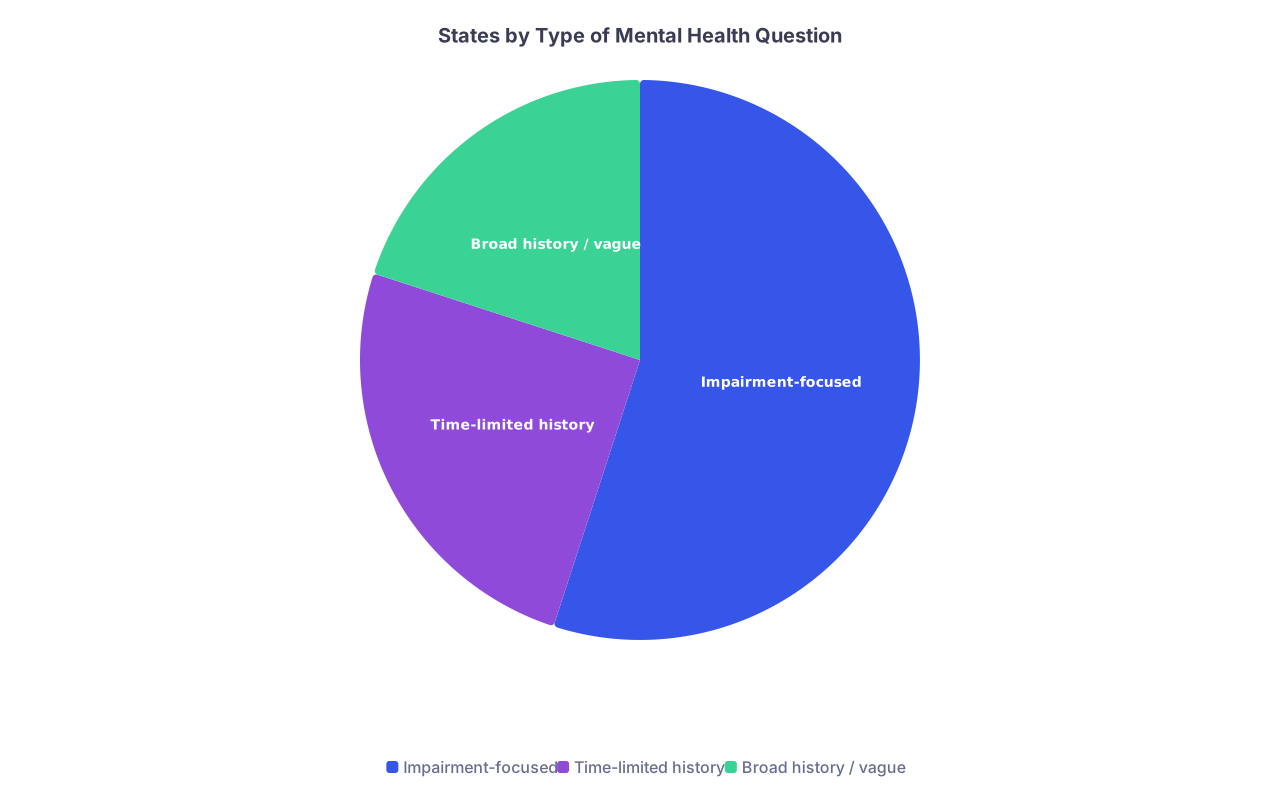
| Category | Value |
|---|---|
| Impairment-focused | 55 |
| Time-limited history | 25 |
| Broad history / vague | 20 |
Again, numbers are approximate, but the point stands: the majority now use impairment-type language, a minority still ask wide-open historical questions, and a small but shrinking group are truly problematic.
But the rumor mill doesn’t care. The worst horror story from the most regressive state becomes “this is what happens everywhere.”
It’s lazy thinking. And dangerous.
You have to actually read:
- Your specific state medical board application
- Renewal questions
- Hospital credentialing forms
Yes, it’s tedious. But it’s your career.
Credentialing vs Licensure: Two Different (But Related) Beasts
People conflate “license” and “job” constantly.
- The state board gives you the legal right to practice.
- Hospitals and employers grant privileges and jobs.
They don’t always ask the same questions. Some hospital privileging forms are more intrusive about mental health history than modern board forms.
For example, a hospital might ask:
- “Have you been treated for any mental health or substance use condition in the past 5 years?”
Legally, that’s more vulnerable to ADA challenge, but it’s still on a lot of forms.
What typically happens if you say “Yes”?
- They may request more documentation.
- They might involve an occupational health or physician wellness program.
- They could put conditions in your appointment letter (e.g., maintain treatment, periodic letters).
Is that annoying and sometimes stigmatizing? Absolutely.
Is it usually career-ending? No.
The truly career-ending scenarios are almost always tied to:
- Repeated performance issues
- Patient safety concerns
- Dishonesty on applications
- Unmanaged or denied impairment
Not “I did CBT and an SSRI during residency.”
The Quiet Backlash: Why Boards are Changing (And Why That Matters)
The dirty secret is that boards and hospitals have been shooting themselves in the foot with bad mental health policies.
We now have solid data showing:
- Physicians in states with intrusive questions are significantly less likely to report seeking mental health care.
- Burnout, depression, and suicide rates in physicians are very high.
- Stigma and fear of career damage are major barriers to treatment.
Translation: aggressive, intrusive questioning is making your doctors sicker and more likely to be impaired.
That’s why organizations like the Federation of State Medical Boards (FSMB), AMA, and AAMC have all pushed for:
- Eliminating “have you ever” mental health history questions
- Focusing exclusively on current functional impairment
- Treating mental and physical health similarly on applications
Some states and institutions are still resisting, but they’re losing ground. Legal pressure, public opinion, and physician advocacy are all moving the needle.
How You Should Actually Think About Disclosing
Let’s cut to the chase. Here’s how a rational, evidence-based strategy looks—very different from the bunk you hear whispered on night float.
Read the actual wording. Carefully.
- If the question is clearly about current impairment and you’re stable and functioning, you’re likely not required to disclose a diagnosis.
- If it asks specifically about treatment in X years, you have a harder decision, but there are still protections.
Distinguish between “diagnosis” and “impairment.”
- You can have depression, see a psychiatrist, function well, and not be “impaired.”
- Answer the question they actually asked, not the worst version living in your head.
Do not lie.
- Getting caught in dishonesty is far more damaging to your career than admitting you saw a therapist.
- Boards come down much harder on falsification than on treated illness.
Get expert advice for messy situations.
- If you have recent hospitalization, suicide attempts, diversion, or legal charges, talk to:
- A lawyer familiar with medical board issues, and
- Your treating clinician
- Craft a consistent, honest, concise narrative and supporting documentation.
- If you have recent hospitalization, suicide attempts, diversion, or legal charges, talk to:
Do not avoid care to “protect” your license.
That’s how you end up with:- Worse symptoms
- More risk of bad outcomes
- A higher chance of actual impairment that boards will act on
Unmanaged illness is what endangers your license, not the fact that you sought treatment.
A Quick Reality Check on Future Trends
The category you asked for—DISABILITY ACCOMMODATIONS, future of medicine—that’s not theoretical here. This area is evolving fast.
Expect more of the following over the next decade:
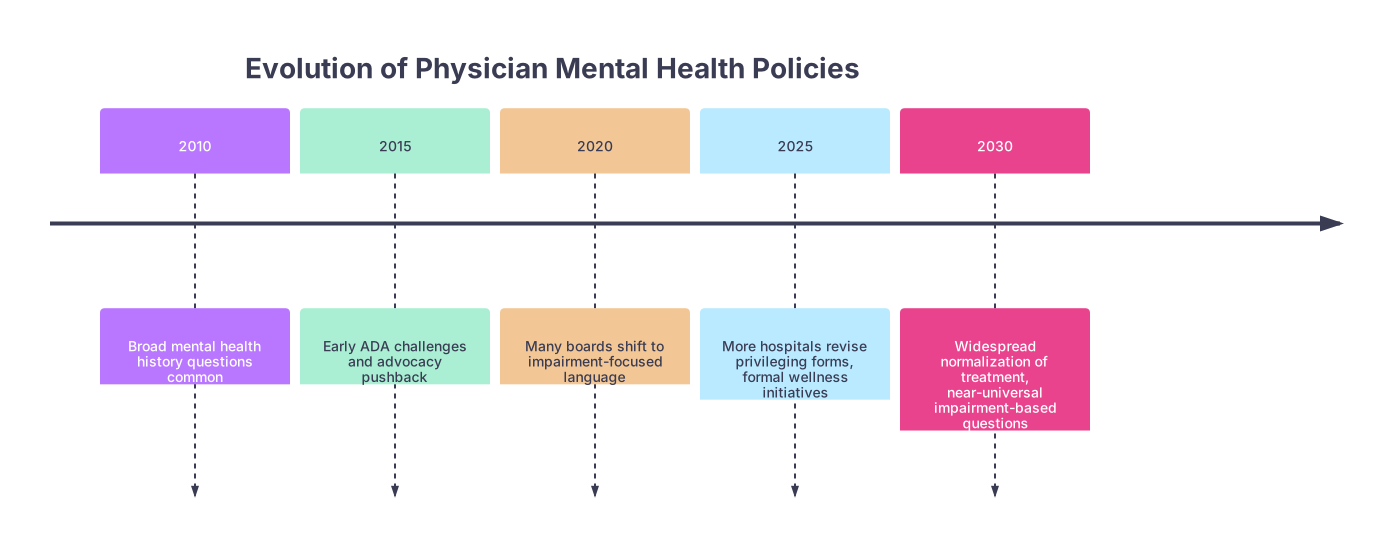
| Period | Event |
|---|---|
| 2010 | Broad mental health history questions common |
| 2015 | Early ADA challenges and advocacy pushback |
| 2020 | Many boards shift to impairment-focused language |
| 2025 | More hospitals revise privileging forms, formal wellness initiatives |
| 2030 | Widespread normalization of treatment, near-universal impairment-based questions |
We’re moving toward:
- Routine, destigmatized mental health care as part of physician wellness
- Stronger enforcement of ADA standards
- More consistent, impairment-based language across states and institutions
There will still be outliers. There always are. But the overall direction is not “crack down on anyone who saw a psychiatrist.” It’s the opposite.
When You Actually Should Worry
I’m not going to sugarcoat the real red flags. Situations that truly put your license at risk—mental health related or not—tend to look like this:
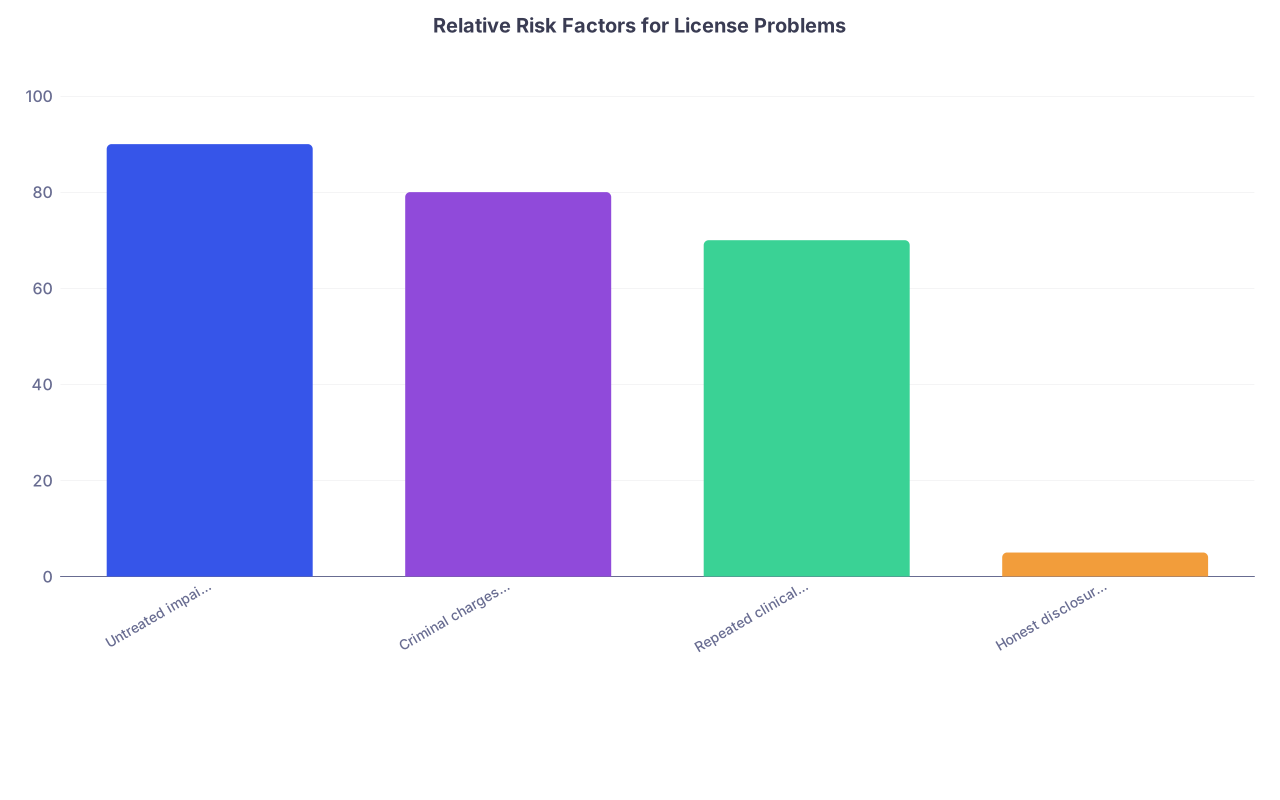
| Category | Value |
|---|---|
| Untreated impairment | 90 |
| Criminal charges (DUI, diversion) | 80 |
| Repeated clinical complaints | 70 |
| Honest disclosure with stable treatment | 5 |
Again, numbers are illustrative, not exact, but the ranking is right.
Most dangerous:
- You’re impaired and deny it.
- You refuse evaluation or treatment when serious concerns arise.
- You falsify forms or lie during investigations.
Least dangerous:
- You disclose you received appropriate treatment, are stable, and have good collateral from a treating clinician.
That aligns with what boards and credentialing bodies act on in the real world.
Bottom Line: Does Disclosing Endanger Your License?
Three things to walk away with:
Modern boards care about impairment, not diagnoses.
A treated, stable mental health condition rarely endangers your license. Unmanaged impairment does.Refusing or avoiding care to “stay off the radar” is more dangerous than disclosing.
The path to disaster is untreated illness → impaired performance → reportable event → forced board involvement.Your best protection is honest, targeted disclosure matched to the actual question, backed by good treatment and documentation.
Not blanket secrecy. Not panicked over‑sharing. Just precise, truthful answers and competent care.
Ignore the folklore. Read the forms. Protect your health first. The evidence is clear: you’re far more likely to keep your license by getting help than by white-knuckling in the dark.