
The usual advice you hear about “just toughing it out” in clinical training is dangerous nonsense.
If you’re asking, “Should I take medical leave or try modified clinical duties?” you’re already past the point where pretending everything’s fine is safe. You need a framework, not vague reassurance.
Here’s the answer you’re looking for: you decide between medical leave and modified clinical duties by looking at one thing first—can you safely and reliably meet the core demands of patient care if your schedule, environment, and tasks are adjusted? If yes, modified duties might be right. If no, you need to be seriously considering medical leave.
Let’s walk through this like adults who care about patient safety and your long‑term career, not about saving face this month.
Step 1: Get Clear on What’s Actually Going Wrong
Before you jump to “leave” vs “modify,” you need a brutally honest diagnosis of the problem. Not just the ICD code—what’s actually happening on the ground.
Ask yourself, and preferably your treating clinician:
What’s the impairment?
Examples:- Depression with severe fatigue and concentration issues
- Flaring Crohn’s with unpredictable bathroom needs and pain
- New MS diagnosis with intermittent weakness
- Pregnancy complications with strict activity limits
- Post‑concussion symptoms with light/noise sensitivity and slowed thinking
How does it show up on the floor or in clinic?
Be concrete:- “I’m missing important details on sign‑out and orders.”
- “By 3 p.m. I’m mentally checked out.”
- “I physically can’t stand for a 6‑hour OR case.”
- “My panic symptoms spike with codes and night float.”
Patterns and predictability:
- Are symptoms constant or episodic?
- Can you usually tell in advance when you’ll have a bad day?
- Are there clear triggers (nights, long cases, high‑acuity settings)?
If you can’t describe what’s going wrong in specific, work‑based terms, you’re not ready to choose between leave and modified duties. Sit with your clinician and spell it out.
Step 2: Understand What “Modified Clinical Duties” Really Means
Too many people think “modified duties” means “they’ll be nice to me for a bit.” That’s not a plan.
Modified clinical duties usually means targeted changes like:
- Adjusted schedule (no nights, shorter shifts, fewer calls)
- Different rotations (outpatient instead of heavy inpatient; consults instead of wards)
- Reduced patient load
- Restrictions on certain activities (no OR, no procedures, no lifting)
- Protected breaks (for food, meds, restroom, pumping, etc.)
- Environmental changes (quiet workspace, screen filters, reduced sensory load)
Done right, it’s formal, documented, and intentional—not just a chief resident “trying their best” informally.
Here’s the key question: If these changes were in place consistently, would you be able to work safely and reasonably reliably most days?
If your honest answer is “probably not,” then modified duties alone is a bad answer.
Step 3: Use This Decision Framework
You don’t need 50 variables. You need five.
| Factor | Better Fit For Leave | Better Fit For Modified Duties |
|---|---|---|
| Symptom severity | Severe, unstable | Mild to moderate, somewhat controlled |
| Predictability | Unpredictable flares, sudden crashes | Reasonably predictable, stable pattern |
| Safety risk | High risk of error or collapse | Risk manageable with specific changes |
| Treatment phase | New diagnosis, meds just starting | Stable regimen needing fine-tuning |
| Time horizon | Needs weeks–months to stabilize | Likely to improve while still working |
Now let’s unpack those.
When Modified Clinical Duties Make Sense
You lean toward modified duties when:
- Your condition is partially controlled, and your clinician thinks you can work with real adjustments.
- You have enough good hours in a day to do core tasks if your schedule is reasonable.
- Your symptoms are predictable enough that colleagues aren’t constantly left scrambling.
- Your main problem is mismatch between current demands and your current capacity, not total inability to handle clinical work.
Concrete examples where modified duties is often appropriate:
- A resident with controlled depression who struggles with night float and 28‑hour calls, but does well on daytime clinic.
- A medical student in third trimester pregnancy who can’t handle OR marathons but can do clinic and shorter inpatient days.
- Someone with a musculoskeletal injury that limits lifting or standing, but who’s cognitively intact and functional with sit‑stand options and shorter shifts.
- A trainee with ADHD or mild post‑concussion issues who performs safely with reduced distractions, structured tasks, and lighter volume.
In these situations, modified duties can:
- Maintain your progression (with possible extension, but continuity remains).
- Reduce the psychological disruption and financial hit of full leave.
- Let you test and refine what accommodations you’ll need long-term.
But here’s the trap: if you’re hoping modified duties will be a “soft” leave while you’re actually falling apart, you’re risking your license, your program’s trust, and patient safety.
When Medical Leave Is the Better Call
Think leave—not just lighter work—when:
- You’re consistently unsafe: missing critical lab results, losing track of patients, blanking in emergencies.
- Your symptoms are unpredictable and severe: panic attacks that come out of nowhere, syncopal episodes, migraines that shut you down, severe pain flares.
- You’re in diagnostic or treatment limbo: starting new psych meds, adjusting complex regimens, undergoing chemo, recent surgery.
- You’re unable to meet basic reliability expectations, even with modifications: can’t make it through most shifts, frequent last‑minute call‑outs, or mental fog so heavy that “simple clinic” is still too much.
- Your clinician says, in plain language, “You shouldn’t be in clinical duty right now.”
Examples where leave is usually the right answer:
- New onset severe depression with suicidal ideation.
- Active substance use disorder being evaluated or treated.
- Uncontrolled seizure disorder with recent events.
- Severe pregnancy complications needing frequent monitoring and real rest.
- Post‑ICU or complex medical recovery where stamina and cognition are obviously compromised.
This isn’t weakness. It’s risk management. For you, for patients, and frankly for your career record.
Step 4: Reality Check – Patient Safety and Professional Standards
You’re not in a desk job where being a bit off is just “a rough day.”
Ask yourself:
- Would I want a loved one cared for by someone functioning like I am right now?
- Am I relying on my co-residents or attendings to silently compensate for me?
- If a major event happened on my shift, would my current functioning hold up under scrutiny?
If your gut answer is “no,” and you can’t fix it with predictable, enforceable modifications, then you’re leaning toward leave whether you like it or not.
Step 5: Consider Career and Training Implications (Without Letting Them Run the Show)
Yes, there are program and career logistics. No, they shouldn’t override safety. But they matter.
Things to look at:
Program policies:
- How many weeks of leave still let you complete the year on time?
- What’s the process for LOA vs reduced schedule?
- Are there board or graduation minimums you must hit?
Board requirements:
Each specialty and med school has rules about required weeks/blocks. You may be allowed:- A certain number of weeks off per year.
- A total cap across training. Your GME office or student affairs can spell this out.
Financial impact:
- Is leave paid, unpaid, or a mix?
- How does this affect benefits, health insurance, and loans?
You should absolutely factor these in. But here’s my blunt take: getting through this month on paper while your health and reputation erode is not a win. An honest, well‑managed leave is usually better on your long‑term record than a year full of near‑misses and “performance concerns.”
Step 6: Build a Concrete “If-Then” Plan
Don’t just decide “modified duties” or “leave” in a vacuum. Create a short, written plan—this is where people actually gain control.
If You’re Leaning Toward Modified Duties
Write down:
- Which duties are unsafe or unsustainable (e.g., night float, OR cases >4 hours, >12‑hour shifts, cross‑cover of >40 patients).
- Specific changes requested (e.g., outpatient rotations for 3 months, no nights, no heavy procedures).
- How long you expect to need this structure (e.g., 8–12 weeks while meds stabilize; through third trimester; for one block).
- Clear red lines: “If X continues or worsens, I will shift to medical leave.”
Then talk to:
- Your treating clinician (to get documentation with functional limits, not just diagnoses).
- Your disability office / GME / student affairs.
- Your program leadership.
You want this formal, not just “we’ll see what we can do.”
If You’re Leaning Toward Medical Leave
You’re planning for:
- An estimated leave duration (common ranges: 4–12 weeks; sometimes longer).
- What you’ll focus on during leave:
- Stabilizing treatment
- Therapy/rehab
- Rest and recovery
- Planning for return with appropriate accommodations
- A return-to-work framework:
- Will you come back directly to full duties?
- Or to a graded return (modified duties first, then ramp up)?

| Step | Description |
|---|---|
| Step 1 | Identify Impairment |
| Step 2 | Consider Medical Leave |
| Step 3 | Plan Modified Duties |
| Step 4 | Formal LOA paperwork |
| Step 5 | Formal accommodation request |
| Step 6 | Safe with modifications? |
| Step 7 | Symptoms predictable and stable? |
Keep one priority in mind: the purpose of leave is to get you to a stable place where you can return safely, not to just stop the bleeding and rush back.
Step 7: Common Mistakes That Make Things Worse
I’ve watched this play out badly more times than I like. The same errors keep showing up:
Waiting too long.
By the time some people ask about leave vs modifications, they’re already on remediation, or they’ve had a reportable incident. Don’t wait for that.Informal “deals” instead of formal accommodations.
A chief letting you “just skip nights for a while” is not the same as a documented, approved adjustment. Informal fixes fall apart the second schedules get tight.Minimizing with your clinician.
If you’re not honest with your treating doctor about how bad work has gotten, they can’t advise you correctly. “Yeah, it’s hard but I’m managing” tells them nothing.Making it about willpower instead of capacity.
You can’t grind through a seizure, suicidal thoughts, or a blown ACL. This is biology, not character.Letting shame run your decision.
Plenty of strong, competent physicians have taken medical leaves or had modified duties. The unspoken secret: a lot of your attendings have been in your shoes and just don’t talk about it openly.
Quick Visual: When Symptoms Cross the Line
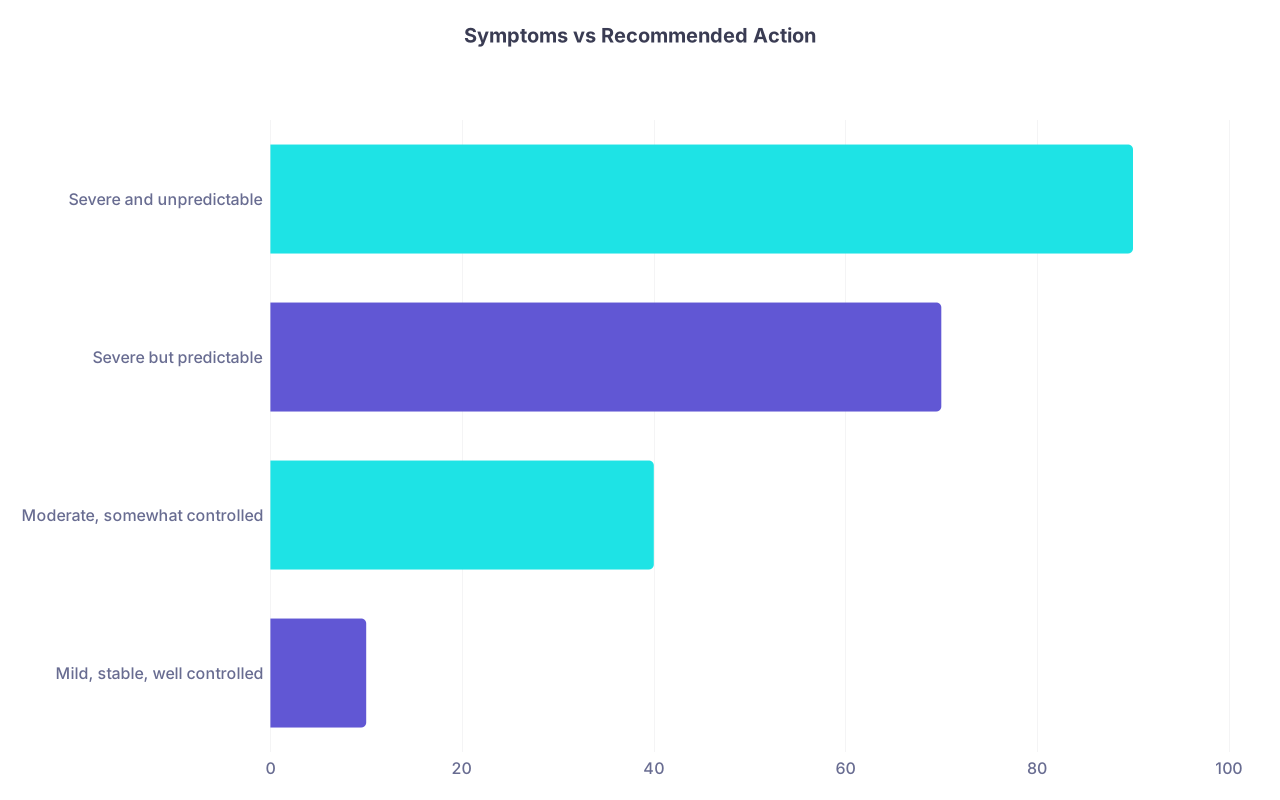
| Category | Value |
|---|---|
| Mild, stable, well controlled | 10 |
| Moderate, somewhat controlled | 40 |
| Severe but predictable | 70 |
| Severe and unpredictable | 90 |
Think of it this way:
- Left side of that spectrum (mild/stable) → modified duties or sometimes just minor adjustments.
- Right side (severe/unpredictable) → you’re flirting with harm if you stay in full clinical work.
FAQ: Medical Leave vs Modified Clinical Duties (Exactly 6 Questions)
1. Will taking medical leave ruin my career or chances at fellowship?
No, not by itself. Programs and fellowships care more about:
- Your long‑term performance and professionalism
- Whether you’re currently stable and reliable
- Whether any issues were handled transparently and responsibly
A well‑managed medical leave with clear documentation looks better than a year full of unstable performance, near‑misses, or professionalism flags.
2. Do I have to disclose the exact diagnosis to my program?
Usually no. You typically need to provide:
- Functional limitations (what you can’t/shouldn’t do)
- Expected duration
- Any needed restrictions
Your disability office or HR usually sees the details; your program leadership gets functional info. Ask your institution how they handle this, but you rarely need to hand your PD your full medical chart.
3. What if my program pushes me toward modified duties but my clinician says I need leave?
You follow your treating clinician, not pressure. Bring a clear letter from your clinician stating:
- That you’re not currently fit for clinical duty
- Expected time frame for reassessment
If your program resists, loop in GME, HR, or your institution’s disability office. You have a right to medical leave when you’re unfit, even if it’s inconvenient for scheduling.
4. What if I start with modified duties and it’s still not enough?
Then you escalate. This isn’t failure; it’s data. If, with honest effort and consistent accommodations, you’re still unsafe or exhausted, shift to medical leave. Document what was tried, what still isn’t working, and get your clinician’s updated opinion.
5. Can I work “nonclinical” jobs during medical leave (research, admin, etc.)?
Sometimes. It depends on:
- The reason for your leave
- Your program’s policies
- Your clinician’s recommendations
If the leave is for something like severe depression or major surgery recovery, even nonclinical work may be discouraged initially. Always clear it with your treating clinician and your institution’s policies before adding side work.
6. How do I explain this to colleagues without oversharing?
You’re allowed boundaries. Scripts that work:
- “I’m dealing with a health issue and following my doctor’s recommendations for leave/modified duties.”
- “I’m taking some time to focus on my health so I can be fully present when I’m back.”
You don’t owe anyone your diagnosis. Share details only with people you genuinely trust—or not at all.
Bottom line:
- If you can’t safely and reliably meet core clinical responsibilities even with concrete, realistic modifications, you should be seriously considering medical leave.
- If your symptoms are stable, predictable, and manageable with clear adjustments, a formal modified duties plan can protect your health and your career.
- Don’t let shame, pride, or short‑term scheduling fears push you into unsafe choices; your job is to protect patients and your future self, not just this month’s rotation grid.