
The most dangerous way to return from medical leave is to “just jump back in.”
That is how students get hurt, fail rotations, or end up right back on leave. Your goal is not simply to “be allowed back.” Your goal is to return with a clear, enforceable, medically sound plan that protects your health and your career.
I am going to walk you through exactly how to do that.
Step 1: Get Clinical-Grade Medical Clearance (Not a Vague Letter)
Most schools will tell you, “We just need a note saying you are fit to return.” That is lazy and unsafe. You need specific, functional clearance, not a three-line “cleared for all duties” letter.
1.1 Translate your medical situation into functional limits
Tell your treating clinician (physician, therapist, psychiatrist, etc.) you must return to clinical rotations, not a desk job. Give them specifics:
- Typical day:
- 10–12 hours on your feet
- Early mornings (pre-rounds at 5–6 AM)
- Unpredictable schedule, pages, cross-cover
- Exposure to infectious patients, blood, and bodily fluids
- High cognitive load, constant task switching
- Emotional stress (death, conflict, bad outcomes)
Ask them to write a note that addresses:
Current stability
- Diagnosis (or at least category, if you need privacy)
- Course: improved, stable, still fluctuating
- Treatment: meds, therapy, rehab, assistive device, etc.
- Any recent hospitalizations or significant events
Specific limitations / restrictions Examples:
- Max continuous standing time (e.g., 4 hours before a break)
- Max weekly hours (e.g., 50–60 vs 80)
- Night shifts and 24‑hour calls: ok, limited, or contraindicated
- Lifting limits (e.g., no more than 25 lb)
- Need for predictable breaks (e.g., a 10–15 min break every 3–4 hours)
- Need for time-protected appointments (weekly therapy, infusions)
Duration of restrictions
- Temporary (3 months, 6 months) vs likely ongoing
- Planned re-evaluation date
What you can do safely
- Can attend full clinical days with X accommodations
- Can perform patient interviews/exams
- Can participate in call with modified schedule
- Can complete documentation and academic activities
Tell your clinician directly:
“My school will build my return plan based on what you write. Please be as specific and concrete as possible.”
If their letter is vague (“Cleared to return with accommodations as needed”), push back once. Ask them to add bullet points that explicitly match the demands of clerkships.
Step 2: Lock in the Right Allies Before You Return
Students who try to manage this alone often get steamrolled by “rotation culture.” You need allies with actual institutional power.
2.1 Your core triangle
You want three entities on the same page:
Student Disability/Accessibility Office (DSO)
- They translate medical documentation into legal accommodations
- They issue formal accommodation letters to clerkship leadership
- They know what has been approved before (even if no one tells you that directly)
Office of Student Affairs / Dean of Students
- They control your schedule, leaves, and official record
- They can override stubborn clerkship directors if needed
- They see the bigger picture of your progression to graduation
You + your clinician
- You supply the medical reality
- Your clinician backs it up with documentation and, if needed, a call
2.2 The meeting you schedule before anything else
Email the DSO and Student Affairs (together) something like:
“I am planning a return from medical leave to clinical rotations effective [target month]. I would like to schedule a joint meeting to:
- Review my updated medical documentation,
- Determine appropriate accommodations for clinical settings, and
- Plan a structured, safe re-entry schedule.
Please let me know available times in the next 1–2 weeks.”
Non-negotiable: have this meeting before you set a specific rotation start date.
2.3 Go in with a draft proposal, not just a story
You are not there to give a 40‑minute narrative of your leave. You are there to walk out with a plan.
Bring:
- Your clinician’s detailed letter
- A one-page summary you wrote that includes:
- What triggered the leave
- What has changed medically / functionally
- Your current limitations (in simple bullets: “No 24h call for 6 months,” etc.)
- Your proposed return structure (next section)
You look much more credible and easier to help when you show you already did half the work.
Step 3: Build a Realistic Re-Entry Structure (Not “Back to Full Speed Day 1”)
The question you must answer is not “Can you do a full rotation?”
The real questions are:
- What pace lets you succeed without crashing?
- How long should the ramp-up be?
- Which rotations are safer to start with?
3.1 Choose lower-risk rotations as your first steps back
There is a clear hierarchy of intensity. Start on the manageable end.
| Rotation Type | Typical Intensity Level | Risk for Return from Leave |
|---|---|---|
| Family Medicine | Low–Moderate | Safer starting option |
| Psychiatry | Low–Moderate | Safer starting option |
| Neurology | Moderate | Reasonable early choice |
| Internal Medicine | Moderate–High | Better mid-ramp option |
| Surgery/OB-GYN | High | Worst first rotation |
If you have any choice, do not start back on:
- Surgery (including subspecialties)
- OB/GYN on labor and delivery
- ICU or night float
Start with something like:
- Outpatient family medicine
- Psychiatry with consistent daytime hours
- Neurology with predictable call structures
3.2 Design a phased ramp-up
Think in phases, not all-or-nothing. A common, workable structure:
Phase 1 (First 2–4 weeks): “Controlled trial”
- 4 days / week instead of 5, or
- Shortened days (e.g., 8–9 hours instead of 12–14), and
- No night call or weekend call
- Built-in protected appointment times (therapy, PT, etc.)
Phase 2 (Next 4–8 weeks): “Standard days, modified call”
- Full clinical days allowed
- Limited call (e.g., no more than 1 call per week, no 24‑hour calls)
- Clear cap on weekly hours (e.g., 50–55 instead of 80)
Phase 3 (After 3–6 months): “Test high-intensity load”
- Trial of higher-demand rotation (medicine wards, then surgical subspecialty)
- Reassess functional limits with your clinician before adding call-heavy rotations
You might not need all three phases. Or you might need longer in Phase 2. The point is: you decide your default, not the rotation culture.
Step 4: Turn Medical Limits into Legally Binding Accommodations
If it is not in writing from DSO to the clinical team, it is not real. It is just a “preference.” Preferences get steamrolled. Accommodations have legal teeth.
4.1 Examples of concrete clinical accommodations
Here is what real accommodations look like for rotations:
Scheduling / hours
- Maximum of X clinical hours per week
- No back-to-back 24‑hour shifts
- No overnight call for X months
- Protected weekly medical or therapy appointment time
Physical demands
- Sit/stand option during rounds and procedures
- No requirement to lift more than X pounds
- Permission to take brief, as-needed breaks for pain or fatigue
Cognitive and documentation
- Extra time for documentation or exams
- Quiet workspace for notes when possible
- Use of assistive technology (speech-to-text, screen reader, etc.)
Psychological / sensory
- Exemption from particular high-trigger environments (e.g., pediatric resuscitation bays for limited periods) if medically justified
- Option to step out temporarily from emotionally intense situations when symptoms flare, with follow-up debrief
Get these converted to formal DSO letters that state, in effect:
“The student is entitled to the following accommodations on all clinical rotations…”
Then those letters go to clerkship directors, not as a negotiation, but as requirements.
Step 5: Negotiate Rotation Details Without Sounding Fragile
You will have to sit down (or Zoom) with at least the first clerkship director you return to. This conversation sets the tone.
5.1 Your objectives in that meeting
You want to:
- Show you are serious and prepared.
- Make your accommodations feel reasonable and workable.
- Clarify expectations so you do not get blindsided by “hidden rules.”
You are not there to ask permission for what DSO already approved. That part is not up for debate.
5.2 How to script the conversation
Something like:
“I am excited to return to clinical work and I want to be transparent so that I can meet the rotation expectations. I have formal accommodations approved by the disability office, which you should have received.
Practically, this means:
– I will not be doing overnight call for the first [X] months.
– My weekly hours are capped at about [X], but I will be present and engaged during that time.
– I have a protected medical appointment [day/time] each week.Within these boundaries, I want to make sure I am still meeting your expectations for patient load, presentations, notes, and learning. Could we walk through how to make this work on your service?”
You sound like a colleague trying to solve a logistics puzzle, not a victim.
Then you ask very specific questions:
- “What is a typical student schedule on this service?”
- “How many patients do you expect me to follow?”
- “How do you prefer I handle days when I have to leave by [time]?”
Document their answers for yourself.
Step 6: Put a Monitoring and Backup System in Place
Returning from leave without a clear safety net is reckless. You want data, checkpoints, and a clear exit plan that is not “crash and burn.”
6.1 Set weekly check-ins with yourself
Once a week, ask yourself:
- Hours worked each day and total that week
- Symptom level (0–10 scale) each evening
- Any significant events (panic attack, flare, near-syncope, cognitive fog)
- Sleep duration and quality
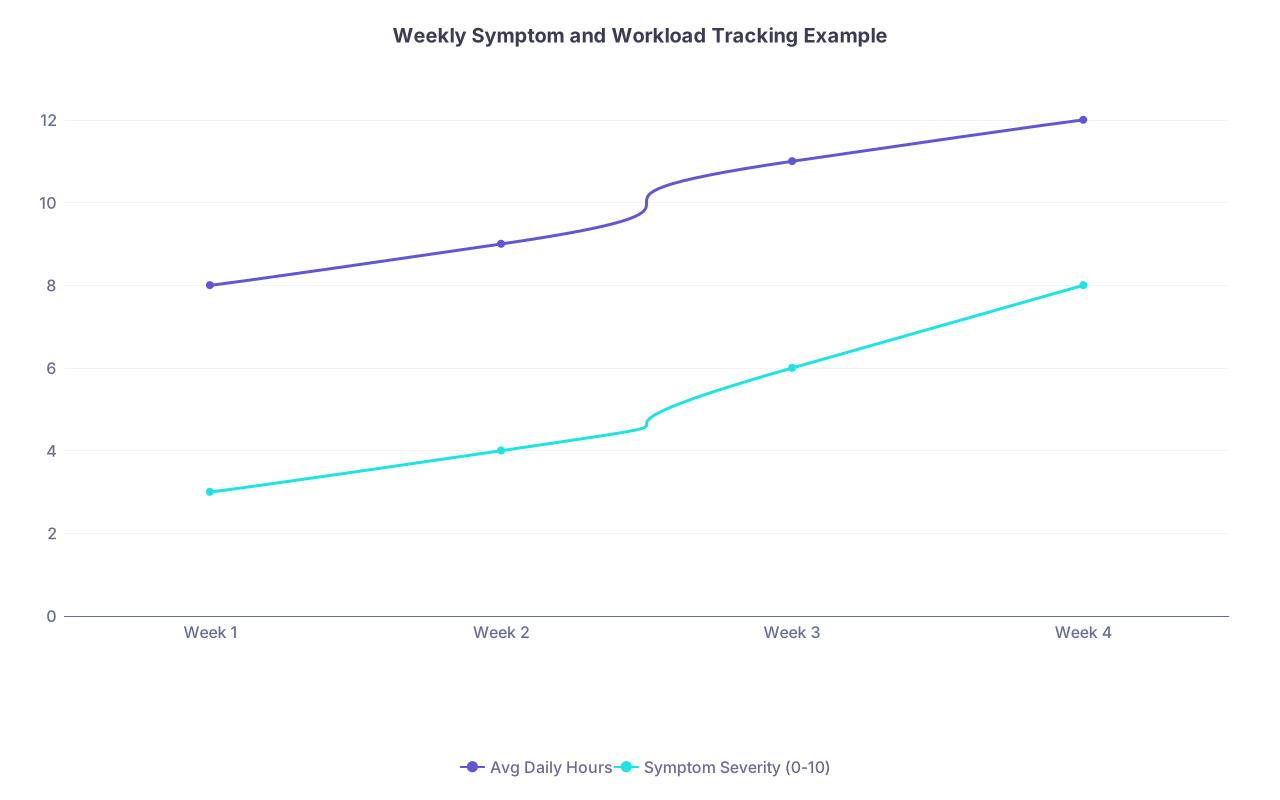
| Category | Avg Daily Hours | Symptom Severity (0-10) |
|---|---|---|
| Week 1 | 8 | 3 |
| Week 2 | 9 | 4 |
| Week 3 | 11 | 6 |
| Week 4 | 12 | 8 |
If your hours and symptoms rise together in a pattern like that, that is not “you being weak.” That is evidence the plan is not safe.
6.2 Schedule formal checkpoints with real people
Before you even start:
- Book follow-up visits with your treating clinician at:
- 2–4 weeks after return
- 3 months after return
- Ask Student Affairs for a check-in at:
- End of first rotation
- End of first 3 months back
Go into those meetings with your tracked data, not just vibes. You want to be able to say, “Here is what happened when my hours went above 55 per week.”
6.3 Have a pre-defined “if this, then that” plan
Negotiate this in advance:
If you miss more than X days on a given rotation due to health:
- Option A: Extend the rotation and complete requirements
- Option B: Convert to a partial completion and schedule a short remedial block later
If symptoms escalate to [defined level] for [defined number] of days:
- Immediate email to DSO and Student Affairs
- Temporary schedule reduction for X weeks
- Short-term change in rotation site if needed
Write this down and get agreement by email. This keeps you from making desperate, on-the-spot choices when you are exhausted.
Step 7: Protect Your Evaluations and Your Record
You are not just trying to survive physically. You must protect your evaluations, narrative comments, and future residency applications.
7.1 Get expectations in writing, early
After meeting with your clerkship director, send a follow-up email:
“Thank you for meeting today to discuss my return to rotations. To confirm my understanding:
– My schedule will be [outline details].
– I will be expected to [typical expectations: see X patients, pre-round, present on rounds, write Y notes].
– If health-related issues arise that affect attendance, I will [who you contact and how we adjust].
Please let me know if I have misunderstood anything.”
This becomes your reference if someone later claims “You were not committed” or “You were never here.”
7.2 Ask for mid-rotation feedback, not just end-of-rotation surprises
Prompt the team early:
- “Are there any concerns about my performance so far?”
- “Do you feel my current schedule is affecting my ability to meet your expectations?”
If they say “No, you are doing fine,” you repeat that in an email to your clerkship coordinator:
“Preceptor X indicated I am meeting expectations and that my current schedule is not limiting my ability to complete the learning objectives.”
You are building a paper trail that you are succeeding within the agreed structure.
Step 8: Decide How You Will Handle Disclosure and Stigma
You do not need to announce your diagnosis on day one. You also do not have to pretend nothing happened.
8.1 Who actually needs details?
- DSO and Student Affairs: They see your documentation, not necessarily your exact diagnosis if you prefer general categories.
- Clerkship directors: They need to know your accommodations and schedule modifications, not your entire medical history.
- Residents and attendings: At most, they need a short, practical explanation if schedule differences are obvious.
Sample language that is honest and minimal:
“I was on a medical leave recently. I am back now with formal accommodations for my schedule as I continue treatment. You may notice I do not take overnight call, but I am fully committed to being here and pulling my weight when I am on service.”
If someone pries further and you are not comfortable:
“I prefer to keep the details private, but I am happy to talk about how I can best contribute to the team day to day.”
If they keep pushing, that is a professionalism problem on their side, not yours.
Step 9: Plan for Residency Applications (Even If They Are Far Away)
You may not be thinking about ERAS or Match right now. You should. Because your leave, schedule modifications, or extended graduation timeline will come up later.
9.1 Understand what actually shows up on your record
Ask Student Affairs directly:
- Will my transcript show that I took a leave?
- Will my MSPE (Dean’s Letter) comment on my leave?
- Will there be any notation of “modified curriculum,” “extended program,” or repeat rotations?
| Item on Record | How Programs Usually Interpret It |
|---|---|
| Gap in enrollment dates | Neutral; prompts question, not judgment |
| “Extended program” note | Mild concern; needs explanation |
| Repeated clerkship | Depends on context; can be benign |
| Narrative about leave | Can be neutral or supportive if framed well |
You are trying to figure out what you will need to proactively explain later versus what may never come up.
9.2 Build your future explanation now, while it is fresh
You want a simple, consistent story that:
- Acknowledges the leave
- Emphasizes stability and recovery
- Highlights growth and insight
- Reassures about current function
For example:
“During my third year, I took a medical leave to treat [brief category, if comfortable: a mental health condition / a chronic illness flare]. I worked closely with my physicians and my school to return safely with a staged re-entry to clinical rotations. Since my return, I have successfully completed [X] rotations, including [higher-intensity ones], with strong evaluations. The experience forced me to confront my limits, commit to sustainable habits, and made me more attuned to patient vulnerability and system barriers.”
You do not need to obsess over this now, but do not wait until ERAS season when everything is chaotic.
Step 10: Know When to Push, When to Compromise, and When to Stop
You will meet three types of faculty:
- Supportive realists – “Let us see how to make this work.”
- Passive resisters – “Our schedule is our schedule; we treat every student the same.”
- Active blockers – “This is not the place for you if you cannot tolerate X.”
You respond differently to each.
10.1 With supportive realists
Be flexible and collaborative. If they say:
“We can cap your hours at 55, but we will need you to take one weekend day call every other week.”
You evaluate with your clinician and decide if that is safe. If yes, agree and document.
10.2 With passive resisters
Use the structure and the law. Calmly:
“I understand the typical schedule. I have formal accommodations that limit my hours and call schedule, which the disability office has approved. I am confident I can meet your learning objectives within those limits. If there are specific competencies you are worried about, I am happy to target them.”
If they still dig in, escalate to DSO and Student Affairs. Quietly but firmly.
10.3 With active blockers
Do not fight that battle alone.
If you hear:
“Maybe medicine is not for you if you need this level of accommodation.”
Stop. Write it down. Then email DSO and Student Affairs:
“During my meeting with Dr. X on [date], I was told [quote]. Given that my accommodations were approved under university policy, I am concerned this may reflect a misunderstanding of my rights and the agreed-upon plan. I would appreciate your guidance on how to proceed.”
Let the institution deal with their problem employee.
Process Map: Safe Return from Medical Leave

| Step | Description |
|---|---|
| Step 1 | Medical Stability Achieved |
| Step 2 | Functional Clearance from Clinician |
| Step 3 | Meet DSO and Student Affairs |
| Step 4 | Define Accommodations and Ramp Plan |
| Step 5 | Select Lower Intensity First Rotation |
| Step 6 | Meet Clerkship Director |
| Step 7 | Start Rotation with Monitoring |
| Step 8 | Progress to Higher Intensity Rotations |
| Step 9 | Adjust Schedule or Reassess |
| Step 10 | Plan for Long Term and Residency |
| Step 11 | Stable and Meeting Goals |
Visual: Typical 3‑Month Ramp Structure
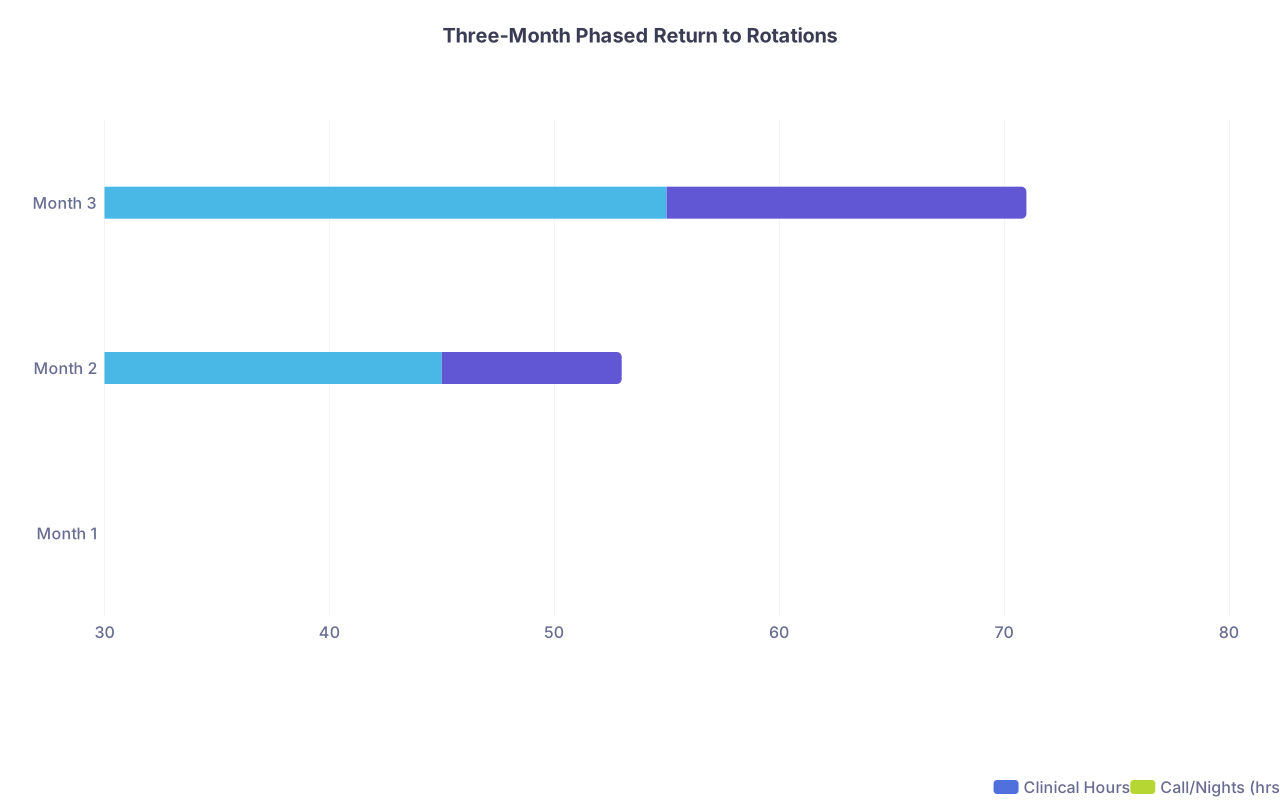
| Category | Clinical Hours | Call/Nights (hrs) |
|---|---|---|
| Month 1 | 30 | 0 |
| Month 2 | 45 | 8 |
| Month 3 | 55 | 16 |
This is what a planned return looks like: staged, measurable, adjustable.
Take This Approach if You Had to Leave for Mental Health
Short version: the rules above still apply. But you must be especially intentional about:
- Night shifts and circadian rhythms
- Access to ongoing therapy and medication management
- Exposure to triggering content (trauma, child abuse, self-harm) in early rotations
Ask your mental health clinician to comment explicitly on:
- Sleep requirements and night work tolerance
- Early warning signs that you or your supervisors should watch for
- Whether you need temporary limits on specific environments (e.g., peds trauma) and for how long
Then treat those as clinical orders for yourself, not “optional guidelines.”
Quick Reality Check: What Success Actually Looks Like
A successful return is not:
- “I handled a surgery month right away without collapsing.”
- “No one suspected I was ever on leave.”
- “I said yes to everything, so no one got annoyed.”
A successful return is:
- You completed rotations without another forced leave.
- Your evaluations describe you as reliable, engaged, and clinically competent.
- Your symptoms stayed within a manageable range with your current treatment.
- You have a clear sense of which environments are sustainable for you long term.

Final Takeaways
- Do not “just go back.” Design a phased, documented, enforceable return plan anchored in real medical clearance.
- Turn your needs into formal accommodations and written expectations, then protect your evaluations with good documentation and mid-rotation feedback.
- Build a support structure and a backup plan before you step back onto the wards, so one bad week does not undo months of recovery.