It’s 11:47 p.m. You’re in your call room, half in your white coat, half in your scrubs, staring at your phone screen. You’ve just googled some combination of “new disability MS3,” “can I still be a surgeon,” and “will they kick me out of med school for this” for the fourth time this week.
Whatever “this” is for you—chronic pain that suddenly went from annoying to life-altering, new onset seizures, a visual change that won’t go away, worsening POTS, a mental health crash that is way past “I’m just stressed”—it’s now real enough that you can’t pretend it’s going to magically resolve by next week’s shelf.
And the question in your head is brutal and simple:
Did my dream specialty just die?
Let me be blunt: your dream specialty is not automatically over. But the way you were imagining it? The “I’ll just power through, no accommodations, I’m fine” version? Yeah, that might be over.
That doesn’t mean you are.
First: No, You’re Probably Not About to Get Booted From Med School
Let’s clear out the absolute worst-case scenarios your brain is spinning.
You’re probably sitting there thinking:
- “If I tell anyone, they’ll say I’m unsafe and I’ll fail the rotation.”
- “What if they say I’m unfit to be a doctor at all?”
- “What if my disability label follows me into ERAS and ruins everything?”
I’ve watched people delay telling anyone for months because of exactly those thoughts. Here’s the reality I’ve actually seen play out:
Most schools are way more scared of an ADA lawsuit than they are eager to fail a disabled student. Med schools are institutions; they’re not kind out of the goodness of their hearts, they’re compliant because they have to be. That works in your favor.
No, that doesn’t mean they’ll give you anything you ask for. But it does mean:
- They can’t legally just say, “Oh you have [condition]? You’re out.”
- They have to at least engage in an “interactive process” to figure out reasonable accommodations.
- They cannot force you to disclose your diagnosis to your clerkship directors or attendings.
The disability office exists for this exact scenario—students who develop new disabilities during medical school. You are not the first person this has happened to, even if it feels like it.
The system is clunky, slow, and sometimes unsympathetic. But “you’re disabled now so your career is over” is not the usual outcome.
The Dream Specialty Panic: What Actually Changes?
Here’s the core fear:
“I wanted Ortho / EM / Surgery / Anesthesia / Neuro / whatever, and this disability means I physically or mentally can’t do it. Am I delusional if I keep trying?”
Your brain goes straight to extremes:
- “I can’t stand more than 30 minutes; I’ll never make it through a Whipple.”
- “I’m on meds that cause tremors—no one is letting me near an OR.”
- “I have a seizure disorder; I’ll never get credentialed.”
- “I have severe anxiety/depression; they’ll never trust me with high-acuity patients.”
Let’s slow that down and get more concrete.
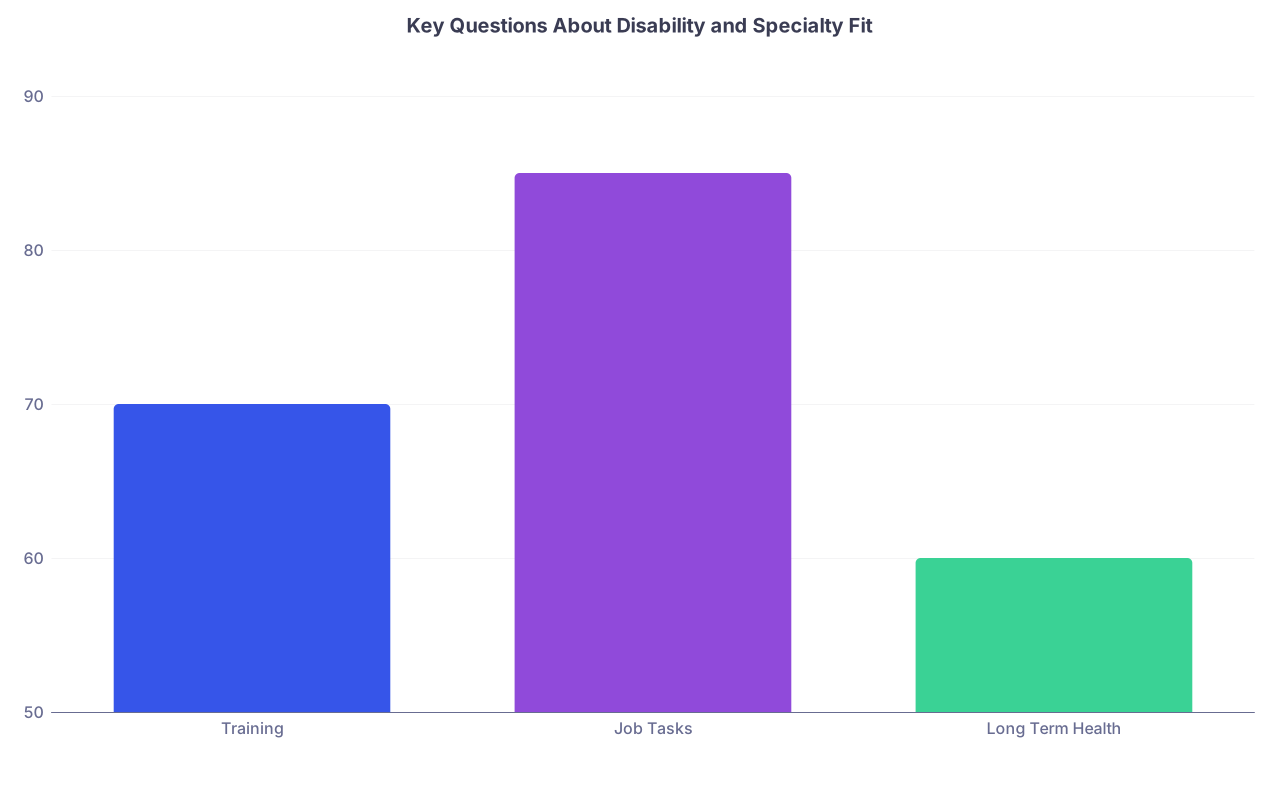
There are three different questions you actually need to answer:
- Can you get through training in that specialty with appropriate accommodations?
- Can you meet the essential job functions safely and reliably?
- Even if you technically can, will the life of that specialty wreck your health long-term?
Those are different. And you don’t have to know all the answers in MS3. You really don’t.
But you can start gathering real information instead of just sitting in the “I guess it’s all hopeless” spiral.
| Category | Value |
|---|---|
| Training | 70 |
| Job Tasks | 85 |
| Long Term Health | 60 |
Think of it like this:
- Training: 80-hour weeks, standing all day, overnight call, lack of control over your schedule, minimal say in where you’re sent. This is survivable for some disabilities with accommodations; for others, it’s a hard no.
- Job tasks: Can you actually do the procedures, rapid decision-making, lifting, visual tasks, psych demands, etc., with assistive devices or modified workflows?
- Long-term: Maybe you could push through five years of residency, but will you be a wreck by 40? That matters too.
And no, you don’t need to answer all of this alone in your bedroom at midnight.
You can’t. Because some of these answers actually depend on:
- Program culture
- Physical environment
- How your condition responds to treatment over time
- What the law and licensing boards actually say, not what your panicked brain is inventing
The Ugly Truth: Not All Specialties Are Equally Flexible
I’m not going to sugarcoat this just to be comforting.
There are specialties and environments that are brutal if you have certain disabilities, especially those that affect:
- Stamina / standing / walking long distances
- Fine motor skills and tremor
- Seizure risk / sudden incapacitation
- Vision (especially depth perception, fine detail)
- Cognitive processing speed / attention under sleep deprivation
But “brutal” doesn’t automatically mean impossible. It means you’ll need to be strategic and realistic.
Here’s a rough example (not law, just pattern) of where I’ve seen students with new disabilities land:
| Disability Type | Often More Challenging | Often More Flexible |
|---|---|---|
| Severe mobility limits | Ortho, Gen Surg, Trauma, EM | Psych, Path, Neuro, Rheum, Derm |
| Visual impairment | Ophtho, some surgery fields | Psych, FM, IM, Path (case-dependent) |
| Seizure disorder | EM, Anesthesia, some surgery | Outpatient FM, Psych, Path |
| Severe chronic pain | High-call surgical fields | Outpatient-heavy, procedural-light |
Is this table perfect? No. Are there disabled surgeons, EM docs, anesthesiologists? Absolutely yes. There are attendings with colostomy bags doing laparoscopic cases, attendings with prosthetics doing ortho, attendings with significant hearing loss running ICUs.
The key difference is whether your disability is:
- Predictable and stable enough to work around, or
- Unpredictable in dangerous ways that compromise patient safety in that specific context.
That’s where things like seizures during procedures, sudden syncope while intubating, or complete visual loss in one eye might make some roles genuinely unsafe. And sometimes that’s not discrimination; it’s patient safety and your own safety.
But that’s a nuanced, individualized conversation—not a “you have diagnosis X, so no surgery for you” blanket rule.
When and How Do You Tell Someone Without Ruining Your Life?
I know you’re probably stuck between:
“I need help now”
and
“If I say anything, they’ll think I’m weak or unfit.”
Here’s the general order that tends to protect you the most:
Get medical evaluation and documentation first.
Not screenshots of Dr. Google. An actual clinician note. The disability office will ask for this anyway.Go to your school’s disability/services office next.
Not your clerkship director first. Not the random attending who “seems nice.”
The disability office is the one tied to legal compliance. They’re the ones who put in writing: “This student is eligible for XYZ accommodations.”Then loop in the curriculum/clerkship leadership as needed—with disability office support.
You don’t have to spill your entire medical chart. You can say:
“I’ve recently developed a health condition, I’m working with the disability office, and I’d like to talk about how to adjust this rotation so I can safely complete it.”Only then, selectively disclose to individual attendings/residents if it directly affects patient care or your safety.
For example:
“I have a condition that makes it unsafe for me to do 28-hour call; my schedule has been adjusted through the school to 16-hour max shifts.”
You are allowed to set boundaries. You’re also allowed to say no to random “just push through” comments from people who have no idea what’s actually going on with your body.

| Step | Description |
|---|---|
| Step 1 | Notice new or worsening symptoms |
| Step 2 | Get formal medical evaluation |
| Step 3 | Contact disability office |
| Step 4 | Discuss needed accommodations |
| Step 5 | Formal accommodation letter |
| Step 6 | Meet with clerkship leadership |
| Step 7 | Adjust schedule/requirements |
| Step 8 | Selective disclosure to team if needed |
“Will Programs Even Rank Me If I Need Accommodations?”
This is the sneaky fear underneath everything:
“Even if I get through med school, I’ll be radioactive for residency.”
Two blunt truths here:
Many programs already quietly accommodate residents. A lot.
Modified call schedules for pregnancy complications. Residents with chronic illnesses who have specific clinic setups. People with ADHD getting extra structure and protected time. Residents with mental health issues doing therapy during work hours. The difference is just… you’re seeing the polished version on interview day.You are not legally required to disclose your disability during residency applications or interviews.
ADA applies here too. They can ask if you can perform the essential functions of the job with or without reasonable accommodation. They can’t demand your diagnosis.
What actually happens:
- Some programs will be quietly thrilled that you’re functional, self-aware, and already know what you need to succeed.
- Some programs will 100% see you as “more work” and quietly move on. You will never know which ones. That’s not fair. It’s just real.
- The places that freak out about a disabled applicant are usually not the places you want to spend 3–7 years of your life anyway.
And here’s the thing I’ve seen: a lot of disabled applicants end up in programs that are objectively better fits—supportive, flexible, less macho—because they’re forced to screen for that.
The “perfect” shiny big-name place that ghosts you? You might have been miserable there.
Let’s Talk Dreams: Redefining “Failure”
The worst part of all of this is the grief you don’t even feel allowed to have.
You had a very specific picture in your head:
- “I’m going to be a trauma surgeon at a big academic center.”
- “I’m going to be the interventional cardiologist doing the midnight STEMI saves.”
- “I’m going to be the fast-thinking, adrenaline EM doc.”
And now your body has betrayed you mid-ride. It’s cruel. It feels personal.
Here’s what no one tells you:
Changing your specialty goal because of a disability is not “settling for less.” It’s making an adult decision with more data.
I’ve seen people:
- Switch from Gen Surg to Radiology and end up genuinely happier, not just “making do.”
- Pivot from EM to Outpatient IM and become the doctor everyone in the community trusts.
- Move from Ortho dreams to PM&R and suddenly feel like their lived experience with disability is their superpower, not their liability.
And I’ve also seen the opposite: people cling to the original dream specialty so hard that they blow up their health and barely crawl through residency, then hate their lives and have nothing left in the tank to practice.
You are allowed to:
- Grieve the original dream. Cry about it. Rage about it. That loss is real.
- Still choose that specialty if, after truly understanding your limits and risks, it makes sense.
- Or pivot to something else and not see that as failure, just… course correction.
Practical Stuff You Can Actually Do Now
You don’t need a 5-year plan tonight. You need the next 3–4 moves.
Here’s what I’d do, in order, if I were you:
Schedule a real appointment for your condition if you haven’t yet.
Not student urgent care unless it’s an emergency. A proper clinic visit with someone who can follow you.Email or call your disability office this week.
You do not have to have the “perfect” doctor letter already. You can say:
“I’ve developed a new health condition and it’s affecting my clinical performance. I’d like to discuss temporary or ongoing accommodations.”On your next rotation, quietly track what actually flares or limits you.
Is it the standing? The night shifts? The speed? The stress? The noise? The cognitive load? This will help you figure out what specialties and environments are realistic.Start talking—off the record—to at least one trusted person in medicine.
Not necessarily your PD or dean. Could be a resident you trust, a faculty mentor, or a physician with a similar condition if you can find one. (“Disabled doctors [specialty]” on Google/Twitter/Reddit is a start.)Give yourself explicit permission to not decide your specialty right now.
You’re allowed to be undecided in MS3. With or without a disability.
FAQ (Exactly 4 Questions)
1. Do I have to disclose my disability to my school or can I just push through?
You technically can try to push through without saying anything, but it usually backfires. If your performance drops—more absences, slower on the wards, shelf scores tanking—people will judge you without the context of what you’re managing.
If you disclose through the disability office, they can build a paper trail that you needed support. That can protect you if someone later tries to say you “lacked professionalism” or “weren’t committed.” Also: if something goes really wrong (like you faint in the OR or have a seizure on the floor) and there’s no record you ever said anything, it’s a mess. I’d rather have accommodations on file and never use them than need them and have nothing.
2. Will a new disability automatically stop me from getting licensed later?
In almost all states, no. Licensing boards are much more focused on whether you’re currently impaired in a way that affects safe practice, not simply whether you have a diagnosis.
For physical disabilities, boards usually don’t care as long as your training program signs off that you met competencies. For mental health, a lot of states are (slowly) moving away from “Have you ever had diagnosis X?” toward “Do you currently have any condition that impairs your ability to practice safely?” You’ll need to check your specific state, but “automatic disqualification because disabled” is not how this usually works.
3. Will programs find out about my disability from med school documents?
Your disability status and specific diagnosis do not automatically show up in your MSPE (Dean’s letter) or transcripts. The disability office and student health are usually firewalled from the academic evaluation process.
Where it can leak indirectly is if you had major schedule disruptions, LOAs, or remediation. Even then, the school doesn’t have to say “because of disability;” they often write something vague like “for personal reasons.” You can choose whether to address that in your application or not. But there’s no checkbox in ERAS that says “disabled—yes/no.”
4. What if my condition gets worse—could I be forced out of residency or med school?
If your condition progresses to where you can’t safely perform essential duties even with reasonable accommodations, then yes, at some point a program can say you’re not meeting requirements. That’s not unique to disability; it’s true for anyone with any major health crisis.
The key difference is: if you’ve been honest, documented, and engaged in good-faith attempts at accommodation, you have more leverage, legal protection, and options (like extended training, partial duties, temporary leave) before it ever gets to “you’re out.” The people who end up in the worst spot are usually those who hide everything until it explodes.
Open your calendar app right now and pick one specific 30-minute block in the next 48 hours. Label it: “Email disability office and schedule doctor appointment.” That’s it. Not “figure out my career.” Just take that one step so you’re not carrying all of this alone in your head.