
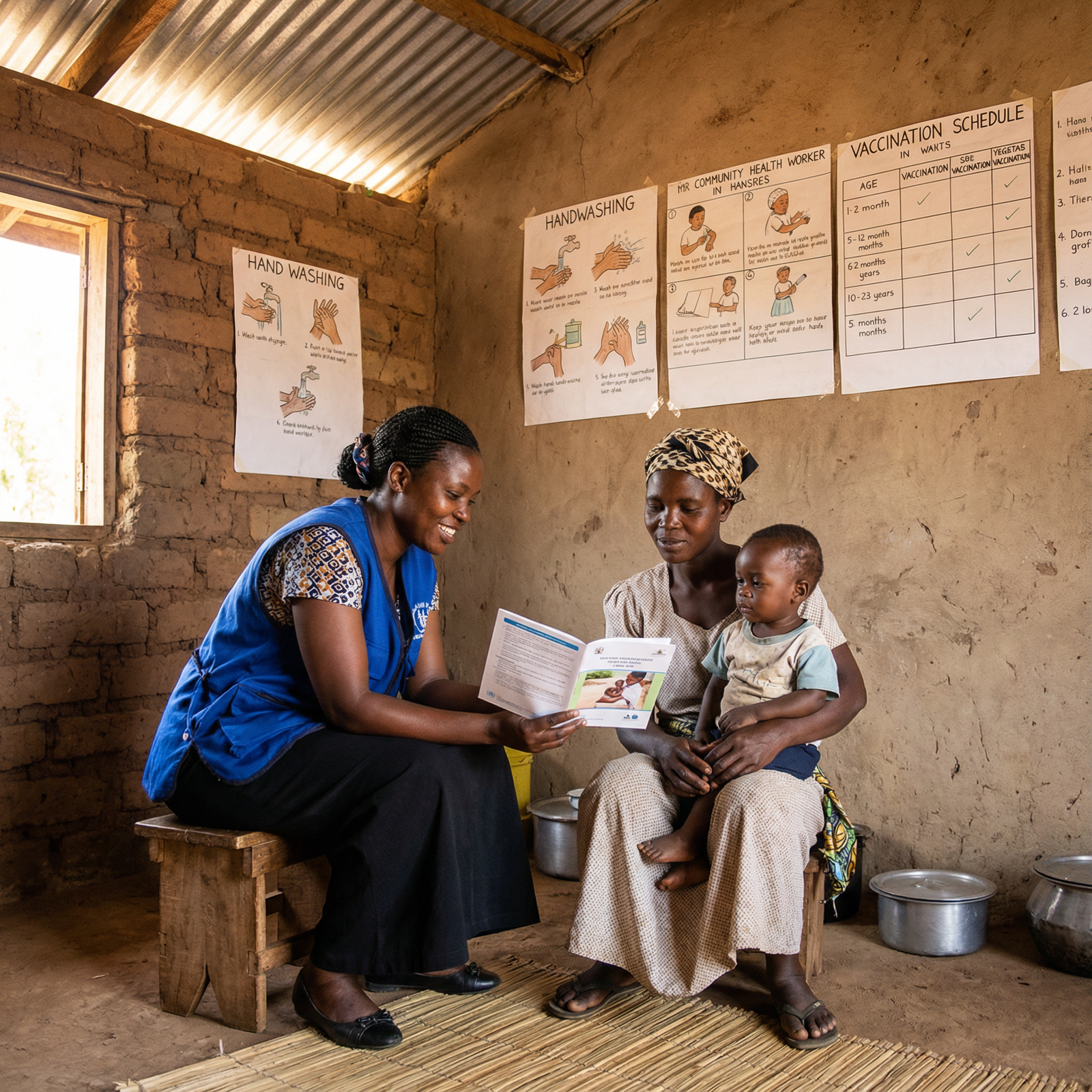
The worst global health gap years are improvised. The best ones are designed like a clinical trial.
You’re about to leave the structure of medical school and step into the chaos of real responsibility. A gap year in global health can either sharpen your judgment, deepen your ethics, and make your residency application stand out—or turn into a feel‑good photo album that quietly embarrasses you five years later.
Let’s design this year properly. Month by month, then quarter by quarter, then week by week on the ground.
12–18 Months Before Departure: Decide If You Should Even Do This
At this point you should not be googling “medical missions” yet. You should be asking three blunt questions:
- Why this, why now, why you?
- What are the risks—to you and to patients?
- How will this affect residency applications and timing?
12–18 Months Out: Clarify Purpose and Constraints
Block a half day. No phone, no internet. Just you, a notebook, and your actual motives.
Write out:
- Long‑term goal (e.g., “ID fellowship + policy work,” “rural FM with migrant health focus”).
- What you want to learn, not just where you want to go (e.g., “learn district‑level primary care systems,” “understand TB program implementation”).
- Non‑negotiables:
- Must match in X specialty, Y year.
- Debt, family, health constraints.
Then reality check:
- Talk to:
- 1–2 residents who did a global health year and are now in the specialty you want.
- 1 program director or APD: “Would this help or hurt my application in [specialty]?”
- Decide:
- Gap between MS4 and residency, or
- Built‑in global health track during residency instead.
If your debt, health, or family situation are on fire, delaying a paycheck for a year might be a bad call. I’ve seen people force this and regret it.
10–12 Months Before: Pick Your Model, Not Your Country
At this point you should be choosing a structure, not chasing Instagram locations.
Broadly, your options:
| Model | Pros | Cons |
|---|---|---|
| Structured fellowship | Mentorship, clear goals | Competitive, less flexible |
| Research year abroad | Strong for academia | Less clinical exposure |
| NGO program role | Systems & implementation skills | Variable supervision |
| Self-designed rotation mix | Maximum flexibility | High logistics burden |
10–12 Months Out: Decide on the Framework
Structured fellowship / program
Examples:- HEAL Initiative (post‑residency, but good model to study)
- Doris Duke International Clinical Research Fellowship (typically MS level)
- University‑affiliated global health fellowships
Use if:
- You want mentorship, letters, and a credible CV line.
- You care more about systems/research than raw procedure numbers.
Research‑heavy year abroad
- Join a PI with an ongoing project in HIV, TB, maternal health, etc.
- Often via your med school’s global health office.
Use if:
- You’re aiming at academic medicine or ID/IM/EM with research focus.
- You’re ok with less hands‑on clinical time.
-
- Work with an organization like Partners In Health, MSF (usually post‑residency, but sometimes student roles), Last Mile Health, etc.
Use if:
- You want to learn how care is actually delivered with broken supply chains and thin staffing.
- You can handle ambiguity and some chaos.
Self‑designed combo (rotations + language + research)
- Hardest to execute well.
- Easiest to drift into voluntourism if you’re not careful.
Only do this if:
- You have a strong in‑country mentor and institution.
- You’re willing to handle licensing, visas, housing, and supervision logistics yourself.
By the end of this phase, you should have:
- A chosen primary model.
- 2–3 possible host institutions or mentors identified.
- A preliminary sense of where (country/region), but not yet locked in.
8–10 Months Before: Align With Residency and Life Logistics
This is where most people screw up: they design a beautiful gap year and forget about the NRMP calendar, applications, or money.
8–10 Months Out: Timeline + Money
You’re fitting three overlapping timelines together:
- Your gap year
- Your residency application cycle
- The host site’s calendar and academic year
First, map the residency application year you’re targeting.
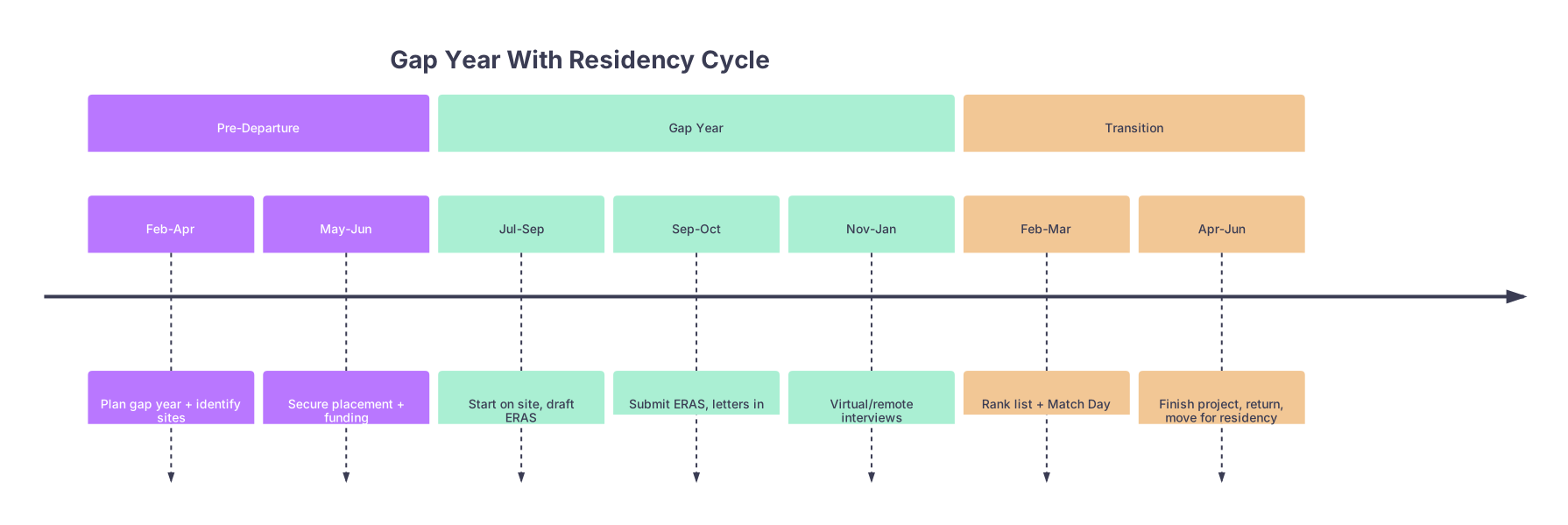
| Period | Event |
|---|---|
| Pre-Departure - Feb-Apr | Plan gap year + identify sites |
| Pre-Departure - May-Jun | Secure placement + funding |
| Gap Year - Jul-Sep | Start on site, draft ERAS |
| Gap Year - Sep-Oct | Submit ERAS, letters in |
| Gap Year - Nov-Jan | Virtual/remote interviews |
| Transition - Feb-Mar | Rank list + Match Day |
| Transition - Apr-Jun | Finish project, return, move for residency |
You must confirm:
- You can reliably access internet for ERAS, interviews, and rank list.
- Time zone won’t make interviews impossible.
- Your host site accepts you dipping out for virtual interviews and occasional trips home if needed.
Now the budget. Be brutal and specific. Estimate:
- Flights: international + in‑country
- Housing (range it; don’t pretend you’ll “just couch surf”)
- Food and local transport
- Insurance:
- Health insurance that covers overseas care
- Medical evacuation coverage
- Liability/malpractice (through home institution if possible)
- Visa / permits / licensing fees
- Program fees (if fellowship or NGO)
- Emergency fund (3–4 months of living costs minimum)
- Loan payments (if not in deferment)
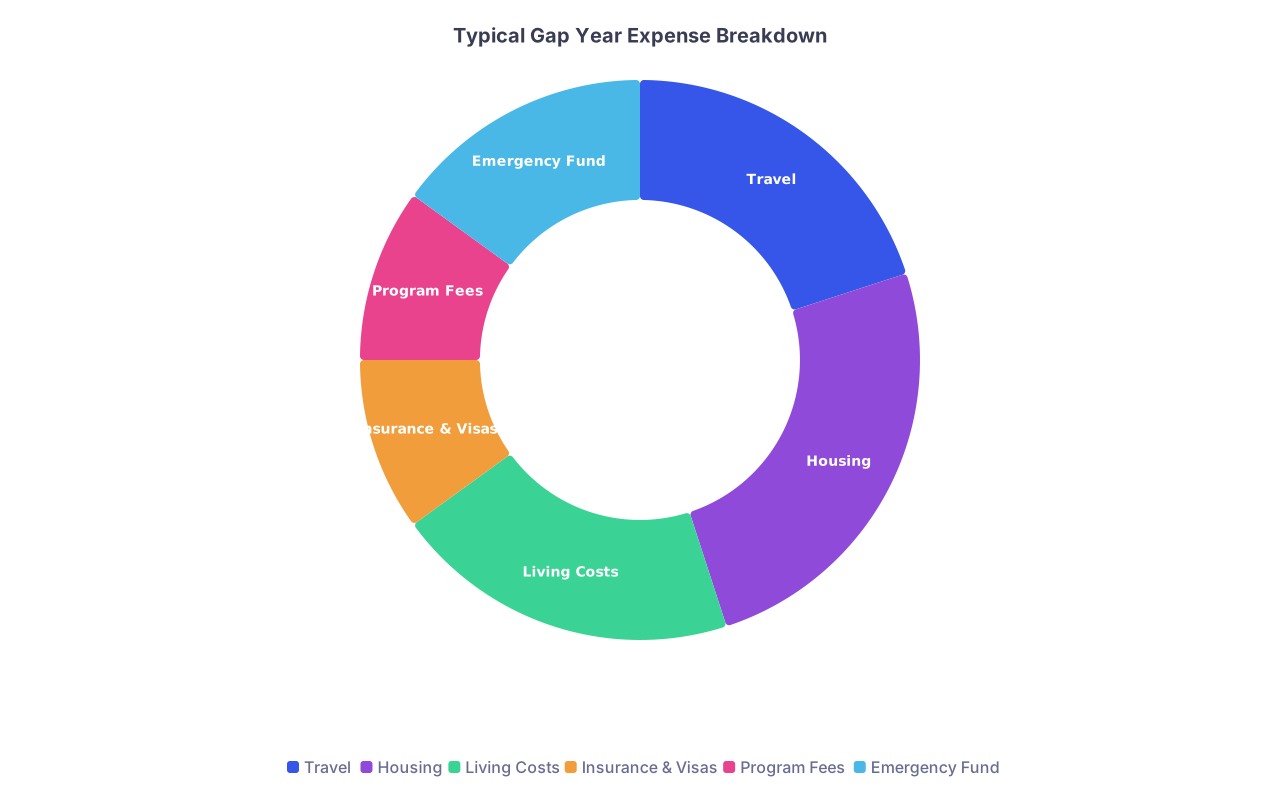
| Category | Value |
|---|---|
| Travel | 20 |
| Housing | 25 |
| Living Costs | 20 |
| Insurance & Visas | 10 |
| Program Fees | 10 |
| Emergency Fund | 15 |
At this point you should:
- Have a rough annual cost number.
- Have a plan to cover it (savings, scholarships, grants, paid role, loans, or combination).
6–8 Months Before: Choose Site & Protect Patients From You
Now we move from “I want to go to East Africa” to “I’m working with the district hospital in [specific town] under Dr. X, doing Y, with Z supervision.”
6–8 Months Out: Site Selection and Ethical Filters
Here’s the blunt ethical screen I use when advising students:
If the host site would let you:
- Intubate when you’ve never done it,
- Run a clinic solo as a student,
- Perform C‑sections as “helping out,”
…walk away. They’re desperate, not ethical.
You want:
- A local supervising physician who:
- Actually works there year‑round.
- Understands your training level.
- Has agreed in writing to your role and limits.
- A defined scope of practice that is no greater than what you’d do at home at your level.
- A host institution with:
- Existing collaborations with your med school / university, or
- A track record of training local staff, not just rotating foreigners.
Red flags:
- No clear supervision structure.
- You’re “the only doctor” for a clinic.
- They pressure you to “do more than you’re allowed to back home.”
- No discussion of data ownership or IRB if they mention “projects.”
At this point you should:
- Have a signed or at least emailed acceptance from the host site.
- Have a draft role description: 1–2 paragraphs, nothing fluffy.
4–6 Months Before: Build Skills So You’re Useful, Not Just Present
This is the part people skip, then regret on day three when they’re handed a stack of charts and can’t say “shortness of breath” in the local language.
4–6 Months Out: Academic and Skill Prep
Focus on three tracks:
Clinical content relevant to the site
- If you’re going to a rural district hospital:
- Obstetric emergencies
- Pediatric dehydration, pneumonia, sepsis
- Malaria, TB, HIV basics
- Snakebites, trauma, sepsis with limited resources
- Use:
- MSF clinical guidelines (they’re written for exactly this)
- WHO integrated management of childhood illness (IMCI) manuals
- If you’re going to a rural district hospital:
Language
- Pick the actual language patients use, not just the colonial language.
- Aim for:
- Greetings, symptoms, basic exam instructions, pain scales.
- Take:
- 2–3 months of structured classes (online tutor if nothing else).
- Make a cheat sheet:
- 1 page for ROS
- 1 page for physical exam and consent phrases
Ethics and safety
- Read:
- “Do No Harm” (Mary Anderson) for humanitarian practice.
- At least one good critique of “voluntourism” and short‑term medical trips.
- Complete:
- CITI human subjects training (if doing research).
- Your school’s global health prep elective, if available.
- Read:
3–4 Months Before: Nail Down Paperwork and Protection
At this point you should be drowning in forms. That’s normal.
3–4 Months Out: Administrative Checklist
University approvals
- Get your med school/global health office to sign off:
- Risk management review
- Legal / liability coverage
- IRB if research or data collection
- Get your med school/global health office to sign off:
Licensing / registration
- Clarify in writing:
- You are not acting as an independent physician.
- Your role is as a trainee under local supervision.
- If any form suggests you’ll be practicing independently, stop and clarify.
- Clarify in writing:
Visas and permits
- Confirm correct visa type (tourist vs work vs volunteer vs student).
- Apply now; some take months.
Vaccines and health
- Travel clinic visit:
- Country‑specific vaccines (yellow fever, typhoid, etc.).
- Malaria prophylaxis plan.
- Chronic meds:
- 12‑month supply if possible. Bring written scripts.
- Travel clinic visit:
Insurance
- Health insurance valid abroad.
- Medical evacuation coverage.
- Malpractice coverage (preferably via your home institution).
2 Months Before: Design the Year Like a Rotation Schedule
Now we get granular. Month‑by‑month on site.
At this point you should design your time in blocks, not as one long vague stay.
Example 12‑month structure:
- Months 1–2: Immersion + shadowing
- Months 3–5: Supervised clinical duties + mini‑project design
- Months 6–8: Implement project / QI / research + ongoing clinical
- Months 9–10: Consolidate project, train local staff, handover planning
- Months 11–12: Wrap‑up, data analysis, writing, and transition to residency
On‑Site Month 1: Humility and Observation Only
You land. You’re not there to “fix” anything in week one.
At this point you should:
- Be shadowing more than touching.
- Be learning more names than diagnoses.
Week‑by‑week, Month 1:
Week 1
- Show up early. Every day.
- Round with local teams. Say little, listen a lot.
- Learn:
- Pharmacy layout.
- How labs are ordered and returned.
- Where people actually document (often not where you expect).
- Ask:
- “What do outsiders usually get wrong when they come here?”
- Then write their answers down.
Week 2
- Start taking histories and doing exams under supervision.
- Present cases the local way, not the “US med student” way if they differ.
- Build trust:
- Do small, unglamorous tasks. Dressings, documentation, organizing supply closets. Yes, really.
Week 3–4
- Identify gaps you consistently see:
- Delayed antibiotics because of pharmacy workflow.
- Documentation chaos.
- Missed follow‑ups.
Do not announce a QI project yet. Just observe patterns.
Months 2–3: Earn Responsibility, Define a Small Project
By now, if you’ve done Month 1 right, staff will trust you enough to give real work.
At this point you should:
- Have clearly defined daily responsibilities.
- Start shaping a realistic project that will outlive you.
Clinical Work
- Agree on:
- Which wards/clinics you’re attached to.
- Who supervises you day‑to‑day.
- What procedures you can assist with vs only observe.
If you find yourself doing things beyond your level because “there’s no one else,” step back. Your responsibility is to patients, not your ego.
Project Design (Late Month 2–3)
Look for something:
- Bounded
- Measurable
- Desirable to local staff
Examples:
- Creating a simple sepsis triage checklist that nurses actually want.
- Standardizing the TB follow‑up tracking log.
- Short teaching modules on neonatal resuscitation, co‑taught with local staff.
Run it through this checklist:
- Does a local clinician or administrator care enough to own this after you leave?
- Can it fit in their existing workflow?
- Do you have (or can you get) proper IRB/ethics approval if collecting data?
Only then move ahead.
Months 4–8: Deep Work and Mid‑Year Reality Check
This is the meat of your gap year: steady clinical work + project implementation.
At this point you should have:
- A weekly structure, something like:
- 3–4 days/week clinical duties
- 1–2 half‑days for project/QI/research work
- 1 half‑day for language/class or community engagement
- Clear feedback loops:
- Regular check‑ins with local supervisor
- Remote check‑ins with home mentor
Mid‑Year (Around Month 6): Hard Self‑Audit
Sit down with:
- Your local supervisor
- Your home‑institution mentor (via video)
Ask bluntly:
- “What is and isn’t working with my role?”
- “Where am I overstepping or underperforming?”
- “If I left next month, what would actually remain from my work?”
If the answer to the last question is “not much,” then you adjust:
- Simplify the project.
- Focus on training local staff to own it.
- Document processes in writing, not just in your head.
Months 9–10: Build Handover, Not Dependence
At this point you should be intentionally working yourself out of a job.
Concrete steps:
- Shift from you doing the thing → you coaching someone local to do the thing.
- Create:
- 1–3 page “how‑to” documents for any process or tool you created.
- A shared folder (cloud or local) with:
- Templates
- Data collection tools
- Teaching slides
Ask:
- “Who will own this after I leave?”
- “Do they actually have the time and authority to own it?”
If they don’t, you haven’t designed something sustainable. Scale back.
Months 11–12: Closure, Reflection, and Returning Home
People love starting. They’re bad at ending. Don’t be that person.
At this point you should be:
- Actively transitioning:
- Patients
- Projects
- Responsibilities
- Preparing to re‑enter the US system and residency.
Final Month On‑Site Checklist
Clinical:
- No new long‑term projects or clinics started.
- Clear handovers for any patients you’ve been deeply involved with.
Project:
- Final in‑country meeting where locals present results/updates, not you alone.
- Written summary left with:
- Local supervisor
- Relevant department/administration
- Your home mentor
Ethical reflection:
- Write:
- 2–3 pages on mistakes you made and what you’d do differently.
- Specific ethical tensions you faced (resource allocation, scope of practice, consent issues).
- Talk:
- With someone who’s not starry‑eyed about global health.
- Let them poke holes in your narrative.
Re‑Entry (Last 1–3 Months Before Residency): Turn Experience Into Trajectory
The worst move is to come back and make your entire personality “I worked in [country].”
At this point you should:
- Update your CV:
- Concrete bullet points:
- “Co‑developed and implemented sepsis triage checklist in district hospital; used for ~300 admissions in 6 months.”
- “Delivered 8 bilingual teaching sessions on neonatal resuscitation to 25 nurses; pre/post scores improved X%.”
- Concrete bullet points:
- Prepare for residency interviews:
- Have specific stories:
- A time you said “no” to practicing beyond your training.
- A resource allocation dilemma.
- A systems workaround that was both safe and realistic.
- Have specific stories:
- Decide how this will shape:
- Your QI or research interests in residency.
- Future fellowship or global health track choices.
Core Takeaways
- Design the gap year like a serious clinical rotation: clear goals, supervision, scope, and evaluation—starting 12–18 months out.
- Protect patients from your enthusiasm: never practice beyond your training, prioritize local leadership, and build projects that can survive your departure.
- Tie everything back to your long‑term path: align with residency timelines, document measurable outcomes, and be ready to talk about ethical tensions, not just “helping.”


