

Ethical Photography and Storytelling in Global Health: A Clinician’s Guide
You are standing in a crowded outpatient clinic in northern Uganda. A child with severe malnutrition is being weighed in a makeshift hanging scale. The image hits you. The contrast of tiny legs, oversized scale, and the mother’s anxious face. You know this photo would raise money for your NGO in ten seconds flat. Your phone is in your pocket. Staff around you are snapping photos casually. No one seems to mind.
This is where most people get it wrong.
They think: “If it helps raise awareness and funding, it must be good.” Or, “Everyone else is taking photos; the local staff do not care.” Or, “I am just documenting for education.” That is how you end up with a thousand “global health” Instagram feeds that are essentially poverty porn with stethoscopes.
Let me be blunt: if you are practicing global health and you have a camera or a smartphone, you are responsible for not turning patients into content.
Let’s break this down precisely.
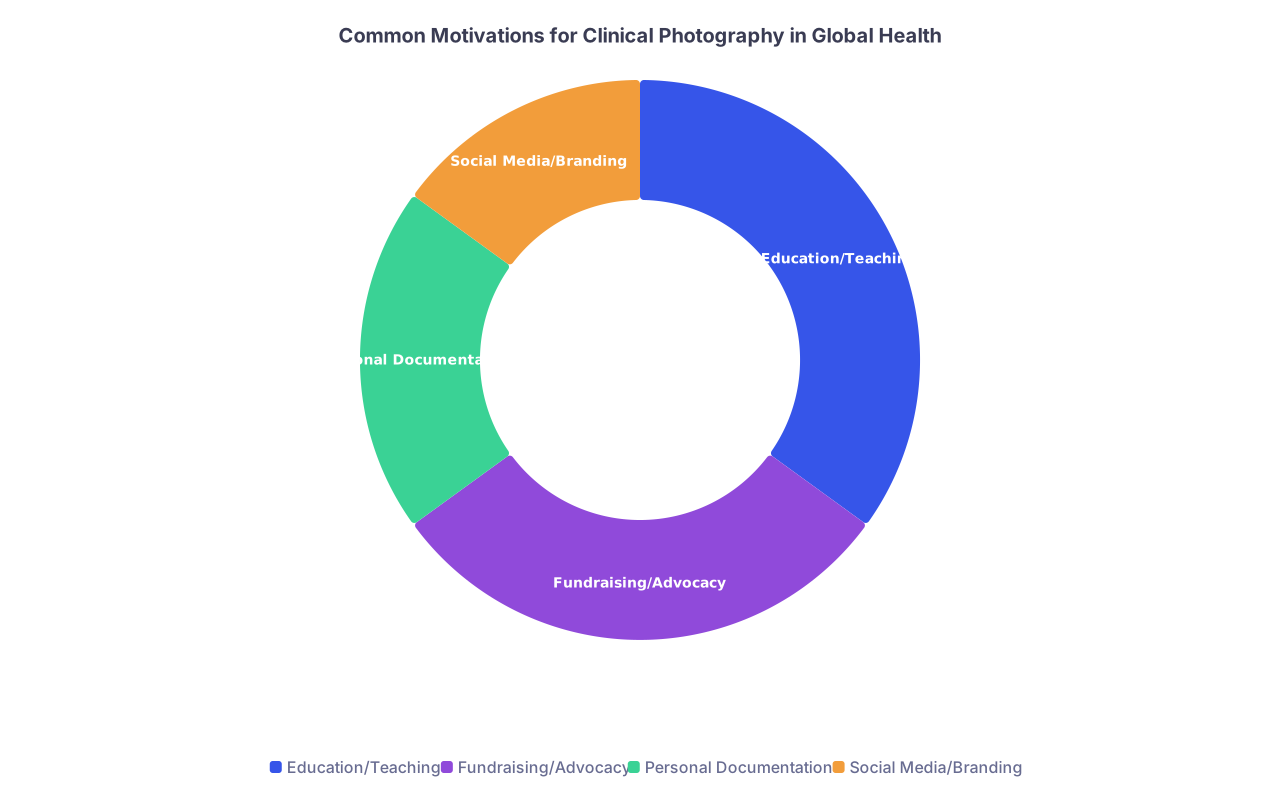
| Category | Value |
|---|---|
| Education/Teaching | 35 |
| Fundraising/Advocacy | 30 |
| Personal Documentation | 20 |
| Social Media/Branding | 15 |
1. The Core Ethical Problem: People vs. Content
Strip away the rhetoric. Ethical photography and storytelling in global health boils down to one question:
Are you treating this person as a full human being with autonomy, context, and dignity—or as a vehicle for your narrative?
You see this everywhere on short-term trips and even in large NGOs:
- Photos taken without consent “because it is just a crowd scene.”
- Close-ups of identifiable children with severe disease posted on Instagram the same day.
- Stories of “my patient who was dying of X until we arrived” told on blogs and podcasts, with zero consultation of the patient or local team.
- “Before/after” surgical photos thrown into PowerPoints, recognisable faces and all, because “this is what donors want.”
Clinically, you would never tolerate this at home. You do not photograph a patient in the US and put it on your personal Twitter, even if they look “inspiring.” You do not publish identifiable photos in a grand rounds talk without a signed, specific consent.
Yet a strange double standard emerges the moment someone lands in a “low-resource setting.” As if HIPAA and basic professional ethics evaporate with the Wi‑Fi signal.
Call it what it is: ethical inconsistency bordering on exploitation.
The global health context makes this worse, not better:
- Power differentials are sharper (wealth, race, language, passport).
- People may feel they cannot say no without jeopardizing care.
- Informed consent is harder to ensure across language and literacy gaps.
- Photos are more likely to leave the country and circulate globally, forever.
So your threshold for ethical scrutiny should go up, not down.
2. Ethical Frameworks That Actually Help You Decide
Let me link this to frameworks you already know, not vague “be respectful” slogans.
Respect for Persons (Autonomy)
Autonomy is not optional because you are “doing good.” Ethical photography means:
- Specific, informed consent for the particular use (teaching vs social media vs fundraising).
- Clear explanation in a language and format the person understands.
- Real ability to refuse, without penalty or subtle pressure.
If they cannot consent (child, unconscious patient), you ask: is this really necessary? Is there a legitimate clinical or educational reason that cannot be met another way? If not, do not take the photo.
Beneficence and Non‑maleficence
Ask two questions before you shoot:
- What concrete benefit will this image or story create, and for whom?
- What potential harms could arise—for the patient, community, or local system?
If your answer to #1 is “it might help awareness” and your answer to #2 includes “they could be recognized, stigmatised, or misinterpreted,” stop. Your benefit is hypothetical and diffuse; the harm is specific and permanent.
Justice
Justice in this context is about who controls the narrative and who bears the risks.
Too often:
- People in high‑income countries gain publications, careers, and praise.
- Patients and local communities gain nothing, or at best vague “awareness.”
- They have no ability to see, correct, or remove what is published about them.
If your photography and storytelling mainly amplify your career but not local voices or priorities, that is not justice. That is extraction.
3. Consent in Practice: How to Do It Without Cheating
This is where people start to wiggle. “We obtained verbal consent.” “It was implied.” “They smiled.” That is not good enough.
When You Must Get Written Consent
Any time:
- The person is identifiable (face, unique features, or clear context).
- The photo or story will leave the immediate clinical/teaching setting.
- You will use it for:
- Fundraising or marketing
- Social media (personal or institutional)
- External presentations, conferences, or publications
You need written consent. Ideally:
- In the patient’s primary language.
- At an appropriate literacy level.
- With a clear explanation of:
- Purpose of the photo/story
- Where it may appear (broadly defined)
- The fact that images online can be copied and shared beyond your control
- The right to refuse or withdraw (up until publication/irreversible distribution)
How to Explain Consent Ethically (Not Just Legally)
Do not just say, “Can I take your picture for education?” People will say yes because you are the doctor.
Instead, break it down simply, e.g.:
- “I want to take a picture of you / your child.”
- “This picture is not needed for your medical care. It is only for [teaching other doctors / showing donors / sharing online].”
- “If you say no, it will not change your care in any way.”
- “If you say yes, other people may see this picture. They may be in other countries. We will not put your name, but people here could still recognize you.”
- “You can say no now, or later before we share it. Saying no is completely okay.”
Then pause. Let silence work. If you feel relief when they say yes, that is your warning sign that pressure was present.
What About Verbal Consent?
Verbal consent is barely acceptable for:
- Non‑identifiable images (back of a head, de‑identified crowd) used strictly for internal teaching.
- Quick, in‑the‑moment images that will never leave your secure clinical or research archive.
Even then, I prefer a short, standardized script and documentation in the chart:
“Photo taken for internal teaching, patient verbally consented, explained no impact on care.”
Most of the “we had verbal consent” stories I hear are retroactive emotional justifications, not real ethical processes.
Patients Who Cannot Consent
Children, unconscious patients, severe cognitive impairment.
Here is my position: For any non‑clinical use (social media, fundraising, personal documentation), do not photograph them in an identifiable way. Period.
For genuine educational value (rare clinical finding, important procedural teaching):
- Get consent from a legal guardian when appropriate.
- De‑identify aggressively: angles, cropping, no faces, no unique tattoos or objects.
- Use the narrowest distribution possible (secure teaching platforms, closed groups, not public internet).
If you are thinking, “But this is such a powerful photo,” you are probably already offside.
4. Power Dynamics You Are Probably Underestimating
Consent in global health is distorted by power.
Patients may assume:
- Photos are part of their care.
- Saying no could anger the doctor or reduce attention.
- “Foreign” clinicians have authority over local staff.
Even local staff may feel they must agree to photos in the clinic because they depend on your NGO’s funding or want to keep the partnership.
You are not on equal footing. You are a visiting clinician, often perceived as wealthy and influential, holding tools and resources others lack.
That means:
- You must lean hard in the opposite direction—normalize “no” as completely acceptable.
- You should sometimes refuse to photograph even if someone encourages you, if the context feels exploitative.
- You should never hand your phone to a child and turn them into a “photo prop” for your social media, no matter how cute the shot.
If your social feeds are full of you surrounded by nameless Black or Brown children, but you do not post US patients that way—ask yourself why.
| Scenario | Ethical? | Key Issue |
|---|---|---|
| Identifiable malnourished child on Instagram, “my heart is broken” caption | No | Exploitative, no clear consent, poverty porn |
| De‑identified hand showing classic rash, used in a closed teaching session with consent | Yes | Clear educational purpose, limited audience |
| Crowded ward photo with faces blurred, posted publicly to “raise awareness” | Borderline | Context may still identify individuals, unclear consent |
| Local nurse portrait with name, celebrating her leadership, with signed consent | Yes | Dignity‑focused, agency preserved |
| Before/after surgery face photos in a donor newsletter without consent | No | Major privacy violation, long‑term harm risk |
5. Storytelling: How You Talk About Patients Matters as Much as Photos
Photography is only half the problem. The way clinicians tell stories in global health is often just as sloppy.
Common Storytelling Red Flags
I see the same patterns, over and over:
- “Hero narratives”: “When I arrived, patients were dying, but we saved them.”
Translation: erasure of local effort and expertise. - “Suffering porn”: graphic details of trauma, assault, or child death to emotionally shock donors.
- “Single story” of a country: one patient becomes the stand‑in for “how things are in [country].”
Ethically rotten. Also, embarrassingly shallow.
Three Questions Before You Tell a Patient Story
Ask these, every time, whether for a talk, grant, blog post, or podcast:
- Would I tell this story in exactly this way if the patient were in the room?
- Would I tell it this way if this were a patient from my own hospital at home?
- Do I have explicit permission to share identifiable details—or have I fully de‑identified and changed non‑essential elements?
If you cannot answer yes, you have work to do.
How to De‑identify Without Destroying the Truth
There is an art to this.
Keep:
- Clinical essence (diagnosis, key decisions, systems issues).
- Structural realities (drug shortages, staffing challenges, health system gaps).
Change or obscure:
- Age (approximate rather than exact).
- Exact location (region instead of specific town or village).
- Timeframe (month/year can be blurred).
- Non‑essential personal facts (number of children, profession, unique life events) if they make the person easily identifiable.
And never combine a story with an identifiable photo unless you have specific consent for that combined use.
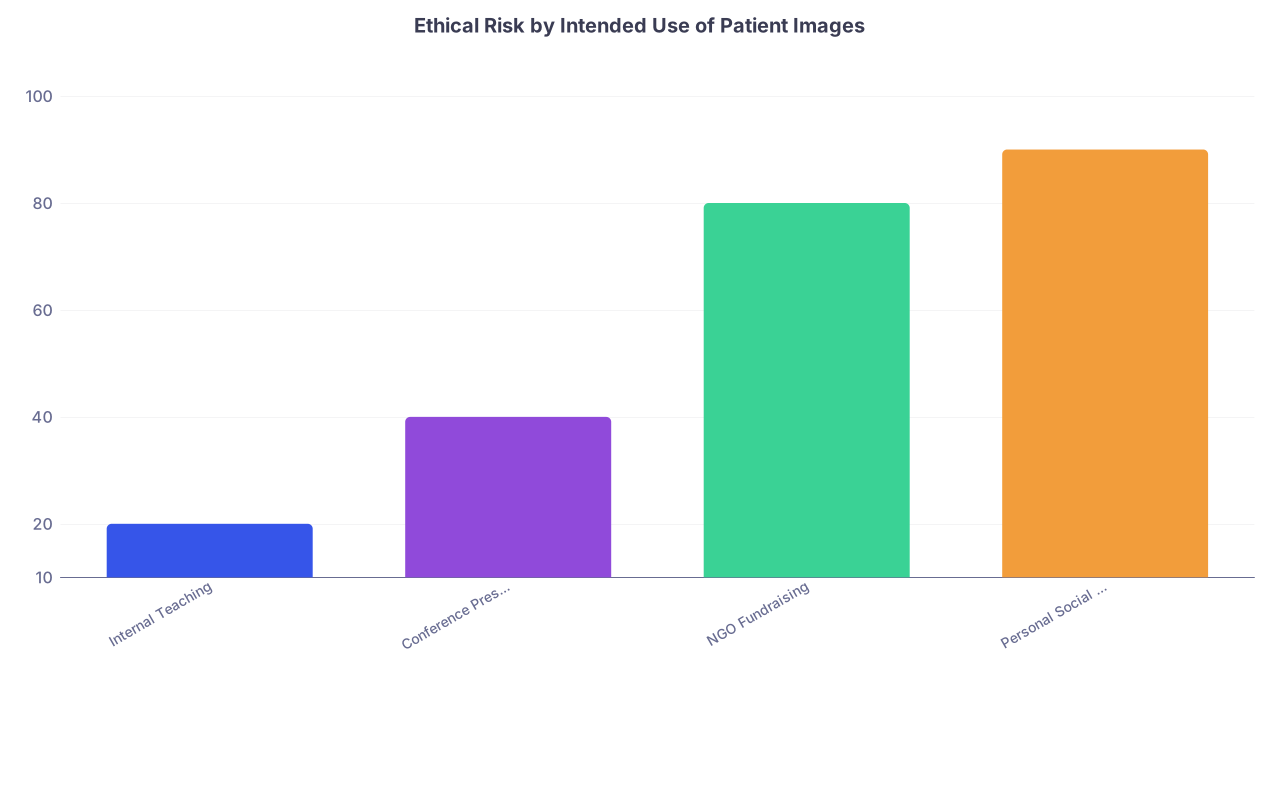
| Category | Value |
|---|---|
| Internal Teaching | 20 |
| Conference Presentation | 40 |
| NGO Fundraising | 80 |
| Personal Social Media | 90 |
6. Social Media: The Highest Risk, Lowest Justification Space
Let me be very direct: posting patient images from global health settings on your personal social media is almost always a bad idea.
The biggest problems:
- Instant, global, uncontrollable distribution.
- Zero meaningful benefit to the patient.
- Embedded self‑branding: however you spin it, the post is about your experience, your compassion, your “global work.”
If you are going to post at all:
- Avoid patient images entirely, especially faces. Use:
- Landscapes
- Clinic exteriors
- Photos of colleagues (with their consent)
- Abstract images (stethoscope on a table, medication vials, etc.)
- Focus captions on systems, not individuals:
- Describe health policies, infrastructure, local leadership.
- Highlight the expertise of local partners, not your own sacrifice.
- Delay posts:
- Do not live‑tweet from the bedside.
- Posting weeks or months later, after leaving, allows more thoughtful reflection and reduces risks of unwanted local attention.
If your practice at home is “no patient photos on my socials,” keep that same rule abroad. Anything else is double‑standard medicine.
7. Working Within Institutions and NGOs: Policies, Not Vibes
You might be thinking, “But my NGO encourages photos—donors want them.” Or, “Our university media team asked for ‘compelling patient stories’.”
That is exactly why you need structure.
Baseline Policy Elements You Should Demand
If you have any influence at all (and you probably do more than you think), push for:
- A written media consent policy for all international projects.
- Standardized, translated consent forms specific to:
- Clinical education use
- Research/publication use
- Marketing/fundraising use
- Storage protocols:
- Secure cloud or institutional drives, not personal phones forever.
- Clear naming conventions for consent status.
- A review process:
- No one posts or publishes patient images or stories without local partner review.
- Sensitive content flagged for institutional ethics review.
If your institution has strict HIPAA/PHI rules at home and almost nothing abroad, that is not an accident. It is because people have not pushed.
Push.
When the NGO Wants “Impact Shots”
You will hear this exact phrase from communications teams: “We need impact.”
Your response should be:
- Offer alternative visuals:
- Photos of staff in action (with their consent).
- Facility improvements, lab equipment, community meetings.
- Patient silhouettes with backlighting, wide angles that do not identify faces.
- Insist on consent workflows:
- No “shoot first, consent later” mass photo days.
- No photographing people in moments of acute distress—labor, dying, resuscitation—unless it is clinically essential and fully consented.
- Reframe “impact”:
- Real impact photos show partnership, dignity, and agency.
- If a donor will only give when they see a child’s ribs, that is a red flag about the donor—not a mandate to exploit patients.
You are a clinician before you are a marketer. Act like it.

| Step | Description |
|---|---|
| Step 1 | Consider taking photo |
| Step 2 | Photo for chart or teleconsult only |
| Step 3 | Store securely, no external use |
| Step 4 | Do not take photo |
| Step 5 | Explain risks and uses |
| Step 6 | Take minimally identifying image |
| Step 7 | Use only as consented and de-identify |
| Step 8 | Clinical care need? |
| Step 9 | Clear educational or advocacy purpose? |
| Step 10 | Can obtain informed consent? |
| Step 11 | Patient freely agrees? |
8. Practical Alternatives: How to Teach and Advocate Without Exploiting
You may be worried that if you follow all of this, you will not have anything compelling to show or teach. That is lazy thinking.
There are plenty of ethical tools if you are willing to do a bit more work.
For Teaching
- Use clinical sketches or diagrams instead of photos for classic findings.
- De‑identify images heavily:
- Crop out faces.
- Use angles that show lesions, not identities.
- Create composite or fictionalized cases that capture real patterns without exposing one person.
And involve local clinicians in case selection and presentation. Let them choose what best represents their reality.
For Advocacy and Fundraising
Focus on:
- System photographs: broken equipment, empty pharmacy shelves, water taps in the hospital courtyard.
- Process photographs: community health meetings, training sessions, policy workshops.
- Positive portraits: local nurses, midwives, physicians, and community health workers, named and honored—with their consent and input on how they are described.
You can make a powerful case for funding by showing that the system works when resourced, not only that patients suffer when abandoned.

9. Your Own Reflection: Why Are You Taking the Photo?
I will end with the most uncomfortable question. But it is the one that actually changes behavior.
When your hand goes to your phone in clinic, pause and ask:
Who is this really for?
- If the honest answer is, “For my memory, for my feed, for my future talk about what a meaningful experience this was,” that is about you.
- If the honest answer is, “For this patient’s clinical care, with documentation and consent,” that is coherent.
- If the honest answer is, “To show the world how terrible things are here,” that is dangerously close to turning someone’s worst day into your moral stage.
You are allowed to have your own feelings and experiences. You are not allowed to solve them by turning patients into props.
If you need to process, write in a private journal that never leaves your phone. Draw. Talk to a mentor. But stop defaulting to the camera roll.
10. Three Anchors to Remember
At the bedside, in the ward, or behind the camera, hold on to these:
Same standards everywhere.
If you would not photograph or publicly describe a patient this way in Boston or Berlin, do not do it in Blantyre or Bamako.Real consent or no photo.
Not “they smiled,” not “everyone does it,” not “the NGO wants content.” Clear purpose, clear explanation, clear freedom to say no.People before narratives.
The patient’s dignity, safety, and privacy outweigh your need for stories, grants, or likes—every single time.


