
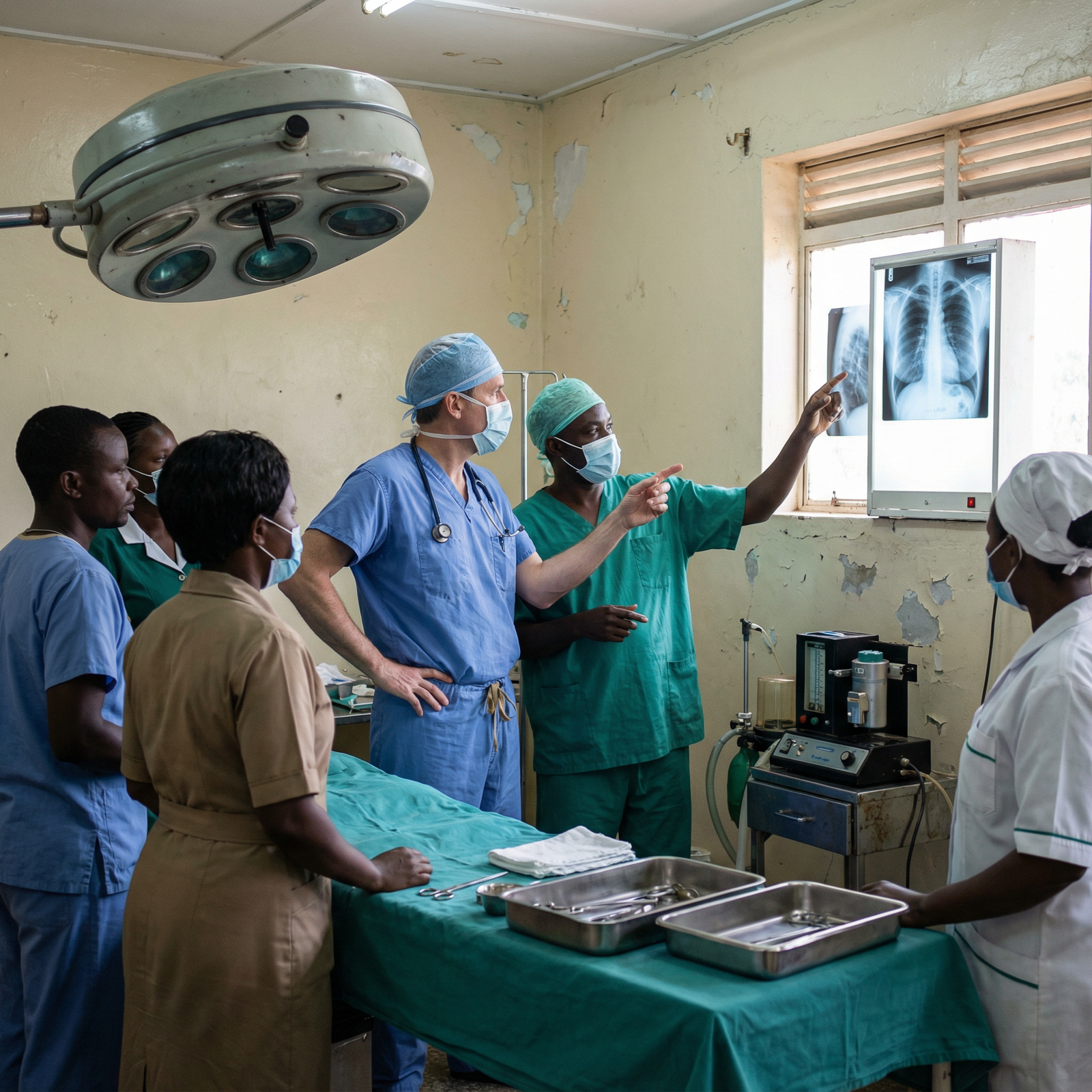
You are in a hot, cramped “theatre” in a regional hospital that runs at half-capacity most of the year and suddenly doubles its surgical volume when your team arrives. It is day three of a week-long hernia and fistula camp. The line of patients outside is longer than when you started. You have a post-op patient with a wound dehiscence, one with new-onset weakness in his hand after a brachial plexus block, and the driver is at the door reminding you the team must leave at 4 p.m. tomorrow to catch the only flight back.
The local junior doctor looks at you and asks, quietly: “So… who is responsible if he needs to go back to theatre next week?”
That is the question most mission-trip brochures never mention. And it is why the ethics of surgical camps are more complex—and frankly, more uncomfortable—than many people want to admit.
Let me break this down specifically.
1. What a “Surgical Camp” Really Is (Beyond the Brochure)
Strip away the glossy language and a surgical camp, in global health terms, is usually:
- A time-limited, high-volume burst of operative care
- Delivered by an external team (NGO, visiting academic group, faith-based mission, or corporate CSR project)
- In a health system that is chronically under-resourced
- With an implicit promise of “help” that patients and local staff may not feel free to question
You are compressing what should be a longitudinal care pathway—assessment, optimization, surgery, and follow-up—into a few intense days, then leaving. That structure creates three ethical pressure points:
- Consent is distorted by power, scarcity, and time pressure.
- Follow-up is precarious, outsourced, or vague.
- Complications float in a gray zone of “shared” but actually “displaced” responsibility.
If you do not design around those three, you are not doing ethical global surgery. You are doing short-term procedural tourism with a stethoscope.
2. Consent: When “Yes” Does Not Mean What You Think
You walk into a ward with 20 patients prepped for “free operations.” Most have waited for years. A translator is available, sort of. And you have 10 minutes per patient.
The Western IRB-approved template of “informed consent” falls apart here for very specific reasons.
2.1 Power and gratitude: the hidden coercion
Patients know you are the people who can make their hernia go away, or their child’s cleft lip repair possible after years of stigma. Everything—from the banner outside to the radio announcements—frames you as benefactors.
That changes the meaning of “voluntary” entirely.
I have heard this exact line more than once: “Doctor, you came from so far to help us. How can I say no?”
That is not truly free consent. That is obligation wrapped in gratitude. Ethically, your job is to push against that current, not ride it.
Concrete implications:
- You must present “no surgery” as a legitimate option, not just a theoretical one. With actual follow-up plans if they defer.
- You must decouple “free care” from “this one shot right now.” If patients believe this is their only chance ever, refusal is irrational, not autonomous.
2.2 Language, literacy, and the illusion of comprehension
Handing someone a translated form and reading a scripted paragraph is not consent. It is paperwork.
Common failures I have seen:
- Explaining “nerve injury” in a language that has no common clinical term for it, so patients hear “small risk the arm may be weak for a few days” when you actually mean permanent deficit.
- Using percentages (“a 1% risk of death”) in populations where numbers above 3 or 4 are not used in daily life. The patient hears: “Almost certainly safe.”
- Translators simplifying or omitting unflattering parts (“they will try not to…”) to avoid “scaring” the patient or “embarrassing” the team.
You want ethical consent? Then:
- Use analogy-based risk framing. “Out of 100 people, about 1 might…”, then draw it out or use stones/beans on the table.
- Ask teach-back, not “Do you understand?” Have the patient (or family) explain in their own words what might go wrong and who they will see if it does.
- Train your translators. Formally. They are not just language conduits. They are co-owners of the consent process.
2.3 Time pressure and the cattle-call problem
High-volume cataract, hernia, or cleft camps often aim for numbers. The funding report loves “we did 300 surgeries in 5 days.”
Ethically, that is a trap.
The moment you let numerical targets drive the clinic flow, consent turns into throughput. You will:
- Shortcut discussion of alternatives (“the local hospital could do it later for a fee…”)
- Skip nuance about follow-up (“if you live far, this might not be the best option”)
- Rush past red flags (patient not repeating risks correctly, family clearly uneasy)
If you are serious about ethics, you put hard caps:
- Max cases per day per surgeon, so pre-op conversations are not reduced to 90 seconds.
- A rule: no patient leaves the consultation without at least one open-ended question asked and answered (“What are you most worried about?”).
Do that, and you will perform fewer operations. Good. That is what ethical constraint looks like.
3. Follow-Up: You Own the Whole Episode, Not Just the Incision
Ethical surgery is not “cut and close.” It is longitudinal responsibility for a predictable arc of recovery, including the typical complications.
In a well-functioning system, that arc includes timely revisits, access to emergency care, and continuity with a known provider. In a camp model, that arc is amputated unless you build in specific countermeasures.
3.1 The brutal reality: many camps have no genuine follow-up plan
The common pattern:
- Day-of-surgery discharge or next-day review
- One follow-up clinic 48–72 hours later
- After that: “Go to your local hospital if you have problems” (which may lack the expertise, supplies, or interest to manage your complications—especially if they resent the visiting team)
So the high-volume week is followed by weeks or months of local clinicians handling the fallout from choices they did not control.
You cannot call that ethical. It is cost-shifting of risk and workload.
3.2 What real follow-up planning looks like
Real follow-up means you can answer, in detail, these questions before you book a single case:
- Who will see this patient if there is wound breakdown, infection, or bleeding on post-op day 5, 10, or 20?
- Does that person have:
- Authority (they can bring the patient back to theatre if needed)
- Skills (they can manage the likely complications of the specific procedure)
- Supplies (antibiotics, blood, sutures, imaging access)?
- How will the patient physically get there, and what will it cost them?
If you cannot answer all three with specifics, you are not ready to run a camp. Full stop.
You then design concrete systems:
- A written, simple follow-up plan on every discharge sheet: “On day X, go here, ask for NAME, this phone number.”
- Clear triage criteria for local staff: this type of pain is normal, this is alarming; any fever past day 3 comes in; any foul drainage comes in immediately.
- Pre-identified re-operation pathway: who can operate, under what conditions, and with what support if a complex revision is needed.
| Component | Unethical Model | Ethical Baseline Model |
|---|---|---|
| Follow-up visits | 0–1 visit then discharge | Scheduled visits at 1 week and 4–6 weeks |
| Named local clinician | None | At least one identified contact person |
| Emergency contact | “Go to nearest hospital” | Specific phone and facility named |
| Re-operation plan | Not discussed | Explicit agreement with local surgeons |
| Data tracking | Headcount only | Registry of outcomes and complications |
3.3 Handing off to local systems without dumping
There is a defensive instinct some teams have: “We do what we can while we are here. The rest is up to the local system.”
That sounds pragmatic. It is actually abdication masked as realism.
Handing off ethically looks different:
- You involve local surgeons in case selection and intraoperative decisions, so they understand exactly what was done and why.
- You document in a format that matches local practice and language, not your home-country template.
- You leave behind what is needed to manage common complications—suture, antibiotics, dressings, sometimes even funds earmarked for specific re-operations.
You are not “helping” if your work generates a cascade of resource-draining problems without the tools to fix them.
4. Complication Ownership: Who Actually Holds the Knife, Ethically
This is where it gets uncomfortable. Because complications are not aberrations. They are part of the statistical fabric of surgery.
If you operate, you will harm a subset of patients. Ethically owned harm is part of honest practice. Displaced harm—where the risk is borne by people far away in time and space—is not.
4.1 Moral responsibility vs. legal responsibility
In these settings, legal recourse is often minimal or nonexistent: no malpractice suits, no professional tribunals that touch foreign volunteers. So your accountability is almost entirely moral and professional.
That is exactly why complication ownership has to be explicit:
- “We will be responsible for supporting re-operations for our complications for X period, in Y way.”
- “We accept that if our choice of technique or case selection leads to downstream cost, we will contribute to addressing it, not just shrug and say ‘that is global surgery.’”
If your team leadership cannot articulate that policy in a paragraph, they are not ready.
4.2 Common ways teams quietly dodge ownership
I have watched this play out too many times:
- A camp does advanced laparoscopic cases in a hospital that has no laparoscopy service when they are gone. Ports, trocars, insufflators all leave with the team. Six weeks later, a patient with a bile leak arrives and the local team must convert to an open salvage operation with limited imaging. The visiting team reports “laparoscopy service introduced successfully.”
- A visiting team introduces a technique for complex fistula repair that local surgeons have not seen, then leaves. When breakdown happens, the local team has to undo or revise a reconstruction they never learned to perform.
In both cases, the external team has extended the risk envelope beyond what the local system can safely manage. That is unethical.
Ethically defensible practice means:
- You match your surgical complexity to the local capacity for follow-up and salvage, not to your visiting skillset or ego.
- You explicitly ask: “If this goes badly in the way it typically can, can the local team manage it without us?” If the answer is no, you either:
- Do not perform that procedure here, or
- Build a serious plan, with funding and training, so they can.
4.3 Financial responsibility: who pays for the mess?
Complications cost money: re-operations, transfusions, extended hospital stays, lost wages, transport. If your camp model assumes the host institution or the patient will eat those costs, you have externalized the downside of your “service.”
More ethical models:
- Establish a complication fund, controlled jointly by local and visiting leadership, earmarked for additional care of patients operated during the camp.
- Cover transport costs for patients who must travel back to the referral center because of a complication directly linked to your camp’s surgery.
- Do not require out-of-pocket payment for re-operation for a complication you created, in patients who were told the surgery was “free.”
If that sounds financially onerous, that is because surgery is costly. If your project budget has room for branded t-shirts but not for complication coverage, your priorities are wrong.
5. The Local Clinician’s Perspective: Burden, Blame, and Bystander Status
It is very easy to experience surgical camps from the visiting side only: the gratification of “helping,” the attractive case mix, the photos. If you want a serious ethical stance, look from the other side of the drape.
5.1 Extra work, little control
Local clinicians often:
- Do double duty: coverage of their usual service plus pre-op, intra-op support, and post-op management for your patients.
- Have limited or no say in what cases you choose. NGO decides “we are doing 80 clefts,” though the biggest local surgical burden might be emergency laparotomies or obstetric fistulas.
Then, when things go wrong, they:
- Receive the patient back to their ward with a partially translated note and a smile.
- Face family anger in their language, not yours.
- May be blamed by administrators or community leaders for bad outcomes of operations they had no real agency over.
That combination—responsibility without control—is the definition of ethical asymmetry.
5.2 Token “capacity building” as a smokescreen
Many camp programs advertise “training and capacity building.” Often this means “local staff can scrub in with us if they are free,” while you rush through cases with your own team at your preferred speed.
That is not capacity building. That is spectator sport.
If you are genuine about local empowerment, you:
- Co-plan the camp with local leadership: which pathologies, which techniques, what volume.
- Agree in advance what training outcomes are expected: “By the end, Dr. X will independently perform basic mesh hernia repairs,” for example.
- Slow down your own throughput to actually teach—talk through decisions, allow local surgeons to operate primary cases, not just close skin.
That will lower your surgical count. Again: so be it. Ethical alignment > case numbers.
6. Data, Outcomes, and the Temptation to Self-Congratulate
Surgical camps love glossy numbers: “We performed 200 life-changing surgeries!” without mentioning the 5 who had major complications or the 20 who never showed up for follow-up because transport was impossible.
You want to claim ethical ground? Then you commit to transparent outcomes, not just volume.
6.1 Tracking beyond the last day of camp
You need a minimal registry that includes, for each patient:
- Contact information and home location
- Diagnosis and procedure
- Surgeon (visiting vs local)
- Immediate complications (intra-op, early post-op)
- Follow-up attendance and late complications up to a defined horizon (often 30 or 90 days)
Then you share that data:
- With the host facility leadership
- With your funders, without airbrushing
- With your own institution, if you are academic
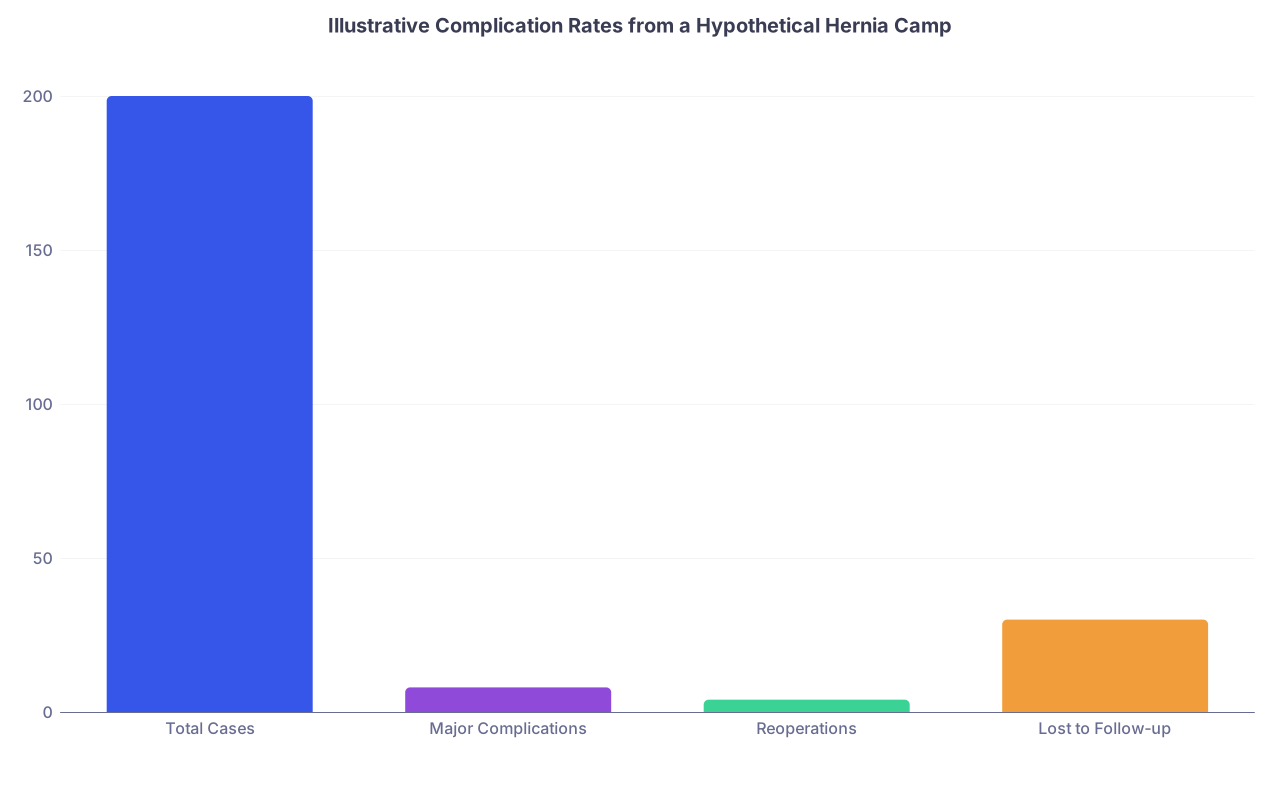
| Category | Value |
|---|---|
| Total Cases | 200 |
| Major Complications | 8 |
| Reoperations | 4 |
| Lost to Follow-up | 30 |
If you see a 15% lost-to-follow-up rate, you do not just shrug. You redesign the next camp: fewer remote patients, transport stipends, stronger community health worker linkage.
6.2 Stop using patients as your portfolio
Medical trainees especially fall into this: you come home with a slide deck of “interesting cases” and stories that make you look brave, altruistic, and “global.”
If you never mention:
- The patient who decompensated post-op when you were already on the plane
- The local nurse who cried because she had to “explain your complication” in her language
- The follow-up challenges that scared you
…then you are still treating these trips as character-building exercises for yourself, not as ethically weighty interventions on other people’s bodies.
Use the data and the hard stories to change your practice, not just your personal statement.
7. How to Decide: Should You Participate in a Surgical Camp at All?
Personal development and medical ethics intersect here. You are trying to grow as a clinician and as a person. You will be pitched mission trips and “volunteer opportunities.” Some are excellent. Many are sloppy. A few are actively harmful.
You need a personal filter. Let me give you a concrete one.
7.1 Questions you should demand clear answers to
Before you sign up, ask:
- Who selects the cases, and how? Is there a triage committee with local clinicians, or just “whoever shows up”?
- What is the plan for follow-up, concretely? Names, dates, locations. Not “we’ll leave information.”
- Who manages complications when you are gone? Has that person agreed to this role?
- Is there a written understanding with the host facility about cost coverage for complications and re-operations?
- How are local trainees or surgeons involved? Are they operating, or just observing?
- What outcomes have you tracked historically? Can I see them?
If the organizers give vague answers, deflect, or focus only on “impact stories,” that is your warning sign.
7.2 Your own red lines
You should have non-negotiables. Examples that I think are reasonable:
- You do not operate independently above the level you would at home under supervision, just because oversight is laxer.
- You do not participate in a camp that does not have an identified and willing local clinician responsible for ongoing care.
- You do not buy into metrics that reward volume without tracking harm.
If that means you turn down some trips, good. This is how you build an ethical spine, not just a global-health-themed CV.
8. Better Models: Moving Beyond the “One-Week Heroism” Template
I am not arguing that all surgical camps are unethical by definition. Some are carefully structured, longitudinal collaborations that happen to involve intense weeks of activity. The difference is in how they handle consent, follow-up, and complication ownership.
Better models tend to share specific features:
- Long-term partnerships (same sites, same teams, over years, not one-offs)
- Progressive transfer of skills and ownership to local surgeons
- Honest reporting of negative outcomes and program redesign in response
Here is a simple contrast.
| Feature | One-Off Camp | Longitudinal Partnership |
|---|---|---|
| Duration of link | 1 week, then gone | Years, with recurring visits |
| Local leadership | Consulted late or minimally | Co-leads agenda and case selection |
| Training focus | Opportunistic, ad hoc | Defined skills with progression over time |
| Follow-up | Weak, short horizon | Integrated into local clinic systems |
| Complication ownership | Implicit, vague | Explicit agreements and funding |
If you want your work to matter ethically and clinically, you aim for the right-hand column, even if you temporarily operate within left-hand constraints. That might mean you go back to the same place repeatedly, invest in boring things (protocols, relationship-building, data), and accept that “personal development” sometimes looks like tedious system work, not drama in the OR.

| Step | Description |
|---|---|
| Step 1 | Offered surgical camp opportunity |
| Step 2 | Decline or push for redesign |
| Step 3 | Request stronger local leadership role |
| Step 4 | Proceed with caution |
| Step 5 | Join and commit to honest outcome reporting |
| Step 6 | Clear plan for follow-up and complications |
| Step 7 | Local clinicians co-leading |
| Step 8 | Willing to adjust model |
| Step 9 | Personally operating within competence |
9. Three Things to Carry Forward
Consent in surgical camps is heavily distorted by power, scarcity, and speed. If you are not actively counteracting those forces, you are not getting true informed consent.
Follow-up and complication ownership are not logistical afterthoughts; they are the core ethical test. If you cannot say who will see your patient at day 7 and who will re-operate at day 21, you should not book the case.
Your “global health” work is only as ethical as the burden it leaves behind. Measure not just how many you operate on, but who pays—clinically, financially, and emotionally—when things inevitably go wrong.


