

You are standing in a one‑room district hospital “ER” at 2 a.m. The power just came back on after a 4‑hour outage. The nurse hands you a chart: a 23‑year‑old woman, postpartum day 1, now hypotensive with abdominal pain. The ultrasound shows a lot of free fluid, the closest surgeon is 3 hours away on a good day, and the only ambulance driver is at home, phone off, because fuel stocks were “reallocated” yesterday for a political convoy.
You have to decide: move her or keep her. And if you move her, how?
That is the real ethical and operational core of referral systems in fragile states. Not some abstract “strengthening the health system” phrase in a strategy document. It is this exact moment: a sick patient, limited options, and a dangerous road between you and definitive care.
Let me break this down specifically.
1. What “Referral System” Really Means in a Fragile State
People hear “referral system” and think polished algorithms, triage forms, and GPS‑tracked ambulances. In fragile states, it usually looks more like:
- A cracked Nokia phone that sometimes has airtime.
- A handwritten logbook.
- Maybe one vehicle that doubles as staff transport, ambulance, and hearse.
- A referral “policy” nobody has read in years.
So let us use a definition that actually fits reality:
A referral system is the set of agreements, processes, and tools that allow a patient to be moved from where they are to somewhere better equipped, without making them worse or disappearing them in the process.
That includes:
- Clinical decision rules: When do you refer? When do you not?
- Communication: Who do you call? How? What information must be sent?
- Transport: What moves the patient? With whom? With what equipment?
- Continuity: What happens at the receiving site? And what happens if they say no?
In stable systems, the backbone is infrastructure. In fragile ones, the backbone is relationships and predictable patterns of behavior.
If you ignore that and try to copy‑paste Western referral protocols, you will fail. I have watched NGOs do this repeatedly.
2. The Risk Equation: When “Referral” Becomes Harm
The key question is not “Can we refer?” It is:
Does the probability of meaningful benefit outweigh the risk of deterioration or death during transfer?
Put more bluntly: are you sending this patient on a 4‑hour, unmonitored, bumpy, armed‑checkpoint‑filled ride to die in the back of a pickup instead of in your ward?
You need a mental model. Here is one that actually works at the bedside.
| Factor Category | Low Risk (Favors Referral) | High Risk (Caution / Stabilize First) |
|---|---|---|
| Clinical stability | BP stable, mentating, airway secure | Shock, labored breathing, GCS ↓ |
| Time to facility | <1–2 hours, predictable | >3–4 hours, roadblocks, insecurity |
| Transport capacity | Trained escort, oxygen, IV, basic drugs | Unaccompanied, no O2, no monitoring |
| Receiving facility | Capacity confirmed, bed available | Unknown status, prior refusals |
| Context/security | Daylight, stable route | Night, active conflict, curfew |
You will not run a formal risk score at 2 a.m., but this is the logic you should be using.
Clinical considerations that matter more than textbooks suggest
Some specific patterns:
- Airway risk: Anyone with fluctuating consciousness, active vomiting, facial trauma, or major neck injury going on an unmonitored trip is a red flag. If you cannot secure the airway or at least position, suction, and train an escort to manage the basics, referral may be more dangerous than staying.
- Uncontrolled hemorrhage: Postpartum hemorrhage, major trauma, ruptured ectopic. If you are sending a bleeding patient without adequate IV access, fluids, uterotonics or tranexamic acid (if indicated), and someone who knows how to use them, you are not “referring”. You are outsourcing your mortality.
- Sepsis and pediatrics: A febrile 2‑year‑old with respiratory distress and hypoxia should not sit for 2 hours without oxygen because you were “waiting for blood tests” before deciding. In children and sepsis, time to antibiotics and oxygen trumps most other variables.
You are constantly balancing:
- Can I stabilize enough here to make transfer survivable?
- Does the delay from stabilization destroy the benefit of the referral?
You will get this wrong occasionally. The ethics piece is whether your decision process was structured, honest, and grounded in available evidence, not whether every outcome is good.
3. Anatomy of a Safe Referral Pathway: The Non‑Negotiables
Let us lay out what a minimally functional, ethically defensible referral process looks like in a fragile context. Not ideal. Achievable.
3.1 Pre‑transfer: Decide, stabilize, communicate
You need three actions before anyone moves:
Make an explicit decision to refer
Not “let us see what happens while the family calls a car.” You document a decision:- Working diagnosis
- Reason for referral (“needs laparotomy”, “needs ICU‑level oxygen”, “needs CT head and neurosurgery”)
- Level of urgency (immediate, urgent, semi‑elective)
If you cannot articulate this clearly, you are not ready to refer.
Stabilize to the maximum capacity of your facility
Translation: use what you actually have, not what the guidelines say you should have.At a minimum for very sick patients:
- Establish at least one reliable IV line (two for bleeding/trauma).
- Start fluids or blood if indicated, and document how much given.
- Administer first‑line antibiotics for suspected sepsis.
- Give pain control and antiemetics when appropriate.
- For respiratory distress: oxygen, positioning, consider bronchodilator or diuretic depending on suspected cause.
- For obstetric emergencies: uterotonics, IV fluids, measure blood loss as best you can.
The common mistake: calling the ambulance first, stabilizing second. Flip that. Prep the patient while someone else starts the transport process.
Communicate with the receiving facility
Not “We are sending a case, please receive.” That is how you end up with a critically ill patient sitting in a corridor because the only ICU bed was taken an hour ago.The minimum call should include:
- Patient age, sex, key vitals, major concern.
- Working diagnosis and reason for referral.
- What you have done already.
- What you realistically expect from them (surgery, blood, advanced imaging, ICU).
- Estimated time of arrival.
And very specifically: “Do you have capacity to take this patient now?”
If they say no? That is where the ethical compression starts. More on that later.
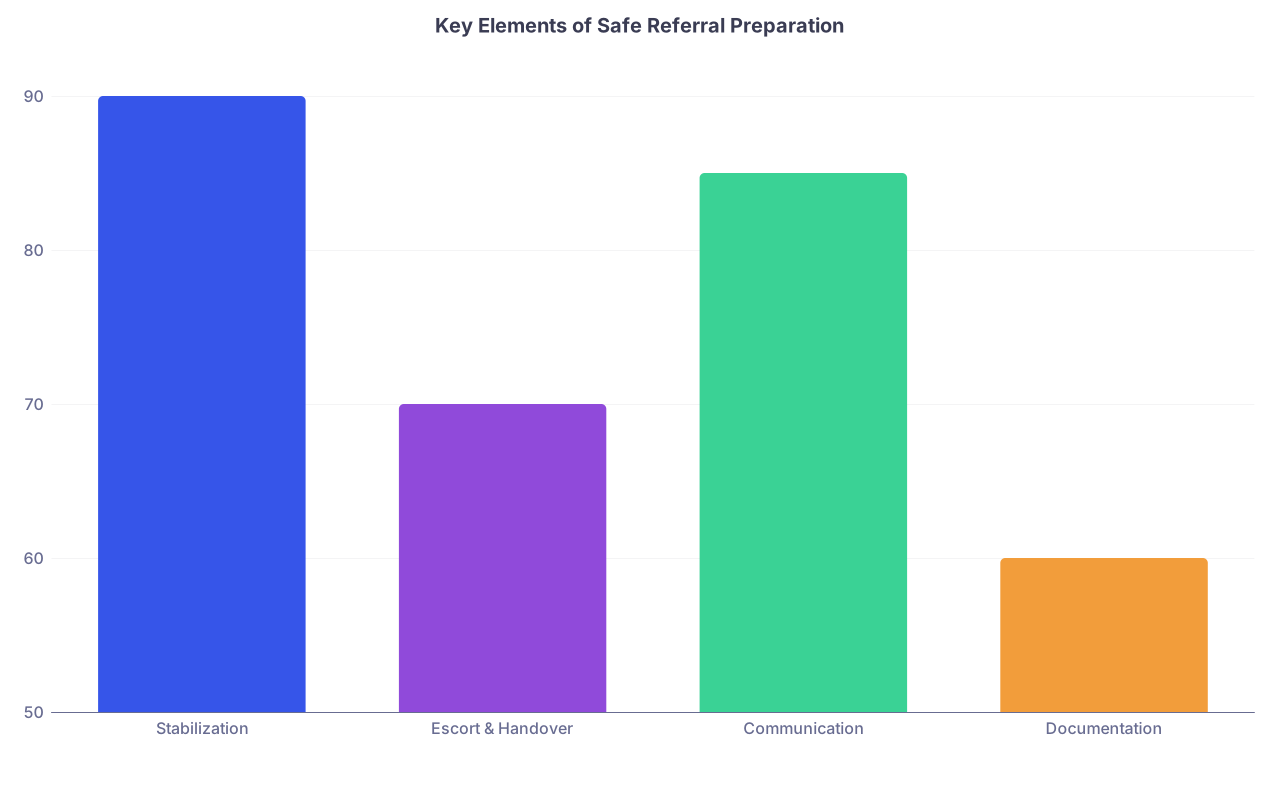
| Category | Value |
|---|---|
| Stabilization | 90 |
| Escort & Handover | 70 |
| Communication | 85 |
| Documentation | 60 |
(Interpretation: in most fragile settings I have seen, stabilization and communication are done more often than not; escorting and documentation are the weak links.)
3.2 During transfer: What must be present in or around the vehicle
Forget the dream of a fully equipped ambulance with paramedics. In most fragile states, you will have:
- One basic ambulance / 4×4 vehicle with stretcher.
- Occasionally, a private car or motorcycle taxi (yes, really) for less severe cases.
- Variable availability of oxygen and monitoring.
- Limited trained escorts.
So define minimum safe package for high‑risk transfers:
-
- Manage an IV line, identify hypotension, give basic meds.
- Position airway and manage simple airway maneuvers.
- Recognize deterioration and call for help on arrival.
Equipment and supplies proportionate to the risk:
- Oxygen cylinder with enough volume for the trip.
- IV fluids, giving sets, tape, extra cannulae.
- Essential drugs: adrenaline, salbutamol, antibiotics, uterotonics, analgesia.
- Simple monitoring (even a manual BP and pulse oximeter is a big step above nothing).
- Basic delivery kit for pregnant women (for the inevitable en‑route birth).
Documentation (paper in a plastic envelope):
- Brief referral note: vitals, diagnosis, treatments given, allergies, relevant history.
- Lab results or imaging reports if they exist.
- Contact info for the referring clinician.
If your system routinely sends severely ill patients alone, with no escort and no documentation, that is not a referral system. It is patient dumping.
3.3 On arrival: The “handover that actually happens”
You want to avoid the very common scenario where the receiving team has no idea how sick the patient is until after the stretcher has been pushed into a corner.
A functional arrival flow:
- Escort gives a 30–60 second verbal handover to a named clinician:
- “23‑year‑old, postpartum day 1, suspected intra‑abdominal hemorrhage. BP 80/50 on arrival to us, now 90/60 after 1 L normal saline and 1 unit blood, HR 124, RR 28, pale and restless, abdomen distended and tender. We started oxytocin and tranexamic acid. No known allergies.”
- Written note is handed over and briefly skimmed.
- The receiving team repeats vitals immediately and assigns location (resus bay, OR, ICU, ward).
Without that, delays multiply. And in emergencies, delay is the main killer.
4. Triage and Prioritization When Everything is Broken
Here is the uncomfortable truth: in fragile states, you often cannot refer everyone who would benefit. Not enough vehicles, drivers, fuel, security, beds, or staff. You will ration.
That rationing needs to be conscious and ethically defensible, not just “whoever shouts the loudest goes first”.
4.1 Two questions to sort out priorities
When referral capacity is limited, ask:
- How much incremental benefit is the higher‑level facility likely to give this specific patient?
- What is the probability they will survive the transfer long enough to receive that benefit?
That creates rough categories:
- High survival chance + high expected benefit → highest priority.
- High survival chance + modest benefit → consider, especially if low transport risk.
- Low survival chance + high benefit if they survived (e.g., massive intracranial hemorrhage needing neurosurgery 8 hours away) → gray zone.
- Very low survival chance + high transport risk + system strain → sometimes you do not refer. And you own that decision.
Examples:
A 25‑year‑old with an open tibia fracture, hemodynamically stable, in pain but otherwise okay, needing ORIF.
- High survival likelihood and clear benefit from referral. If you have limited vehicles, they should not bump your ruptured ectopic who is actively bleeding, but they also should not wait days because “not immediately life‑threatening.” Orthopedic disability is long‑term, real harm.
A 60‑year‑old in cardiogenic shock with suspected STEMI 6 hours from a cath lab that may or may not be functioning, no thombolytics on site, no vasopressors for the road.
- Theoretical benefit from referral is high. Realistic chance they reach that cath lab alive and appropriately treated? Quite low. This is exactly the kind of case where, in fragile contexts, conservative/palliative management on site might be more ethical than a brutal ride to nowhere.
Triage is not just about urgency, it is about yield. What are you likely to gain for this patient, with these resources, today?
4.2 Referral queues and transparency
A system that deals honestly with scarcity:
- Maintains a visible queue (even if it is just a whiteboard) of patients awaiting transfer.
- States the criteria for bumping someone up the queue (e.g., new life‑threatening bleed).
- Documents when referrals are canceled or downgraded, and why.
You are not building a bureaucracy; you are protecting yourself and your patients from arbitrary, sometimes corrupt, decision‑making.
I have seen ambulances diverted at the last minute to transport officials, leaving critical patients waiting. Written queues and logs make that harder to hide.
5. The Ugly Layers: Politics, Security, and Money
If you pretend referral decisions in fragile states are purely clinical, you will miss 50% of the story.
5.1 Security and access
No, you do not send an ambulance through an active firefight because “the protocol says urgent.” You also do not leave it to the driver’s personal bravery each time.
You need pre‑negotiated rules with security actors:
- Agreed routes and times when medical vehicles are not to be targeted (and you document, repeatedly, when this agreement is violated).
- Clear markings on vehicles and staff (yes, they might still be attacked, but lack of marking almost always makes it worse).
- Standing rules: no armed escorts inside the ambulance compartment, no transporting combatants in the same vehicle as civilians, etc.
Medical neutrality is not just an ICRC training slide. It is a strategic asset that, if consistently demonstrated, can actually protect your referrals.
5.2 Financial realities: who pays for the trip?
In a lot of places, this is the real bottleneck. Families are asked to:
- Pay for fuel.
- Pay the driver “per trip”.
- Pay informal fees at checkpoints.
- Pay at the receiving facility on arrival.
So patients delay or decline referral. Or they discharge against medical advice and try to hitchhike.
Ethically, the bar is simple: life‑saving referrals should not depend on a family’s immediate cash on hand.
If your facility or project has any say:
- Create a specific, protected budget line for emergency transport.
- Make it explicit to staff that they cannot charge separate “transport fees” for emergency referrals.
- Monitor for extortion at every level—drivers, clinicians, guards.
Because otherwise, your triage grid is meaningless. The actual triage becomes: whose family can pay.
5.3 Politics and “VIP referrals”
Here is where you need a spine.
You will get requests to use scarce ambulances for:
- Non‑urgent transfers of officials or their relatives.
- Inter‑facility transfers of political favorites (“Send him to the capital for a check‑up”).
- Bodies.
If you always say no, you may lose political cover and then lose your whole ambulance fleet. If you always say yes, you destroy fairness and trust.
The pragmatic line:
- Codify that life‑threatening emergencies have absolute priority.
- Any VIP or non‑urgent referral can only use capacity not currently blocking or delaying an emergency.
- Track and publish aggregate use of ambulances (how many VIP trips, how many emergencies).
Is this messy? Yes. But transparency is the only realistic brake on abuse in highly politicized systems.
6. Micro‑Ethics at the Bedside: You, the Patient, and the Family
Let us come back to that postpartum patient in your ward.
This is not just a “system” problem. You have individual duties.
6.1 Informed risk discussion, not fake reassurance
Families in fragile contexts are often more savvy than outsiders realize. They know the roads are dangerous. They have heard of people dying in ambulances. They have seen referrals that end with the phrase “the hospital in the city refused us.”
So you do not get to say, “We will send her and she will be fine.”
You say something like:
- “She is very sick. We think she needs an operation we cannot do here.”
- “The hospital in X can probably do that, but it is 3 hours away and the road is rough.”
- “On the way, there is a risk her bleeding gets worse. We will send oxygen, fluids, and a nurse with her, but we cannot guarantee she will arrive alive.”
- “If she stays here, we will continue fluids, medicines, and watch her very closely, but we do not have the ability to operate if she needs it.”
You are not transferring decision‑making entirely to the family in a crisis, but you are not infantilizing them either. You frame it honestly.
6.2 Capacity and coercion
Sometimes families “refuse” referral because:
- They cannot pay.
- The husband or male decision‑maker is absent.
- There is fear of mistreatment at the referral hospital.
- There are cultural constraints (woman not allowed to travel unaccompanied, etc.).
Your job is to:
- Clarify what costs are actually covered and what are not.
- Offer solutions (e.g., a female escort, a relative allowed to accompany).
- Document clearly if they still refuse.
But you do not threaten abandonment of care if they refuse transfer (“If you do not go, we will do nothing”). That crosses the ethical line into coercion.
6.3 When you know the system will fail them
Here is the darkest part. Sometimes you know, from experience, that:
- The so‑called referral hospital has no blood, no surgeon on call, and is overwhelmed.
- The ambulance you “might” get in an hour never comes on time.
- The receiving facility has previously turned away patients like this for lack of beds.
You still have to decide.
Two things I have found useful:
- Use current information, not just institutional memory. Call, ask directly: “Do you have a surgeon in house now? Do you have a free ICU bed? Do you have oxygen?” Do not rely on last month’s horror stories only.
- Be honest in your own note about these constraints. If you recommend or decline referral contrary to guideline, write why: “Referral not attempted due to verified lack of blood and surgical capacity at regional hospital; prioritized comfort care and maximal medical stabilization on site.”
Ethical practice in a broken system sometimes means not obeying the letter of ideal‑world guidelines. But it never means lying to yourself or to the family about why you chose what you chose.
7. Designing Better Referral Systems with Almost No Money
You are not the Minister of Health. But you can nudge the system around you.
Here is where modest, targeted changes actually move the needle.
7.1 Standardize the essentials, not the fantasies
What you actually need on paper:
- A 1‑page referral form with: demographics, vitals, working diagnosis, treatments given, reason for referral, contact details.
- A simple referral register: name, diagnosis, date/time of decision, date/time of departure, vehicle, escort, arrival confirmation, outcome if known.
- A short referral protocol: who to call, which facility for which problem, basic criteria for prioritization.
Stop at that. Do not write a 45‑page guideline you will never use.
7.2 Build “hotline” relationships
In a fragile state, one of the most effective interventions is also the most banal: a direct phone number.
Create:
- A WhatsApp group or direct line that connects key clinicians at sending and receiving facilities.
- Agreed call hours and backup numbers.
You will see referral times drop just because you removed three layers of switchboard nonsense and gatekeeping.

| Step | Description |
|---|---|
| Step 1 | Patient identified |
| Step 2 | Stabilize |
| Step 3 | Call receiving clinician |
| Step 4 | Prepare transport |
| Step 5 | Consider alternate facility |
| Step 6 | Escort and transfer |
| Step 7 | Handover on arrival |
| Step 8 | Capacity confirmed |
That is your real “referral system architecture” in 90% of these settings.
7.3 Audit your own referrals
Every couple of months, sit down with your team and ask five brutal questions about the last 20–30 referred patients:
- How many arrived alive?
- How many actually received the care we were referring for (surgery, ICU, etc.)?
- How many were sent without an escort?
- How many referrals were delayed >6 hours after decision?
- How many were refused at the higher‑level facility?
Put simple numbers on it.
Because then you see patterns:
- “All night‑time transfers are delayed because we have no night driver.”
- “Half our trauma referrals are refused because of no blood at the referral center.”
- “Children under 5 are almost never sent with caregivers because there is no space in the ambulance.”
That tells you where to push: a night‑shift driver, blood bank advocacy, a policy that at least one caregiver rides with pediatric patients.
8. Personal Ethics: How to Survive This Without Getting Numb
You will lose patients you tried to refer. You will watch systems fail them in slow motion. You will carry some of those names for a long time.
A few anchors that help:
- Intent and process matter. You are responsible for the quality of your decisions and advocacy within constraints, not for the outcome of an entire failed state.
- Write things down. Document refusals, delays, shortages. That record is your moral alibi and your tool for change.
- Do not normalize the absurd. When something is wrong—patients paying bribes to get in an ambulance, VIPs cutting the line, staff refusing to escort patients because “too busy”—say so out loud in meetings. Repeatedly.
- Teach the next person. Every junior colleague you train to think clearly about referral risk, stabilization, and honesty multiplies your effect more than any beautifully formatted protocol.
You are not going to fix the national health system. But you can keep the patients in front of you safer than they would have been without you.
And that is not nothing.
Key Takeaways
- In fragile states, a “referral system” that is ethical and functional relies less on equipment and more on clear decisions, basic stabilization, honest communication, and at least one trained escort with minimal supplies.
- Referral is not automatically good; every transfer must pass a risk–benefit test that considers the patient’s stability, transport conditions, and real capacity at the receiving facility.
- You will ration. Making that rationing explicit, documented, and grounded in clinical benefit—not in money, politics, or convenience—is the core ethical task when you move the sickest patients through a broken system.


