

You step into the “teaching room” of a district hospital in rural East Africa. Plastic chairs, one broken fan, a whiteboard that has seen better days. You are the visiting resident / faculty / NGO-affiliated educator who has been flown in to “teach”. The medical officer-in-charge stands at the back of the room, arms crossed, watching how you handle his students. He knows this hospital, these patients, this system. You know the latest guidelines, academic slides, and maybe some grant expectations.
If you run this alone as a solo foreign “expert,” you will fail. Ethically, educationally, and politically. The way out is co-teaching with local faculty. Done well, it is the backbone of responsible global medical education. Done poorly, it is performative and extractive.
Let me break this down specifically.
1. What Co-Teaching Actually Means in Global Health (Not the Brochure Version)
Forget the glossy NGO language for a second. In real global health settings, “co-teaching with local faculty” can mean very different things:
Token co-teaching:
The visiting team runs the show; local faculty sit in the back, nod, translate occasionally, and sign the attendance sheet. Ethically weak. Educationally mediocre.Parallel tracks:
Local faculty teach their own sessions; visiting faculty do separate “special lectures.” Minimal integration. Students learn to treat foreign sessions like guest performances.True co-teaching:
Shared planning, shared classroom time, shared authority, shared feedback. Students see two kinds of expertise: deep contextual knowledge and external subspecialty / guideline-based knowledge integrated in real time.
You want number 3. It is slower, messier, and forces you to admit what you do not know. But it is the only model that is genuinely respectful, sustainable, and educationally sound.
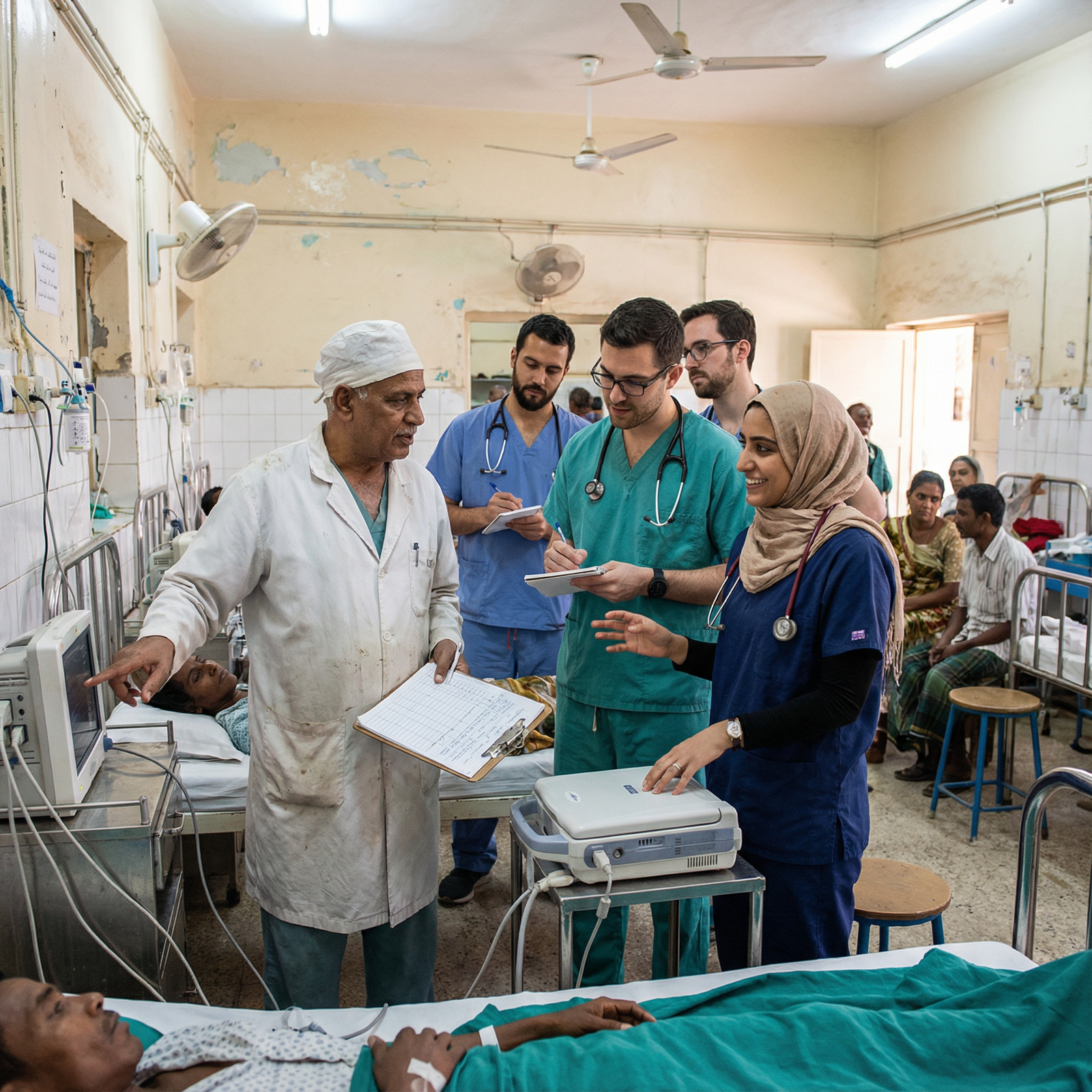
The Three Pillars of Ethical Co-Teaching
Everything else hangs off these three:
- Shared agenda-setting
- Shared classroom presence
- Shared ownership of outcomes (good and bad)
If your trip is built entirely around “my talk, my slides, my schedule,” you are not co-teaching. You are exporting.
2. Why Co-Teaching Is an Ethical Issue, Not Just a Teaching Style
This sits squarely in personal development and medical ethics for a reason. How you teach abroad says a lot about what you think you are entitled to.
Power, Status, and the Hidden Curriculum
Students notice who stands at the front, who gets introduced as “expert,” whose opinion ends the debate.
If the pattern is:
- Visiting faculty arrive
- Local faculty “defer”
- Students direct questions to the foreigner
then your teaching is reinforcing one message: external expertise > local expertise.
That is unethical. Because you are not more expert in:
- Local epidemiology
- Resource constraints
- Legal and regulatory environment
- Cultural norms around consent, disclosure, family involvement
You probably know less about all of that than the intern in the room.
Competence and Non-Maleficence
Teaching is an intervention. Poorly contextualized teaching can cause harm. Classic examples I have seen:
- Teaching sepsis bundles assuming 24/7 labs and intensive care, where the hospital has no blood gases, no vasopressors, and one oxygen concentrator that works intermittently.
- Encouraging routine use of expensive second-line antibiotics, creating pressure on local prescribers without any plan for antibiotic stewardship or cost.
- Demonstrating procedures with disposable equipment that was donated once and will not be restocked.
Ethical teaching in this context demands local co-leadership precisely to avoid this mismatch. Local faculty are the safety check.
Justice and Professional Development for Local Faculty
If every visiting faculty member treats local staff as translators and gatekeepers rather than as co-educators, you have a one-directional pipeline: prestige, CV lines, and publications flow north; clinical and moral burden stays south.
Co-teaching done right is also faculty development. It can:
- Provide local faculty with exposure to different teaching methods.
- Create legitimate co-authorship opportunities.
- Strengthen their regional academic standing, not just yours.
If your partnership MOU lists you as PI on every educational initiative and relegates local faculty to “local collaborator,” you already know the ethics are off.
3. Concrete Co-Teaching Models That Actually Work
Let us get specific about structures. These are models that I have seen succeed in different settings when adapted thoughtfully.
Model 1: Alternating Lead with Real-Time Integration
Structure:
- Pre-session: 30–60 minutes planning with local faculty.
- Classroom: Each session has a designated “lead teacher” and “context anchor.”
- The lead alternates: one session led by local faculty, next by visiting faculty.
Example: Managing diabetic ketoacidosis (DKA) in a regional hospital.
Local lead:
- Presents two local cases, typical presentation, common delays, where patients come from, typical resource constraints (no continuous insulin infusion, irregular lab access).
- Outlines the current locally-used protocol.
Visiting co-teacher:
- Lays out standard international guideline-based management (ADA/ISPAD style) using simple visuals.
- Then explicitly asks the local faculty: “Where does this break in your setting? Where do we need to adapt?”
Joint:
- Together, they build a hybrid “best possible in this hospital” DKA algorithm on the board.
- Students are asked to identify which steps are “ideal” vs “minimal acceptable” in their reality.
This model respects both evidence-based standards and constraints. It also models humility for students: “Guidelines are tools, not commandments.”
Model 2: Dual-Facilitator Case Conferences
Structure:
- Weekly or biweekly case conference.
- A local resident or intern presents.
- Local attending and visiting faculty co-facilitate discussion.
How it plays out:
- Case is presented using whatever local format exists (SOAP, structured case summary).
- Local faculty emphasize diagnostic reasoning, cultural factors, system barriers (“family could not pay for CT,” “blood not available”).
- Visiting faculty contribute up-to-date literature, alternative approaches, and ask “what if” questions without shaming resource limitations.
Important nuance:
The visiting teacher must avoid “Well, in my hospital we would just send them to CT and call neurosurgery.” Everyone already knows that. The real teaching is: “Given that CT is 6 hours away and costs a month’s salary, how can we risk-stratify? What are red flags that absolutely require referral versus those we manage here?”
Model 3: Bedside Teaching with Pre-Brief and Debrief
Bedside teaching in cross-cultural, low-resource settings is where ethics often go sideways: photographing patients, intrusive questioning, turning wards into spectacle.
A safe co-teaching model:
Pre-brief (in a side room)
- Local faculty outline which patients have agreed to teaching encounters.
- They explain language constraints, sensitive issues, and absolute no-go topics (e.g., certain reproductive health questions that conflict with local norms unless very carefully handled).
At the bedside
- Local faculty lead introductions in the local language and control the flow.
- Visiting faculty ask questions but let local faculty translate and moderate.
- Clinical teaching points are directed to students, not performed “over” the patient’s body.
Debrief
- Away from patients, both faculty discuss:
- What would be done differently in the visiting faculty’s home institution and why.
- What options exist realistically here.
- What ethical tensions came up (e.g., disclosure, consent, resource triage).
- Away from patients, both faculty discuss:
This reduces the “medical safari” dynamic and models respect.
Model 4: Curriculum Co-Design and Delivery
This is the gold standard but requires long-term partnership.
Process:
- Needs assessment led by local faculty (visitors assist, do not dominate).
- Joint selection of priority topics (e.g., emergency obstetrics, antimicrobial stewardship, trauma).
- Co-development of modules with clear learning objectives.
- Shared delivery schedule: sometimes in-person, sometimes via tele-education.
- Built-in evaluation with local faculty leading the feedback interpretation.

| Step | Description |
|---|---|
| Step 1 | Local Needs Assessment |
| Step 2 | Set Joint Priorities |
| Step 3 | Design Modules Together |
| Step 4 | Plan Teaching Schedule |
| Step 5 | Co-Teach Sessions |
| Step 6 | Collect Feedback |
| Step 7 | Revise Content Together |
You measure success not by how many lectures the visiting team gave, but by whether:
- Local faculty feel ownership.
- Content persists after visitors leave.
- The institution incorporates elements into official training programs.
4. Role Clarity: Who Does What in a Co-Teaching Setup
Ambiguity ruins collaborations. Here is what tends to work when responsibilities are explicit.
| Domain | Local Faculty Lead | Visiting Faculty Lead |
|---|---|---|
| Needs assessment | Yes | Support |
| Topic prioritization | Yes | Input |
| Contextual adaptation | Yes | Suggest options |
| Evidence review | Input | Yes |
| Session logistics | Yes | Minimal |
| Teaching delivery | Shared | Shared |
| Evaluation design | Shared | Shared |
If your team is leading most rows in that table, you are not partnering; you are outsourcing local autonomy.
5. Practical Tactics to Make Co-Teaching Work Day to Day
You do not fix power and ethics with mission statements. You fix them with small, repeatable behaviors.
Before You Arrive
- Request the existing curriculum and exam blueprint. Do not design in a vacuum.
- Ask for a list of local guidelines, protocols, and formularies. Base your teaching on what is actually available.
- Schedule a virtual planning meeting with local faculty where you ask:
“Which topics do you want us to support?” not “Here is what we plan to teach.”
In the Room: How You Actually Talk
Language matters. Over time, students copy your patterns.
Bad patterns:
- “We do it this way in the US, which is the standard.”
- “Ideally you would… but I know you might not be able to.”
- “In low-resource settings, you cannot…”
Better patterns:
- “International guidelines suggest X. Given your lab access, which parts of X are realistic here?”
- “At my institution we use Y. What is the closest analogue that you have?”
- “Let us separate ideal management from best-possible management in this hospital.”
And the most crucial line you can use in front of students:
“I do not know the right answer for your setting. Dr. [Local Faculty], how is this usually handled here and what are the constraints?”
That one sentence both protects patients and re-centers local expertise.
Sharing Slides and Materials
Obvious, but often mishandled:
- Always share editable versions, not just PDFs.
- Co-brand with both institutions’ logos if possible.
- Invite local faculty to modify and adapt for their future teaching.
- Ask how materials should be formatted to align with their existing teaching platform (PowerPoint vs. offline handouts vs. WhatsApp PDFs).
If your slides are locked, copyrighted, or withheld, you are not collaborating, you are broadcasting.
6. Ethical Fault Lines and How to Avoid Stepping on Them
Let us talk about where things go wrong. Because they will if nobody is watching.
](https://cdn.residencyadvisor.com/images/articles_svg/chart-common-failures-in-global-health-teaching-programs-3414.svg "Common Failures in Global Health Teaching Programs")
| Category | Value |
|---|---|
| Token local involvement | 80 |
| Misaligned content | 65 |
| Patient consent issues | 50 |
| Data ownership conflicts | 40 |
| [Short-termism](https://residencyadvisor.com/resources/global-healthcare/what-senior-faculty-quietly-think-about-short-term-medical-missions) | 75 |
1. Using Patients as Teaching Props
Ethical failures:
- Taking photos without robust consent, often justified as “for education.”
- Discussing stigmatizing conditions (HIV status, sexual history) in front of a large group without proper framing or permission.
- Asking culturally insensitive questions just to “demonstrate thoroughness.”
Prevention:
- Local faculty must lead on defining what is acceptable.
- Explicitly ask: “Which topics are sensitive here, and how should we handle them?”
- Err on the side of patient dignity over pedagogical completeness.
2. Undermining Local Practice Without Offering Alternatives
Standing up in a room and loudly declaring, “This protocol you are using is outdated and wrong” without understanding why it exists is arrogance, not quality improvement.
A better pattern:
- Ask for the rationale behind current practice.
- Map differences to cost, availability, training level, and regulatory constraints.
- Offer options, not judgments: “If drug A is not available, drug B at this dose may be a step closer to guideline-based care than drug C.”
3. Intellectual Colonialism: Data and Authorship
You run co-taught sessions. You collect pre- and post-test scores. You publish a “capacity-building” paper. Local faculty are relegated to acknowledgments or low-author positions.
That is unethical.
If local faculty:
- Helped design the teaching
- Delivered sessions
- Enabled access to learners and clinical settings
they are co-investigators, not “field assistants.”
Norms that should be non-negotiable:
- Joint authorship with local faculty in meaningful positions (often first or senior, depending on initiation).
- Shared access to full datasets.
- Agreement that any future reuse of tools or curricula includes the partner institution.
7. Your Personal Development: What Co-Teaching Does to You (If You Let It)
This is not only about what you bring. It is about what you learn, and how you change.
Cognitive Flexibility
When you teach with local faculty who manage sepsis without vasopressors, STEMI without cath labs, or oncology without oncologists, your clinical reasoning expands. You start solving problems from first principles again.
That makes you a better clinician anywhere. Including your own high-resource hospital where the CT is “down for two hours” and everyone panics.
Humility as a Core Professional Skill
True co-teaching forces you to say “I do not know” in front of learners and colleagues. Not about random minutiae, but about entire health systems, economic realities, and cultural constructs.
That humility:
- Protects patients from your overconfidence.
- Builds trust with local teams.
- Keeps you intellectually honest back home.
Ethical Reflexes
If you take co-teaching seriously, you start asking different questions automatically:
- “Who benefits from this?”
- “Who is missing from this conversation?”
- “What happens when we leave?”
- “Would I accept this arrangement if I were the local faculty?”
Those reflexes are part of mature professional ethics. They bleed into how you supervise residents, design QI projects, and participate in research everywhere.
8. Long-Term: Building Programs That Outlast the Visitors
Sustainability is not a buzzword. It is the ethical floor.
Signs your co-teaching model is mature and not just a feel-good project:
- Local faculty run the same sessions independently when you are not there.
- Curriculum documents, slides, and case banks are stored on local servers or systems, not just your institutional drive.
- New local faculty are onboarded into the teaching program by their own colleagues, not by you.
- Funding flows include line-items for local faculty time, not just visiting flights and hotels.
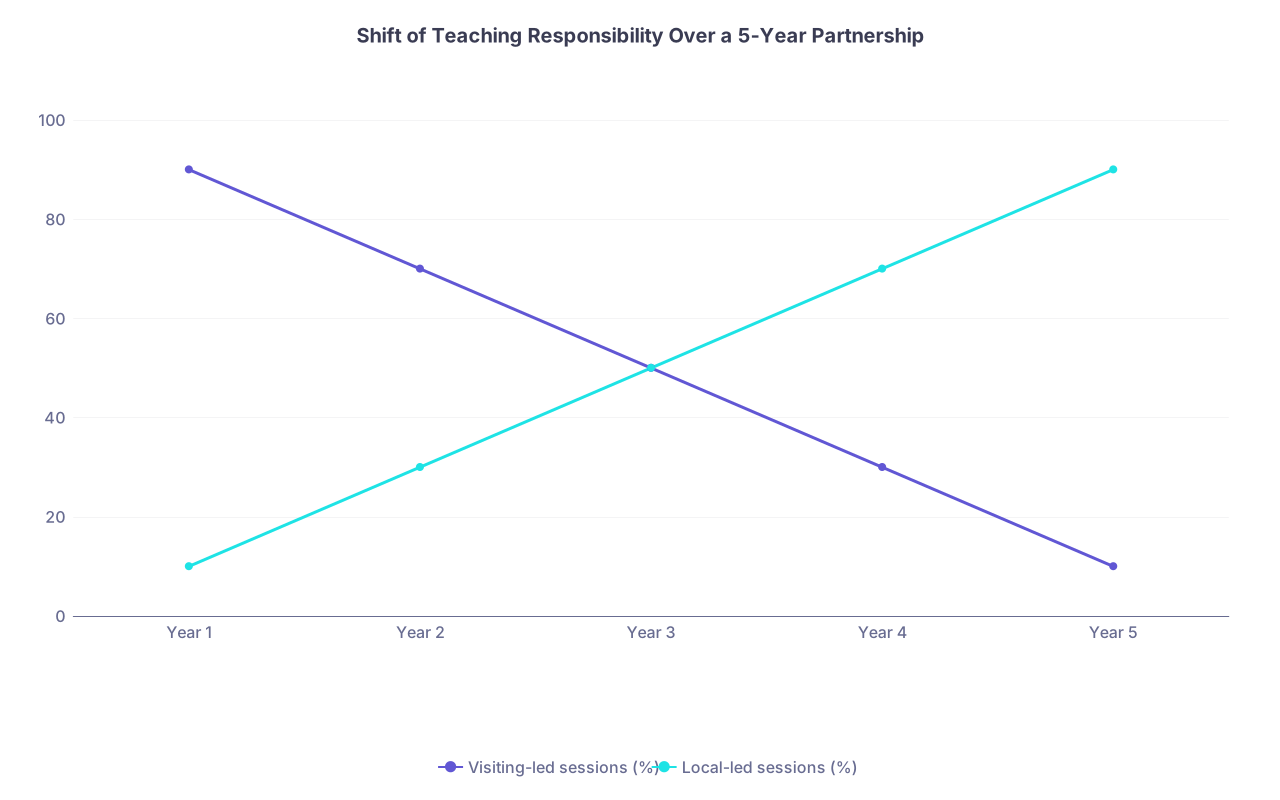
| Category | Visiting-led sessions (%) | Local-led sessions (%) |
|---|---|---|
| Year 1 | 90 | 10 |
| Year 2 | 70 | 30 |
| Year 3 | 50 | 50 |
| Year 4 | 30 | 70 |
| Year 5 | 10 | 90 |
If after five years your visiting team still delivers 80–90 percent of the teaching, something is structurally wrong.
FAQs
Is it ever appropriate for visiting faculty to teach solo without local co-teaching?
Rarely, and only when local faculty explicitly ask you to cover a niche topic they do not feel comfortable with (e.g., pediatric electrophysiology in a general hospital). Even then, you should still seek local input on context and invite them to introduce you and close the session so authority is not fully externalized.What if local faculty use practices that are clearly harmful or outdated—am I obligated to confront that publicly?
You are obligated to protect patients, but public humiliation is counterproductive. Raise concerns privately with senior local colleagues, frame discussions around evidence and feasibility, and offer to jointly explore alternatives rather than “correcting” them in front of trainees.How do I handle situations where local faculty insist I lead everything because they see foreign involvement as higher status?
You push back gently but firmly. Explain that co-teaching is part of the partnership expectation, that students need to see their faculty as primary experts, and offer supportive roles (e.g., they lead cases, you supplement with guideline updates) rather than accepting full control.What should I do if our funding agency or NGO pressures us to maximize ‘teaching hours delivered’ by visiting staff?
Argue explicitly that ethical, effective programs prioritize local leadership even if that means fewer foreign-branded hours. Document how co-teaching and faculty development lead to more sustainable impact; present this as better value for money, not a compromise.Can residents or trainees from high-income countries meaningfully co-teach, or should this be limited to senior faculty?
Residents can absolutely co-teach, but they must do so under a clear framework: always paired with local faculty, aware of their limited authority, and focused on narrow, well-supervised areas. Unsupervised resident “experts” teaching abroad is one of the more reckless patterns I have seen.
Key points to keep in your head:
- Co-teaching with local faculty is not decoration; it is the ethical core of cross-border medical education.
- Real co-teaching redistributes authority, not just tasks; if you are always the “expert at the front,” you are doing it wrong.
- Sustainable programs aim for local ownership within a few years, with visiting faculty as invited partners, not the default center of gravity.


