

The way most residents “plan” overseas electives is backwards. They pick a country on Instagram, email a random contact four months before departure, then scramble through visas, licensing, and ethics modules. That is how you end up unsafe, useless to the host team, and occasionally in front of a program director explaining why your ‘global health’ month did not count.
You are a resident. Your time and reputation are expensive. You need a real timeline.
Below is a practical, month‑by‑month guide from early PGY1 through the end of PGY3. I will assume a single 4‑ to 8‑week overseas elective taking place late PGY2 or during PGY3, which is when most programs can spare you and you have enough clinical maturity to contribute.
Use this as a backbone. Adjust exact months to your program length and specialty.
PGY1: Laying Foundations, Not Booking Flights
Months 1–3 of PGY1: Observe, Do Not Commit
At this point you should:
- Keep your mouth shut about “saving the world” and watch how your seniors actually function.
- Identify your true interests rather than fantasies: infectious disease, surgery, EM, OB, peds, health systems, ethics, etc.
- Start a simple running note titled “Global interest log”:
- Cases that spark your curiosity (e.g., TB, refugee care, HIV in pregnancy).
- Attendings with clear international experience.
- Hospital global health office or international partnerships.
Why no commitments yet?
Because you do not know your schedule flexibility, your program’s rules, or frankly whether you even like your specialty enough to do it in a high‑resource setting, let alone a low‑resource one. Instead, you quietly map the landscape.
Practical steps this quarter:
- Ask chief residents: “Does anyone in our program typically do overseas electives? When? With whom?”
- Skim your residency handbook for:
- Elective requirements.
- Restrictions on out‑of‑country time.
- Malpractice coverage language.
If you cannot find anything written, flag that. You will need to push later.
Months 4–6 of PGY1: Define Your Target Window and Goals
At this point you should:
- Decide when in residency your overseas elective is most realistic.
- Most common:
- Internal medicine: late PGY2 or early PGY3.
- Pediatrics: mid‑PGY2.
- Surgery: often PGY3 or a research year; earlier is tough because of OR volume expectations.
- EM: usually PGY3.
- Most common:
- Draft 2–3 clear goals. Example:
- “Gain experience managing high‑burden TB/HIV in an inpatient setting.”
- “Work alongside local trainees in a district hospital, not an expat bubble.”
- “Understand ethical challenges of practicing in a resource‑limited ICU.”
Your goals matter because they drive where you go and what is actually appropriate. A US neurology resident managing only private‑pay expat patients in a European capital is not “global health”. It is medical tourism.
Tasks for this period:
- Meet with your program director (PD) briefly:
- Ask: “When have prior residents done overseas electives? Any preferred partners or big red flags?”
- Clarify: Is there a strict limit on time out of the country? Any board rules you need to know?
- Identify any existing institutional partnerships:
- University global health center.
- Sister hospitals (e.g., collaboration with a teaching hospital in Uganda, Haiti, India, etc).
Capture all of this in a short document. Two pages max. This becomes your planning anchor.
Months 7–9 of PGY1: Ethics and Reality Check
At this point you should stop romanticizing and start reality‑testing.
You need to answer three ethical questions early:
- What level of supervision will I have?
- What procedures and responsibilities will I not take on, even if asked?
- Does this site have a track record of hosting trainees responsibly, or am I the experiment?
Concrete steps:
- Attend any global health or ethics talks at your institution. Sit in the back. Take notes on:
- Scope‑of‑practice issues.
- Hidden costs to host institutions.
- “Voluntourism” traps (you will hear that word a lot, for good reason).
- Ask an attending with global experience:
- “What is one overseas rotation you would do again?”
- “What is one you would never repeat, and why?”
Start drafting an “Ethical Boundaries” document for yourself:
- Procedures you will not perform without proper supervision (e.g., C‑section as an IM resident).
- Settings that feel wrong: orphanage medicine, super short mission trips that disrupt local care, rotations that bypass local trainees.
You are not being dramatic. You are drawing lines before you are sleep‑deprived, flattered, and handed a scalpel.
Months 10–12 of PGY1: Choose Region and Rough Timeframe
By the end of PGY1 you should have:
- A target timeframe: e.g., “March–April of PGY3”.
- A short list of 2–3 regions or countries that match:
- Language you speak / are willing to learn.
- Clinical interests (e.g., francophone West Africa vs. Central America vs. South Asia).
- Realistic safety and political stability.
Avoid this mistake: “Anywhere is fine, I’m flexible.” That is how you end up with no spot, or one that starts after fellowship.
Focus like this:
- If you speak Spanish → consider established programs in Central or South America.
- If you are comfortable in French → several West African sites host residents routinely.
- If English only → plenty of options (Kenya, Uganda, Tanzania, India, some Caribbean sites), but still check language predominantly used on wards.
Now is also the time to check rough cost expectations:
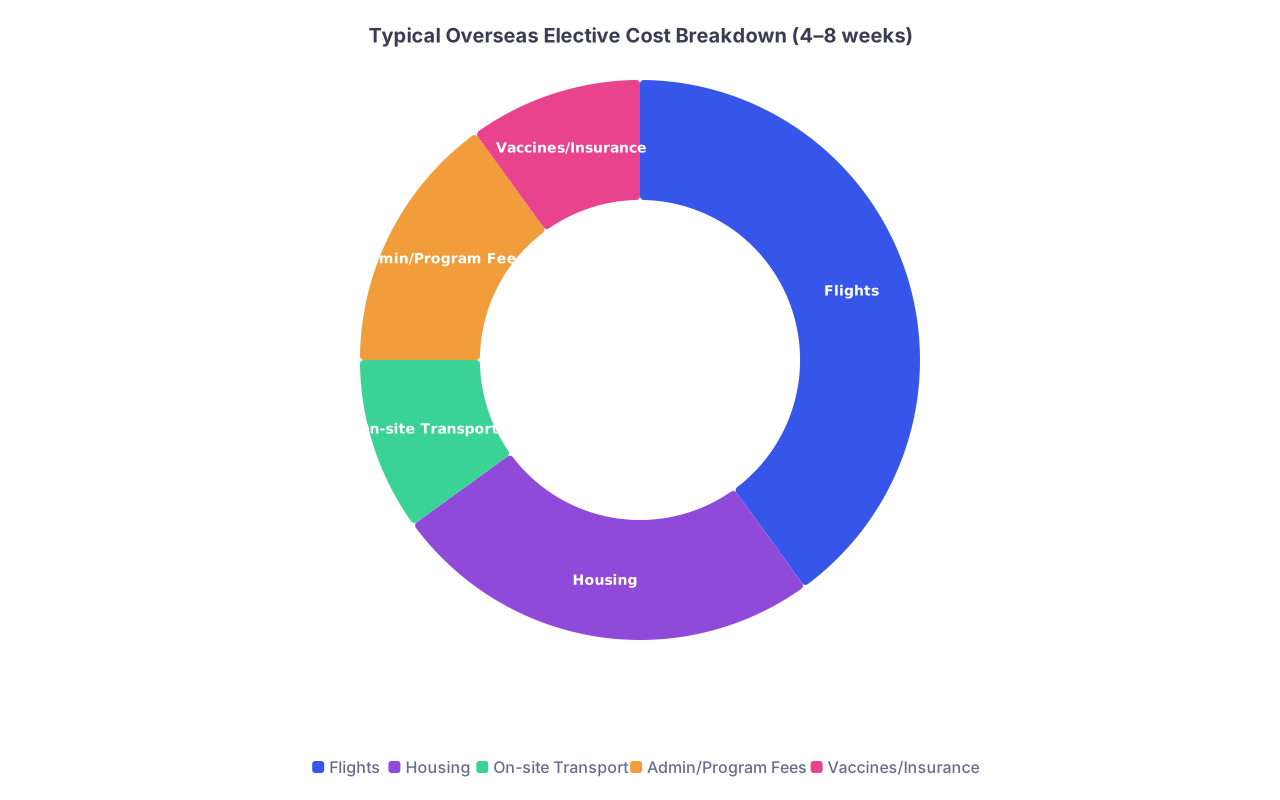
| Category | Value |
|---|---|
| Flights | 40 |
| Housing | 25 |
| On-site Transport | 10 |
| Admin/Program Fees | 15 |
| Vaccines/Insurance | 10 |
You do not need exact numbers, but you should not be blindsided that a “cheap” elective ends up costing $4,000+.
PGY2: Converting Intention into an Actual Rotation
This is where residents either get serious or the plan quietly dies.
Months 1–3 of PGY2: Lock the Date with Your Program
At this point you should:
- Confirm your elective month in writing with:
- Program director.
- Chief residents (who build schedules).
- Global health / GME office if they coordinate international electives.
Send a short, clean email:
- “I would like to schedule an overseas elective for March–April of PGY3.”
- Attach your 1‑page summary of goals and possible sites.
- Ask: “What are the formal steps and deadlines to have this approved?”
If your program has a formal application, get it now. Most require:
- Educational objectives.
- Description of host site and supervision.
- Proof of malpractice/insurance coverage.
- Sometimes IRB review if you plan any research.
You want those hurdles visible early.
Months 4–6 of PGY2: Select Site and Confirm Supervision
At this point you should actively narrow from 2–3 regions to 1 site.
How to choose intelligently:
- Prioritize:
- Existing institutional partnership.
- Clear local supervisor (named physician).
- History of hosting residents from your or similar programs.
- De‑prioritize or avoid:
- Sites where you are the only trainee and the hospital is otherwise heavily understaffed.
- Trips led by non‑medical NGOs with no real integration into local health systems.
- Electives advertised mainly with tourism photos and vague “impact” language.
You need a video call (Zoom, etc.) with the host supervisor. Non‑negotiable.
On that call you ask:
- “What is the usual daily schedule for residents?”
- “What are residents not allowed to do?”
- “How are local trainees involved?”
- “What language is used for rounds and documentation?”
- “What do visiting residents often get wrong here?”
If the answers are fuzzy, or they seem surprised by basic supervision questions, walk away. I have seen residents land in settings where “supervision” meant an attending in another town.
Once you are comfortable:
- Request a formal invitation letter:
- Dates.
- Role (observer vs. hands‑on).
- Confirmation of supervision.
- Any required local registration or licensing details.
Months 7–9 of PGY2: Approval, Licensure, and Insurance
This is the bureaucratic slog. Do not underestimate it.
At this point you should:
Submit formal elective approval to your program / GME:
- Host letter.
- Your objectives.
- Risk assessment (security, health).
- Plan for debriefing afterward if required.
Clarify licensing status:
- Many sites classify you as:
- “Observer only” → easier, but limited hands‑on experience.
- “Visiting resident/registrar” → may require temporary local registration.
- Ask host explicitly: “Do I need to register with the local medical council? How long does it take?”
- Many sites classify you as:
Check malpractice and liability:
- Talk to GME and your risk management office:
- Does your malpractice extend to this site and country?
- Are there exclusions for non‑US practice?
- If not covered, consider:
- Institution‑based coverage through the partnership.
- Short‑term international malpractice (rare but exists).
- Talk to GME and your risk management office:
This is unglamorous, but if coverage is unclear and something goes badly wrong, you are legally exposed and your PD will not be amused.
Months 10–12 of PGY2: Visas, Vaccines, and Funding
Now the logistics become concrete.
At this point you should:
Start visa process:
- Check whether you enter as tourist, student, or something else.
- Some countries require a letter from the host institution for a specific visa category.
- Confirm how long your passport must be valid (often 6+ months beyond departure).
Begin vaccines and prophylaxis:
- Appointment with travel clinic:
- Routine boosters.
- Yellow fever, typhoid, rabies pre‑exposure, Hep A/B, etc, depending on region.
- Malaria prophylaxis plan.
- Some vaccines require series over weeks. This is why you did not wait until two months before flying.
- Appointment with travel clinic:
Build a rough budget and funding plan.
| Source | Typical Amount | Notes |
|---|---|---|
| Residency/global health grant | $500–$2000 | Often competitive |
| Departmental travel funds | $500–$1500 | Ask early, limited pool |
| Personal savings | Variable | Plan months in advance |
| External foundations/societies | $500–$3000 | Specialty‑specific grants |
| Family support/loans | Variable | Last‑resort gap filler |
Apply for any institutional or society grants now. They always have annoying deadlines and expect a one‑page proposal.
PGY3 (or Elective Year): From Countdown to Rotation and Back
I will assume your rotation is in Month 7–8 of PGY3. Adjust dates if your timing is different; the interval relationships are what matter.
T‑6 Months: Final Program Approval and Schedule Lock
Six months before departure (roughly Month 1 of PGY3 if you go in Month 7):
At this point you should:
- Reconfirm with:
- Program director.
- Chief residents.
- Host supervisor.
- Ensure your residency schedule reflects:
- No critical rotations immediately before/after that you cannot swap.
- Adequate buffer to manage jet lag and reentry.
If your program uses any online elective catalog (VSLO, institutional portal), make sure your rotation is actually entered and labeled correctly so you get credit.
Also:
- Confirm coverage:
- Clinics you will miss.
- Longitudinal continuity clinic issues (especially in IM and peds).
- Call swaps arranged well in advance.
This is where poor planners watch their rotation die because “we just could not cover your clinics.”
T‑4 Months: Clinical and Cultural Preparation
At this point you should not be thinking about souvenirs. You should be tuning your brain for the medicine you will see.
Tasks:
Ask host for:
- Common diagnoses and protocols.
- Any standard operating procedures (SOPs) for wards, ICU, OR, or outpatient.
Build a focused reading list:
- WHO guidelines for the region (HIV, TB, malaria, maternal health).
- Local treatment guidelines if available.
- A small set of key articles on health system structure and ethics issues in that country.
Start language preparation:
- If not fluent, commit to:
- 20–30 minutes per day of focused medical language or basic communication.
- Key phrases for consent, pain assessment, and OB histories.
- If not fluent, commit to:
Nothing screams “unprepared outsider” like landing in a rural hospital where everyone greets you in the local language and you cannot say good morning back.
T‑3 Months: Safety, Contingency, and Ethical Grounding
At this point you should explicitly plan for what could go wrong.
- Register with your national foreign affairs / state department registry if available for travelers.
- Clarify local:
- Emergency contacts.
- Nearest higher‑level hospital.
- Evacuation options if there is sudden instability.
Have an honest discussion with yourself (and ideally your PD) about:
- What circumstances would make you abort the rotation early?
- How will you communicate serious ethical concerns if they arise?
- Who is your “backstop” at home? (Global health faculty or PD who will actually answer emails.)
Revisit your “Ethical Boundaries” document. Update it with specifics from the host site.
T‑2 Months: Detailed Logistics and Packing Strategy
This is where a lot of residents waste time and money.
At this point you should:
Book travel with:
- Enough buffer days before starting clinical work (2–3 days minimum).
- Reasonable routes that minimize overnight arrivals in unfamiliar cities if unsafe.
Confirm housing:
- Secure written confirmation (email) of cost, location, and what is included.
- Ask about:
- Water reliability.
- Mosquito nets.
- Kitchen access.
- Commuting time to hospital.
Create a packing list that respects two rules:
- You are not the supply chain for the entire hospital.
- You can bring targeted, requested items if vetted through the host.
Common categories:
Clinical:
- Lightweight white coat or scrubs depending on norm.
- Stethoscope, penlight, basic diagnostic tools.
- A few laminated cards: local drug dosing, WHO charts you will actually use.
Personal safety:
- Copies of passport/visa.
- Quiet money belt or equivalent.
- Lock for bags.
Electronics:
- Voltage converter.
- Offline resources (e.g., UpToDate chapters saved as PDFs if your license allows, open‑access guidelines, apps that work offline).
Avoid bringing:
- Random boxes of equipment that nobody requested.
- Short‑dated meds you want to “donate” to clear your home cabinet.
T‑1 Month: Final Checks and Mental Prep
At this point you should:
Reconfirm:
- Flight details.
- Airport pickup or safe ground transport plan.
- First‑day meeting place and time.
Have a short pre‑departure meeting (even informal) with:
- Global health faculty.
- A recent resident who went to the same or similar site.
Ask them bluntly:
- “What surprised you the most?”
- “What would you absolutely do differently?”
- “What did you regret not preparing for?”
Also:
- Share your itinerary and contacts with family and one trusted colleague.
- Print or screenshot:
- Invitations.
- Insurance cards.
- Key phone numbers.
Then stop tinkering. Focus on rest and finishing current rotations well. Burning out before you leave is idiotic.
During the Elective: Weekly Anchors
You do not need a day‑by‑day script, but you do need structure. Otherwise you float, annoy your hosts, and learn much less than you could.
Here is a simple weekly frame:
Week 1 – Orientation and Listening
At this point you should:
- Prioritize:
- Learning ward routines, hierarchies, and documentation.
- Understanding where you fit among local trainees.
- Explicitly ask:
- “What do you expect from me?”
- “What should I avoid doing this first week?”
Do more observing than leading. You are not there to redesign their rounds on day two.
Weeks 2–3 – Contributing Within Scope
By now you should:
- Carry a reasonable patient load under local supervision.
- Teach only where invited and where you are sure your knowledge is applicable.
- Keep a brief reflective log focusing on:
- Ethical dilemmas.
- Resource constraints.
- Instances where local practice diverges from what you know, and why.
Week 4 (and beyond if longer) – Consolidation and Handover
At this point you should:
- Ensure smooth handoff of any ongoing patient responsibilities.
- Ask local colleagues:
- “What feedback do you have for me?”
- “What contributions felt most helpful? Least helpful?”
You are not the hero. You are a temporary guest. Leave cleanly.
T+0–2 Months After Return: Debrief and Integrate
The rotation is not “over” when your plane lands.
At this point you should:
- Schedule a debrief with:
- PD or global health mentor.
- Any funding body that requires a report.
Topics to cover:
- Did the elective meet your educational goals?
- Any significant ethical concerns you encountered?
- Concrete suggestions for improving the partnership.
This is also the time to process personal impact:
- Write a short reflection or case discussion.
- Present at noon conference or a global health forum.
- Credit the host institution properly. No savior narratives.
If you promised anything to the site (protocol drafts, teaching materials, collaboration), deliver it now or explicitly say you cannot. Ghosting a host institution is disgraceful.
Year‑End of PGY3: Close the Loop
Before graduation, you should:
- Provide written feedback to:
- Global health office.
- Future residents where appropriate.
- Clarify whether the elective:
- Counts fully for your board requirements.
- Needs any documentation for credentialing or fellowship applications.
If you are applying to fellowship, you can now articulate:
- How the elective changed your clinical judgment.
- What ethical tensions you saw and how you handled them.
- How you will continue global work realistically (not “move abroad and fix everything”).
Key Points to Remember
- Serious overseas electives are built 12–18 months in advance, not slapped together the quarter before.
- Ethical clarity and supervision are non‑negotiable; if those are weak, you walk away, no matter how “cool” the location.
- Your responsibility runs beyond the flight home: debrief, close the loop with hosts, and leave the partnership stronger for whoever comes after you.


