

The first 90 days in a new global health post will make or break your impact. Most people get this wrong by doing too much, too fast, for the wrong reasons.
You’re not there to “fix” anything in three months. You’re there to build trust, understand systems, and avoid becoming the story. Here’s how that looks on a clock and calendar.
Overall 90‑Day Structure
Think of your first three months in three phases:
- Days 1–30: Observe and listen (with discipline).
- Days 31–60: Contribute carefully inside existing structures.
- Days 61–90: Co‑create small, sustainable changes—or decide not to.
We’ll go month by month, then zoom to weekly and daily priorities, with ethical landmines flagged exactly where they usually blow up.
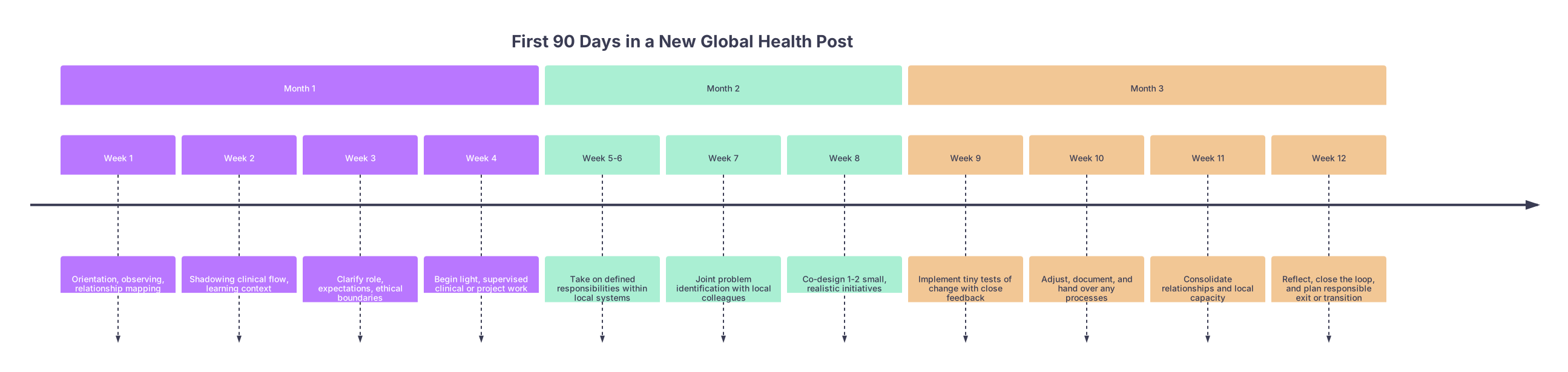
| Period | Event |
|---|---|
| Month 1 - Week 1 | Orientation, observing, relationship mapping |
| Month 1 - Week 2 | Shadowing clinical flow, learning context |
| Month 1 - Week 3 | Clarify role, expectations, ethical boundaries |
| Month 1 - Week 4 | Begin light, supervised clinical or project work |
| Month 2 - Week 5-6 | Take on defined responsibilities within local systems |
| Month 2 - Week 7 | Joint problem identification with local colleagues |
| Month 2 - Week 8 | Co-design 1-2 small, realistic initiatives |
| Month 3 - Week 9 | Implement tiny tests of change with close feedback |
| Month 3 - Week 10 | Adjust, document, and hand over any processes |
| Month 3 - Week 11 | Consolidate relationships and local capacity |
| Month 3 - Week 12 | Reflect, close the loop, and plan responsible exit or transition |
Month 1 (Days 1–30): Shut Up, Show Up, Learn
Your main job in Month 1 is simple and hard: resist the urge to “fix things.” At this point you should be learning like a resident on Day 1 of a new ICU rotation—but in someone else’s country, system, and history.
Week 1: Landing, Orientation, and Power Check
Day 1–3: Arrive and orient.
At this point you should:
- Learn names and roles of:
- Medical director
- Nursing leadership
- Community health workers
- Admin / logistics people (these people will save you later)
- Walk the compound or facility:
- Where do patients enter?
- Where do staff actually spend time?
- Where do people talk honestly? (It’s rarely the official meeting room.)
Ethical priorities right now:
- Power audit. Ask yourself: Who brought you here? Who pays you? Who can say “no” to you? That power matters more than your good intentions.
- Scope honesty. When people ask what you do, be specific and modest:
- Wrong: “I’m here to improve maternal health services.”
- Better: “I’m here for 9 months to work with the maternity team on whatever they identify as priorities.”
Day 4–7: Listen in stereo.
At this point you should:
- Do structured listening with at least 3 groups:
- Clinicians (doctors, clinical officers, nurses)
- Non‑clinical staff (cleaners, registrars, drivers)
- Patients or community reps
Ask questions like:
- “What’s working well here that outsiders usually miss?”
- “What has been tried before that didn’t work?”
- “If you had funding for one thing tomorrow, what would you choose?”
Do not promise anything. A simple, “That’s helpful for me to understand; I can’t promise but I will keep this in mind,” is honest and ethical.
Week 2: Shadowing and System Mapping
By now, you should be mostly invisible and always useful.
At this point you should:
- Shadow:
- Triage
- Outpatient consultations
- A ward round
- Pharmacy or supply chain office
- A community outreach day if available
Map basic flows:
- Patient journey: From gate → triage → clinician → lab/pharmacy → discharge.
- Data journey: Where is data recorded? Paper? Registers? Electronic? Who touches it?
- Decision journey: Who actually decides:
- Staffing rosters?
- Referral approvals?
- Ordering supplies?

Ethical pitfalls this week:
- Jumping in clinically before you understand:
- Local disease patterns
- Local guidelines (or their absence)
- Typical thresholds for admission, referral, antibiotics, etc.
- Imposing your standard of care as the only ethical option.
If you see something that looks unsafe:
- Ask privately: “Can you walk me through how you usually manage this situation here?”
- Then: “In my training we did X—would it be useful if we discussed pros and cons with the team sometime?”
You’re not there to run a parallel health system out of sheer moral distress.
Week 3: Clarify Your Role (Before It’s Defined For You)
If you don’t define your role now, someone will decide you’re either the 24/7 on‑call foreign workhorse or the magical grant‑writing machine. Neither is good.
At this point you should:
- Have a blunt meeting with:
- Your direct supervisor
- A senior clinician or nurse leader
- Clarify:
- Duration of your post
- Typical weekly schedule
- Clinical vs teaching vs administrative time
- Boundaries: what you cannot and will not do (e.g., “I’m not licensed for surgery; I can assist but not perform major procedures independently.”)
Draft a one‑paragraph description of your role and share it with:
- Department heads
- Nursing leads
- Admin lead
This is not corporate nonsense. It’s how you stop role drift that leads to exploitation or unsafe practice.
Ethical priorities now:
- Informed consent about you. Patients and staff should understand:
- Who you are
- Your level of training
- That you’re temporary
- Avoid savior optics. Confirm how you’re introduced:
- Not “specialist from Europe / US here to fix the hospital”
- Instead: “Colleague who will be working with our team for X months”
Week 4: Light Contribution, Maximum Feedback
You can start doing more, but with guardrails.
At this point you should:
- Take on:
- A half‑day clinic under direct supervision or side‑by‑side with a local colleague
- One small, existing meeting (e.g., join weekly morbidity meeting, not create a new one)
- Ask for explicit feedback from:
- At least one nurse
- At least one clinician
- A non‑clinical staff member you work with often
Questions to ask:
- “Am I getting in the way anywhere?”
- “Is there anything I’m doing that doesn’t fit how you work here?”
- “Is there any task you wish I’d stop doing, or start doing?”
This is how you catch cultural missteps before they harden into resentment.
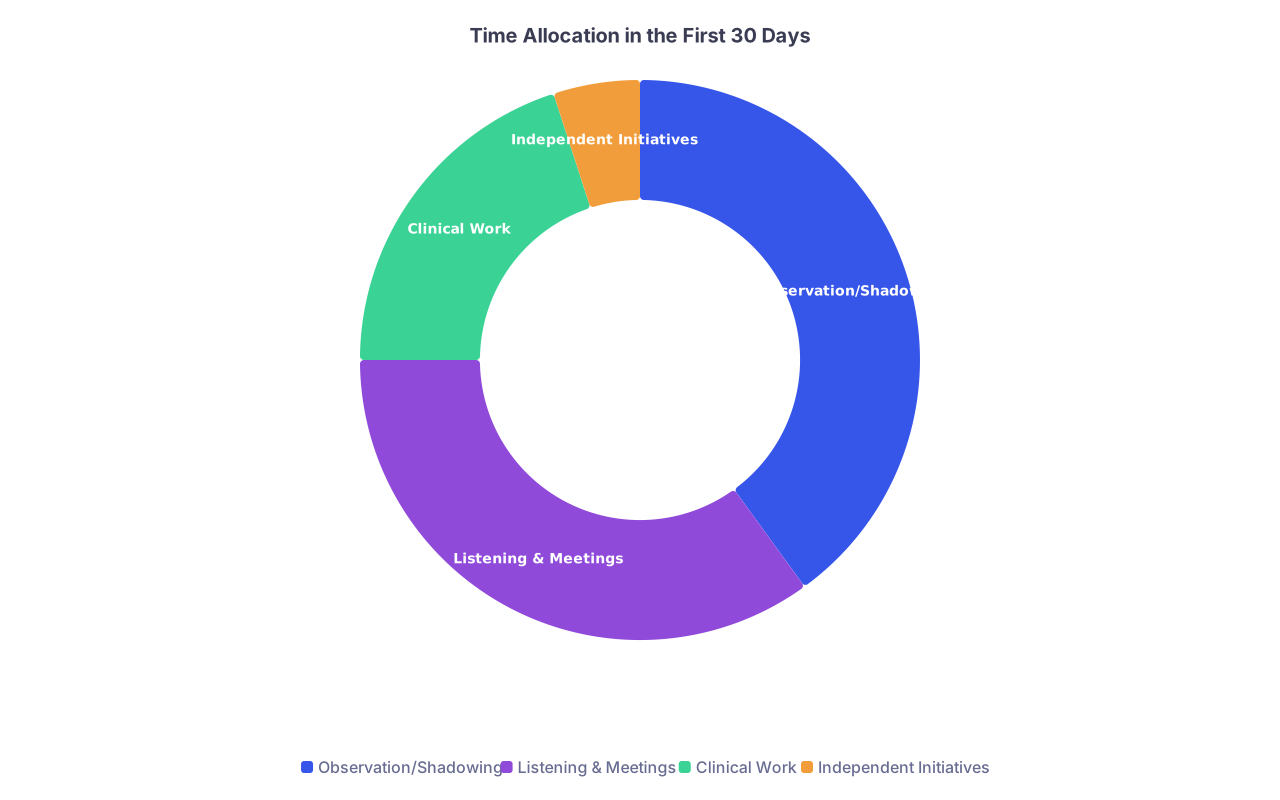
| Category | Value |
|---|---|
| Observation/Shadowing | 40 |
| Listening & Meetings | 35 |
| Clinical Work | 20 |
| Independent Initiatives | 5 |
The ratio above is about right. If “Independent Initiatives” is more than 10% in Month 1, you’re moving too fast.
Month 2 (Days 31–60): Contribute Inside the System, Not Around It
If Month 1 is about humility, Month 2 is about disciplined contribution without creating dependence or chaos.
Weeks 5–6: Take On Defined Responsibilities
By now, you should have:
- A predictable weekly schedule
- Clear supervisors
- A sense of who trusts you and who doesn’t (yet)
At this point you should:
- Take on recurrent tasks that:
- Already exist
- Will continue after you leave
- Examples:
- Joining the existing inpatient ward round twice a week
- Teaching 30‑minute case discussions during already scheduled teaching time
- Helping the data clerk clean up one specific register on Fridays
Avoid:
- Creating new parallel clinics
- Starting a new database that only you understand
- Running “special” clinics that only function when you’re there
Weeks 7–8: Joint Problem Identification (Not Your Personal Crusade)
By mid‑Month 2, you finally have enough context to help identify real problems with the people who live them.
At this point you should:
- Sit down with:
- 2–3 front‑line staff
- 1–2 mid‑level leaders
- Ask:
- “If we could improve one tiny thing in the next two months, what would feel actually possible?”
- “What have you tried before? What blocked it?”
- “Who would need to agree before we do anything?”
You’re looking for overlap between:
- What bothers staff daily
- What’s ethically important (patient safety, equity, dignity)
- What’s actually feasible with existing resources
| Option | Feasibility (3 mo) | Ethical impact | Dependency on you |
|---|---|---|---|
| New EMR system | Low | Medium | Very high |
| Triage checklist for pediatrics | High | High | Low |
| Weekly grand rounds series | Medium | Medium | Medium |
| New outreach project | Low | Variable | High |
You want high feasibility, high ethical impact, low dependency. That’s your sweet spot.
Ethical guardrails:
- If the “problem” is essentially “we need more stuff” (ventilators, specialists, new building), you’re not fixing that in 90 days. Do not pretend otherwise.
- If your idea requires you personally to be present forever, it’s a vanity project, not capacity building.
Month 3 (Days 61–90): Tiny Changes, Deep Roots
Month 3 is where well‑meaning people often mess up. They suddenly realize their time is short and start sprinting, creating half‑built projects that quietly die after they leave.
Resist that.
Weeks 9–10: Test One Tiny Change, With Local Ownership
At this point you should:
- Pick one small initiative co‑owned by local staff:
- Example: A simple sepsis bundle checklist for the inpatient ward
- Example: A 2‑line change in the triage register to flag high‑risk pregnancies
- Define:
- Who leads it locally (not you)
- What “success” looks like after 2–3 weeks
- How data will be tracked (simple tallies, not a new Excel hellscape)
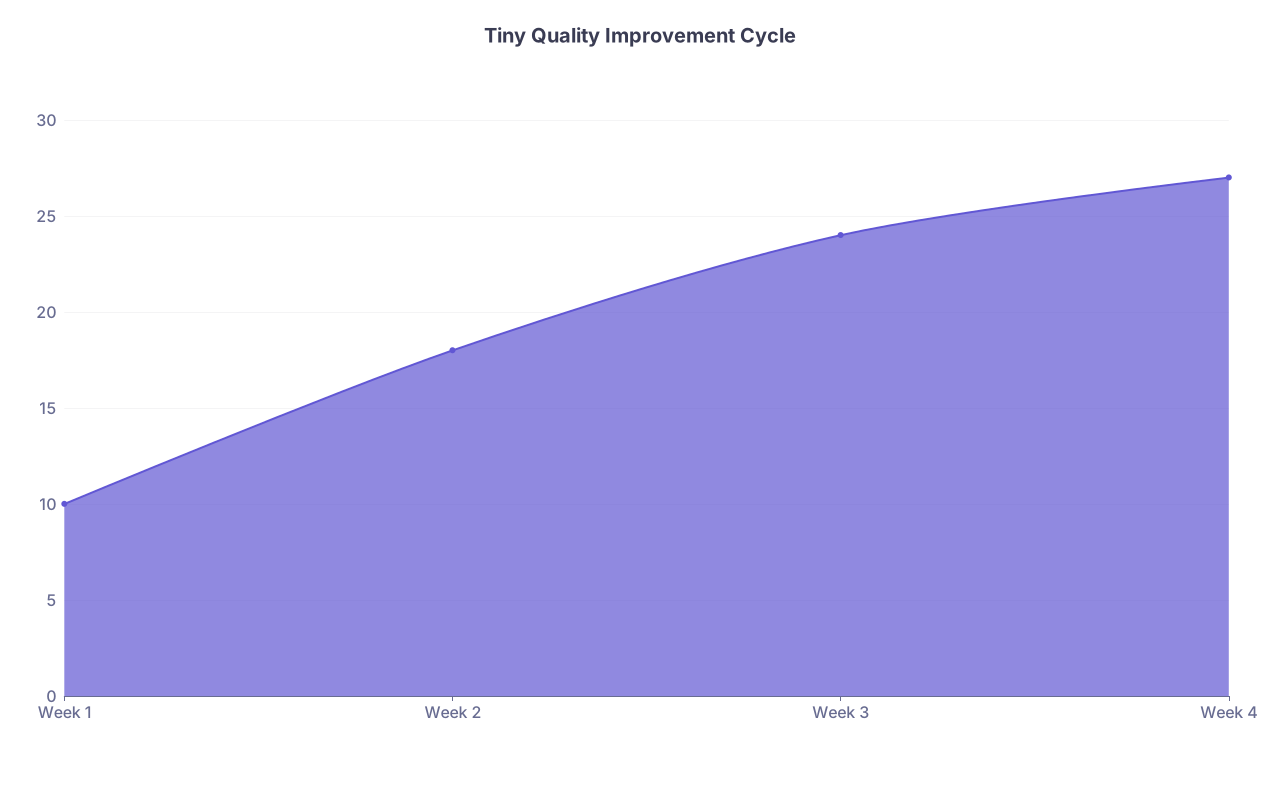
| Category | Value |
|---|---|
| Week 1 | 10 |
| Week 2 | 18 |
| Week 3 | 24 |
| Week 4 | 27 |
Think of something like the chart above: low‑stakes, small sample, visible improvement. Not a research study. Not a 40‑page protocol.
Ethical safeguards:
- No stealth research. If you’re collecting data that could identify patients, you’re in IRB territory. Don’t call it “quality improvement” just to skip ethics review.
- Local credit first. If something works, the story should be:
- “The maternity team developed…”
Not: “Our visiting doctor implemented…”
- “The maternity team developed…”
You’re a catalyst, not the protagonist.
Weeks 11–12: Handover, Reflection, and Exit Ethics
The final weeks are not the time for one last big push. They’re for consolidation and clean exit.
At this point you should:
- Hand over any ongoing initiative with:
- A one‑page summary (plain language, no jargon)
- Clear names for:
- Who does what
- When
- Using which tools (forms, checklists, registers)
- Meet separately with:
- Your supervisor
- A nurse or midwife leader
- A non‑clinical colleague who knows the real story (registrar, cleaner, driver)
Ask them:
- “What should the next person who comes after me absolutely know from day 1?”
- “Is there anything I started that you think should be stopped?”
Document this. Do not assume the organization will retain the nuance.
Ethical exit checklist:
- No patients dependent on you alone for continuity of care. If you’ve taken on complex patients, ensure:
- Handover to a named clinician
- Transfer notes in the local system, not your personal notebook
- No “ghost commitments”:
- Don’t promise to send money later
- Don’t promise to “get them to the US for treatment”
- Don’t casually say “I’ll try to get you supplies” unless you actually have a concrete plan and authority
Daily and Weekly Routines That Keep You Out of Trouble
Here’s what your time should roughly look like after the first couple of weeks.
| Day | Morning Focus | Afternoon Focus |
|---|---|---|
| Monday | Ward round with local team | Debrief, chart review, informal teaching |
| Tuesday | OPD/clinic (side-by-side) | Data or register review with clerk |
| Wednesday | Community/outreach (if exists) | Reflection, reading, language practice |
| Thursday | Small teaching within schedule | Join existing team meeting |
| Friday | Light clinical duties | Follow-up on tiny QI / documentation |
Daily 10‑minute ethical check (yes, actually do this):
At this point each day you should ask yourself:
- Did I take over any task today that a local colleague could or should own?
- Did I make any decision today that would be hard for this team to sustain when I leave?
- Did I do or say anything that might have undermined a colleague in front of patients or staff?
If the answer to any is “yes,” fix it the next day. Apologize if needed. People remember that.
Three Common Pitfalls – And When They Usually Hit
Let me be blunt. I’ve seen these same mistakes repeat across countries and organizations.
Pitfall 1 (Week 2–4): The Hero Clinician
Pattern:
- You see clinical gaps and feel you must “step in.”
- You start staying late, doing more, taking over decisions.
- Staff start saying things like, “Let’s wait for the foreign doctor.”
Why it’s unethical:
- Creates dependence
- Undermines local confidence and training structures
- Makes you feel morally superior while actually weakening the system
Counter‑strategy:
- Always ask: “Who usually handles this?” and support them to do it.
- If you must intervene for safety, debrief afterward with the team privately.
Pitfall 2 (Month 2): The Lone Ranger Project
Pattern:
- You get frustrated by “inefficiencies.”
- You design a new protocol/database/pathway that only you understand.
- You’re told “this is great!” (translation: “we’ll drop this as soon as you leave.”)
Why it’s unethical:
- Wastes local time and hope
- Occupies bandwidth that could have gone to real priorities
- Looks good on your CV, does nothing lasting there
Counter‑strategy:
- Refuse to start anything that:
- Requires internet where there isn’t reliable internet
- Requires your language skills when you’re the only one who speaks that language
- Requires you personally to maintain it
Pitfall 3 (Month 3): The Guilt‑Driven Frenzy
Pattern:
- You realize you’re leaving soon.
- You overwork, overpromise, and start multiple things at once.
- Then you vanish, leaving people to deal with the mess.
Why it’s unethical:
- Treats your emotional comfort as more important than their reality.
- Confuses people about what they can expect from “partners” in the future.
Counter‑strategy:
- From Day 1, talk about your end date openly.
- In Month 3, reduce your start‑up energy and increase your handover and documentation.
Final Thoughts: What Actually Matters in the First 90 Days
If you remember nothing else:
- Your first job is to learn the system, not fix it. Month 1 should feel almost uncomfortably slow. That’s right.
- Any change worth making will still matter after you’re gone. If it only works when you’re there, it’s probably about you, not the community.
- Ethics in global health is mostly about power and humility, not slogans. At each phase—arrival, contribution, exit—ask who gains, who loses, and whether you’re building local strength or just your own narrative.
Do those three things well over 90 days, and you’ll have done more for global health than a dozen flashy, unsustainable “projects.”


