
What if the “life-changing” medical mission that made you feel like a hero actually did more harm than good?
Let’s drop the romance and look at the data.
The Myth: “Any Help Is Better Than No Help”
You know the story: A group of students, residents, or clinicians flies to a low‑resource country for one or two weeks. They see hundreds of patients, take touching photos with kids, post a reflection about “how much they learned from the resilience of the people,” then go home. The narrative is always the same:
“We brought care where there was none. We made a difference.”
Except…that’s not really what the evidence shows.
Publications in The Lancet, BMJ Global Health, Academic Medicine, and Annals of Global Health have been picking apart short-term medical missions (STMMs) for more than a decade. When you sift through the noise, a pretty consistent pattern emerges:
- Benefits are often short-lived and difficult to measure.
- Harms are underreported, but very real.
- The biggest gains usually go to the visitors, not the host communities.
Let’s be blunt: “Any help is better than no help” is lazy thinking. In clinical medicine, “any drug is better than no drug” would be malpractice. Short-term missions are no different.
What the Data Actually Shows (When Anyone Bothers to Measure)
The first problem: most short-term missions never evaluate anything rigorously. Feelings, anecdotes, and photo counts don’t equal impact.
Where people have tried to measure impact, the picture is…mixed at best.
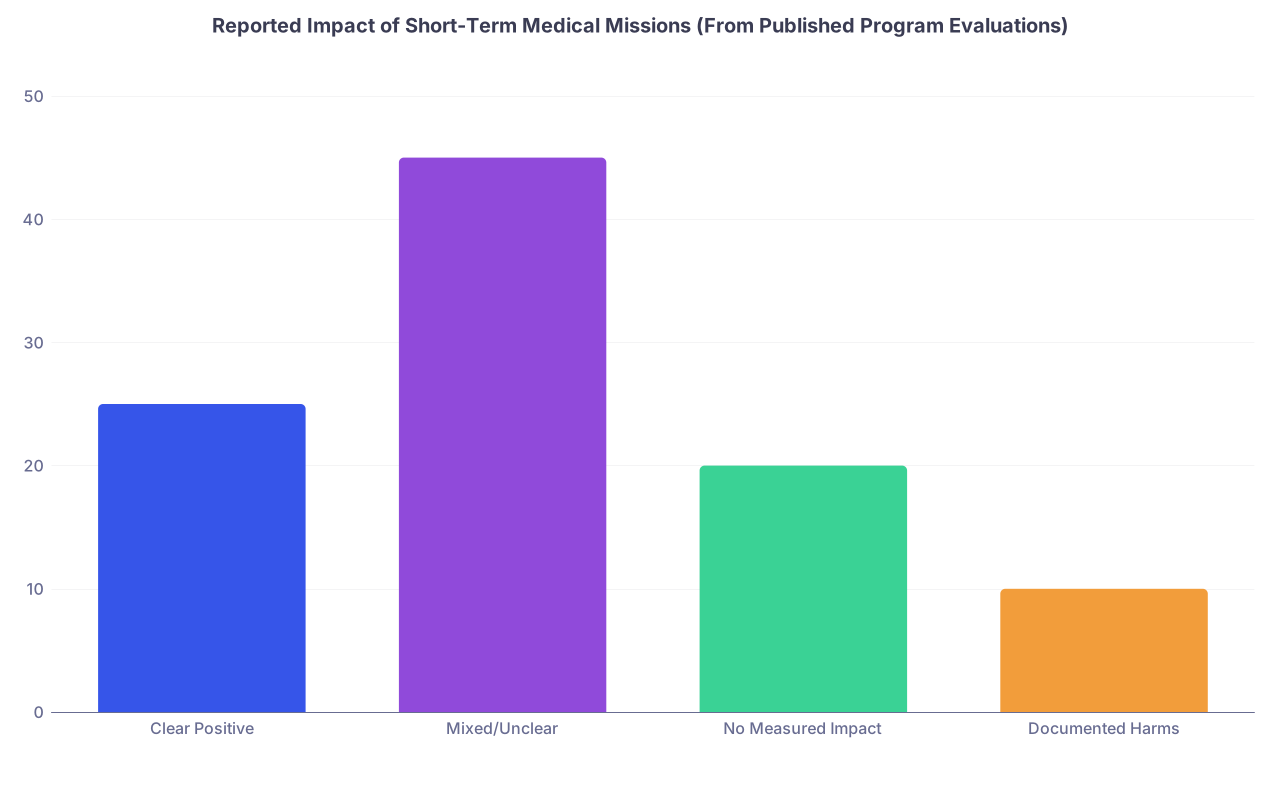
| Category | Value |
|---|---|
| Clear Positive | 25 |
| Mixed/Unclear | 45 |
| No Measured Impact | 20 |
| Documented Harms | 10 |
These are ballpark proportions you see again and again in the literature: about a quarter report clearly positive outcomes, many more are ambiguous, and a nontrivial number report actual harm or no benefit at all.
Common “positive” findings (from better‑designed programs):
- Increased local capacity when missions focus on training, not just direct care.
- Improved adherence to guidelines when partnerships are long‑term and bidirectional.
- Narrow, targeted programs (e.g., cleft surgery tied to local follow‑up) with good outcomes and patient satisfaction.
But there’s a catch: these tend to be longitudinal, recurring teams embedded in real partnerships, not one‑off voluntourism trips.
On the flip side, documented or highly plausible harms:
- Interrupted local continuity of care. Patients start treatment regimens that cannot be maintained once the team leaves.
- Undermining local health systems. Free foreign clinics siphon patients away from local providers who are actually there year‑round.
- Unsafe or unregulated care. Students and early trainees doing procedures they would never be allowed to perform at home.
- Ethical and legal gray zones. Poor consent, limited documentation, nonexistent medico‑legal oversight.
This is not rare. I’ve read far too many program reports where participants quietly admit: “We’re not sure what happened to most of these patients after we left.”
That alone should bother you.
Who Actually Benefits? Follow the Incentives
Here’s where things get uncomfortable.
Short-term missions reliably benefit:
- Applicants trying to “stand out” for medical school or residency.
- Institutions wanting global health branding without serious commitments.
- Attendees who want “transformative” experiences and dramatic stories.
Patients and local health workers? Less clear.
A lot of STMMs are fundamentally education or tourism projects with a thin layer of service on top. The honest flyer would say:
“Come learn procedures you can’t get away with at home, in a place with fewer rules and a great backdrop for Instagram.”
Harsh? Maybe. But listen to how students talk about these trips during interviews.
“I got to suture for the first time!”
“I did deliveries on my own.”
“I prescribed antibiotics all week.”
Notice the subject of those sentences. Not the patients.
The Ugly Reality: Unsafe Scope of Practice
This is one of the most consistent and damning findings in the literature.
Students and residents on short missions frequently work above their level of training:
- Unsupservised deliveries.
- Suturing complex lacerations.
- Running “their own” clinic room.
- Assisting in surgeries with minimal preparation.
There’s a paper in Academic Medicine where med students openly describe doing pelvic exams and procedures abroad that they weren’t allowed to do at home. Faculty know this. Some even justify it as a “learning opportunity.”
Imagine the reverse: a group of undertrained foreign students flying into your hospital, operating in your community, on your family, without full licensure or accountability. You’d call that unethical. Maybe criminal.
But stamp it as “global health mission” and people lose their critical thinking.
If you would not be allowed to do it in your home country, doing it to poorer, more vulnerable patients abroad does not become ethical just because you’re “helping.”
Continuity of Care: The Part Everyone Glosses Over
Medicine is not a one‑week sport.
Chronic diseases, post‑operative care, complications, delayed adverse effects—none of this fits neatly into a 7–10 day window. Yet many missions behave as though their responsibility ends at airport security.
This is the most fundamental structural flaw in STMMs: no continuity.
Common scenarios I’ve seen and heard (from clinicians and local partners):
- Hypertensive or diabetic patients started on meds with no reliable follow‑up, no local prescription access, no monitoring.
- Complex diagnoses (suspected cancer, TB, autoimmune disease) given to patients with no real pathway to evaluation or treatment.
- Surgeries done by fly‑in teams with no robust system for handling complications or revisions.
Some better programs mitigate this:
- Running clinics within an existing local system, not parallel to it.
- Using local health workers as primary providers, with visitors as consultants or trainers.
- Structured handoff: patient lists, clear documentation left with local staff, direct communication channels.
But most brochure‑style “mission trips” marketed to students simply don’t do this well, if at all. They come, they see, they prescribe, they leave.
“We Provide Care Where There Is None” – Often False
Another myth: STMMs go where there is absolutely no care.
Sometimes that’s true. Often, it’s not.
You’ll see teams set up a pop‑up clinic in a school or church right down the road from an underfunded but functioning local health center. Patients flock to the “free foreign doctors,” while local staff watch their patient volume and trust evaporate.
Health economists call this market distortion. You parachute in free short‑term care without integrating with the system that will be there long after you leave. You teach communities to wait for foreigners rather than use local services.
There are published examples of:
- Local physicians losing income because patients prefer free mission care.
- Ministry of Health clinics underused during mission weeks.
- “Mission season” where people stockpile problems to present to visiting teams.
For a specialty clinic tightly coordinated with local referral systems, that might be fine. For generic primary care brigades? You’re often just competing with, not complementing, local services.
If the host community has to choose between their own fragile health system and a revolving door of foreign volunteers, and you make that choice harder, you’re not helping.
When Short-Term Missions Actually Make Sense
Not all STMMs are disasters. The blanket “all are bad” statement is as lazy as “any help is good.” The truth is more nuanced and more demanding.
Short-term work can be defensible—sometimes even excellent—when certain conditions are met.
| Feature | High-Risk / Harmful Model | Higher-Value Model |
|---|---|---|
| Duration | One-off 1–2 week trip | Recurring, long-term partnership |
| Primary goal | Visitor experience | Local priorities and capacity |
| Scope of practice | Above home-country norms | At or below home-country norms |
| Integration | Parallel pop-up clinics | Embedded in local health system |
| Follow-up | None or minimal | Clear pathways, documented handoff |
Patterns in stronger programs:
Long-term partnerships, short-term visits.
The calendar may be short, but the relationship is not. Same institution, same community, years at a time. Local partners set priorities.Capacity building over hero medicine.
Teaching, systems improvement, guideline development, training local staff—that’s the real multiplier. Not “we saw 800 patients in four days.”Strict respect for scope of practice.
No cowboy procedures. Trainees do less, not more, than they would at home. Local clinicians lead; visitors support.Local ownership and accountability.
Memoranda of understanding with ministries of health. Clear lines of responsibility. Documentation in the local language and system.Real outcome tracking.
Not just how many patients seen, but: Did local capacity increase? Did complication rates change? Did this align with national health strategies?
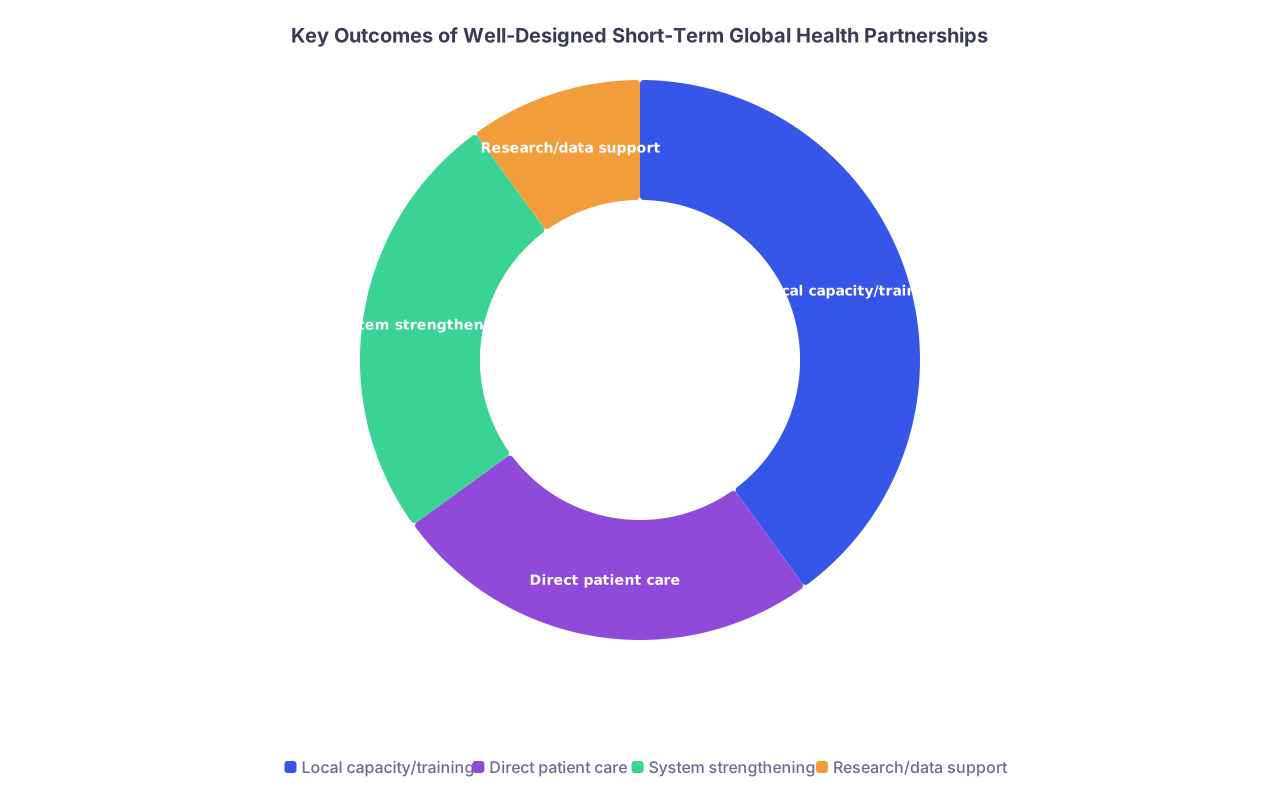
| Category | Value |
|---|---|
| Local capacity/training | 40 |
| Direct patient care | 25 |
| System strengthening | 25 |
| Research/data support | 10 |
Notice the emphasis: capacity and systems, not just head-count medicine.
The Ethics: Feel-Good vs. Do-Good
If you are a student or trainee, here’s the trap: You will absolutely feel like you helped. Patients will be grateful. You will have unlimited positive reinforcement. You’ll write a personal statement about “serving the underserved.”
Feelings are not a surrogate endpoint.
From an ethics standpoint, ask yourself the same questions you’d ask at home:
- Would this level of supervision be acceptable in my own hospital?
- Would this consent process pass IRB scrutiny in my country?
- Is this intervention sustainable or at least responsibly handed off?
- Who asked for this project—us or them?
And the hard one:
- If this trip did not exist, would the local health system be worse off, the same, or actually better?
If your core defense of a trip is “I learned so much,” you’ve told on yourself. You did a global elective, not a global service.

How to Evaluate a Short-Term Mission Before You Sign Up
You’re not powerless in this. You can actually interrogate a program instead of being swept up in the hype.
Blunt screening questions to ask organizers:
Who are your local partners, and how long have you worked with them?
Vague answers = red flag. Concrete names (Ministry of Health, specific hospital) and multi‑year relationships = better.Who defines the goals of this project?
If the answer centers on student experience or “exposure” more than local priorities, be suspicious.What happens to patients after we leave?
If they can’t show you a real follow‑up system with local providers, prescriptions, and clear referral pathways, that’s a problem.What will my actual role be, and what supervision is in place?
Acceptable answer: “You will observe, assist within your training level, and work under direct supervision of licensed clinicians. Local providers lead care.”How is the program evaluated?
Look for structured evaluation from both sides, including local feedback that actually changes future practice.
If you ask these questions and they stare at you like you just insulted their grandmother, you’ve learned something important.

| Step | Description |
|---|---|
| Step 1 | Offered short mission spot |
| Step 2 | Strongly reconsider |
| Step 3 | Borderline - proceed cautiously |
| Step 4 | Reasonable to consider joining |
| Step 5 | Long-term local partnership? |
| Step 6 | Clear local-led goals? |
| Step 7 | Ethical scope and supervision? |
| Step 8 | Continuity and follow up? |
| Step 9 | Capacity building focus? |
If You’re Serious About Global Health, Do This Instead
If what you actually want is to help—and not just collect photos—rethink the short-term, pop‑up clinic model.
More impactful options:
- Join programs with multi-year commitments to the same site or system.
- Focus on research, quality improvement, and training that empowers local teams.
- Work on boring but critical problems: supply chains, record systems, infection control.
- Learn from diaspora physicians from that country; they often know the real needs.
- Build expertise in something that travels well: ultrasound training, EMR design, guideline implementation.
You don’t need to touch 100 patients in a week to do good. In fact, the more you feel like the star of the show, the more likely you’re doing it wrong.

FAQ (Exactly 3 Questions)
1. Are short-term medical missions always unethical?
No. They’re not automatically unethical, but they’re structurally high risk. The shorter and more isolated the trip, the more likely you are to see scope-of-practice violations, poor follow‑up, and system distortion. Missions embedded in true long-term partnerships, with local leadership and strong continuity plans, can be ethical and effective—but they’re a minority compared with the typical voluntourism model.
2. Is it ever appropriate for students to do hands-on clinical work abroad?
Yes, but the rules should be at least as strict as at home, not looser. Students can take histories, perform exams, assist with procedures under direct supervision, and contribute to education or quality improvement. What’s not acceptable is using poverty and weak regulation as an excuse to practice “above your pay grade.” If you wouldn’t be cleared to do it in your own hospital, you shouldn’t be doing it overseas on more vulnerable patients.
3. If I already went on a questionable mission, does that make me a bad person?
No. Most people join these trips with good intentions and incomplete information. The ethical failure is usually at the structural and institutional level. What matters now is how you respond to better evidence. You can be honest about the limits and problems of what you did, refuse to romanticize it, and use that discomfort to push for better models—or to sit out future trips that you know are more about optics than outcomes.
Key takeaways:
- “Any help is better than no help” is a myth; short-term medical missions can and do cause harm when poorly designed.
- The best programs are long-term partnerships disguised as short-term trips: local-led, capacity-focused, and ruthless about scope and follow-up.
- If your main outcome is that you felt inspired, you did personal development, not global health—and you should be honest enough to call it that.


