

It is July 1. New academic year. You are PGY-2 in internal medicine (or surgery, pediatrics, EM—does not really matter). Your co-resident just mentioned they matched into a global health fellowship, and you did the quiet mental math.
You want that too. In about a year, you will be submitting applications. Right now your “global health CV” is…a couple of short-term trips from med school, one poster from an NGO survey, and a line that says “Intermediate Spanish.”
You have twelve months. That is enough time to build a serious, credible global health profile—if you treat this like a project, not a vague aspiration.
Here is how to do it, month by month.
Month 12: Take Inventory and Choose a Direction
At this point you should stop hand-waving and get concrete.
1. Audit your current CV (brutally).
Open your CV and mark:
- In green: Anything truly “global health–relevant.”
- In yellow: Things that can be framed as relevant with context.
- In red: Noise. Generic, not helping your global story.
Typical global-relevant items:
- Work with displaced populations, migrants, refugees, Indigenous groups
- Research in LMIC settings, implementation science, health systems, epidemiology
- Language proficiency tied to specific populations
- Ethics committee work, human rights projects, policy involvement
If your “green” section is one short elective abroad and a vague “interest,” you have work to do. That is fine. Year is young.
2. Pick a global health lane.
Global health fellowships are not impressed by “I like global health.” They like:
- “I am building a career in HIV implementation in East Africa.”
- “I focus on surgical capacity strengthening in fragile states.”
- “I am interested in migrant health and cross-border TB control.”
You do not need a perfect niche, but you need a direction. Choose:
- A population (refugees, rural, urban slums, Indigenous, migrants)
- A domain (infectious diseases, NCDs, surgery, EM, maternal-child, health systems, ethics)
- A geography (broad is acceptable: Latin America, East Africa, South Asia) or a theme that crosses geography (forced displacement, climate and health)
3. Map programs against your lane.
Spend a weekend doing targeted reconnaissance.
Look at 4–6 fellowships you might actually apply to:
- HEAL Initiative
- UCSF Global Health
- Brigham Global Health Equity
- Hopkins GH fellowships
- Peds GH programs at CHOP, Texas Children’s, etc.
Build a simple comparison table.
| Program | Focus Area | Required Time Abroad | Research Emphasis |
|---|---|---|---|
| HEAL | Health equity, primary care | 6-12 months | Moderate |
| BWH GHE | IM, systems, policy | 3-6 months | High |
| UCSF GH | ID, HIV, implementation | 4-8 months | High |
| CHOP GH | Peds, capacity building | 2-4 months | Moderate |
Now ask: What do their current fellows’ CVs have that you do not? That is your gap list for the year.
Month 11: Clarify Goals and Ethics Grounding
By now you should have a rough lane. Next step: align what you want with what is actually ethical and sustainable.
1. Write a 1-page personal statement draft.
Not for submission. For yourself. Answer:
- What kind of work do you see yourself doing 10 years from now?
- Why this region/population? Be specific—no “I like to travel” nonsense.
- What skills do you absolutely need to acquire in fellowship to get there?
Keep this file open all year; your CV and projects should start to match this story.
2. Start formal ethics/justice grounding.
If your “global health” experience to date has mostly been short-term trips, you need to show growth beyond voluntourism.
Options this month:
- Enroll in an online course (free or cheap, 4–8 weeks) on:
- Global health ethics
- Research ethics in LMICs
- Decolonizing global health
- Examples: Harvard FXB online content, Johns Hopkins Coursera, London School of Hygiene & Tropical Medicine short courses
You want at least one formal ethics/justice entry in your CV by the time you apply.
3. Identify mentors. Plural.
At this point you should schedule three meetings:
- A home institution global health faculty member
- Someone involved in global research or partnerships (even if not in your specialty)
- Your program director or APD
Ask very direct questions:
- “If I want to be competitive for X fellowship next year, what would you expect to see on my CV?”
- “Who has matched to these programs from our institution? Can I talk to them?”
- “What ongoing global or migrant/refugee projects exist here that actually need help?”
Take notes. These conversations shape your next 10 months.
Months 10–9: Start Concrete, Ongoing Global Work
Now you move from “interest” to “engagement.” Short bursts look weak; sustained involvement looks serious.
1. Lock in one longitudinal clinical or service commitment.
Best options if you are in the US or Europe:
- Regular clinic with refugees, asylum seekers, or recent immigrants
- Street medicine or mobile clinic with a high proportion of marginalized patients
- Telemedicine with a partner site in an LMIC (if established and ethical)
- Community health worker supervision or QI in safety-net settings
Commitment target:
- 3–6 hours per month, consistently for the next year
- Specific role, not “show up when you can”
This gives you:
- A real story about continuity and trust
- Evidence you understand social determinants, not just pathology
- A base for QI or research projects
2. Join one serious global research or implementation project.
You are not starting a project from scratch right now. You are joining something that already exists.
Ask mentors:
- “What projects are ongoing where an extra resident could realistically add value in 6–9 months?”
- “Who is drowning in data cleaning, chart review, REDCap work, follow-up, or manuscript drafting?”
You want:
- A defined deliverable: abstract, poster, manuscript, protocols, or policy brief
- A role that grows: from database custodian to co-author, not just eternal RA
3. Start tracking your impact.
From day one, keep a simple log:
- Hours per month at each site
- Specific tasks performed (e.g., “led weekly case review on X”)
- Any measurable outcomes (clinic flow, adherence, follow-up rates)
Later, your CV bullets will be much stronger:
- “Coordinated monthly refugee clinic, increasing follow-up completion from 62% to 81% over 9 months.”
Month 8: Upgrade Skills (Language + Methods)
By now, you should have 2–3 clear global threads started. This month you strengthen the foundation.
1. Get serious about language.
If your work involves a major non-English language, “basic” is not enough. Pick one:
- Spanish, French, Portuguese, Arabic, Swahili, Hindi, etc.
Minimum actions:
- Enroll in a structured course (community college, hospital program, or reputable online platform)
- Schedule weekly 30–60 minute conversation practice (language tandems, tutors)
- Start using the language in clinic, with supervision, where appropriate
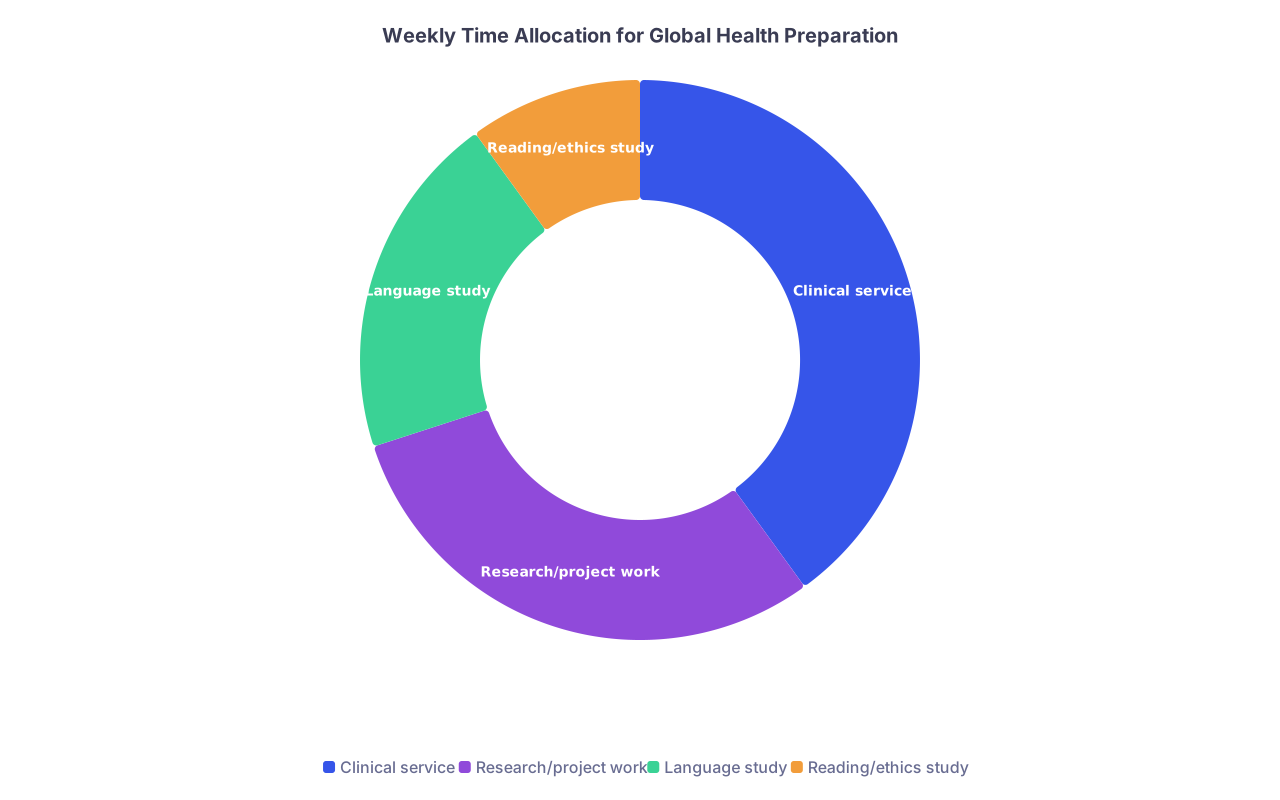
| Category | Value |
|---|---|
| Clinical service | 4 |
| Research/project work | 3 |
| Language study | 2 |
| Reading/ethics study | 1 |
You are not becoming fluent in 12 months, but you can move one level up (e.g., “intermediate” with basic clinical functionality) and show intentional effort.
2. Take one methods course that actually matters.
Global fellowships care a lot about:
- Implementation science
- Program evaluation
- Epidemiology/biostatistics
- Qualitative methods and community-based research
Pick one short course you can complete before applications open. Aim for:
- Formal certificate or transcript
- Final project you can reference (“Needs assessment of X clinic,” etc.)
Month 7: Solidify Your Ethical Framework in Practice
At this point you should not just “know” global health ethics. You should be applying it.
1. Concretely address power and partnership.
In your ongoing project, ask:
- Who defined the research question or program aim?
- How are local partners leading, not just “participating”?
- Who owns the data? Who gets authorship?
Document:
- Any steps you take to promote equitable authorship
- Any decisions where you advocated for local leadership
- How community members or local clinicians shape the work
These become compelling interview stories.
2. Avoid the “I need a quick trip” trap.
Someone will suggest a 2-week mission trip so you “have something global.” Decline or heavily scrutinize unless:
- There is an existing, long-term partnership
- Your role is clearly educational, observational, or capacity-building
- You are not practicing beyond your training or license
- There is a local request for your involvement
Short-term trips, done poorly, hurt your application. Programs are tired of savior narratives.
Month 6: Midpoint Review and CV Restructure
You are halfway to application season. Time to look hard at progress.
1. Do a mid-year CV review with a trusted mentor.
Bring:
- Updated CV
- List of current projects and timelines
- Draft list of fellowships you will likely apply to
Ask:
- “If you were on a selection committee, what would you think of this CV today?”
- “What are the top two weaknesses I must fix in the next six months?”
2. Restructure your CV into global-relevant sections.
Stop burying global pieces under generic headings. Create:
- “Global and Local Health Equity Experience”
- “Global Health Research and Quality Improvement”
- “Ethics, Equity, and Policy Training”
Within those, use evidence-based bullets:
- Scope (“served X patients,” “covered Y clinics,” “oversaw Z team members”)
- Role (“primary author,” “lead resident,” “coordinator,” “PI delegate”)
- Outcome (abstract accepted, process metric improved, curriculum implemented)
Months 5–4: Produce Outputs (Posters, Abstracts, Talks)
At this point you should convert ongoing work into visible products. Fellowships want evidence that you can close the loop.
1. Target one to two conferences.
Global-relevant options:
- CUGH (Consortium of Universities for Global Health)
- ASTMH
- Specialty-specific GH or ID conferences
- Regional refugee health or migrant health meetings
Plan backward:
- Find deadlines (often 4–8 months before conference)
- Identify which project is most likely to yield data in time
- Decide on format: poster, oral, workshop, panel
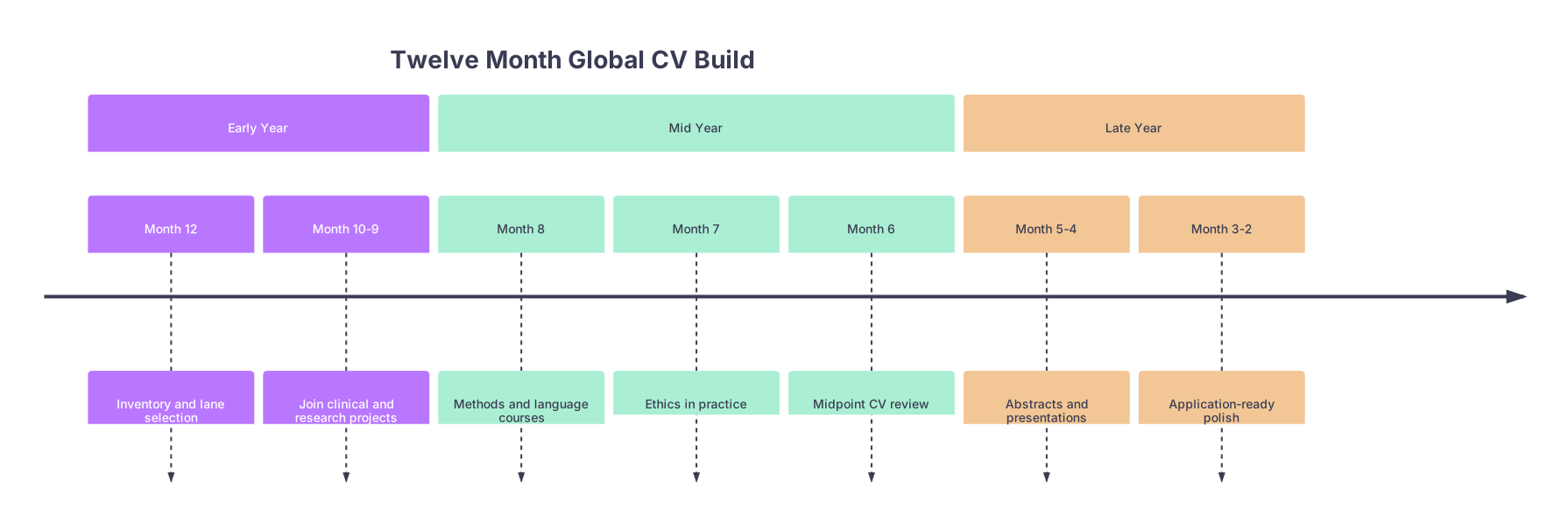
| Period | Event |
|---|---|
| Early Year - Month 12 | Inventory and lane selection |
| Early Year - Month 10-9 | Join clinical and research projects |
| Mid Year - Month 8 | Methods and language courses |
| Mid Year - Month 7 | Ethics in practice |
| Mid Year - Month 6 | Midpoint CV review |
| Late Year - Month 5-4 | Abstracts and presentations |
| Late Year - Month 3-2 | Application-ready polish |
2. Turn local work into scholarly products.
Examples:
- QI in refugee clinic → abstract on no-show reduction
- Community partnership → workshop on ethical partnerships
- Telehealth project → poster on feasibility and acceptability
Do not underestimate “local” work. Global fellowships understand that humility, rigor, and partnership at home often translate better than a scattered list of overseas trips.
Month 3: Letters, Leadership, and Final Gaps
You are now within one quarter of application season. Time to lock in social proof and clean up loose ends.
1. Secure your letter writers.
You want:
- 1–2 letters from people who have seen you in global or equity-focused settings
- 1 letter from a clinical supervisor attesting that you are actually good at your job
- Optional: a methods or research mentor if that is a big part of your application
When you ask, provide:
- Updated CV
- One-page personal statement draft
- Bullet list of projects you did together and what you hope they will highlight
Ask early. People travel, forget, or write terrible last-minute letters when rushed.
2. Take on one contained leadership role.
You are not founding a new NGO at month 3. But you can:
- Lead the global health residents’ group or journal club
- Coordinate the refugee clinic schedule and onboarding
- Organize a small ethics/justice case discussion series
Goal: Show that you can organize, not just participate.
3. Patch obvious holes.
Examples:
- No formal ethics training yet? Complete a short online module or workshop and document it.
- No teaching? Guest lecture for med students on migrant health, or present in morning report with a global equity lens.
Month 2: Refine Narrative and Standardize Documentation
By now, the content is mostly there. Next: coherence.
1. Create a one-page “Global Health Snapshot.”
This is not official, but it helps you and your letter writers. Sections:
- Focus: 2–3 sentences on your lane (e.g., “I focus on humanitarian EM and displacement.”)
- Key experiences: 3–5 bullets with dates and roles
- Skills: languages, methods, specific tools (REDCap, GIS, qualitative analysis software)
- Ethics lens: 1–2 bullets demonstrating how you integrated equity and partnership in real decisions
You will use this to align your personal statement, CV, and faculty letters.
2. Quantify everything.
Go through each CV entry and ask: can I add a number?
Instead of:
- “Volunteered in refugee clinic.”
Write:
- “Provided longitudinal care for ~40 refugee and asylum-seeking patients over 10 months, coordinating interpretation and social services across three partner organizations.”
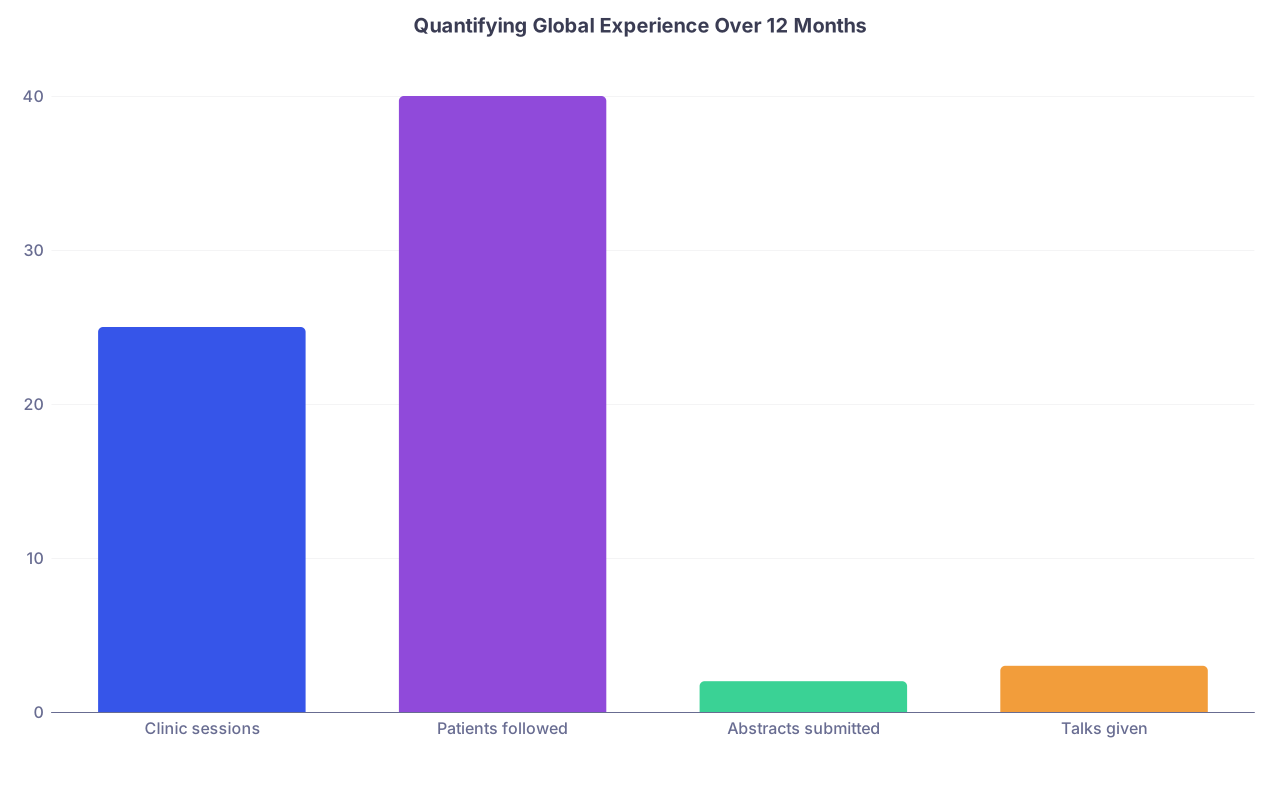
| Category | Value |
|---|---|
| Clinic sessions | 25 |
| Patients followed | 40 |
| Abstracts submitted | 2 |
| Talks given | 3 |
The numbers do not need to be huge. They need to be real.
Month 1: Final CV Polish and Ethical Self-Check
You are basically there. Do not blow it in the last mile.
1. Run a “savior narrative” filter on your application.
Go through your CV and statement and hunt for red flags:
- Overemphasis on how much you helped in a short time
- Vague claims of “served” without mentioning local teams
- Descriptions of countries or communities that are patronizing or exoticizing
Fix it:
- Center local partners and systems
- Emphasize reciprocity and long-term commitment
- Be honest about what you learned and how your thinking changed
2. Cross-check your story with actual timelines.
Global health committees are very good at spotting inflated claims. Make sure:
- Dates match across CV, ERAS/other applications, and letters
- Roles are accurate (do not call yourself “co-investigator” if you were an RA)
- Time abroad versus time in local/remote work is clear and not misrepresented
3. Have one person outside your specialty read the CV.
Preferably someone in global health or ethics who is not deeply invested in your success. Ask:
- “Do you believe I am serious about a career in global health after reading this?”
- “Where do I sound naive, vague, or self-congratulatory?”
Then actually fix what they point out.
Putting It All Together: A Compact Timeline
To make this painfully clear, here is the high-level sequence you should be following:
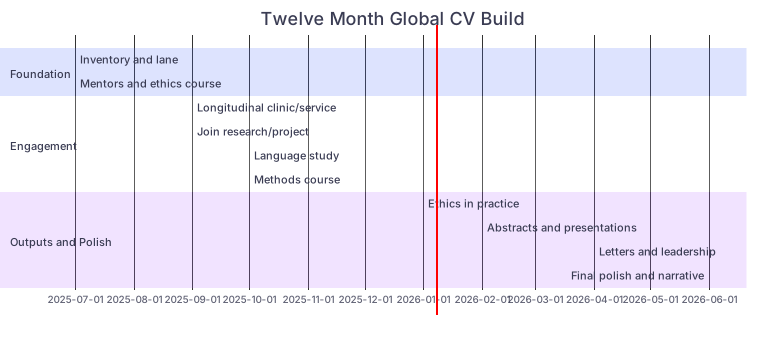
| Task | Details |
|---|---|
| Foundation: Inventory and lane | a1, 2025-07, 1m |
| Foundation: Mentors and ethics course | a2, after a1, 1m |
| Engagement: Longitudinal clinic/service | b1, 2025-09, 9m |
| Engagement: Join research/project | b2, 2025-09, 8m |
| Engagement: Language study | b3, 2025-10, 8m |
| Engagement: Methods course | b4, 2025-10, 3m |
| Outputs and Polish: Ethics in practice | c1, 2026-01, 3m |
| Outputs and Polish: Abstracts and presentations | c2, 2026-02, 3m |
| Outputs and Polish: Letters and leadership | c3, 2026-04, 2m |
| Outputs and Polish: Final polish and narrative | c4, 2026-06, 1m |
Last 2 Weeks: The Quiet Rehearsal
You are about to hit submit. Two final tasks.
1. Build a one-page “interview crib sheet.”
Columns:
- Experience
- What I did
- What I learned (especially ethically)
- How it shapes my future work
You will use this to practice 4–5 key stories you can tell cleanly in 2–3 minutes each.
2. Do a final values check.
Ask yourself, candidly:
- Would I still do this work if I never got a fellowship or a title from it?
- Am I prepared to commit for a decade, not a year?
- Do my actions over the last 12 months match the values I claim?
If the answer is yes, your CV will reflect it. People on the other side can tell.


Three Things to Remember
- At twelve months out, do not chase random trips. Commit to longitudinal, partnership-based work, even if it is local.
- Your CV must show skills and outputs, not just interest: clinics run, projects completed, abstracts submitted, ethics studied.
- Every line on your CV should align with one coherent story: you are building a serious, ethically grounded global health career, not a curated travel log.


