

You’re back from that big global health trip. The one you were sure would “change your life” and “confirm your calling.” You wrote the grant, did the pre-departure training, posted the obligatory scrub selfie with kids in the background (and then felt weird about it). You’ve maybe even mentioned “lifelong commitment to global health” in a personal statement or two.
And now you’re home, staring at your notes, and this quiet thought keeps showing up:
“Wait… what if this isn’t what I want long-term?”
Cue the panic spiral:
- Did I lie in my application?
- Are programs going to think I’m fake if I pivot?
- What if I burn out on global health after investing years into it?
- Is it unethical to use global health to “get in” and then change directions?
Let’s talk about that. Bluntly. Because you’re definitely not the first person to freak out over this, and pretending everybody’s “lifelong calling” never shifts is just dishonest.
The Fear Underneath: “If I Change, I Was Never Genuine”
The thing that’s probably making your stomach twist isn’t just “I might pivot.” It’s: If I pivot later, does that mean everything I’m saying now is bullshit?
I’ve watched so many students go through this exact sequence:
- First global health exposure (trip, elective, research)
- Emotional high: “This is it, this is what I want”
- They start branding themselves as “global health person”
- Time passes. Systems look messier, funding is weird, ethics feel uncomfortable, life priorities shift
- Cue: “What if I don’t want to spend my life flying back and forth to [country]?”
Here’s the annoying truth: interests evolve. They’re supposed to. A 22-year-old version of you and a 38-year-old version of you are allowed to want different things.
It doesn’t mean you lied now. It means you grew.
The only dishonest thing would be pretending you know with certainty how you’ll feel in 10–15 years. And you don’t. Nobody does. Not the people writing “I will absolutely be a surgeon-scientist” at 21. Not the people swearing they’ll be primary care for underserved urban communities forever. People pivot constantly.
Global health isn’t exempt from that.
Is It Ethically Okay To Pivot Away From Global Health Later?
Short answer: yes, if you were honest in the moment and you don’t exploit people along the way.
Let me separate two things:
- Changing your mind
- Using communities as a prop while never caring what happens to them
Changing your mind is human.
Using people as “poverty wallpaper” for your career narratives is gross.
The ethical issues show up when:
- You overstate your experience (“I led” when you shadowed; “I built a program” when you joined it for 2 weeks)
- You promise commitments you never intend to keep (“I will return yearly to this village” when you made that line up for drama)
- You center yourself over the community (“I went to save them” vibes)
If, right now, you genuinely are drawn to global health, equity, cross-cultural work, system-level stuff—and you say that—then that’s honest. Even if 10 years from now you’re a hospitalist in Ohio who occasionally donates to Partners In Health and that’s it.
Ethical red flags are about intent and representation, not about later evolution.
Ask yourself, today:
- Am I exaggerating what I did?
- Am I making promises (explicit or implied) about specific future commitments?
- Am I aware of the power dynamics, or am I romanticizing “helping the poor”?
If you keep those clean, pivoting later isn’t a moral failure. It’s adulthood.
“But My Personal Statement Says I’m Committed to Global Health Forever”
This is where people get really stuck. The literal words on the page.
Maybe you wrote:
“I plan to dedicate my career to global health and serving underserved communities worldwide.”
And now you’re sitting there thinking: What if that ends up not being true? Did I just lie on a legal document?
No. Personal statements are not sworn affidavits. They are snapshots of who you are right now and what you currently aspire to. Admissions committees know this. Residency directors know this. They’ve watched a hundred “future surgeon-scientists” turn into hospitalists, and “definitely peds” applicants match EM.
But you can write about global health in a way that gives you breathing room.
Instead of locking yourself into “lifelong global health career,” anchor to values and themes, not rigid future job titles.
Compare these:
| Type | Example Line |
|---|---|
| Rigid | "I will build a career solely in global surgery and return to Country X every year." |
| Flexible | "My experiences in Country X shifted how I think about equity, systems, and resource allocation, and I hope to carry that lens into whichever clinical setting I ultimately practice in." |
| Rigid | "Global health is my only professional goal." |
| Flexible | "Global health work has been my first real window into health equity, and right now, it feels like the direction I want to keep exploring." |
See the difference?
The second column is still enthusiastic. Still specific. Still sincere. But it doesn’t pretend you can time-travel and guarantee who you’ll be in 2040.
If you already sent something more rigid—fine. You wrote the truth as you felt it then. That’s allowed. You’re not stamped “global health only” for life.
The Career Reality: Very Few People Do “Global Health 100%”
There’s this illusion that “global health career” means you live half the year in a field site and the other half writing grants in Boston or London. Some people do. But lots don’t.
Here’s what I’ve actually seen people end up doing, after being very “global health” as students:
- Full-time academic doc in the US with 10–20% global health work (consulting, research, short visits)
- Domestic safety-net work that’s essentially “global health principles at home”
- Policy, public health, or quality improvement jobs that apply the same thinking without leaving the country
- Zero formal global health work, but their early experiences shaped how they treat immigrants, refugees, uninsured patients
Your “global health passion” might morph into:
- Health systems thinking
- Anti-racism work
- Migrant health
- Rural care
- Palliative care in low-resource US settings
Is that a betrayal? No. It’s the same moral core, different setting.
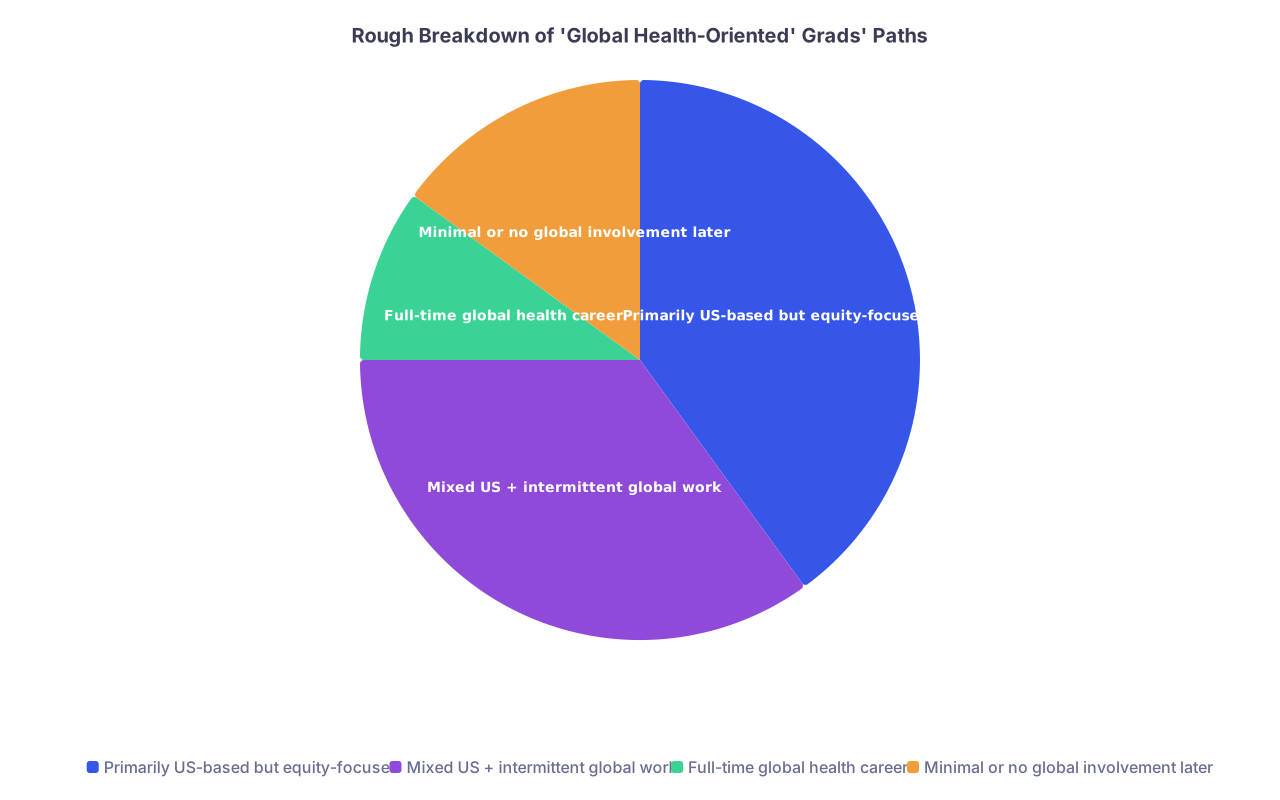
| Category | Value |
|---|---|
| Primarily US-based but equity-focused | 40 |
| Mixed US + intermittent global work | 35 |
| Full-time global health career | 10 |
| Minimal or no global involvement later | 15 |
Numbers are illustrative, but that rough picture matches what I’ve actually seen over the years.
So if your brain is screaming, “What if I don’t do enough global health to justify what I’m writing now?”—remember: the field itself is porous. You can “pivot” and still be living out the same values, just not in the Instagram version you’re imagining.
The Worst-Case Scenario You’re Afraid Of (Let’s Actually Spell It Out)
Let’s say the absolute nightmare happens:
- You build a big global-health-heavy narrative
- Match into a residency partly because of that
- Two years later, you’re like, “I hate travel, grants, and trying to do WhatsApp meetings across time zones”
What then?
Reality check on what won’t happen:
- No one is going to drag out your personal statement and charge you with “career fraud”
- Your residency program is not going to fire you for not joining the global track
- The communities you worked with are not sitting around monitoring your career path and tallying your “commitment score”
What might happen:
- Mild awkwardness when people say, “Hey, aren’t you doing global health?” and you say, “Actually, I’m moving more toward X now”
- A bit of internal guilt or shame (this part is real, and it sucks)
- You’ll grieve the identity you thought you’d have
But your job, ethically, is to keep being honest from that point forward.
You’re allowed to say, “I used to think I wanted a big global health career, but as I’ve gone along, I’ve realized I’m more energized by [insert new direction]. I’m still grateful for what global health taught me.”
That’s not failure. That’s self-knowledge.
The Line Between “Exploring” and “Performing” Global Health
Here’s where you should be a little anxious (in a productive way): performative global health.
A few red flags:
- You only talk about global health when it’s application season
- You have no idea what local partners gained from your presence
- You frame your work as “I went to give back” instead of “I went to learn and support ongoing efforts”
- You’re more fluent in buzzwords (“capacity building,” “sustainability,” “decolonizing global health”) than in what the community actually asked for
If that’s ringing a bit too true, the pivot question isn’t your real problem. The problem is you might be using global health as a costume instead of a genuine area of learning.
If, on the other hand:
- You grapple with ethical questions
- You can name what you got wrong or misunderstood early on
- You care about what happens to that clinic or project after you leave
…then you’re not a fraud for re-evaluating what role you want global health to play in your life.
You’re actually taking it seriously enough to ask the hard questions.
How To Talk About Global Health Now Without Trapping Your Future Self
You want to sound genuine. You don’t want to oversell. You also don’t want to be so vague you sound like you don’t care. There’s a middle ground.
Practical ways to phrase things:
Focus on what it changed in you, not what you did “for them”
- “Working in a district hospital in Kenya forced me to confront how much I took resource abundance for granted.”
- “I started asking why some patients wait months for basic tests while others get them in hours.”
Emphasize questions you’re still wrestling with
- “I don’t know yet what the right balance is between short-term electives and long-term partnerships, but I’m interested in being part of programs that are wrestling with that tension.”
Name your current intention, but keep it conditional
- “Right now, I see myself pursuing a career that keeps one foot in US academic medicine and one in global health partnerships.”
- “I hope to continue building on this interest during residency through electives and research, and then see where that leads.”
That’s honest. It leaves room for growth. You don’t need to promise the 20-year plan.
A Quick Reality Check: Programs Don’t Need You To Be Locked In
Residency and med school programs actually like people who:
- Have thought deeply about health equity
- Understand systems-level issues
- Show they can work across cultural and resource differences
- Are reflective about ethics, not just chasing stamps in their passport
You don’t have to promise to be the next Paul Farmer to “justify” your interest in global health.
If anything, the most thoughtful global-health-oriented faculty I’ve met get nervous when they hear absolute language from a 23-year-old:
“I am definitely going to spend my career in this one village.”
They know how often that doesn’t hold. Life gets in the way. Family, partner jobs, illness, burnout, visas, politics. They’re not counting future flights, they’re looking for your mindset.
What You Can Do Today To Calm This Down
You want something actionable, not just “it’s fine, don’t worry” (because clearly you are worrying).
Do this:
- Open whatever document has your global health narrative (personal statement, CV, secondary essay).
- Highlight every sentence that:
- Makes a definite claim about your future (“I will… for my career,” “I plan to always…”)
- For each of those, ask:
- Is this a value, or a prediction?
- Can I rephrase it as a hope, interest, or intention instead of a guaranteed outcome?
Example edits:
“I will dedicate my life to global health.”
→ “Right now, global health feels like the direction I want to keep building my career toward.”“I plan to spend my career traveling between the US and low-income countries.”
→ “I can imagine a future where part of my work includes ongoing partnerships with clinicians in low-resource settings.”
That edit pass alone will remove 70% of the “oh God, what if I change” anxiety because you’re no longer promising a future you can’t control.

| Step | Description |
|---|---|
| Step 1 | First Global Experience |
| Step 2 | Strong Interest and Identity |
| Step 3 | Write Applications With Global Focus |
| Step 4 | Global Health Career Core |
| Step 5 | Hybrid or Domestic Equity Focus |
| Step 6 | Different Focus, Lessons Still Applied |
| Step 7 | More Exposure and Training |
You’re somewhere on that diagram. All three endpoints are valid. The ethical issue is not where you end up; it’s how truthfully you describe where you are now, and how respectfully you treat the people and communities you work with along the way.
FAQ (4 Questions)
1. If I pivot away from global health, will programs think I used it just to “get in”?
Probably not—unless you obviously faked or exaggerated things. Faculty know interests change. They’ve watched dozens of trainees “pivot” in every direction. If you showed up, did the work, reflected honestly, and then later realized you’re pulled elsewhere, most reasonable people will understand that. The real damage to credibility happens when people inflate, misrepresent, or posture—not when they evolve.
2. Is it wrong to go on a global health elective if I’m not 100% sure I’ll do global health long-term?
No. That’s literally what training is for: exploring. What’s wrong is treating the community like a training playground or photo op. If you’re going with humility, wanting to learn, contributing in ways the local partners actually want, and being honest about your level of experience, it’s okay that you’re not locked in for life. You can learn a ton and later aim those lessons at local, regional, or policy work.
3. Do I need to scrub all “lifelong commitment” language from my existing applications?
You don’t have to panic-edit everything, but it’s smart to avoid absolute language if you still can. If apps are already submitted, let it go—you wrote your genuine aspiration at the time. If you’re still drafting, revise phrases that sound like binding contracts into intentions and interests. That’s not watering it down; it’s making it honest and sustainable.
4. What if deep down I’m already realizing global health isn’t my thing—should I still lean on it as a theme?
No. That’s when it crosses into performance. If your excitement was real once but has cooled, you can still use global health as part of your story, but shift the emphasis: what you learned, how it reoriented your thinking, why you now feel drawn to [primary care / psych / health policy / local underserved work]. Don’t sell a passion you no longer have. Sell the insight it gave you and the direction you’re actually interested in now.
Today, do this one concrete thing: open your main personal statement or global health essay, find the strongest future-claiming sentence (“I will…” / “I’m certain…”), and rewrite it as an honest current intention instead of a lifetime guarantee. That one line change will loosen the trap you’re building around your future self.


