
The worst way to handle past weaknesses in a letter of intent is to pretend they never happened.
If a red flag exists in your file—failed course, LOA, Step failure, professionalism concern—admissions and program directors already know. The only real question is whether you handle it with maturity or with denial. Your letter of intent is one of the few places where you can take control of that narrative.
Let me show you how to do it without sounding defensive, desperate, or dishonest.
1. When You Should Clarify Past Weaknesses (And When You Should Not)
Before you write a single sentence, you need to decide if the weakness even belongs in a letter of intent.
Cases where you should address the weakness
If any of these apply, it is usually smart to clarify:
- USMLE/COMLEX failure or significant score drop
- Course or clerkship failure, remediation, or repeat year
- Leave of absence (medical, personal, academic)
- Professionalism concerns mentioned in your MSPE / dean’s letter
- Significant gap in training or employment
- Major shift in performance (weak preclinical, strong clinical, or vice versa)
Why? Because these are the things that:
- Show up clearly on your transcript, and
- Prompt whispered conversations in the selection committee room
If they are already discussing it, you want to supply the script.
Cases where you usually should NOT bring it up in a letter of intent
These are often too minor or already explained elsewhere:
- A single low grade in one preclinical course with otherwise consistent performance
- Slightly below-average Step 1 or Step 2 score with no failure
- “Average” research output when others have more
- Not being AOA / Gold Humanism etc.
If the issue is:
- Not explicitly called out as a red flag, and
- Already “priced into” your application,
then dragging it back into the spotlight in a letter of intent can do more harm than good. You are reminding them to doubt you.
How to decide in 30 seconds
Ask yourself:
- Would most programs call this a “red flag” in a selection meeting?
- Would I be nervous if this came up unprompted in an interview without a prepared explanation?
- Has anyone (advisor, PD, dean’s office) told me this needed addressing?
If “yes” to any of those, you probably need a concise, controlled clarification in your letter of intent.
2. Core Principles: How to Sound Mature, Not Defensive
You want to come across as someone who:
- Understands what happened
- Takes clear responsibility
- Has already corrected the problem
- Is now performing at or above expectations
To get there, follow four rules.
Rule 1: Own it in one line
No long saga. No blaming everyone else.
Bad:
“Due to multiple external stressors, including family challenges, curriculum changes, and an unsupportive environment, my Step 1 result does not reflect my true ability.”
Better:
“I did not pass Step 1 on my first attempt.”
Short. Clear. Adult.
Rule 2: Give focused, factual context (no drama)
You can briefly explain what contributed, but keep it under control.
Good structure:
- 1 sentence naming the issue
- 1–2 sentences of unemotional context
- 1–2 sentences showing concrete change and improved performance
Avoid:
- Emotional overload (“devastated,” “crushed,” “unfair”)
- Blaming specific people or institutions
- Over-sharing personal medical/mental health details (you can reference them more generally)
Rule 3: Show evidence of improvement, not promises
Program directors believe data, not intentions.
So do this:
- Link the weakness to later strengths: improved scores, solid clerkship performance, positive evaluations, leadership, consistent reliability
- Reference specific outcomes: “honors in medicine and surgery,” “Step 2 score of 247,” “successful remediation with no further concerns”
Skip vague claims:
- “I am now fully ready”
- “I have grown a lot”
- “I will not let this happen again” (say it with evidence, not slogans)
Rule 4: Keep it brief and then move on
Your letter of intent is not an apology essay. It is a statement of commitment and fit.
You want:
- One compact paragraph (two at most) on the weakness
- The rest focused on why you are a strong fit and deeply interested in this specific program
If half your letter is about your past, you just reconfirm their fears.
3. Exact Structure: Where and How to Place the Clarification
You do not lead with your weaknesses. You place them in the middle, between genuine interest and your current strengths.
A clean structure looks like this:
- Opening – Clear statement of intent and interest in the program
- Fit & motivation – Why this program, why this specialty, why you match what they value
- Clarification of weakness – Brief, honest, solution-focused paragraph
- Evidence of current readiness – Skills, performance, and traits you bring now
- Closing – Reaffirmation of interest and professionalism
Think of the weakness section as a controlled detour. Not the main road.
4. Templates: Polite, Mature Language You Can Copy
Here is what you actually came here for: phrases and structures you can use without sounding guilty or begging.
A. General template for addressing any significant weakness
“I would also like to briefly address [specific issue] in my record. During [time period], I experienced [very concise, non-dramatic context]. This contributed to [outcome: course failure, exam failure, leave, etc.]. I took responsibility for this and [concrete actions: changed study methods, sought mentorship, addressed health, improved time management]. Since then, I have [evidence of improvement: completed all subsequent rotations successfully, achieved a Step 2 score of X, received strong clinical evaluations, had no further concerns].
This experience has made me more [mature / organized / realistic] and has strengthened my commitment to [relevant trait: reliability, self-improvement, patient care].”
That is the backbone. You will customize the context and evidence.
5. Specific Scenarios and How to Fix Them
Let us walk through the common disasters.
Scenario 1: Step 1 or Step 2 failure
This is a classic anxiety trigger for applicants. Programs already see the failure in ERAS. You are clarifying, not revealing.
Goal:
Show that:
- You understand why you failed
- You corrected the underlying problem
- Your retake and subsequent performance prove it
Example paragraph:
“I would also like to briefly address my Step 1 result. I did not pass Step 1 on my first attempt. At the time, I underestimated the volume of material and relied too heavily on passive review rather than structured practice questions. After this experience, I worked closely with my academic advisor to redesign my approach, incorporating daily question blocks, spaced repetition, and scheduled review sessions. On my second attempt, I passed comfortably and later earned a Step 2 score of 246, which I believe better reflects my current knowledge base and test-taking approach. Since then, I have completed my core clerkships with strong evaluations and no further academic concerns.”
Notice:
- No blaming
- No melodrama
- Concrete change and measurable improvement
Scenario 2: Failed course or clerkship, or repeated year
Here the fear is: “Will this person struggle with our clinical workload?”
You need to show:
- The failure was time-limited and understood
- Your later performance is stable and above the bar
Example paragraph:
“You will notice that I repeated my second-year preclinical curriculum after initially failing [course/block]. During that period, I was balancing school with significant family responsibilities and did not seek help early enough when I began to fall behind. I accepted the decision to repeat the year and used the time to build a more systematic study routine, meet regularly with course faculty, and improve my time management. Since repeating the year, I have passed all subsequent courses and clerkships on the first attempt, earned honors in internal medicine and pediatrics, and have been consistently described as reliable and well-prepared in my clinical evaluations.”
Again: short, specific, then pivot to evidence.
Scenario 3: Leave of absence (LOA)
Programs mainly worry about:
- Stability
- Reliability to complete residency without repeated interruptions
You do not need to disclose details you are not comfortable sharing, especially about health. You do need to show that the underlying issue is resolved or well managed.
Example paragraph (personal / medical LOA):
“I also want to briefly clarify the leave of absence noted in my transcript. I took a personal leave during my third year for health-related reasons. During this time, I worked with my healthcare providers and my school to ensure that I could return safely and sustainably. Since resuming my training, I have completed all remaining clerkships on schedule, passed Step 2, and maintained consistent performance without further interruptions. I feel fully able to meet the demands of residency and am grateful for the perspective this period has given me on resilience and patient empathy.”
Keep it high level. The point is capacity and stability now.
Scenario 4: Professionalism concern or MSPE comment
This one is tricky. You cannot ignore it if it is explicitly in the MSPE. But you also cannot attack your school or minimize it.
Your goal:
- Own the behavior
- Show insight
- Show change documented by others (evaluations, leadership roles, trusted responsibilities)
Example paragraph:
“I am aware that my MSPE references a professionalism concern from early in my clinical training related to lateness and incomplete documentation. At that time, I struggled with overcommitting myself and did not yet have an effective system for prioritizing clinical responsibilities. After direct feedback from my attending, I met with our clerkship director, adjusted my schedule, and began using structured task lists and daily check-ins with the team. Since then, my evaluations have consistently commented on my reliability, timely follow-through, and strong communication with the team. I take that early feedback seriously and have worked to ensure that it no longer reflects how I function as a member of the healthcare team.”
This is the tone you want: humble, corrective, backed by evidence.
6. Making It Actually Polite (Without Sounding Weak)
Polite does not mean submissive. It means respectful, concise, and professional.
Here are phrases that work well in a letter of intent without sounding needy:
- “I would like to briefly address…”
- “You will notice that…”
- “I took responsibility for…”
- “I worked closely with…”
- “Since that time, I have…”
- “I understand how this may raise questions about…”
- “My subsequent performance reflects…”
Avoid:
- “I beg you to look past…”
- “I hope you can forgive…”
- “I know my record is terrible, but…”
- Over-apologizing or self-deprecating humor
You are not on trial. You are explaining, then moving on.
7. Full Sample: Integrated Letter of Intent with Clarification
Here is a condensed sample (you will adapt length and specifics to your situation and specialty).
Dear Dr. [Program Director Last Name] and the [Program Name] Selection Committee,
I am writing to express my strong interest in ranking [Program Name] as my top choice for residency in [specialty]. After interviewing with your team and speaking with current residents, I am confident that your program offers the rigorous clinical training, supportive culture, and commitment to [specific features: underserved care, education, research, etc.] that align with my goals as a future [specialty] physician.
I was particularly impressed by [specific detail from your interview day—resident camaraderie, curriculum structure, patient population, mentorship, etc.]. The opportunity to train in a setting where [concrete aspect] fits perfectly with my interests in [specific clinical or academic interest]. I can clearly see myself contributing to and growing within this environment.
I would also like to briefly address the Step 1 failure noted in my application. I did not pass Step 1 on my first attempt. At that time, I relied on passive review and did not appreciate how much daily active practice and structured schedule were necessary for success. In response, I met regularly with my academic advisor, adopted a question-based approach with daily practice blocks, and used spaced repetition to build retention. On my second attempt, I passed Step 1 and subsequently earned a Step 2 score of 247. Since then, I have completed my core clerkships with strong evaluations, including honors in internal medicine and surgery, and have had no further academic concerns.
Clinically, I bring [2–3 strengths: calm bedside manner, thoroughness, efficiency, teaching interest]. Attendings have consistently commented on my [specific feedback: team communication, reliability, ownership of patient care]. I am particularly drawn to [Program Name] because I believe your emphasis on [teaching, underserved care, research, etc.] will allow me to continue developing these strengths while contributing meaningfully to your resident cohort.
If given the opportunity, I would be honored to train at [Program Name] and am committed to ranking your program first. Thank you for your time and consideration.
Sincerely,
[Your Name]
Notice how the weakness takes one paragraph, sandwiched between genuine program interest and current strengths.
8. Common Mistakes That Ruin Good Letters
I see the same errors over and over. Easy to avoid once you know them.
Mistake 1: Over-explaining
Five paragraphs on why you failed Step 1. Detailing every family crisis. Naming every professor.
Fix:
- One paragraph
- No more than 4–6 sentences on the weakness
Mistake 2: Vague non-apology
“There were some circumstances outside my control that affected my performance.”
Reads as evasive. Committees do not like vague.
Fix:
- Name the issue clearly
- Give a simple, plausible explanation
- Show exactly what changed afterward
Mistake 3: Blaming the system
“The exam did not reflect my knowledge,”
“The grading was unfair,”
“The school environment was toxic.”
That might even be true. Does not matter. It makes you look risky.
Fix:
- Focus on what you controlled and changed
- Leave institutional critiques for another setting (or never)
Mistake 4: Ignoring a major red flag entirely
If you failed a board exam or repeated a year and never mention it, you look either:
- Unaware, or
- Avoidant
Fix:
- Briefly, directly, and professionally address it once
Mistake 5: Making the whole letter about your weakness
If your “letter of intent” spends more time on your past problems than on your genuine interest in the program, the signal is wrong. They remember the weakness, not the fit.
Fix:
- Structure: interest → fit → brief clarification → strengths → clear commitment
9. Quick Checklist Before You Hit Send
Run your letter through this filter:
- Is the weakness significant enough to deserve mention?
- If yes, one controlled paragraph.
- Do I clearly state what happened in plain language?
- Do I provide brief, neutral context without drama or blame?
- Do I show concrete steps I took to improve?
- Do I provide hard evidence of better performance since then?
- Is the rest of the letter focused on fit, strengths, and genuine interest?
- Is my tone respectful, confident, and adult throughout?
If you can check all of that, your letter is doing its job.
10. Visual Reference: What Programs Actually Care About
To keep your anxiety in proportion, remember: your weakness is not the only factor.
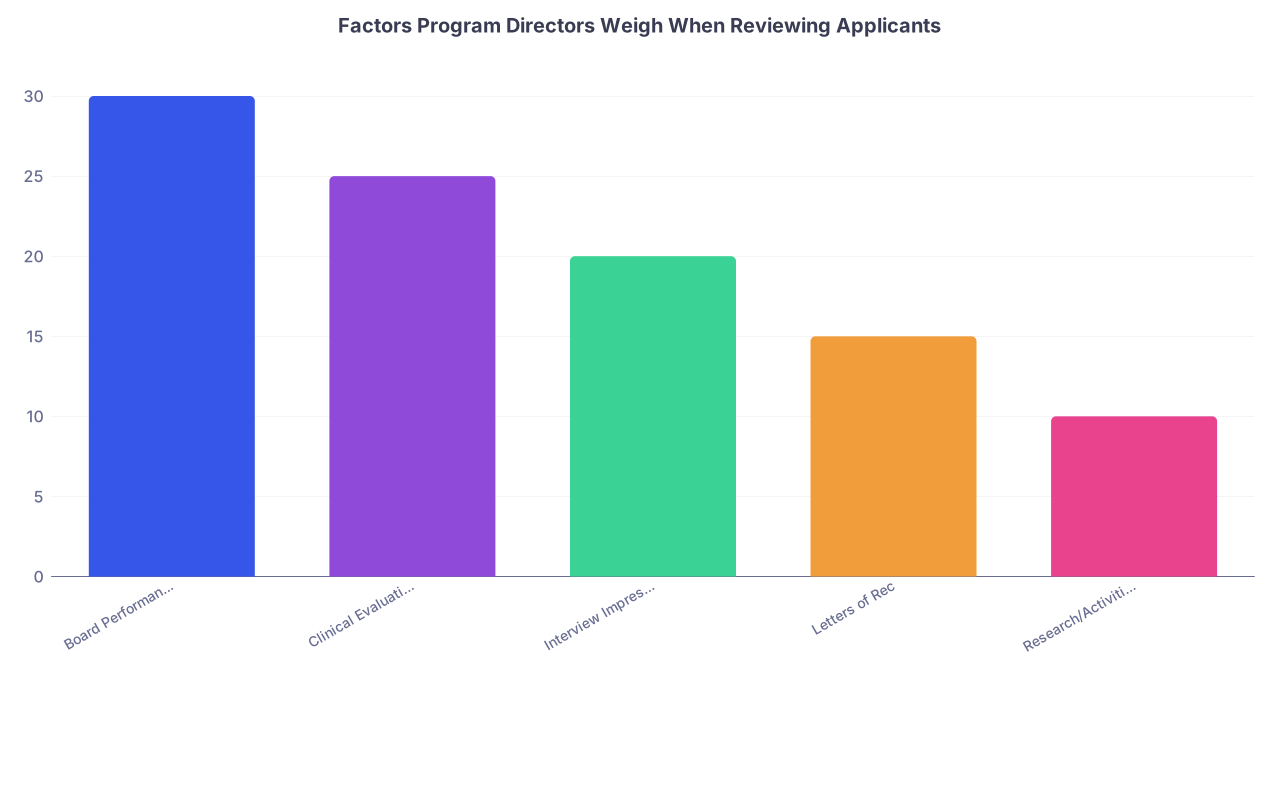
| Category | Value |
|---|---|
| Board Performance | 30 |
| Clinical Evaluations | 25 |
| Interview Impression | 20 |
| Letters of Rec | 15 |
| Research/Activities | 10 |
That bar chart is not exact data for every specialty, but it is close in spirit. Your past weakness is one piece. Your response to it and your current performance often matter more.
11. Process Map: Where Clarification Fits in the Application Story

| Step | Description |
|---|---|
| Step 1 | Application Submitted |
| Step 2 | Program Reviews File |
| Step 3 | Focus on Overall Fit |
| Step 4 | Committee Discusses Concern |
| Step 5 | Reads MSPE and Letters |
| Step 6 | Reads Letter of Intent |
| Step 7 | Committee Assumes Worst |
| Step 8 | Improved Understanding |
| Step 9 | Decision on Rank |
| Step 10 | Red Flag Present |
| Step 11 | Clarification Included |
Your letter of intent does not erase the red flag. It reframes it from “unanswered concern” to “understood, corrected issue.”
12. Short Summary: How to Fix This Without Making It Worse
You do not need a perfect record to match. You need a coherent story that shows growth and reliability.
Focus on these:
- Address real red flags once, directly, and briefly – Do not ignore them, do not obsess over them.
- Show concrete improvement with real evidence – New scores, clerkship performance, evaluations.
- Make the letter mostly about fit and strengths, not damage control – Programs rank people they are excited about, not people who are “less problematic than expected.”
Handle your past weakness like a professional, and your letter of intent becomes a strength instead of a liability.
FAQ
1. Should I address the same weakness in every letter of intent or only for certain programs?
If the weakness is a clear red flag (exam failure, repeated year, LOA, professionalism concern), you should address it consistently in any letter of intent where you are declaring serious interest. Programs talk to each other less than people think, but your own story needs to be internally consistent. Minor issues that are not true red flags usually do not need to be mentioned anywhere.
2. What if my school already explained the weakness in the MSPE? Do I still need to mention it?
Yes, briefly. The MSPE is the school’s perspective. Your letter is your perspective. A short, aligned clarification shows maturity and insight. You do not need to rehash everything; you just need to acknowledge it, accept responsibility, and connect it to your current performance.
3. Is it ever okay to mention mental health or personal crises as context?
Yes, but carefully and at a high level. You can say “health-related reasons,” “family responsibilities,” or “personal circumstances” without going into intimate detail. Your goal is not to earn sympathy; it is to show that the situation was time-limited, appropriately managed, and that your current functioning is stable enough for the demands of residency or further training.
4. Can I ask a mentor or advisor to review my clarification paragraph?
You should. Someone who knows your file—and has seen selection from the program side—can tell you if your tone is right, if you are oversharing, or if you are not taking enough ownership. A clerkship director, dean’s office advisor, or trusted attending is far better than a random friend.