
Programs are not obsessing over your letter of intent. They are obsessing over their rank list data, their match outcomes, and their time. Letters of intent sit somewhere between background noise and occasional tie‑breaker, not at the center of the universe you have been told they inhabit.
Let me be blunt: the LOI industrial complex—consultants, Reddit threads, group chats—massively overstates how much power these letters have. Programs are not rearranging their rank lists en masse because you wrote “I will definitely rank you #1.”
They mostly do not believe you. And they mostly do not care.
What Programs Actually Care About (Versus What You’re Told)
If you listen to applicants talk in January and February, you’d think the Match is decided by three things: thank-you emails, LOIs, and how many “signals” you send a program after the interview.
Here’s what the data and real behavior say instead: programs care about what predicts a resident who will show up, not scare patients, pass their boards, and not quit. LOIs are, at best, a weak and easily faked proxy for “interest.”
Look at what programs actually use as primary ranking criteria in surveys from NRMP’s Program Director Survey and similar specialty-specific data:
- In‑person or virtual interview performance
- Faculty and resident evaluations from interview day
- USMLE/COMLEX scores or pass outcomes
- Clerkship performance / MSPE narratives
- Fit with program culture and career goals
- Professionalism signals (or red flags)
Letters of intent? They don’t even have their own line item.
At most, they show up folded into a vague bucket like “perceived interest in program,” and even then, that’s usually based on you attending the pre‑interview dinner, how you acted with residents, whether you asked questions that showed you actually know what the program does, and maybe—maybe—any post-interview communication.
So no, academic programs are not quietly shifting from objective-ish metrics to being controlled by LOIs. The story you’re being sold is upside down.
How Much Do LOIs Actually Matter?
Let me separate myth from reality cleanly.
Myth: Programs increasingly rely on LOIs to decide their rank lists.
This is the narrative: with Step 1 becoming pass/fail, and everyone “looking the same,” programs now depend heavily on LOIs to detect “true interest.”
Reality: Programs are leaning harder into structured signals and internal data, not random essays you send them after the fact.
They use things like:
- Away rotations / sub‑Is (their own direct experience with you)
- Institutional connections (home medical school, shared faculty)
- Preference signaling systems where they exist (OTOH, EM token systems, etc.)
- Interview scoring rubrics
LOIs are unstructured, easily gamed, unverifiable promises. From a program’s perspective, that makes them weak evidence.
I’ve seen this in real time. PDs opening their email in late January with dozens of near-identical “you’re my number one” messages. They scroll, maybe glance at the name, rarely forward to the rank committee, and then move on to the next real task: reconciling the spreadsheet of interview scores with faculty comments before the rank meeting.
When LOIs do matter
They have niche use cases. Think of them less like a powerful weapon and more like a tiebreaker coin.
- Borderline candidate who the program already likes, hovering around the edge of being rankable vs. not.
- Two similarly scored applicants where one has clearly articulated, consistent interest that matches what the program offers.
- Very small, niche fellowships or highly academic programs where they actually read every email and know every name on the rank list personally.
Even then, the LOI is rarely the reason you move. It’s more like the excuse someone uses to justify a small adjustment they already wanted to make: “We liked them and they say we’re their top choice; let’s bump them a spot or two.”
That is light-years away from the fantasy that LOIs can drag a mediocre application from the bottom to the top.
The Ugly Truth: Programs Do Not Fully Trust LOIs
Here’s what no one tells you out loud: program directors assume you’re lying.
Not individually. Systemically.
When a PD says, half‑joking, “Everyone tells us we’re their number one,” that’s not hyperbole. That’s experience. They’ve literally watched applicants:
- Tell multiple programs they are “my definite #1”
- Send “I’ll absolutely match if ranked” messages to programs that end up ranking them low
- Disappear post‑match into a totally different program they supposedly “loved less”
So from the program side, LOIs suffer from three major problems:
- No verification – There’s no way to check if you also told six other programs they were your top choice.
- Mass production – Templates and consultants lead to the same phrases: “your program is my top choice,” “perfect fit,” “incredible training,” “supportive culture.” None of that differentiates you.
- Timing games – Some applicants send “interest” emails to nearly every place that interviewed them, trying to get any advantage. Over time, PDs blunt their response.
Which is why, if you sit in on rank meetings, the conversation is about performance, fit, faculty impressions, red flags. Not about who sent what LOI.
The LOI, at best, occasionally gets mentioned like this:
“By the way, they did email saying we’re their first choice.”
Response: “Okay, good to know.”
Then back to: “Are we comfortable with them in our top 20?”
That’s the reality.
How LOIs Fit Into the Bigger Ecosystem of Signals
Programs are drowning in signals. You’re not just competing with other LOIs—you’re competing with better forms of evidence.
| Signal Type | Typical Impact on Rank Decisions |
|---|---|
| Interview performance | Very High |
| Faculty/resident feedback | Very High |
| Clerkship/MSPE narrative | High |
| Board exams (Step/COMLEX) | High to Moderate |
| Away rotation performance | High |
| Home institution status | Moderate |
| Preference signals (formal) | Moderate |
| LOIs / post-interview emails | Low |
If you want to play the real game, you focus upstream:
- How you interview
- How you behave clinically
- How you treat staff and residents
- How coherent your story is across ERAS, your CV, and what you say on interview day
The LOI comes after all of that. It’s not a patch for a weak interview. It’s not a resale item for a shaky application. It’s a mild nudge layered on top of everything that already happened.
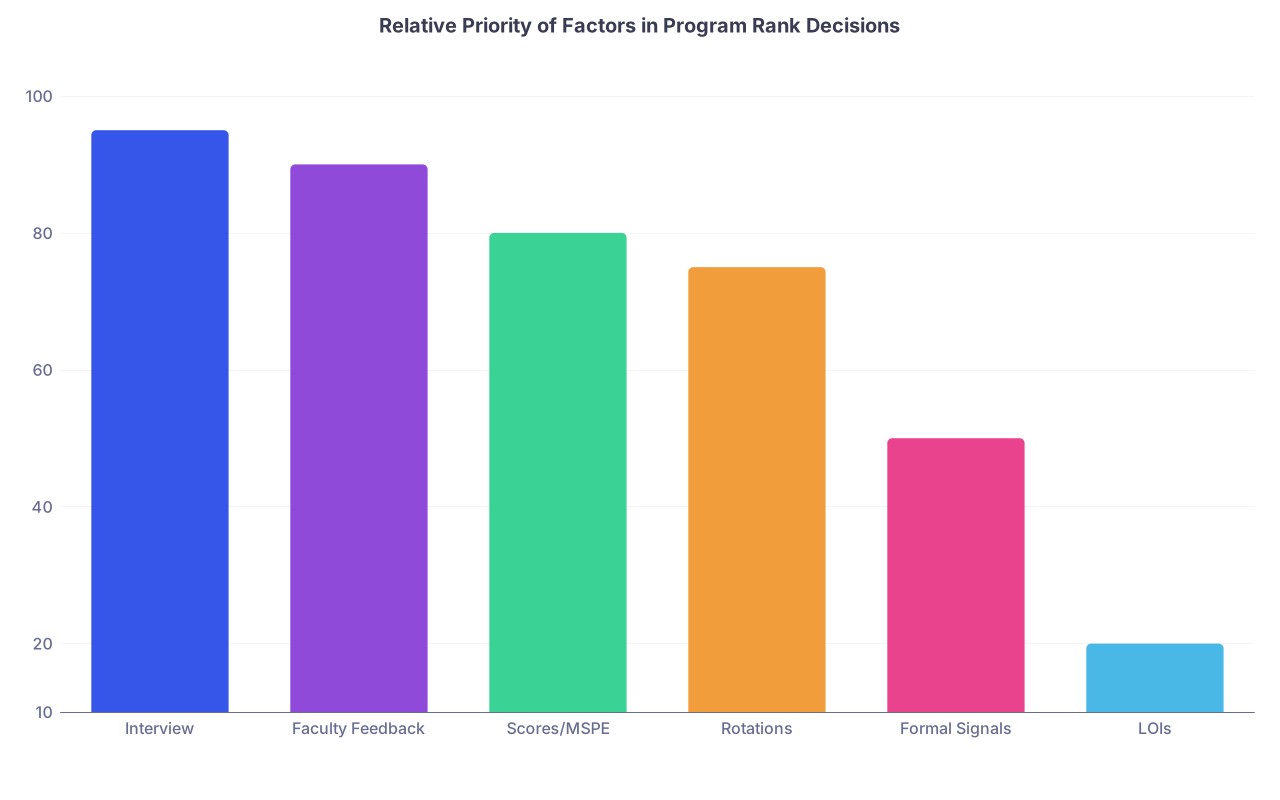
| Category | Value |
|---|---|
| Interview | 95 |
| Faculty Feedback | 90 |
| Scores/MSPE | 80 |
| Rotations | 75 |
| Formal Signals | 50 |
| LOIs | 20 |
Let me decode that: if your interview was mediocre and your faculty feedback was lukewarm, no LOI in existence is going to fix it. Programs are not that naive.
The Compliance Myth: “Programs Can’t Care About LOIs”
Another common myth: because of Match rules, programs cannot consider LOIs at all. So they ignore them entirely.
That’s also wrong—but in a different way.
Match rules restrict what programs can do and say regarding coercing you about ranking, and how they use post‑interview communication to pressure you. They’re not forbidden from reading emails. They’re not required to pretend your LOI never existed.
In practice, what happens:
- Many programs adopt formal policies: “We do not consider post-interview communication when building our rank list.” That’s mainly to avoid coercion, favoritism, and legal headaches.
- Some really do enforce this rigorously. Committee never sees your LOI; PD just leaves it in the inbox.
- Others treat it as a soft boundary: they won’t respond meaningfully, they won’t promise you anything, but they will store “expressed strong interest” in the back of their mind when there’s a true toss‑up.
So no, LOIs are not banned. They’re just structurally weak players in a very crowded field.
Step 1 Pass/Fail: Did That Make LOIs More Important?
This is one of the loudest myths right now:
“Since Step 1 is pass/fail, programs have nothing left to go on, so LOIs now matter more.”
I’ve watched how programs responded. They did not rush into the arms of LOIs. They pivoted to:
- Heavier emphasis on Step 2 CK scores
- Focusing more on clerkship grades and narrative comments
- Greater use of home/away rotations and direct experience
- Internal scoring systems for interviews to reduce random noise
And yes, some programs are a bit more open to structured preference signals where those systems exist. But LOIs? Same position as before: occasionally helpful, rarely decisive.
If you’re hoping Step 1 pass/fail suddenly turned your February emails into a kingmaker, you’re betting on the wrong horse.
The Real Risks of LOIs That People Ignore
The obsession with “maybe it helps” ignores how LOIs can actually hurt you.
Not in a dramatic blacklisting way (that’s rare). More in an “are we sure about their judgment?” way.
I’ve seen:
- Applicants send obviously copy‑pasted LOIs to multiple programs with wrong names or details. Instant professionalism question.
- Overly emotional or desperate letters: “Matching here is my only dream, my life will be destroyed otherwise.” That doesn’t read as commitment. It reads as instability.
- Letters that contradict what you said on interview day. On the interview, you pitched yourself as academic‑career driven. In the LOI you gush about community-based general practice and never mention research. PDs notice when stories don’t line up.
- People lying about ranking (“you are my #1”) then matching somewhere else in a tiny specialty. Programs talk. It may not hurt you now, but it can poison bridges you might need later for fellowships, jobs, or letters of recommendation.
This is why I push applicants to treat LOIs like any other professional communication: concise, accurate, consistent with your record, and never overpromising.
If You’re Going to Send an LOI, Do It Like an Adult
I’m not telling you to never send an LOI. I’m telling you to stop treating it as sorcery.
A sane, evidence-aligned LOI strategy looks like this:
One true LOI
If you’re going to say “you are my number one,” mean it. And only say it to one program. Anything else is just you burning your own integrity.Keep it short
PDs don’t want a second personal statement. Four to eight sentences is plenty. Identify yourself clearly, express genuine interest, connect that interest to specific program features, state your intent, and stop.Be specific and credible
“I loved meeting Dr. X and hearing about your structured mentorship for residents pursuing cards fellowship,” is real.
“Your program is the ideal place for my training” is fluff.Don’t argue your file
The rank meeting is not your appeal hearing. Do not re-litigate your Step score, that one clerkship grade, or your research output.Accept the limited effect
Send it knowing it might move you a tiny bit if they already like you. Not as a fix for a bad interview or weak application.
And for everywhere else? A brief, honest “continued interest” email if you really feel compelled, but understand that many programs literally ignore all of it by policy.

| Step | Description |
|---|---|
| Step 1 | Application Submitted |
| Step 2 | Interview Invitation |
| Step 3 | Interview Day |
| Step 4 | Faculty and Resident Evaluation |
| Step 5 | Rank Meeting |
| Step 6 | Rank List Finalized |
| Step 7 | Optional LOI Sent |
Notice where the LOI sits: after the real decisions are mostly formed.
So, Do Programs “Care More” About LOIs Now?
No. They care more about managing risk in a higher‑volume, more homogeneous applicant pool.
LOIs are a small, noisy, sometimes slightly helpful, sometimes slightly annoying side channel. The people who talk about them nonstop are usually not the people sitting in rank meetings.
The smart move isn’t to ignore them entirely or worship them. It’s to right‑size them.
You put 95% of your energy into the parts programs actually weight heavily: performance, professionalism, interviewing like a functional adult, aligning your trajectory with what the program actually does.
You reserve 5% for a carefully used LOI, if at all.
Years from now, you will not remember the exact paragraph you wrote in some midnight LOI. You will remember whether you behaved in a way that made programs want you in the room at 3 a.m. with a crashing patient—and that, not a promise in an email, is what they were judging all along.