
The way most applicants treat second-look visits is a waste of leverage.
You are walking into a program, handing them live data on your genuine interest, meeting future advocates face to face… and then you send them a generic, timid letter of intent three weeks later that could have been written before you ever stepped on the plane. That is the wrong play.
If you do a second look, it should directly fuel a sharper, more credible, more persuasive letter of intent. Otherwise, you just spent money on flights and a hotel for vibes.
Let me show you how to turn a second-look visit into a letter of intent that actually moves you up a rank list.
Step 1: Decide If a Second Look Is Even Worth It
Before you worry about letters of intent, fix the upstream problem: too many people do second looks out of anxiety, not strategy.
You should do a second look only when at least one of these is true:
- The program is realistically in your top 3.
- You have a specific decision to clarify (Program A vs Program B).
- You want to explore a niche interest there (research track, fellowship pipeline, unique patient population) that you could not adequately assess on interview day.
- You have serious information gaps: culture, call structure, mentorship, operative / procedural exposure, academic support.
If the program is somewhere between #7–#15 on your list, do not burn time and money on a second look hoping to “impress” your way up. That is fantasy. Second looks are for decision-making and tightening the top of your list, not for resurrecting Hail Mary options.
| Scenario | Second Look? |
|---|---|
| Program is clear #1–#3, culture still fuzzy | Yes |
| Program is #10, hoping to jump to top 3 | No |
| Need to compare two similar top programs | Yes |
| No realistic chance of matching there | No |
| Need to clarify research or fellowship fit | Yes |
If you are doing a second look, commit to this: the visit will generate concrete, specific material that you will use in your letter of intent. That is the whole point.
Step 2: Go Into the Second Look With LOI Intel in Mind
A powerful letter of intent does not appear magically on the plane home. It starts before you arrive.
You are not a passive guest on a tour; you are on a reconnaissance mission to collect evidence for why this program is your number one and what you will do with the opportunity.
Here is how you prep.
A. Define Three Things You Want to Prove (To Yourself)
Before the visit, write down three specific questions you want answered. Not generic fluff like “Is the culture good?” but targeted, rank-list-changing questions, such as:
- “Are junior residents actually getting hands-on operative experience by PGY2?”
- “How supported are residents in applying to competitive fellowships?”
- “Do graduates land the kind of jobs I want (academic, community, subspecialty-heavy)?”
These questions will shape what you ask and observe, and later, they become the backbone of your LOI: “During my second look, I specifically wanted to understand X, Y, and Z. Here is what I found, and it is why I will rank you first.”
B. Pre-Identify People to Target
Look at your interview notes and the program website and make a hit list:
- Faculty whose interests overlap yours.
- Residents in your target fellowship or career path.
- Chiefs, especially those who came from med schools like yours or similar backgrounds.
- Program leadership you met previously (PD, APDs, core faculty).
Then, aim to:
- Reconnect with at least one faculty member you met on interview day.
- Meet at least one resident at your target PGY level (e.g., early clinical years if you care about early autonomy; seniors if you care about fellowships).
- Have one focused conversation on research/academics if that matters to you.
- Have one conversation about wellness, call, and schedule expectations.
Later, these become named, specific references in your letter that show you actually engaged with the people and structure of the program.
C. Build a Short “Second-Look Question Bank”
Do not wing it. You will forget half of what you meant to ask.
Bring a focused list (written in your phone or a small notebook). Examples that actually yield useful LOI content:
- “What is one thing this program does better than places your friends are training?”
- “How does the program respond when a resident is struggling clinically or personally?”
- “For residents applying to [fellowship], what kind of support do they get? Letters? Protected time? Introductions?”
- “What has the program changed in the last 2–3 years in response to resident feedback?”
When you get real answers, you get real sentences for your LOI.
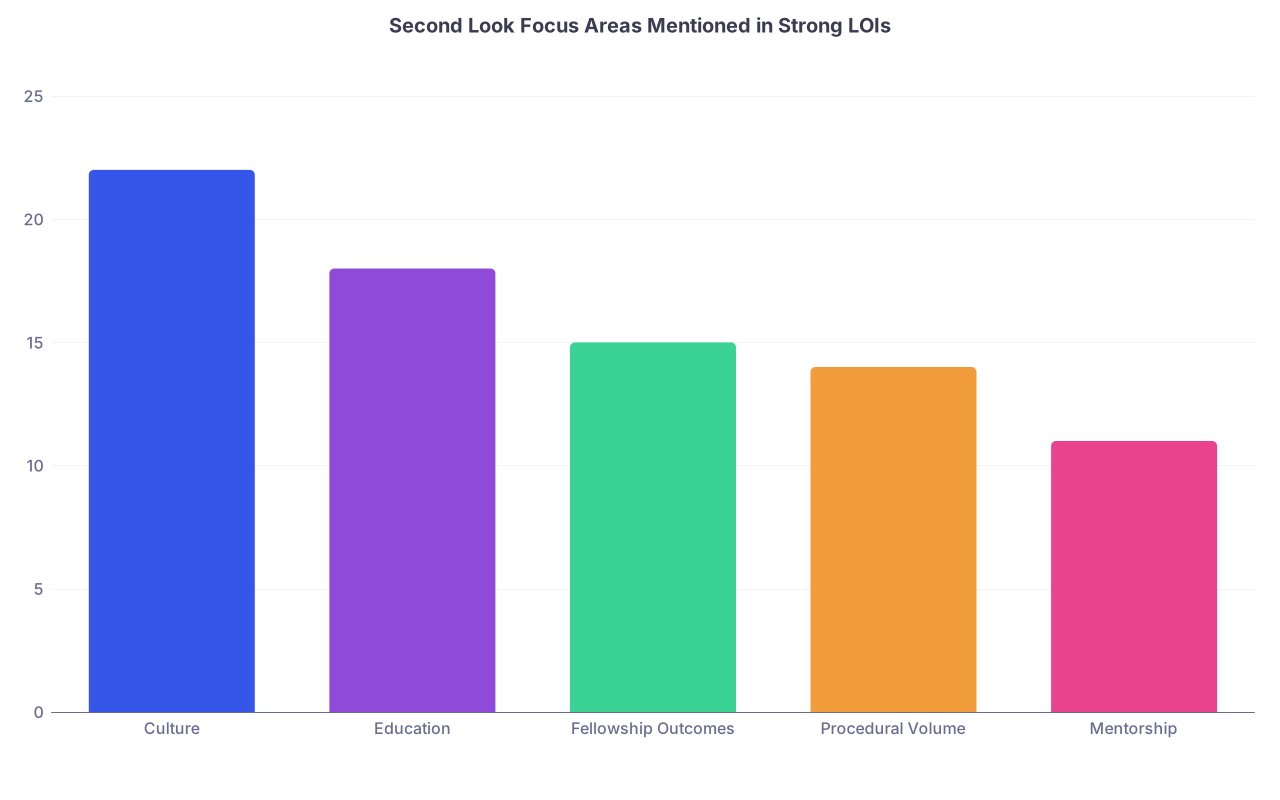
| Category | Value |
|---|---|
| Culture | 22 |
| Education | 18 |
| Fellowship Outcomes | 15 |
| Procedural Volume | 14 |
| Mentorship | 11 |
Step 3: Treat the Visit Like Fieldwork, Not a Social Event
I have watched applicants turn second looks into glorified reunion tours. They hang out with residents, enjoy the city, then try to squeeze some generic “I loved the collegial atmosphere” line into their letter.
That is not enough.
Here is the protocol.
A. Capture Specifics in Real Time
During the day, when you hear something that clicks, make a quick note as soon as you have a minute:
- Direct quotes (approximate is fine).
- Concrete examples.
- Program quirks you genuinely like.
Examples of raw notes that later turn into strong LOI material:
- “PGY2: ‘I was primary on 3 colectomies this month; attendings step back early.’”
- “Weekly simulation: residents run codes, line placement, airway, debrief with faculty.”
- “PD changed jeopardy call system after wellness feedback—extra golden weekends now.”
- “Research: 3 residents each year do dedicated research block; one matched at [top fellowship].”
Then, back at your hotel or that night at home, expand your notes into full sentences while things are still sharp. That 20–30 minutes of reflection after a long day pays off later.
B. Watch the Interactions, Not the Script
Every program has a polished pitch. The real intel lives in how people behave when they are not presenting.
Things to observe and later use in your LOI:
- Residents joking with each other in the lounge versus sitting in strained silence.
- How faculty talk about residents when residents are not around. Respectful? Dismissive?
- The way seniors guide interns on rounds. Teaching or just barking orders?
- Whether nurses are included in the teaching environment or clearly adversarial.
If you see good dynamics, capture them specifically:
“During sign-out, I watched a PGY4 walk an intern through a difficult patient handoff, pausing to explain the ‘why’ behind each step. That kind of deliberate teaching is exactly the learning environment I am seeking.”
One observation like that is more persuasive than three paragraphs of generic praise.
Step 4: Within 24 Hours, Lock In the “Why This Program Is #1” Story
Do not wait three weeks and hope your memory holds. Within 24 hours of the second look:
- Write down:
- 3 specific things that improved your opinion of the program.
- 1–2 neutral or concern areas (for your own ranking decision, not necessarily for the LOI).
- Write one paragraph, just for yourself, starting with:
- “This second look confirmed that this program is my number one choice because…”
You are not drafting the final LOI yet; you are crystallizing the narrative while the emotions and details are still vivid.
Ask yourself:
- If I were the PD reading this, would I believe this applicant was actually here last week?
- Could I swap the program name and send this to three different places without changing much?
If yes, you do not have enough specific material yet.
This mini “debrief” is what you will refine into your final letter.
Step 5: Build the Actual Letter of Intent Around the Second Look
Now we put it together. The second look should not be a side note in your LOI; it should be the spine.
Structure That Works
Aim for 4–6 tight paragraphs, ¾ to one page max. Do not send a two-page manifesto; PDs do not have that kind of patience.
Paragraph 1 – Clear Commitment + Anchor to Second Look
- State unambiguously that you will rank them first.
- Tie that commitment to your second-look experience.
Example:
I am writing to state unequivocally that I will rank [Program Name] as my first choice for residency. My recent second-look visit solidified this decision, as it confirmed that the culture, clinical training, and mentorship at your program align directly with the environment I am seeking.
No hedging. No “strongly considering ranking you highly.” That language is useless.
Paragraph 2 – Specific Observations From the Second Look
Reference concrete things you saw or heard. Name people when appropriate.
Example:
During morning rounds on the general medicine service, I watched Dr [Faculty] invite the PGY2 to lead the discussion and then deliberately ask the intern to propose a management plan before offering her own input. Later that afternoon, a senior resident described how this graduated autonomy extends into their ICU rotations, sharing that by the middle of PGY2 he was independently presenting plans to the critical care attendings. This intentional balance of supervision and independence is exactly how I want to develop as a clinician.
You are showing, not telling, that you understand their training environment.
Paragraph 3 – Connect Program Strengths to Your Goals
Here is where you tie their features to your trajectory.
Example:
At my second look, I spoke with Dr [Research Director] and several residents involved in outcomes research on [specific topic]. Hearing how residents are supported with dedicated research time, statistical resources, and mentorship that has led to presentations at [national meeting] reassured me that I could continue the work I began in medical school on [your interest]. My long-term goal is to pursue fellowship in [field] with a focus on [niche], and I am confident that the academic infrastructure at [Program] would allow me to develop the skills and portfolio needed for that path.
The key: your goals are not generic (“I want to be a competent physician”). They are concrete enough that the program can see how you fit into their ecosystem.
Paragraph 4 – Culture and Support, Grounded in Something You Saw
Everyone says “supportive culture.” You will not stand out with that phrase. Instead:
What stood out most during my second look was how transparently residents spoke about both the strengths and the ongoing challenges of the program. Several residents described how, after feedback about burnout during a heavy ICU block, the program leadership restructured the call schedule and added an extra golden weekend. Seeing residents comfortable voicing concerns—and knowing that leadership has a track record of responding—gave me confidence that this is a place where I would be both pushed and supported.
Specific change. Specific example. That is what PDs remember.
Paragraph 5 – Reaffirmation and Professional Closing
End with clear reaffirmation and gratitude, not more arguments.
For these reasons, I am confident that [Program Name] is the best place for me to train, and I will be ranking your program first. Thank you again for the opportunity to interview and return for a second look. I would be honored to join your residency and contribute to the community I observed on my visit.
That is enough. Do not over-sell.
Step 6: Timing and Communication Strategy
You can ruin a perfectly good LOI with bad timing or sloppy communication.
A. When to Send the LOI
General rule: 1–2 weeks after your second look, and before rank lists are finalized.
- If the second look is early: wait a few days, polish, send within 7–10 days.
- If the second look is late in the season: you may need to send the LOI within 3–5 days.
Check your match calendar. Many programs finalize their rank lists earlier than you think.
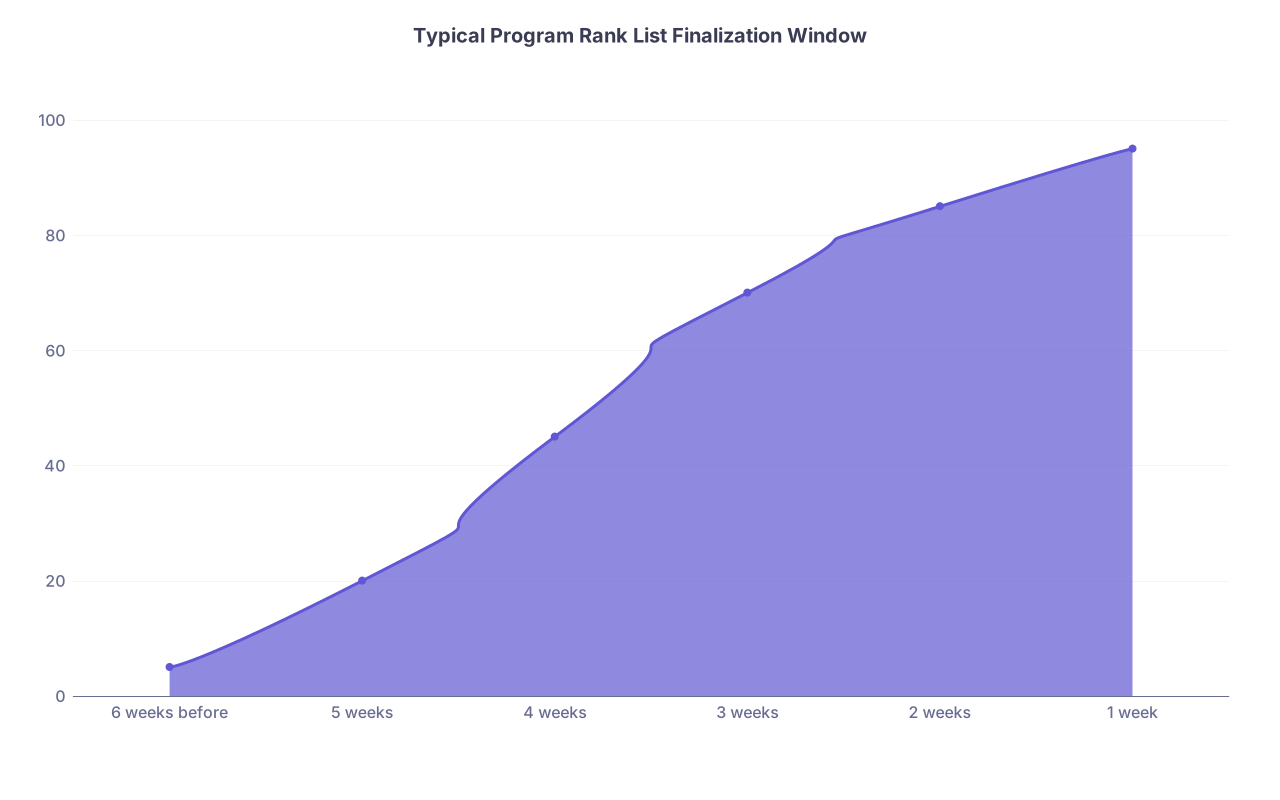
| Category | Value |
|---|---|
| 6 weeks before | 5 |
| 5 weeks | 20 |
| 4 weeks | 45 |
| 3 weeks | 70 |
| 2 weeks | 85 |
| 1 week | 95 |
(The values represent the approximate percentage of programs that have finalized lists by each point; do not assume you have until the official deadline.)
B. Who to Send It To
Standard approach:
- Address the letter to the Program Director.
- CC the program coordinator.
- Optionally CC an APD or faculty member who was heavily involved in your interview/second look, if your interactions were substantive.
Do not mass-email half the faculty. That looks desperate.
Subject line suggestions:
- “Letter of Intent – [Your Name], [Specialty] Applicant”
- “[Your Name] – Ranking [Program Name] First”
Keep attachments simple: PDF is standard. Do not send Google Docs links.
C. One Letter of Intent. Period.
If you are sending “you’re my #1” letters to multiple programs, stop. Program directors talk. It is professionally dishonest, and yes, people do get caught.
You get:
- One true letter of intent (I will rank you first).
- As many “letters of strong interest” as you want (“I remain very interested in your program and will rank you highly”), as long as you are transparent and not misleading.
If this is your LOI, say so clearly and do not send another LOI somewhere else.
Step 7: Common Mistakes That Kill the Power of Your Second Look
You can do everything right on the visit and still write a weak letter if you fall into these traps.
Mistake 1: Vague, Copy-Paste Praise
If your letter leans heavily on:
- “Excellent clinical training”
- “Supportive environment”
- “Diverse patient population”
- “Strong reputation”
…you sound like everyone else. Those phrases are fine if they follow specific examples from your second look. On their own, they are filler.
Fix: Every generic compliment must be backed by at least one observation or conversation from the visit.
Mistake 2: Overselling or Flattery
PDs and residents can smell over-the-top flattery from three screens away.
- “Your program is the absolute best in the country.” (You have not trained at every program in the country. It reads as noise.)
- “I have dreamed of training here since childhood.” (No you have not; you discovered them 9 months ago on FREIDA.)
Fix: Replace exaggerated praise with precise alignment:
“Your program’s emphasis on [specific thing] matches the way I want to train.”
Mistake 3: Cramming in Your Entire CV
Your LOI is not a second personal statement. It is not the place to relist all your research, leadership, and hobbies. The program already has your ERAS.
You can reference one or two elements of your background only insofar as they connect to how you will contribute to the program, and ideally anchored to second-look conversations:
“When I discussed my prior work in [topic] with Dr [Faculty] during my second look, we identified several ongoing projects where my skills in [method] could help advance the group’s efforts.”
Short, targeted, and tied to the visit.
Mistake 4: Being Cute or Ambiguous About Ranking
Some people try to be clever:
- “You are tied for first.”
- “You will be ranked very highly.”
- “You are my top choice among academic programs in the Midwest with X feature.”
PDs are not playing decoding games. If you want the letter to have any weight, say the words:
“I will rank your program first.”
If you are not ready to commit, it is not a letter of intent. It is an interest letter. Call it what it is.
Step 8: After Sending – Quiet, Targeted Follow-Through
Once your LOI is sent, your main work is done. Do not badger the program for a response. Many will not reply substantively because of NRMP rules and general caution.
A simple, appropriate follow-through pattern:
- If a faculty member or resident you met on the second look reaches out or responds, thank them and keep it short.
- Do not email the PD again asking, “Did you see my LOI?” They saw it.
- If there is a major update (new publication accepted, major award) that is truly relevant, you can send a separate, brief update, but do not spam.
You are not trying to “win” by volume of emails. The quality of your second look and the precision of your LOI matter far more than repeated contact.
A Concrete Example Framework You Can Adapt
To make this crystal clear, here is a simple fill-in-the-skeleton structure based on second-look content. Do not copy it verbatim; use it as a scaffold.
Opening:
- “I am writing to state unequivocally that I will rank [Program Name] first on my [specialty] rank list. My recent second-look visit confirmed that your program is exactly where I hope to train.”
Clinical Training Detail:
- “During [rounds / clinic / conference], I observed [specific interaction]. This demonstrated [quality of training, autonomy, teaching style].”
Career/Fellowship/Research Fit:
- “In speaking with [Faculty/Resident] about [topic], I learned that residents interested in [goal] are supported through [specific mechanisms]. This aligns directly with my goal of [your path].”
Culture/Support Story:
- “What stood out most was [example of program responsiveness, resident cohesion, wellness initiative, etc.], which reassured me that I would be joining a community that is both demanding and supportive.”
Closing with Reaffirmation:
- “For these reasons, I am convinced that [Program Name] is the best environment for my training, and I will be ranking your program first. Thank you again for the opportunity to interview and return for a second look. I would be honored to contribute to your residency.”
That is it. Clean, specific, and tied directly to what you actually saw.

| Step | Description |
|---|---|
| Step 1 | Decide if Second Look is Worth It |
| Step 2 | Plan Questions and Targets |
| Step 3 | Attend Second Look and Take Notes |
| Step 4 | 24 Hour Debrief - Clarify Why #1 |
| Step 5 | Draft LOI Centered on Visit |
| Step 6 | Send LOI to PD and Coordinator |
| Step 7 | Minimal, Professional Follow Up |

The Future Angle: Second Looks Are Quietly Becoming Data
You might think your second look is just a courtesy visit. It is not. Programs increasingly:
- Track who returns for second looks.
- Log who sends clear, specific LOIs.
- Correlate this with match outcomes to refine their own ranking strategies.
Over the next few years, do not be surprised if more programs:
- Explicitly cap or schedule second looks.
- Formally discourage them to avoid equity issues.
- Or quietly pay more attention to who shows up and follows through professionally.
That means your strategy has to mature too. The bar for a “useful” second look will get higher, not lower.
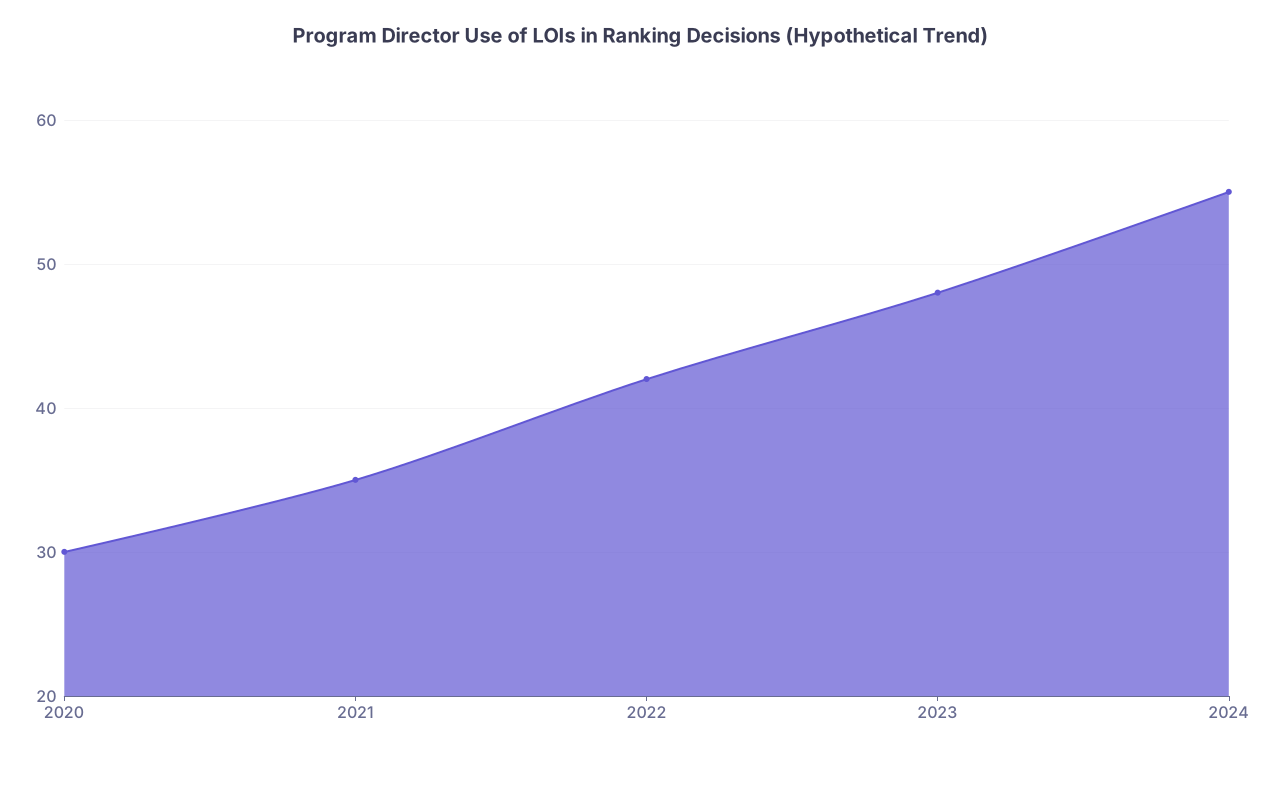
| Category | Value |
|---|---|
| 2020 | 30 |
| 2021 | 35 |
| 2022 | 42 |
| 2023 | 48 |
| 2024 | 55 |
Whether or not the exact numbers match reality at your specialty, the direction is clear: well-crafted, honest signals of interest are not going away.
So you might as well get very good at them.
Bottom Line
Three points to walk away with:
- Do not waste a second look. Go in with questions, watch closely, and harvest specific details you can use.
- Build your letter of intent around the second look—concrete observations, named conversations, and a clear, unambiguous commitment to rank them first.
- Keep the letter tight, honest, and specific. One true LOI, timed well, is far more powerful than vague interest spread thin across multiple programs.