
The worst letters of intent are rushed, emotional emails sent the night you panic about not matching. The best ones are quietly finalized after a disciplined, surgical week of preparation.
You have one week before you hit send. Here is exactly what to do with every day.
First, Set the 7‑Day Window
Before anything else, anchor the week.
- Pick the exact send date for your final letter of intent (LOI).
- Count back 7 days. That is Day ‑7. Today.
Your goal is simple: arrive at the send date with a letter that is:
- Strategically accurate (right program, right message, no contradictions).
- Fact‑checked (no internal inconsistencies with ERAS/AMCAS, your interviews, or past emails).
- Emotionally calm and professional.
You are not “finding the words” this week. You are finishing the strategy and cleaning the execution.
Day ‑7: Lock Your Strategy Before You Touch the Letter
At this point you should stop pretending every option is open and make the hard calls.
1. Declare Your True #1 (To Yourself)
You cannot write a real LOI if you are still ranking in your head.
Sit down with three things:
- Your current tentative rank list.
- A list of where you have already sent signals / thank‑you notes.
- Your non‑negotiables (geography, partner job, family, fellowship goals, etc.).
By the end of Day ‑7 you must:
- Choose one program that will receive a true, explicit final LOI.
- Decide whether you will send any “very high on my list” letters to others (and if so, cap it—usually 2–3, never calling any of them your #1).
If you are still “tied between two programs,” you are not ready to write. Call your mentor, advisor, or that brutally honest co‑resident you trust and talk it out. Do not draft anything until you commit.
2. Confirm Policy & Ethics
Different spaces, different rules.
- Residency (NRMP): You may tell a program they are your first choice. You may not ask them how they will rank you. You may not make or imply a binding contract. If you say “I will rank you #1,” you had better do it.
- Med school / fellowship: Policies vary, but the same rule holds: do not lie. Programs talk. Your reputation follows you.
At this point you should:
- Re‑read the match / admissions communication policies (NRMP, SF Match, school handbook, whatever applies).
- Decide what strength of language you are comfortable using:
- “I will be ranking [Program] first.”
- “You remain my top choice.”
- “You are my preferred destination for residency.”
No weaseling. Pick the strongest truthful sentence you can stand behind.
Day ‑6: Build the Content Skeleton (No Wordsmithing Yet)
Now you know who you are writing to and what you are allowed to say. Today is structure only.
At this point you should outline a one‑page maximum letter. No more.
Basic skeleton:
Opening
- Explicit statement you are writing a letter of intent.
- Name the program correctly. Spell it exactly as the program does.
Declaration
- One clear sentence of intent:
- For final LOI: “I will be ranking [Program Name] as my number one choice.”
- For softer letters: “I will be ranking [Program Name] very highly on my list.”
- One clear sentence of intent:
Why Them (2–3 bullets or short paragraphs)
- Anchor in specific details from:
- Interview day.
- Conversations with residents or faculty.
- Curriculum, patient population, research, or geographic fit.
- This should read like you know the program, not like you skimmed the website.
- Anchor in specific details from:
Why You (1 paragraph)
- Connect your training, strengths, and goals to what they value.
- No generic “hard‑working, team player” fluff. Concrete, verifiable traits.
Reassurance & Gratitude
- Reaffirm your commitment / enthusiasm.
- Thank them for the interview and ongoing consideration.
Clean Close
- No begging. No emotional oversharing.
- Professional sign‑off with full name, AAMC/NRMP ID if appropriate.
Write this as bullet points or short phrases today. Not full sentences.
Day ‑5: Draft Version 1 — Fast and Honest
Today you move from outline to full draft. But you do it fast.
1. Draft in One Focused Session
Block 60–90 minutes. Phone out of the room. Inbox closed.
At this point you should:
- Expand your skeleton into full paragraphs.
- Keep the tone:
- Direct.
- Respectful.
- Specific.
- Avoid:
- Flattery with no evidence (“your amazing program”).
- Overly personal pleas (“this has been my dream since childhood”).
Write like this is the only email the PD will read from you. Because realistically, it might be.
2. Hit the Required Notes
Check your draft for these elements:
- One unambiguous statement of intent:
- Good: “I will be ranking [Program] as my first choice.”
- Bad: “I am very interested and hope to train at [Program].”
- 2–3 program‑specific reasons:
- Named faculty.
- Unique rotations.
- Distinct patient population.
- Track / pathway that matches your goals.
- 1–2 you‑specific reasons:
- “My background in X prepares me to contribute to Y at your program.”
- “I have already done Z that aligns with your AIMS statement.”
When you are done, save it with a clear filename:
- “LOI_[ProgramName]Draft1[Date].docx”
Then close it. Do not edit again today. You need distance.
Day ‑4: Fact‑Check, Consistency Check, Reality Check
Today is about not getting caught lying or contradicting yourself.
1. Internal Consistency
Open:
- Your ERAS/AMCAS application.
- Personal statement.
- Any prior emails to this program.
- Your LOI Draft 1.
At this point you should compare and fix:
- Career goals: Do they match across documents?
- Geography/family explanations:
- If you told another program you “must be near aging parents in Boston,” you cannot now tell a West Coast program that “staying on the West Coast to support family is crucial.”
- Research and niche interests:
- Do not suddenly become passionate about a subspecialty you have never mentioned anywhere else.
Anything that smells like you custom‑fabricated a story for them will hurt you more than staying general.
2. External Accuracy
Check:
- Correct program name and spelling.
- Correct titles (Program Director, Chair, etc.).
- Any claims about:
- Rotation structures.
- Tracks / pathways.
- Faculty names.
If you are not 100% sure, verify via:
- Program website.
- Interview day slides.
- Notes you took.
No guessing. Program directors remember when applicants “quote” features that do not exist.
3. Reality Check with One Trusted Reader
Pick one:
- Advisor.
- Faculty mentor.
- Senior resident who matched well in the same specialty.
Send them:
- Your draft.
- A one‑line ask: “Can you check this for tone, clarity, and whether it sounds honest and specific enough for [Program Name]?”
Do not send this out to four friends and collect a Frankenstein edit. One strong opinion beats six conflicting ones.
Day ‑3: Revise for Precision and Tone
Feedback should have come back or will come back today. This is your craft day.
At this point you should:
1. Tighten the Language
Goals:
- Shorter sentences.
- Less filler.
- Sharper verbs.
Examples:
- Replace “I truly believe that your program would be an excellent fit for me”
with “Your program is the best fit for my training goals.” - Replace “I feel that I would be able to contribute meaningfully”
with “I will contribute meaningfully through X and Y.”
Cut anything that:
- Merely repeats your CV.
- Could have been written to ten other programs.
2. Calibrate the Emotional Temperature
You want:
- Warm, not desperate.
- Confident, not entitled.
Red flags to remove:
- “I will be devastated if I do not match at your program.”
- “This is my only hope to stay with my partner/family.”
- “I beg you to consider ranking me highly.”
Better:
- “If I have the opportunity to train at [Program], I will not hesitate to match there.”
- “I would be honored to join your residents and contribute to your mission.”
3. Ensure Clarity on Intent
Re‑read the “intent” sentence.
Ask:
- Could a PD misread this as a hedge?
- If someone printed this and showed it to another PD, would I be embarrassed?
If you are sending a true LOI, the answer must be crystal clear: they are #1.
Day ‑2: Final Content Lock and Logistics
Today you freeze content. No more major rewrites after this.
1. Final Read Aloud
Read it out loud. Slowly.
At this point you should:
- Catch any awkward phrasing.
- Fix typos.
- Trim 1–2 extra sentences that add nothing.
Keep the whole letter under one page. PDs read these between cases or in 30‑second chunks.
2. Verify Recipient and Channel
Decide:
- Who exactly will receive this?
- Program Director only?
- PD + PC?
- Through an online portal that converts to PDF?
Check:
- Correct email addresses.
- Correct subject line convention used in your specialty / region.
Example subject lines:
- “Letter of Intent – [Your Name], [Specialty] Applicant”
- “Final Letter of Intent – [Your Name], AAMC ID XXXXXXXX”
Create the email shell today:
- To/CC fields.
- Subject line.
- Body with [PASTE LETTER HERE] placeholder.
Then save as a draft. You are staging the send, not sending yet.
3. Document Your Promise
You are making a commitment. Treat it like one.
- Add a note to your rank list spreadsheet or a simple text file:
- “I promised [Program] that I will rank them #1 on [date].”
- If you are also sending “rank you highly” letters elsewhere, list those too.
This prevents you from panicking and rearranging your list in a way that violates what you wrote.
Day ‑1: Sanity Check, Sleep, and No New Drama
The day before you send the LOI is not the day to invent new strategies.
At this point you should:
1. Do a 5‑Minute Future‑You Test
Ask yourself:
- If I match at this program, will I feel aligned with what I wrote?
- If I do not match here but my letter surfaces somehow, will I still be proud of it?
- If another program PD saw this, would it contradict anything I told them?
If the answer to any of those is “no,” you do not edit the letter to make it more manipulative. You adjust your mindset or your rank list.
2. One Last Spellcheck and Format Check
Open the draft email and:
- Paste your final letter in.
- Run spellcheck.
- Confirm:
- Greeting is correct.
- Single clear intent sentence is visible without scrolling (if possible).
- Signature includes:
- Full name.
- AAMC/NRMP ID.
- Email and phone.
3. Then Stop Touching It
Close the laptop. No more reading it on your phone at midnight and “just tweaking one phrase.”
Your brain needs to be calm tomorrow. Program directors can smell panic in over‑engineered, over‑edited prose.
Day 0 (Send Day): Execute Cleanly and Walk Away
This is the only day that counts to the outside world.
At this point you should:
1. Send at a Reasonable Time
Ideal windows:
- 8–10 AM local time for the program.
- On a weekday (if you have a choice).
Hit send. Confirm it leaves your outbox. Do not follow up “just to make sure you got it.”
2. Update Your Rank List Immediately
Right after sending:
- Open your rank list.
- Put that program firmly at #1 (or “very high,” whatever you promised).
- Lock it in whatever system you use to track this.
You have now tied your behavior to your word. Good.
3. Do Not Send Competing LOIs
Once a true LOI goes out:
- No other program should receive language that sounds like “you are my #1.”
- If you send softer “rank you highly” notes, keep them honest and vague:
- “I will rank [Program] very highly.”
- Never “top choice,” “top priority,” or “at the top of my list” to multiple places. That is how reputations die.
The 48 Hours After Sending: Hands Off the Keyboard
The week before your final letter was about precision. The days after are about restraint.
At this point you should not:
- Email again to “clarify” something trivial.
- Ask whether your letter affects your rank.
- Send a second letter changing your stated intent. That is catastrophic.
What you can do:
- Log the date and content of your LOI for your records.
- Focus on your rotations, studying, or whatever else is in front of you.
- Finalize the rest of your rank list based on genuine fit, not guesswork about how your letter “played.”
One‑Week Snapshot Timeline
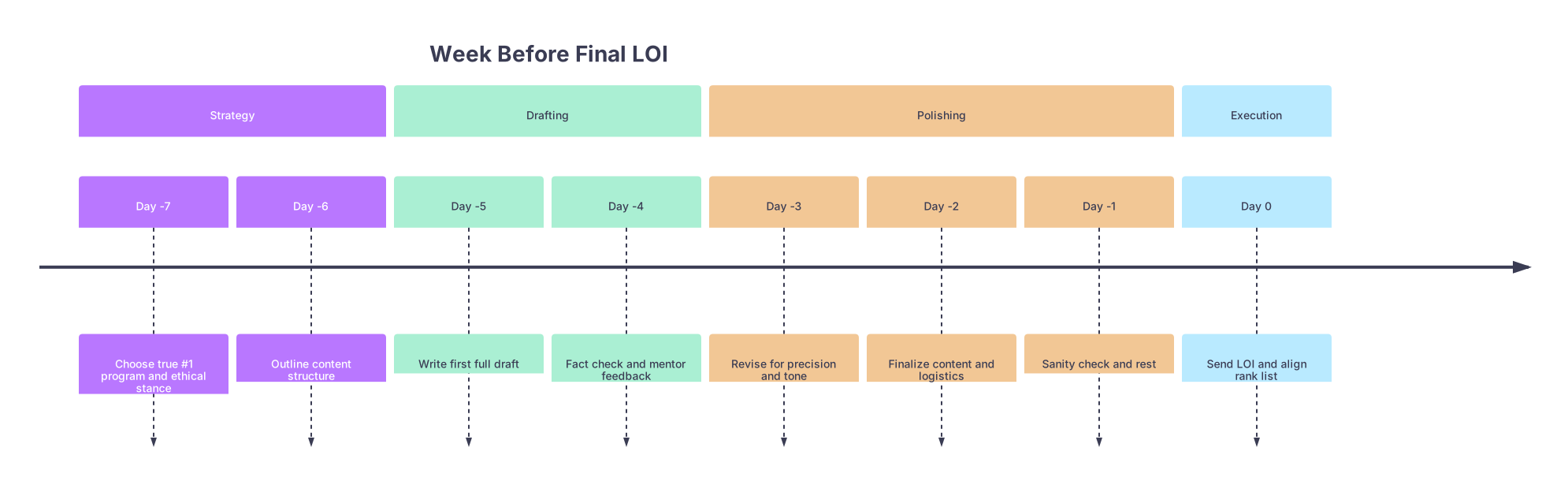
| Period | Event |
|---|---|
| Strategy - Day -7 | Choose true #1 program and ethical stance |
| Strategy - Day -6 | Outline content structure |
| Drafting - Day -5 | Write first full draft |
| Drafting - Day -4 | Fact check and mentor feedback |
| Polishing - Day -3 | Revise for precision and tone |
| Polishing - Day -2 | Finalize content and logistics |
| Polishing - Day -1 | Sanity check and rest |
| Execution - Day 0 | Send LOI and align rank list |
Quick Comparison: Strong vs Weak LOI Week
| Aspect | Strong Week | Weak Week |
|---|---|---|
| #1 Choice | Decided by Day -7 | Still undecided on send day |
| Draft Timeline | Draft on Day -5, revise twice | Single draft night before |
| Specificity | 2–3 program-specific reasons | Generic compliments and flattery |
| Consistency Check | Cross-checked with apps and prior emails | No comparison, risk of contradictions |
| Ethics | One true LOI, honest language elsewhere | Multiple programs told they are #1 |
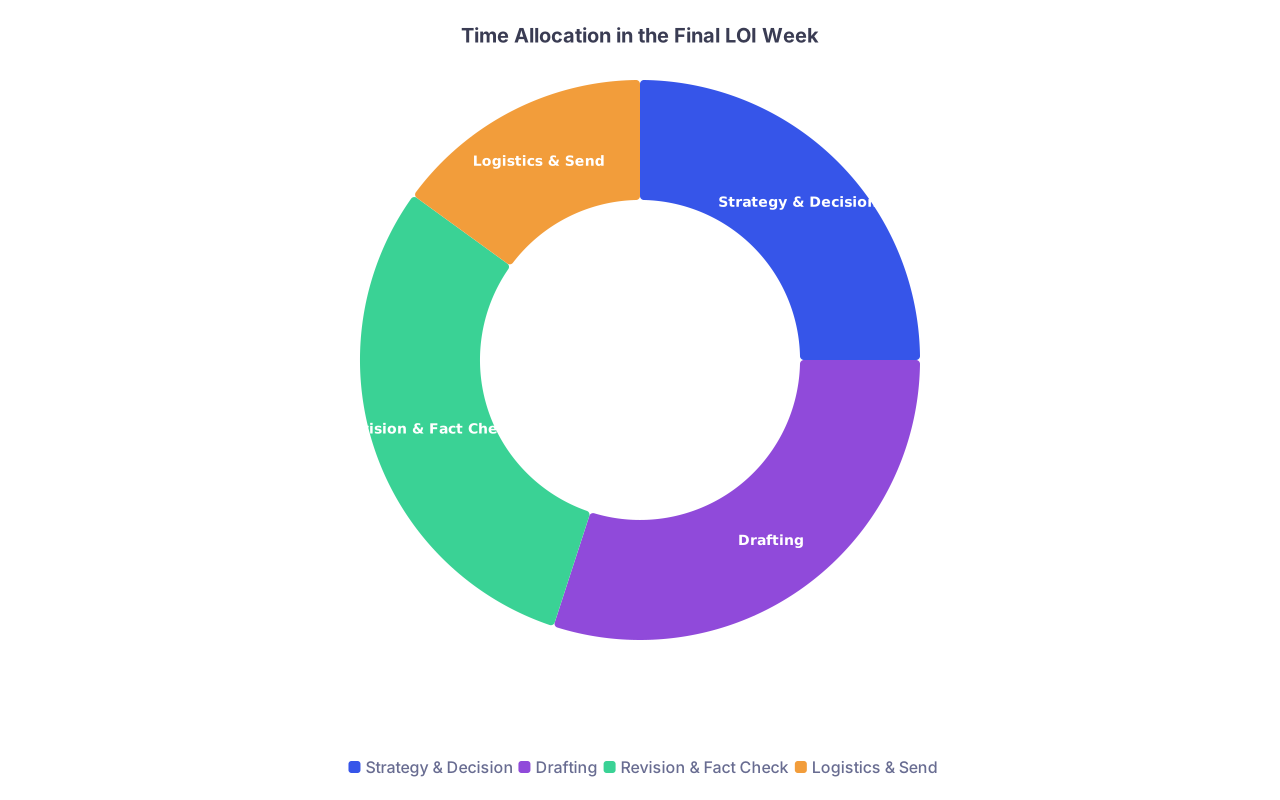
| Category | Value |
|---|---|
| Strategy & Decision | 25 |
| Drafting | 30 |
| Revision & Fact Check | 30 |
| Logistics & Send | 15 |
Strip It Down: What Actually Matters
If you remember nothing else:
- Decide your true #1 before you write. Everything else is noise.
- Make one clear, honest statement of intent, backed by specific reasons that match your record.
- Align your actions with your words: your rank list, your other emails, and your future self all need to agree with what you just sent.
You do not need the perfect letter. You need a precise, honest one, sent after a disciplined week instead of a panicked night.