
The fastest way to damage your match chances is to be sloppy with letters of intent when your home program is not your true top choice.
Let me be blunt: programs talk, coordinators talk, faculty talk. If you tell more than one place “You’re my #1 and I will rank you first,” you’re gambling with your reputation in a very small community. And if one of those places is your home program, that gamble gets riskier.
This is the situation:
You like your home program. You’d be fine training there. But your real top choice is somewhere else—maybe a stronger name, a better city, or better fit. You’re trying to figure out who gets a letter of intent, what to say to your home PD, and how not to set yourself on fire politically.
Here’s how to handle it without lying, burning bridges, or sabotaging your match.
1. Get Clear on the Rules You’re Actually Playing Under
Before we touch strategy, you need the ground rules. Not the fantasy version people quote. The actual ones that matter.
There are three separate realities you’re balancing:
NRMP rules and ethics
- You are allowed to tell a program they’re your first choice.
- You are not allowed to demand or require any ranking promises in return.
- Programs are not supposed to ask you for ranking commitments, but some do anyway—subtly or not.
Professional reputation
- Program directors know each other.
- Coordinators share stories.
- Your behavior as an applicant can follow you as a fellow, job applicant, or faculty.
Human behavior
- Programs respond to genuine interest.
- They are turned off by obvious mass emails, vague flattery, or inconsistent stories they hear from colleagues.
- Your home PD has outsized influence. Even if you do not match there.
So the real game is:
Maximize your chance of matching at your true #1, keep your home program reasonably happy, and do it all without getting a reputation as dishonest.
2. Decide: Who Actually Gets a True Letter of Intent?
A letter of intent (LOI) is not just a “love letter.” It’s a specific thing with a specific meaning:
“I will rank you first.”
If your LOI does not say that clearly, it’s not a true LOI; it’s just a “letter of interest” or “update.” Those are different tools.
So step one: stop spraying “LOI” language everywhere. Decide what you’re sending:
| Type | Core Message | How Many Programs | Risk if Misused |
|---|---|---|---|
| True Letter of Intent | I will rank you first | 1 | High (if duplicated) |
| Strong Interest Letter | I am ranking you highly | A few (2–5) | Low |
| Update Letter | New accomplishments/info only | As needed | Low |
You get one true LOI. Use it on your actual top choice, even if that’s not your home program.
If you’re thinking, “But my home PD basically expects me to say they’re #1,” that’s a separate problem—and we’ll solve that directly in a later section. Do not let guilt or culture push you into lying.
3. What Your Home Program Actually Cares About
Most applicants overestimate how personally their home program will take it if they are not #1.
I’ve sat in rooms and heard versions of all of these:
- “She’s going to Hopkins for residency? Good for her.”
- “He’s chasing a spouse match in another city—makes sense.”
- “She told us we were #1, then we found out she’d said the same thing elsewhere. That stung.”
Notice the pattern?
Programs don’t usually get upset that you left. They get upset if you misled them.
Your home program usually cares about three things:
- Their reputation: Did their trainee match somewhere respectable?
- Their relationship with you: Are you leaving on good terms?
- Basic respect: Did you ghost them or lie to their face?
So your job isn’t to pretend they’re your first choice. Your job is to:
- Treat them like a serious option, even if they’re #2–4
- Avoid last-minute surprises that make them feel used
- Communicate honestly but strategically
4. How to Handle LOI When Home Is Not #1
Here’s the actual situation you’re in:
- You interviewed at your home program
- You interviewed at your real #1 elsewhere
- You want to send a true LOI to #1
- You don’t want to insult or alienate your home program
Step-by-step, here’s how to handle it.
Step 1: Send the true LOI to your real #1
This goes to the PD (and optionally CC the PC). Very short, very direct. Something like:
Subject: Letter of Intent – [Your Name]
Dear Dr. [PD Last Name],
Thank you again for the opportunity to interview at [Program Name]. My interview day confirmed that [Program Name] is my top choice for residency.
I want to state clearly that I will be ranking [Program Name] as my first choice. The combination of [specific 2–3 features: e.g., strong training in X, supportive culture, and geographic fit with my partner’s job in Y] makes it the ideal place for my residency training.
I would be honored to train at [Program Name] and contribute to your residency.
Sincerely,
[Your Name, Med School, AAMC ID]
No hedging. No “among my top choices.” No paragraphs of fluff. Specific, confident, and final.
Step 2: Plan your home program communication on a separate track
You do not send your home program a second LOI.
Instead, you send them a “strong interest” letter that makes them feel respected and genuinely valued, without lying about rank order.
That email might look like:
Subject: Thank you and continued strong interest – [Your Name]
Dear Dr. [PD Last Name],
Thank you again for the opportunity to train at [Home Program Name] as a student and for the chance to interview for residency.
I wanted to express my sincere gratitude for your mentorship and for the faculty who have invested in my development. I greatly value the training environment at [Home Program Name]—particularly [specific points: e.g., the operative autonomy I saw on my sub-I, the supportive culture on the wards, and the strong outcomes for graduates pursuing fellowships].
I will be ranking [Home Program Name] very highly on my list. I’d be proud to continue my training here and contribute as a resident.
Thank you again for your support.
Sincerely,
[Your Name]
Key line:
“I will be ranking [Home Program Name] very highly on my list.”
This is honest if they’re in your top few. It sounds very positive. It is not a commitment to #1.
If they’re not actually high on your list—borderline rank or below—don’t say “very highly.” Say something like:
I will be ranking [Home Program Name] on my list and would be honored to train here if given the opportunity.
Be accurate. Be respectful. But don’t fake enthusiasm you absolutely don’t feel.
5. What If Your PD Cornered You and You Already Hinted They’re #1?
This happens. In the hallway, after your home interview, or on a Zoom debrief:
“So, are we your top choice?”
You panic. You mumble something noncommittal that felt like a yes. Now you’re stuck.
Here’s how to dig out without making it worse.
First, understand what actually happened. In most of those conversations, you said something like:
- “You’re definitely one of my top choices.”
- “I’d be thrilled to stay here.”
- “I can’t imagine a better place to train.”
Those sound strong but are not explicit rank promises. Programs know this game. They know students are cautious.
If you did explicitly say “Yes, you’re #1” and now you’re sending an LOI elsewhere, you have two options, neither perfect:
Stick with your verbal commitment
- Pros: You keep clean ethics with your home program.
- Cons: You don’t pursue your true #1.
- When this makes sense: Your #1 vs home are similar in training quality, location, or outcomes, and burning trust at home is not worth the marginal gain.
Honor your real preference and accept the risk
- Pros: You go after where you actually want to be.
- Cons: If your home PD ever learns you told another program they were #1, that’s a hit to your reputation.
- If you choose this, you do not go back and dramatically “clarify” or try to rewrite history. You send the “highly ranked” letter and keep things bland and respectful.
My bias? Don’t put yourself in this position in the first place. When cornered, default to phrases like:
- “You’re absolutely one of my very top programs.”
- “I’d be very happy training here.”
- “I’m still waiting to see the full picture, but I can say I’d be proud to stay.”
If you’re reading this too late and already made a hard promise, you have to decide whether the marginal upgrade at Program X is worth knowingly burning that trust. Sometimes it is. I won’t pretend it never is. But that’s a conscious trade-off, not an accident.
6. Timing, Volume, and How Not to Look Desperate
Letters of intent and interest are tools, not therapy. Used right, they can matter. Used wrong, they just annoy busy PDs.
Here’s reasonable timing:
- Window: 1–3 weeks before rank lists are due
- True LOI: 1 program, well before the final week if you can
- Strong interest letters: 2–5 programs you’d genuinely be happy at
- Updates: Only if you have something real—publication accepted, AOA, major award, new Step 2 score
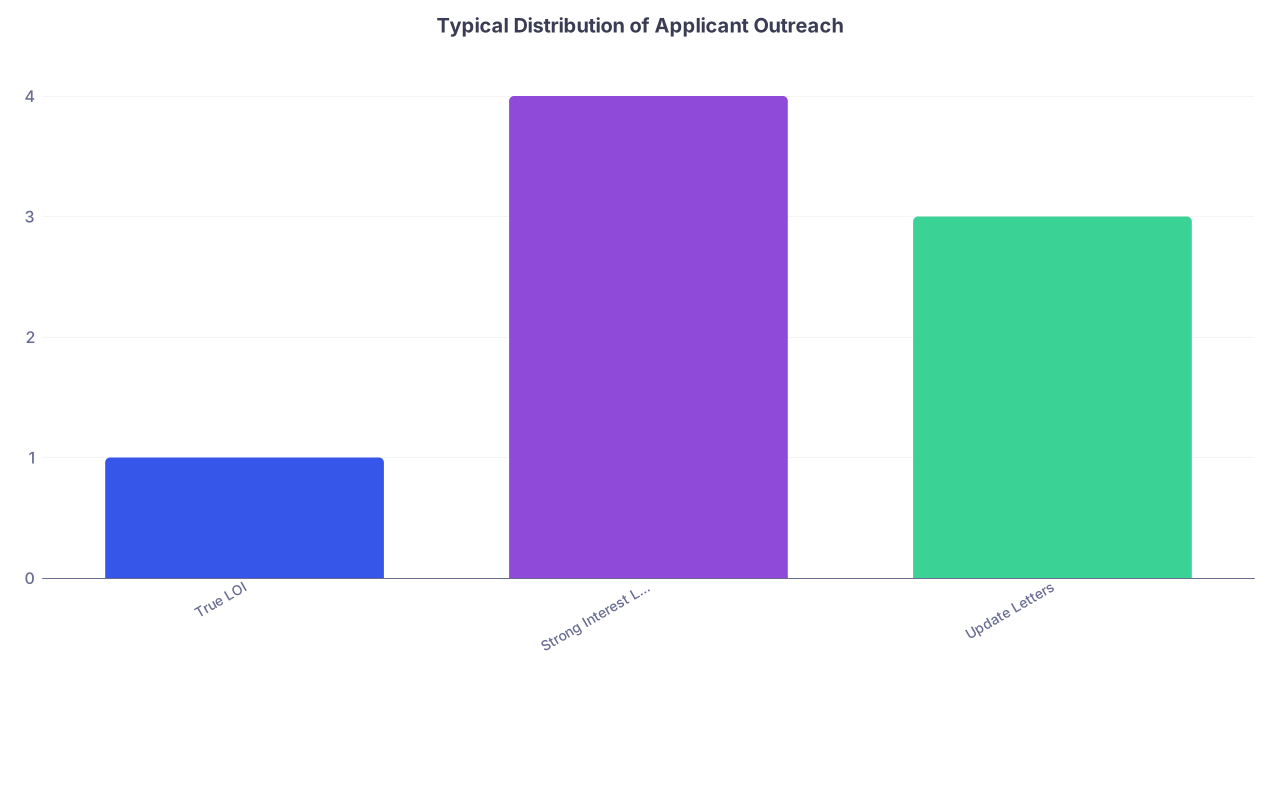
| Category | Value |
|---|---|
| True LOI | 1 |
| Strong Interest Letters | 4 |
| Update Letters | 3 |
Common mistakes I see every single year:
- Sending an “LOI” to 4 programs all saying “top choice” in slightly different words
- Emailing weekly “just to reiterate my interest” with nothing new to say
- Writing 900-word essays about your lifelong dream of training there with zero program-specific content
Filter yourself with this rule:
If the PD forwarded your email to the whole committee, would it help you or make you look anxious and unfocused?
If it’s not specific and not concise, don’t send it.
7. Special Cases: Couples Match, Geography, and Weak Home Programs
Real life isn’t clean, so let’s deal with some messy scenarios.
Couples Match with Conflicting Top Choices
You want Program A in City 1. Partner wants Program B in City 2. Your home is in City 3.
Your LOI still goes to your #1 program. But you acknowledge the couples match reality:
I am participating in the couples match with my partner, who is applying in [Specialty] in [Geographic region or city]. We are building a list that prioritizes programs where we can both train at strong institutions. [Program Name] is my clear top choice in that process, and I will be ranking it first.
With home, you can honestly say something like:
As we work through the couples match, [Home Program Name] remains a program where we would both be very excited to match. I will be ranking [Home Program Name] highly.
No lies. Still shows respect.
When Your Home Program Is Objectively Weak
Sometimes the issue isn’t “not my top choice.” It’s “I really, really don’t want to stay here.”
Maybe the training is poor. Maybe there’s toxic leadership. Maybe you saw the residents quietly warn students away.
In that case:
- Do not oversell your enthusiasm.
- You can still thank them, acknowledge the training, and show appreciation without implying you’ll rank them high.
Something like:
I am grateful for the training I received at [Home Institution] and for the opportunity to interview for residency. I appreciate your consideration and all the support the department has provided during my medical school years.
That’s enough. You don’t have to go further.
And no—you do not owe them your future just because you went to med school there.
When Geography Is the Real Driver
If you’re leaving mostly for location—partner, family, cost of living—you can “blame” geography without insulting your home program.
To your home PD in conversation or email:
I deeply appreciate everything I’ve received here. I’m building a rank list that prioritizes being closer to my partner/family in [region]. That’s a major factor for me personally, but I remain very grateful for [Home Program] and would be proud to train here if I end up matching.
This signals strongly: “I might not rank you #1, but the reason is not you personally.” That softens the blow.
8. How Programs Actually Use Your Letters
A harsh truth: your beautifully written LOI will not magically turn a weak application into a match.
It can do a few things:
- Nudge you up a few spots if you’re already in their rankable pool
- Break a tie between similar applicants
- Reassure them you’re likely to come if they rank you aggressively
Programs do not usually reshuffle the entire list for a single LOI. But LOIs matter more at:
- Smaller programs
- Less famous but solid programs that worry about being “backup options”
- Your home program, where they already know you
So your home program might be more influenced by a sincere “I’ll rank you highly” than your dream coastal powerhouse is by your LOI. That’s fine. You still tell the truth.
9. A Simple Strategy You Can Actually Follow
If you want this in checklist form, here’s your playbook when home isn’t your top choice:

| Step | Description |
|---|---|
| Step 1 | Make True Rank List |
| Step 2 | Pick Real #1 Program |
| Step 3 | Send True LOI to #1 |
| Step 4 | Identify 2-5 Programs for Strong Interest Letters |
| Step 5 | Send Strong Interest Letters |
| Step 6 | Email Home PD - High Respect, Honest Wording |
| Step 7 | Stop Sending Extra Emails |
And to make sure you do not accidentally lie, sanity-check any email that mentions your rank list:
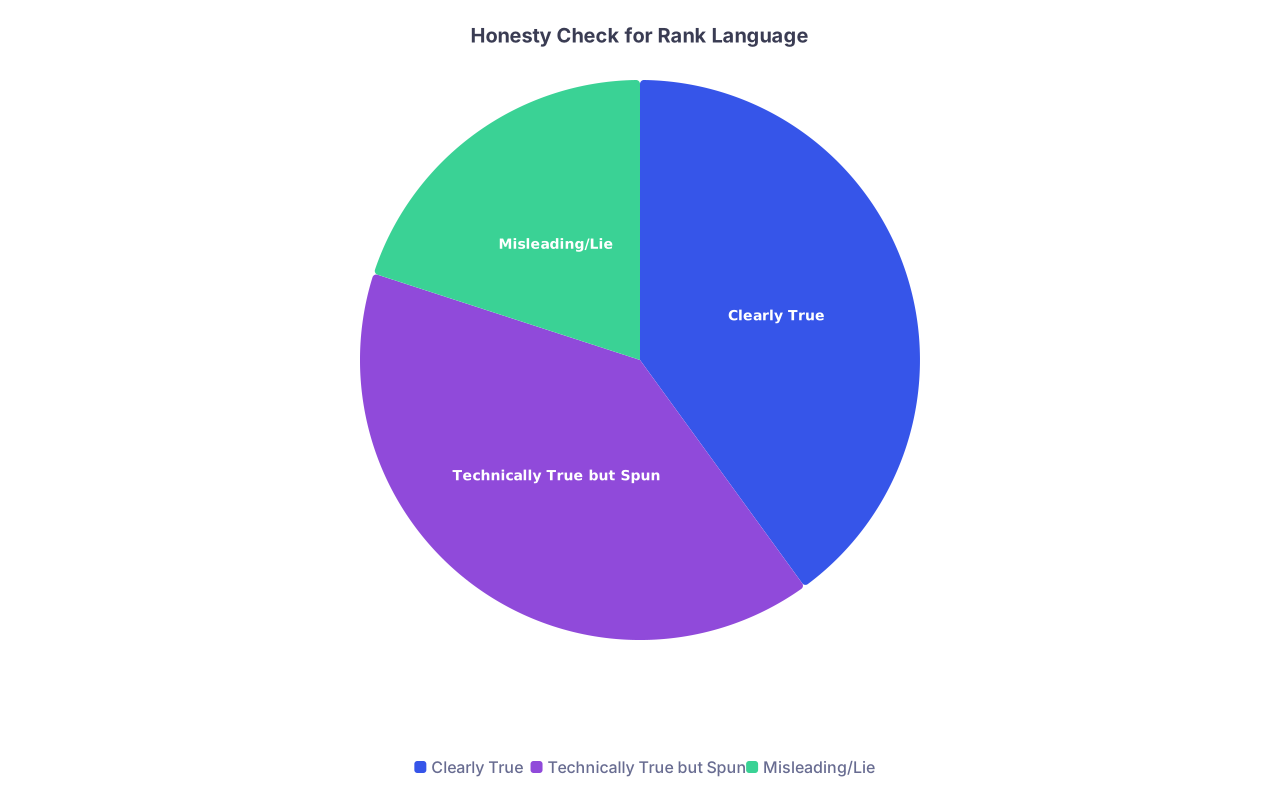
| Category | Value |
|---|---|
| Clearly True | 40 |
| Technically True but Spun | 40 |
| Misleading/Lie | 20 |
Do your best to stay out of that last slice. Especially with your home program.
10. The Reputation Piece You’re Probably Underestimating
You’ll forget most of this stress a year into residency. PDs will not.
The same people reading your LOI and interest emails now may:
- Get a call to hire you as a fellow
- Sit on a promotions committee when you’re faculty
- Read your name on a grant or paper and remember, “Oh, that applicant…”
What they remember usually isn’t where you ranked them. It’s whether you handled things like an adult.
That means:
- You were honest, even when it was awkward
- You didn’t mass-email empty flattery
- You didn’t try to play three programs against each other with contradictory promises
- You closed the loop respectfully
You’re not trying to be perfect. You’re trying to be someone people would want as a colleague in five years.
Open your drafts folder right now and do this:
Find any email that uses “top choice,” “#1,” or “letter of intent.” For each one, write—on paper—exactly what your real rank list position for that program is. If the email doesn’t match that reality, fix the wording before you hit send.