Self-Studying the MCAT: Red Flags That You Need Outside Help
What does it actually look like when MCAT self-study stops being “independent” and starts being sabotage?
Let me be blunt: a lot of smart premeds crash their MCAT because they cling to the idea that “I should be able to do this myself.” Pride is expensive. Especially when one bad score follows you into every secondary and every interview.
This isn’t an anti–self-study rant. Many students do very well with mostly self-study.
The mistake is not self-studying.
The mistake is ignoring the warning signs that you should not be doing it alone anymore.
Let’s walk through the big red flags. If you recognize yourself in several of these, you’re not “just a slow learner.” You’re under-supported.
Red Flag #1: Your Scores Flatline (or Drop) No Matter What You Do
You do QBank questions. You review explanations. You “study harder.”
Your scores? Stuck.
That’s not grit. That’s a signal.
What a plateau really looks like
I’ve seen this pattern dozens of times:
- AAMC FL1: 503
- FL2: 504
- FL3: 503
- FL4: 504
Same range. Different exam. You tweak your Anki schedule, add another content book, swap out UWorld for Kaplan, and… nothing moves.
Or worse:
- Third-party FL: 508
- AAMC FL1: 502
You tell yourself, “It’s just nerves. I’ll do better test day.” No. You probably will not. Test day is not a magical confidence generator.
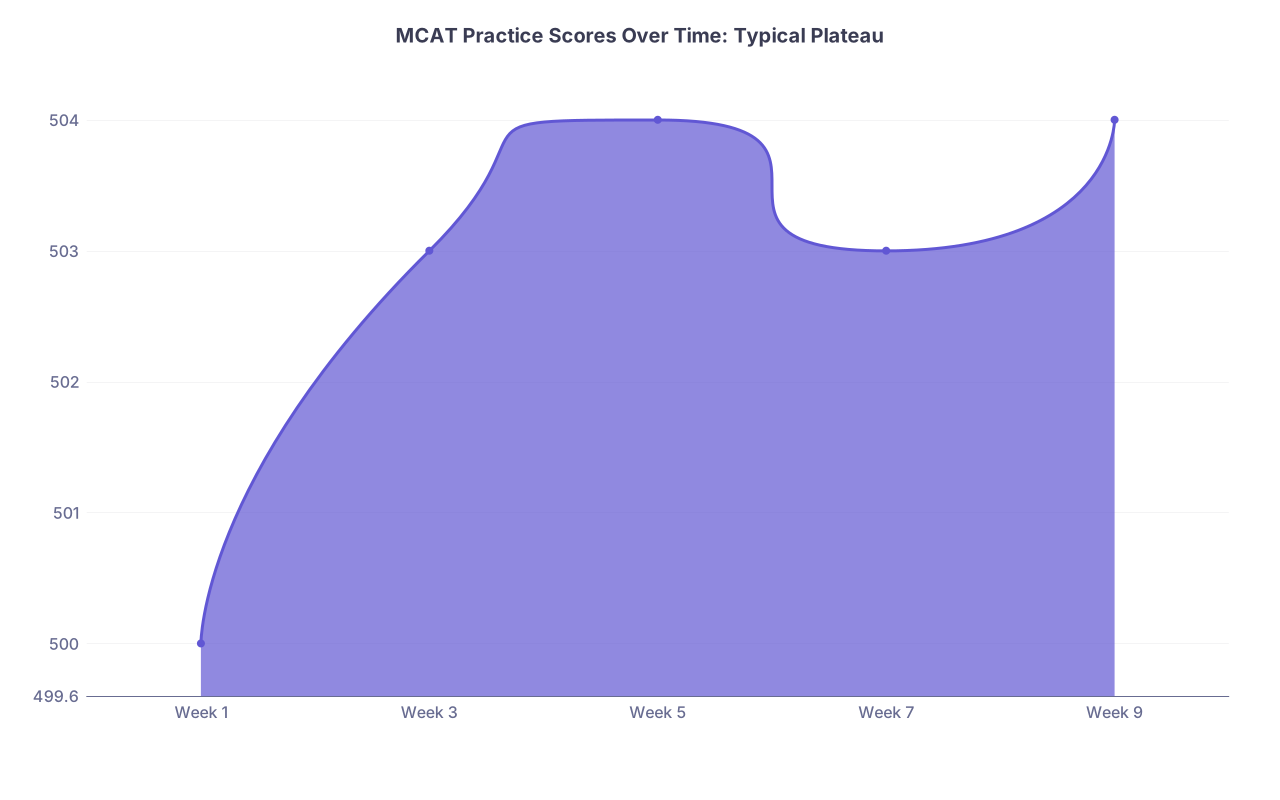
| Category | Value |
|---|---|
| Week 1 | 500 |
| Week 3 | 503 |
| Week 5 | 504 |
| Week 7 | 503 |
| Week 9 | 504 |
Why this is a red flag
A long plateau (3–4 full-lengths) means:
- You don’t actually know what’s driving your misses.
- Your review process is shallow or ineffective.
- You’re repeating the same mistakes in slightly different clothing.
A good tutor, study partner, or course doesn’t just “explain the question.” They spot patterns you’re blind to:
- “You keep changing right answers to wrong ones.”
- “You ignore figures and jump straight to the text.”
- “Your CARS issue isn’t comprehension; it’s timing panic.”
If your score curve is a flat line, you do not have an effort problem. You have a feedback problem.
Mistake to avoid: Waiting for the plateau to magically break two weeks before your exam. It almost never does.
Red Flag #2: You Have No Idea Why You Got Questions Wrong
If your wrong answers review sounds like this, you’re in trouble:
- “Ugh, stupid mistake.”
- “I knew that, I just misread.”
- “I gotta memorize this formula better.”
- “I’ll remember that next time.”
That’s not review. That’s denial with highlighter.
The level of analysis you should be doing
For each missed (or lucky guessed) question, you should be able to answer:
What type of error was this?
- Content gap?
- Misreading or rushing?
- Misinterpreting the data?
- Logic flaw in the reasoning?
At what step did I go wrong?
- Translating the question stem
- Extracting from the passage/figure
- Applying the concept
- Eliminating answers
How will I prevent this exact mistake in the future?
- Specific note, flashcard, or process change
Most self-studiers never get to that level because no one has shown them how. Or because it feels slow and uncomfortable, so they avoid it and call it “time-saving.”
Why help matters here
A good outside set of eyes can say:
- “You consistently pick answers that introduce new information not supported by the passage.”
- “You’re memorizing pathways, but you can’t reason through novel scenarios.”
- “You always reread passages multiple times. Your process is broken, not your memory.”
If you’re getting lots wrong and your only takeaway is “review more,” you’re not actually learning from your mistakes.
Mistake to avoid: Treating wrong answers as random bad luck rather than diagnostic gold.
Red Flag #3: You’re Re-Reading Content Instead of Fixing Strategy
If your solution to every score problem is:
- “I should re-read Kaplan Biology.”
- “I’ll redo that Sketchy playlist.”
- “Maybe I just need another Anki deck.”
…you’re stuck in content comfort.
Re-reading feels productive. It’s not. At a certain point, it’s procrastination in disguise.
Signs you’re hiding in content review
You’ve completed at least one full content pass, but:
- You’re still rarely doing timed passages.
- You avoid full-length exams because “I’m not ready.”
- You keep pushing back your test date to “finish review.”
In explanations, you think:
- “Oh yeah, I know this”
but you didn’t know it under pressure. Which is the only version that counts.
- “Oh yeah, I know this”
You say things like:
- “Once I really master the content, my strategy will be fine.”
No. Strategy doesn’t spontaneously appear like a side effect of memorization.
- “Once I really master the content, my strategy will be fine.”
Where outside help changes this
Someone objective can call you on it:
- “You’ve read the same chapter three times. I want you doing three timed passages a day instead.”
- “You don’t need another resource. You need a process for attacking passages.”
- “Your knowledge is fine. Your translation of that knowledge under time constraints is broken.”
Mistake to avoid: Believing your problem is always “more content” when your scores say “better application.”
Red Flag #4: You Cannot Stick to a Plan Longer Than 10 Days
You write a beautiful 12-week study schedule. Color-coded. Hour by hour.
By Day 4, it’s dead.
Chaos patterns I see all the time
Constant resource hopping:
- Week 1: Khan Academy + Anki
- Week 2: Kaplan books + UWorld
- Week 3: Reddit says Jack Westin for CARS so you ditch everything else
Mood-based studying:
- “I don’t feel like physics today.”
- “CARS is too depressing, I’ll do bio again.”
Crunch-binge cycles:
- 10-hour Sunday marathons
- Then 3 days of nothing because you’re fried
Self-study demands self-management. If your planning is fantasy-based (“This week I’ll just grind 8 hours a day after work”), it will collapse. Then you’ll feel like a failure, not because you’re lazy, but because the plan was delusional.
What outside help gives you here
- Realistic structure: Someone who says, “With your job and classes, this is what’s actually possible.”
- Accountability: Knowing you have to show someone your progress next week changes behavior.
- Course structure: Even a well-designed group course can keep you from reinventing the wheel every Sunday night.
Mistake to avoid: Confusing “I can’t stick to this impossible plan” with “I’m not cut out for medicine.” No. You’re just writing bad plans with no external guardrails.
Red Flag #5: Your Mental Health Is Tanking – And You’re Ignoring It
Let’s talk about the thing premeds love to minimize.
MCAT self-study can quietly wreck you if you’re not careful.
Signs the exam is chewing you up
You’re having:
- Persistent insomnia or 3 a.m. wake-ups obsessing over scores
- Daily anxiety or dread opening your prep materials
- Crying after practice tests or spiraling into “I’m never getting in”
You start:
- Avoiding social contact completely
- Stopping exercise, hobbies, basic self-care
- Equating your worth with one number
You think things like:
- “If I don’t hit 515+, I might as well quit.”
- “Everyone else seems to handle this okay; I’m just weak.”
I’ve seen students drag themselves to test day in this state, score well below their AAMC practice average, and then feel even worse because “I wasted my only shot.”

Why this requires outside help
This is not a “work harder” problem. It’s a support problem.
You may need:
- A tutor or coach to simplify decisions and reduce noise.
- A therapist or counselor to help manage anxiety and perfectionism.
- A study group or accountability buddy so you aren’t doing this in total isolation.
Mistake to avoid: Treating severe anxiety, burnout, or depression as a “normal” part of MCAT prep. It’s common; it’s not healthy.
Red Flag #6: Your Practice Conditions Are Completely Unrealistic
You’d be shocked how many people “practice” like this:
- Doing CARS untimed “to work on comprehension”
- Taking full-lengths in chunks across two days
- Always studying with music, snacks, and phone within reach
- Using third-party FLs exclusively and ignoring AAMC
Then they walk into a silent, strict testing center and wonder why their score tanks.
Mismatch patterns that should bother you
All practice at:
- 60–90 minutes at a time
vs. - Real test: ~7.5 hours with minimal breaks
- 60–90 minutes at a time
Always untimed or generous timing
vs.- Real test: brutal timing, especially for CARS
Heavily relying on:
- TPR, NextStep, Kaplan FLs
but taking almost no: - AAMC Section Banks, Question Packs, and FLs
- TPR, NextStep, Kaplan FLs
| Area | Realistic Practice | Unrealistic Practice |
|---|---|---|
| Timing | Fully timed sections & FLs | Mostly untimed or extra time |
| Exam Length | 6–7.5 hour simulations | 1–2 hour chunks only |
| Materials | Heavy AAMC usage | Only third-party exams |
| Environment | Quiet, no phone, test-like | Music, phone, casual setting |
| Review Style | Deep error analysis | Quick glance at explanations |
Where outside help fixes this
Someone experienced can tell you:
- Which third-party exams actually approximate AAMC.
- When to start full-lengths and how often.
- How to simulate test conditions correctly and build stamina.
If you’re constantly surprised by your FL scores because practice “felt easier,” it’s a sign your training environment is fake-comfortable.
Mistake to avoid: Letting 3 months of “practice” train you for an exam you’re not actually going to take.
Red Flag #7: You Don’t Understand the Exam Itself
Another silent killer: studying hard for the wrong exam.
I’ve sat with students who scored 500–503 after months of grinding, and when I asked them:
- “What skills is CARS really testing?”
- “How does the MCAT actually use experimental design?”
- “What does ‘thinking like the MCAT’ even mean to you?”
…they had no real answer. Just vague “critical thinking” buzzwords.
Signs you don’t really get the MCAT
You treat it like:
- A giant biology/biochemistry test with some side subjects
You’re shocked by:
- How “unfair” passages feel
- How many questions can be answered without reading all the details
- How often common-sense reasoning beats obscure memorization
You’re still:
- Memorizing every enzyme in glycolysis
but missing basic graph interpretation or control group logic
- Memorizing every enzyme in glycolysis

| Step | Description |
|---|---|
| Step 1 | Read Question Stem |
| Step 2 | Scan Passage/Figure with Purpose |
| Step 3 | Identify Tested Concept or Skill |
| Step 4 | Generate Prediction or Framework |
| Step 5 | Evaluate Each Answer Choice |
| Step 6 | Select Best Supported Answer |
How outside help changes this
- Courses and tutors who actually know what they’re doing will:
- Show you recurring passage structures and question types
- Teach you a specific, repeatable approach like in the diagram above
- Force you to stop treating the exam like a trivia contest
Mistake to avoid: Thinking more flashcards will fix a fundamentally wrong understanding of what the MCAT is testing.
Red Flag #8: You’re Repeating the Same Score After a Retake
This one hurts, but you need to hear it.
If you:
- Took the MCAT once
- Self-studied again, “adjusted a few things”
- Retook and scored within 2–3 points of your first score
You do not need “more time.” You need a different approach.
What usually went wrong
Common patterns:
- You reused the same resources and schedule style.
- You never had anyone else look at your process or mindset.
- You told yourself, “I just didn’t study enough last time; I’ll grind harder.”
A second (or third) self-study retake using the same instincts that failed you the first time is not “dedication.” It’s stubbornness.
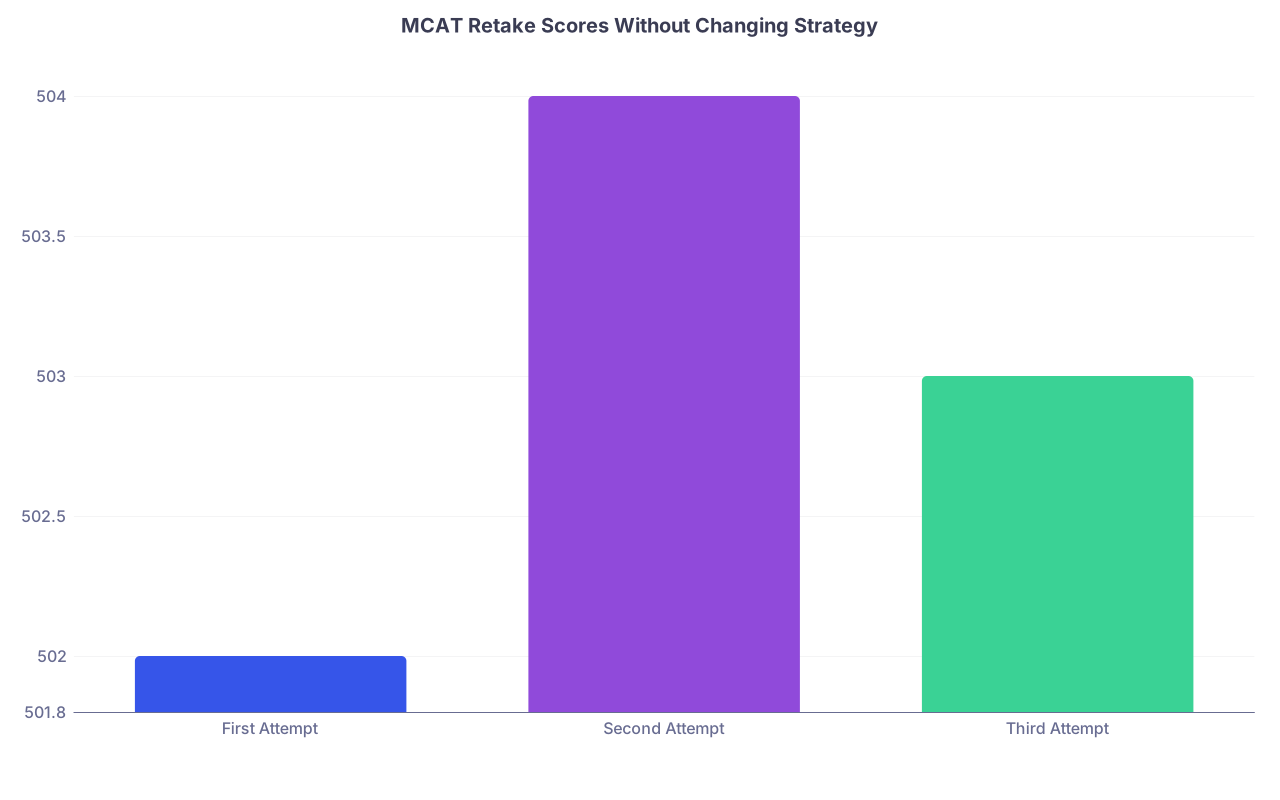
| Category | Value |
|---|---|
| First Attempt | 502 |
| Second Attempt | 504 |
| Third Attempt | 503 |
Why outside help becomes non-negotiable
At this point, medical schools are reading a narrative:
- “Same applicant, same score range, multiple tries.”
You need someone to help you:
- Autopsy your old attempts (materials, timing, mindset, test-day conditions).
- Identify your true limiting factors.
- Design a plan that doesn’t just copy-paste the last one.
Mistake to avoid: Stacking attempts with minimal strategy change and hoping admissions committees won’t notice the pattern. They will.
When Self-Study Is Enough – And When You Must Escalate
Self-study can absolutely work if:
- Your diagnostic or early FL is already close to target (e.g., 508 aiming for 512).
- You’re naturally systematic and can stick to long-term plans.
- Your FL scores trend upward with clear reasons for each improvement.
- Your mental health is stable and you have at least some support system.
You probably need outside help if:
- You’ve plateaued for multiple FLs with no clue why.
- You can’t build or follow a consistent, realistic schedule.
- Your mental health is slipping and you’re pretending it’s “fine.”
- Your practice conditions look nothing like test day.
- You’ve already taken the exam and did not significantly improve.
And here’s the key:
Getting help is not a confession of incompetence. It’s a strategic move.
Self-studying the MCAT is like lifting heavy alone in a gym.
Yes, you can do it. But if you’re shaky, exhausted, and the bar keeps crashing on your chest, the problem is not “I should just push harder.”
You need a spotter.
FAQs
1. What kind of outside help is best if I can’t afford a full tutoring program?
Look for targeted, not maximal, support. Options that don’t destroy your budget:
- One or two sessions with a strong scorer (ideally 520+) just to analyze your FLs and study plan. Implementation you can still do solo.
- A reasonably priced group course that includes structured homework and schedules.
- A study buddy several points above you who is serious and consistent, not just venting on Discord.
- Free or low-cost resources from your school’s premed office or learning center.
Avoid the trap of buying five different $200+ courses because “more must be better.” One structured path you actually follow beats a graveyard of unused logins.
2. How long should I wait before deciding my plateau is real?
If you’ve taken:
- At least 2–3 AAMC full-lengths under realistic conditions
and - Your scores are stuck within a 2–3 point band
and - You’ve honestly tried to improve your review process
…then the plateau is real enough to take seriously. Do not wait for “just one more FL” to rescue you. Talk to someone who can dissect those exams with you.
3. Can I still self-study if I’m a nontraditional student with a full-time job?
Yes, but you have to be ruthless about realism. The danger for nontrads is magical thinking: planning 4 hours of studying after a 10-hour shift. Doesn’t happen. You burn out, then blame yourself.
If you’re working full-time, you may especially benefit from:
- External scheduling help (tutor, coach, structured course).
- A defined, limited set of resources so you’re not wasting time comparing everything.
- Periodic check-ins to keep you from wandering off-plan when life gets messy.
If you keep writing plans you never execute, that’s your signal to get outside structure.
4. How do I know if my issue is mostly content or mostly strategy?
A quick diagnostic:
If you consistently miss:
- Discrete (stand-alone) questions on basic facts and definitions
in topics you just reviewed → content is weak.
- Discrete (stand-alone) questions on basic facts and definitions
If you:
- Do fine on untimed questions
but fall apart under timed conditions
or - Understand explanations perfectly but can’t reproduce the logic solo
→ strategy and test-taking are the bigger issue.
- Do fine on untimed questions
Most students have a mix, but if you’re repeatedly saying “I knew this” after seeing explanations, you don’t need a fourth content pass. You need someone to help you rebuild your approach.
Key points:
- Plateaus, vague review, fake practice conditions, and mental collapse aren’t “normal grind”; they’re red flags that your self-study setup is broken.
- Outside help isn’t an ego verdict; it’s a tool. Use it before you waste attempts and burn yourself out.