
The way faculty react when you say “I’m overwhelmed” is not random. It’s patterned, predictable, and heavily influenced by conversations you never hear.
Let me pull back the curtain on those conversations.
What You Think They Hear vs What They Actually Hear
You think you’re saying: “I’m struggling but I want to do better.”
What many faculty actually hear depends on three things: your timing, your track record, and their own burnout level.
I’ve sat in meetings where clerkship directors scroll through names and say things like:
- “He told me he was overwhelmed, but his evals are fine. I think he just panicked.”
- “She waited until week four to mention anything. That’s not overwhelmed, that’s crisis-level.”
- “This one was honest early. We adjusted his schedule. He did well eventually.”
They’re not all heartless. They’re also not all enlightened mental health advocates. They are busy physicians, under pressure, trying to triage students in the same way they triage patients: Who needs immediate intervention? Who’s safe with watchful waiting?
So when you admit you’re overwhelmed, they’re mentally sorting you into a category. And there are categories, whether anyone admits it publicly or not.
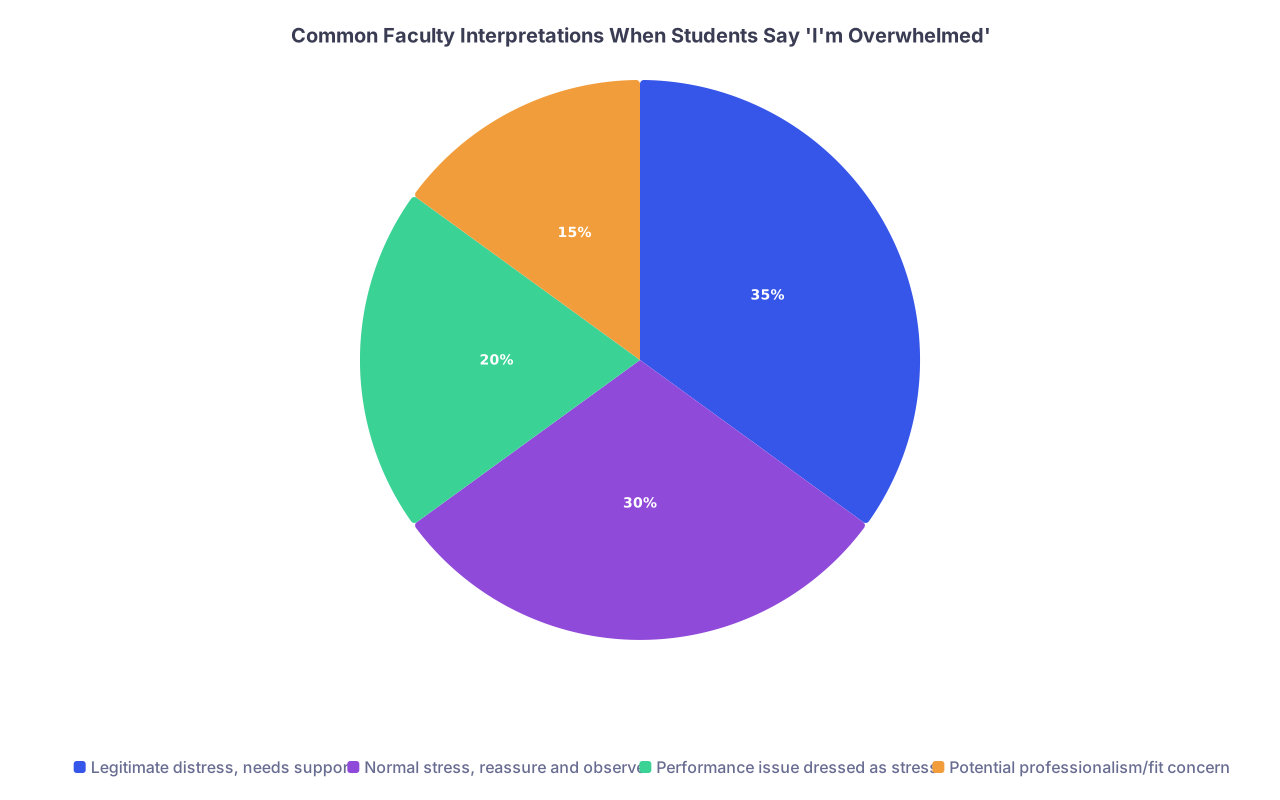
| Category | Value |
|---|---|
| Legitimate distress, needs support | 35 |
| Normal stress, reassure and observe | 30 |
| Performance issue dressed as stress | 20 |
| Potential professionalism/fit concern | 15 |
The Hidden Faculty Archetypes: Who You’re Actually Talking To
The truth: “faculty” isn’t one entity. You’re dealing with very different personalities and lenses. If you misunderstand which one is in front of you, you’ll misinterpret their reaction.
1. The Quiet Ally
Every school has a few. Psychiatry faculty. A couple of younger hospitalists. The clerkship director who remembers bombing their first OSCE.
When you say “I’m overwhelmed,” this is the person who silently thinks: Of course you are. This system is ridiculous.
They’re watching for:
- Whether you’re self-aware or just venting
- Your insight into what’s driving it (schedule, perfectionism, sleep, family, mood)
- Whether you’re willing to do something concrete about it
What they really think:
- “Good, they’re talking before something breaks.”
- “I can probably help adjust something if they’re specific.”
- “If I support them now, they’re less likely to implode mid-rotation.”
What they’ll rarely say out loud:
- “Our workload is unreasonable.”
- “The culture is toxic on that service.”
- “The residents are over the line; they’re part of why you’re overwhelmed.”
These are the people who will advocate for you behind closed doors. But they also have limited political capital. If you’re chronically overwhelmed, disorganized, and not following through, even the Quiet Ally starts to back off. Because they know their reputation with other faculty is on the line if they “always take the struggling student’s side.”
2. The Old-School Hardliner
You know exactly who I mean. They tell you how they worked 120-hour weeks, never complained, and “just got it done.”
When you admit you’re overwhelmed, their internal translation is often:
- “Soft.”
- “Not resilient enough.”
- “This generation…”
What they really think:
- “Everyone’s overwhelmed. Why is this special?”
- “Medicine isn’t for everyone. Maybe this is natural selection.”
- “If I let this slide, I’m lowering standards.”
I’ve watched attendings like this say one thing to a student and another thing in the evaluation meeting. To your face: “You’re doing fine, just hang in there.” In the meeting: “He seemed a bit fragile, needed more reassurance than usual.”
Here’s the ugly truth: these people still carry influence on Clinical Competency Committees (CCCs) and promotions committees. When your name comes up and your struggles are framed as “overwhelmed,” the Hardliner’s voice is often the one saying, “We need to be careful about passing someone who can’t handle pressure.”
It’s not always fair. Often it’s not. But you need to know that’s in play.
3. The Overloaded Middle Manager
This is your clerkship director, site director, or dean of students who’s trying to keep the whole machine running. They’ve seen 200 students cycle through, and you’re number 147.
When you say, “I’m overwhelmed,” what they’re thinking is:
- “Is this a student-in-crisis problem or a scheduling/rotation problem?”
- “Do I need to pull in counseling, disability, or a LOA conversation?”
- “Can I fix this with tweaks, or is this bigger?”
I sat in one dean’s office while she flipped between emails and calendars and said, “Half my job is detect who’s about to blow up. I’d much rather someone walk in and say they’re overwhelmed than wait until they disappear from the wards.”
So they’re listening for:
- Safety: Are you hinting at burnout, hopelessness, suicidal thinking?
- Function: Are you still showing up, reading, doing basic tasks?
- Pattern: Is this a one-time stress spike, or have multiple faculty flagged “concern”?
They are more pragmatic than emotional. They’re not judging you as weak. They’re judging the risk of doing nothing.
Timing: When You Speak Up Changes Everything
Same words. Very different reaction depending on when you say them.
Here’s what actually happens behind the scenes, case by case.
You Speak Up Early (Preclinical or Early in a Course)
Scenario: M2, two weeks into a heavy block, you email the course director: “I’m really overwhelmed, I’m falling behind, I’m not sure how to catch up.”
I’ve watched these emails land. The good faculty think:
- “This student is paying attention to the early warning signs.”
- “We can suggest tutoring, time-management, maybe an exam deferral if it’s bad.”
- “This is manageable.”
The less-good faculty think:
- “We’re all overwhelmed, but fine, I’ll send them to the learning specialist.”
No one is seriously questioning your fitness for medicine at this stage. No one is talking about professionalism. Mostly they slot you into “needs support.”
If you follow up, implement suggestions, and your performance stabilizes, the story ends there. The email never comes up again.
You Wait Until You’re Already Failing
Different story.
Scenario: You’re on internal medicine. First two weeks you say nothing. Your notes are late, you’re always a bit behind. Week three your attending writes in the mid-rotation eval: “Pleasant but disorganized, seems overwhelmed, needs tightening up.”
You see the feedback, panic, then finally go to the clerkship director: “I’ve been overwhelmed the whole time. I didn’t want to say anything.”
What the clerkship director is actually thinking:
- “Now I have both performance and wellbeing issues.”
- “I can’t clean this up easily. There’s already documentation.”
- “If I give them a pass, what do I write in the narrative?”
And in the CCC meeting you’re not in, the conversation can sound like:
- “She came to us late in the game.”
- “If she’d spoken up earlier, we could have helped.”
- “We should probably mark this as ‘needs development’ and watch her next rotation.”
Now your honest admission is documented as a pattern: delayed self-reporting. That’s when the word “overwhelmed” starts to contaminate things like “professional identity” and “reliability.”
You Only Speak Up After a Big Incident
This is the worst-case pattern faculty dread.
- You disappear from a shift.
- You blow a major exam.
- A resident reports “concerning behavior.”
Then, when cornered, you say: “I’ve been overwhelmed for months.”
Faculties’ internal reaction is blunt:
- “We missed it.”
- “They didn’t feel safe to come earlier.”
- “Now I have a duty-to-act problem.”
At this point, mental health moves from “support” conversation to “liability and safety” conversation. That’s when mandatory leave, formal evaluations, or professionalism language enter the chart.
Not because they hate you. Because the institution is terrified of being the program that ignored a student in crisis.
What “Overwhelmed” Signals To Different Committees
You need to appreciate one uncomfortable fact: your words don’t just land in one person’s head. They echo through committees.
Let me decode the major ones.
Clinical Competency Committee (CCC)
Their job is to decide: are you safe and competent enough to progress?
If “overwhelmed” shows up in multiple narratives, they start asking:
- Is this student simply experiencing normal stress?
- Or is their function genuinely impaired on the wards?
They don’t care if you cried once in a call room. They care if you’re missing key data on presentations, forgetting tasks, or needing constant supervision because you’re mentally flooded.
A single, well-handled admission of being overwhelmed, early, followed by documented improvement? They like that story. It screams growth and insight.
Repeated discussions of being overwhelmed with no improvement in performance? Different story. That’s when comments like “concern about coping skills under pressure” start creeping into the file.
Promotions Committee
This is the group that decides pass/fail/LOA/remediation.
When your case lands in front of them with a mental health note, their internal monologue is simple:
- “Can we justify promoting this student safely?”
- “Do we have enough documentation that they got support, used it, and stabilized?”
- “Are we setting them up for bigger collapse as a resident if we rubber-stamp this?”
They’re afraid of one thing: graduating someone who melts down as an intern and ends up in a catastrophe. That fear shapes their interpretation of “overwhelmed.”
Here’s a pattern I’ve seen more than once: the promotions committee is actually reassured when someone admits they’re overwhelmed early, seeks treatment, and asks for structured accommodations or a leave. That looks responsible.
They’re far more unnerved by the “always fine, never asks for help, then suddenly implodes” student. That one keeps them up at night.
How Faculty Distinguish “Normal” vs “Red-Flag” Overwhelm
You and your classmates toss the word “overwhelmed” around constantly. Faculty know that. So they’re looking for qualifiers.
Here’s the kind of mental triage they actually do, whether consciously or not.
| Category | What They Think | Typical Response |
|---|---|---|
| Normal but stressed | Expected for med school | Reassure, suggest basic resources |
| Overloaded but functional | Needs support and structure | Study help, schedule tweaks, check-ins |
| Impaired functioning | At risk academically/clinically | Formal support, documentation, possible remediation |
| Safety concern | Possible risk to self/patients | Immediate referral, possible leave |
When you say “I’m overwhelmed,” what pushes you into a higher category in their mind?
Concrete things:
- You’re not sleeping more than 2–3 hours consistently
- You’ve stopped eating regularly
- You miss shifts, sessions, or deadlines
- You’re crying frequently at work or unable to complete tasks
- Peers or residents have expressed concern to faculty
The student who says, “I’m overwhelmed; I’m going home every night and just doom-scroll, I’m eating garbage, and I haven’t opened First Aid in a week,” gets flagged as “needs intervention.”
The student who says, “I’m overwhelmed; I’m working 12 hours, I still do Anki, but I feel constantly behind,” is seen as “normal med student, maybe overly conscientious.”
Both are suffering. But the faculty response—and the story that gets written about you—will differ.
What Faculty Appreciate When You Admit You’re Overwhelmed
Here’s the part people rarely tell you: most faculty actually like students who are appropriately transparent about overwhelm.
The key word there is “appropriately.”
They appreciate when:
- You come early, not after a disaster.
- You’ve thought about specific stressors, not just “everything.”
- You express a desire to improve, not just to be rescued.
- You’re open to concrete changes (study plans, therapy, meds, time off).
There’s a particular tone that lands well. It sounds like this:
“I’m overwhelmed, and it’s starting to affect how I’m functioning. I’m not asking to be excused from expectations, but I need help figuring out how to meet them without burning out.”
That signals:
- Insight
- Motivation
- Responsibility
It does not read as “weak.” It reads as “adult.”
On the other hand, what irritates faculty—and yes, they do get irritated—is when “I’m overwhelmed” comes packaged with:
- Blame: “If the schedule wasn’t so unfair, I’d be fine.”
- Entitlement: “I just need you to let me skip X/Y/Z.”
- Vagueness: “I don’t know what’s wrong, everything just sucks.”
- No follow-through: you’re referred to counseling and never go, or you disappear from emails.
They don’t expect you to be perfect. They do expect you to participate in your own rescue.
How To Talk About Being Overwhelmed Without Sabotaging Yourself
Let me be blunt: hiding everything is dangerous. Oversharing everything, in the wrong way, is also dangerous. There’s a middle lane.
Use it.
Step 1: Pick the Right Person First
Do not start with the most unsympathetic attending on the rotation. Start with:
- Your college advisor or learning community faculty
- A dean of students / student affairs
- A trusted resident who can point you to the right faculty
Once you’ve anchored with someone in your corner, they can help you script what to share and where.
Step 2: Frame It Around Function, Not Just Feeling
You’re not in therapy with them. You’re in a professional training relationship. So you say:
- How you’re feeling: “I’m overwhelmed, exhausted, more anxious than usual.”
- How it’s affecting function: “I’m having trouble concentrating, I’m slower on pre-rounding, I’m forgetting small tasks.”
- What you’re already trying: “I’ve cut back on social stuff, I’m using a planner, but it’s not enough.”
- What you’re asking: “I need help making a sustainable plan / getting connected to mental health / considering a schedule change.”
That signals you’re not just dropping problems in their lap. You’re asking for collaboration.
Step 3: Expect Them To Document Something
Anything involving academic performance or clinical function gets documented. That scares students. It shouldn’t.
What committees read matters more than the mere existence of documentation.
There’s a big difference between:
- “Student expressed being overwhelmed, sought help early, connected with resources, performance improved.” and
- “Student repeatedly reported being overwhelmed, did not follow through with recommended support, ongoing concerns about reliability.”
You can’t fully control what they write. But you influence it a lot by what you do after the conversation.
Step 4: Separate Two Tracks: Getting Well vs. Staying On Schedule
This one stings, but it’s real.
Schools are juggling two competing drives:
- Protect you as a human being.
- Keep you moving through an expensive, rigid curriculum.
The solution they don’t advertise, but use constantly, is this: temporary slowing down.
- Exam deferrals.
- Lightened load.
- Short leaves of absence.
Students often resist these because they’re terrified it means they’re “weak” or will never match. Faculty, meanwhile, often see them as the most responsible, career-protecting choices.
I’ve watched students white-knuckle through Step 1 or a core clerkship while utterly overwhelmed, land a barely passing or failing score, then have to explain that for years. The ones who took 3–6 months to get treatment, stabilize, then came back? They usually performed better and matched just fine—often with a better story to tell.
The Quiet Thing Faculty Won’t Tell You Directly
Most faculty know the system is harder on you than it was on them. More exams. More documentation. Less autonomy. More scrutiny. And a pandemic thrown in for flavor.
They won’t say this out loud in the middle of rounds, but privately I’ve heard:
- “I’m shocked we don’t have more breakdowns.”
- “The best students are usually the ones who admit when they’re overwhelmed and get help.”
- “The ones who scare me are the ‘I’m fine’ people who clearly aren’t fine.”
So when you admit you’re overwhelmed—clearly, concretely, and early—many of them actually relax. Because they finally know where you really are.
And that means they can do what they’re supposed to do: teach you, support you, and keep you from becoming one more tragic story whispered in a faculty lounge.

| Step | Description |
|---|---|
| Step 1 | Student admits overwhelm |
| Step 2 | Advisor/Dean support |
| Step 3 | Performance issues already documented |
| Step 4 | Resources + minor adjustments |
| Step 5 | Formal remediation plan |
| Step 6 | Improved function, positive narrative |
| Step 7 | Ongoing concern, flagged to committees |
| Step 8 | Timing |
| Step 9 | Follow-through? |