

The pressure to turn every messy human experience into a glowing CV bullet point is toxic. Especially when it comes to medical missions.
The Fear Behind This Question
You’re not actually asking, “Is it safe to leave my mission off my CV?”
What you’re really asking is:
- “If I leave it off, will programs assume I never cared about service?”
- “If I put it on, will they ask me about it and I’ll freeze or sound fake?”
- “Will people judge me for not having had a ‘life-changing’ global health experience?”
- “Does it look suspicious if I went on a mission and then never mention it again?”
And underneath all of that:
“I didn’t love this experience. Does that mean something is wrong with me?”
Let me say this bluntly: No. It doesn’t.
You can have a complicated, even negative, reaction to a medical mission and still be a good, deeply ethical future physician. Honestly, that reaction probably puts you ahead of a lot of people who came back with cliché Instagram captions and zero critical thought.
The Biggest Myth: “Every Mission Must Go on the CV”
There’s this unspoken rule in premed / med school culture:
If you did anything that looks “impressive” on paper—especially abroad—you have to list it.
That’s wrong.
You do not have to list everything you’ve done. Your CV is not your diary. It’s a selective, strategic document, not a full autobiography. Leaving something off is not lying. It’s curating.
Here’s the real rule:
If you can’t talk about an experience with:
- honesty,
- insight,
- and at least some sense of what you took away from it,
then it’s not strong application material. Even if it had palm trees and passports and “global health” in the title.
, Wasted opportunity to impress](https://cdn.residencyadvisor.com/images/articles_svg/chart-common-applicant-fears-about-leaving-mission-off-c-8941.svg "Common Applicant Fears About Leaving Mission Off CV")
| Category | Value |
|---|---|
| Looks bad to leave it off | 80 |
| They’ll think I hate service | 65 |
| [Interviewers will be suspicious](https://residencyadvisor.com/resources/medical-missions/how-mission-work-actually-comes-up-in-residency-interviews) | 50 |
| Wasted opportunity to impress | 70 |
Most people force missions onto their CV because they’re terrified of “wasting” the optics. You’re actually asking a more mature question: “Is it ethical and safe to not?”
That’s a good sign.
Let’s Be Honest About Why You Didn’t Love It
You’re worried that if you tell the truth—
“I felt like a tourist.”
“I felt uncomfortable with the power imbalance.”
“It felt performative.”
“I barely did anything medical but everyone back home treated me like a hero.”
“I hated how people took photos with kids they didn’t know for social media.”
—someone will label you as ungrateful or not committed to service.
I’ve heard versions of your story so many times. A premed or med student goes to:
- A short-term clinic in Central America
- A week-long “mission” where they hand out vitamins and take blood pressures
- A trip that’s supposedly about “helping” but mostly about “exposure”
And they come back with this unsettled feeling they can’t shake.
Because deep down, a lot of these experiences are ethically messy.
They might:
- Disrupt local care without integrating with existing systems
- Use local patients as “learning opportunities”
- Drop in, take photos, leave, and never address structural issues
- Elevate the visiting students while ignoring local expertise
If you saw some of that and didn’t like it, that’s not a red flag. That’s your ethics working.
So no, you don’t need to punish yourself by immortalizing it on your CV just because other people would.
Will Leaving It Off Make Me Look Less “Service-Oriented”?
Short answer: only if you have nothing else that shows service.
If your entire application has:
- no community involvement,
- no volunteering,
- no longitudinal anything,
- and the only “service” you ever did was this mission…
Then yeah, leaving it off might leave a hole. Not because it was a mission, but because then there’s nothing else.
But if you’ve got:
- local free clinic volunteering,
- tutoring,
- advocacy work,
- long-term community engagement,
- service in your own city or state,
you don’t need the mission to “prove” you care. In fact, a lot of programs respect local, sustained service more than one flashy trip.
Here’s the part you’re probably not hearing enough:
Plenty of faculty side-eye short-term medical missions. They won’t say that on websites, but they absolutely talk about it behind closed doors. They’ve read 1000+ personal statements that sound like: “I went to [country] and realized how privileged I am.” They’re tired.
So your quiet, consistent work at the local FQHC or free clinic? That can look better than a one-week trip with a photo-op vibe.
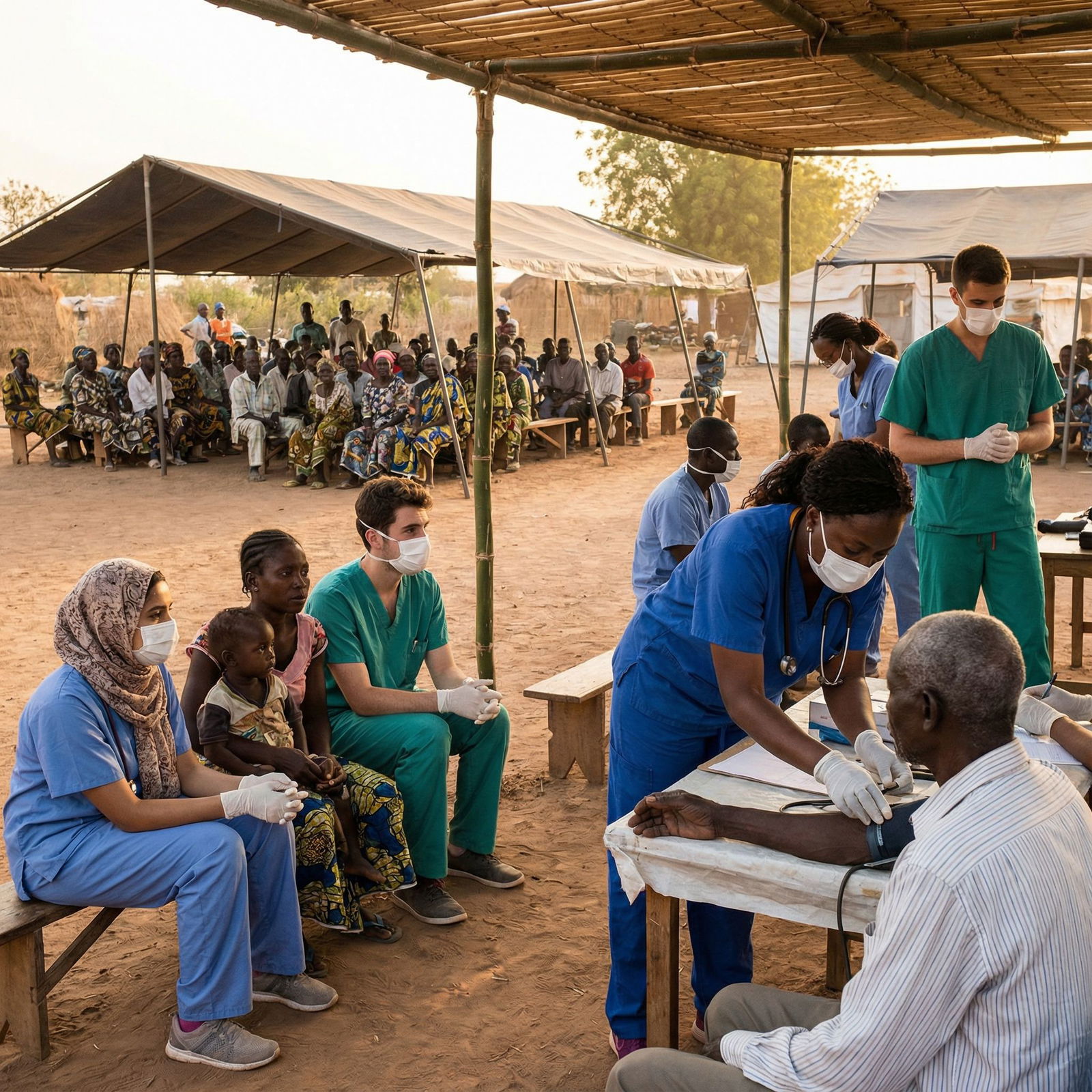
The Real Risk: Putting It On When You Can’t Stand Behind It
Everyone worries about the risk of leaving something off.
Almost nobody thinks about the risk of putting something on that you don’t actually feel good about.
Imagine this:
You list the mission under “Clinical Experience – Global Health.”
You show up to an interview.
The interviewer’s eyes light up.
“Oh, you went to [country]! I’ve done work there too. Tell me about it. What did you learn? What were the ethical challenges? Would you go back?”
Now you’re trapped.
Because you:
- Don’t want to trash the organization.
- Don’t want to sound ungrateful.
- Don’t want to look naive.
- Don’t want to lie.
So you mumble something generic and safe, and it feels awful because you’re trying to dodge the core truth: you didn’t love it and you’re not sure if it was actually right.
This is the bigger risk. Listing an experience that:
- You can’t discuss comfortably,
- You don’t respect in retrospect,
- or that pushes you into ethical territory you’re not ready to unpack under pressure.
If the thought of being grilled on this mission in an interview makes your stomach sink right now, that’s your sign.
You’re not obligated to turn that anxiety into a recurring nightmare by putting it front and center on your CV.
What If They Find Out I Went and I Didn’t List It?
Here’s the anxious brain scenario:
An interviewer somehow knows you went (mutual friend, Instagram, LinkedIn, whatever) and says:
“I heard you went on a mission trip to [country], but I don’t see it on your CV. Why not?”
You can answer that. Honestly. Calmly. Like this:
“I did go on a short-term mission trip during college. It was a complicated experience for me. I realized I didn’t yet have the framework or training to fully evaluate the impact we were having, and I left with more ethical questions than answers. I’ve chosen to focus my CV on work I can stand behind more confidently—especially my local, longitudinal service—but the mission did influence how seriously I now take issues of sustainability and partnership in global health.”
That answer does three important things:
- Acknowledges the experience without hiding it.
- Shows ethical reflection instead of performative “savior” vibes.
- Highlights that you learned from it and moved toward more grounded work.
That’s not suspicious. That’s mature.
Is it possible someone super into missions might think, “Hmm, I wish they’d loved it more”? Sure. But you can’t build an application trying to pre-please every hypothetical extremist evaluator. You’ll twist yourself into knots and still fail.
Programs are looking for integrity. Not theatrical enthusiasm.
Should I Ever Put It On If I Didn’t Love It?
Maybe. But only if you can talk about it like an adult and not like a hostage.
There are a couple of scenarios where including it could actually be powerful:
You’ve done a lot of thinking and reading since then about global health ethics, power dynamics, and short-term missions. You can articulate very clearly:
- What didn’t sit right with you,
- How it shaped your future choices,
- Why you now approach service differently.
You’ve intentionally pivoted since then:
- Maybe that unease is exactly what pushed you toward more sustainable work:
- Long-term partnerships with a particular community
- Work with a global health department that focuses on capacity-building, not drop-ins
- Research on global health policy or ethics
- Maybe that unease is exactly what pushed you toward more sustainable work:
Then the mission isn’t just “volunteering abroad.” It’s a turning point. A catalyst.
But if you’re still stuck in, “It just felt off and I don’t know how to say that without sounding like a jerk,” you’re probably not ready to center it.
You can always talk about this in an essay or interview if asked, without putting it as a formal entry on your CV.

| Step | Description |
|---|---|
| Step 1 | Did medical mission |
| Step 2 | Include on CV |
| Step 3 | Optional - include with nuance |
| Step 4 | Leave off CV |
| Step 5 | Focus CV on other service |
| Step 6 | Do you feel good about its impact? |
| Step 7 | Can you discuss it with clear insight? |
Ethics Check: Are You Hiding, Or Are You Being Honest?
There’s a difference between:
- Hiding something because you’re ashamed of how it looks.
- Consciously choosing not to highlight something because you’re not comfortable endorsing it.
You’re closer to the second one.
Ask yourself these questions and answer brutally honestly (no one else has to see the answers):
- If I include this, am I presenting it in a way that feels true to my actual experience?
- Would I feel okay if an interviewer asked: “What were the ethical concerns?”
- Do I feel pressured to include it only because it sounds impressive?
- Do I think the patients/communities involved would recognize themselves in how I describe it—or would it feel like I used them?
If you feel gross writing the bullet point, that’s your gut talking.
And you don’t win any moral or professional prize for ignoring your gut to look better on paper.
A Quick Reality Check: How Programs Actually Read This Stuff
Here’s the part you don’t see. You imagine adcoms and PDs going line by line through your CV, obsessing over every missing detail like detectives.
They’re not.
They’re:
- Skimming for patterns.
- Looking for red flags.
- Glancing at a couple of experiences that stand out.
Short-term mission trips? They’re so common they’re almost background noise now. It’s not the magic golden ticket people think it is.
But what does stand out is inconsistency:
- Overblown language with vague responsibilities
- “Life-changing” experiences that produce zero concrete insight
- A mile-long list of “activities” that all look like one-offs with no depth
If leaving the mission off means your CV looks more coherent and more honest, that helps you.
You don’t owe anyone proof that you got on a plane to care about people.
So… Is It Safe To Leave It Off?
Yes.
If:
- You have other service experiences,
- You’re not trying to hide something unethical or dangerous you did,
- You couldn’t talk about it in an interview without feeling like you’re performing a script you don’t believe,
then yes, it’s not just safe—it might be wiser—to leave it off.
And if you’re still twisting yourself up, here’s a compromise:
You can leave it off your CV now.
If, in a year or two, you’ve processed it more and feel like you have something important and honest to say, you can always bring it back in a more reflective context—like a personal statement about ethics or a meaningful experiences essay.
You’re allowed to grow before you package this.
| Situation | Better Choice |
|---|---|
| Loved it, can discuss ethically | Include on CV |
| Mixed feelings, but processed deeply | Optional include |
| Still confused, feel uneasy | Leave off CV |
| Only major service you’ve ever done | Likely include |
| Plenty of strong local service already | Safe to leave off |
What You Can Do Today
Open your CV right now and:
- Delete the mission entry.
- Or rewrite it, honestly, and then decide if you still want it there.
- Or leave it off and instead strengthen the descriptions of your local, sustained service.
Then ask yourself this:
“If someone read this CV, would they see a person who cares about patients and communities—even if they never got on a plane?”
If the answer is yes, you’re fine.
Not just “fine.” You’re probably more grounded than a lot of people faking a perfect global health narrative.
FAQ (Exactly 6 Questions)
1. Will programs think I never did any global health if I leave my mission off?
Maybe. But that’s not automatically bad. A lot of excellent applicants have zero global health on their CV and match just fine. Global health isn’t a requirement for most specialties or schools. What matters more is that your experiences—whatever they are—show maturity, commitment, and integrity. If you do want to signal interest in global health but don’t want to highlight the mission, you can mention ethical questions you’ve explored, coursework, or future goals in that space instead.
2. What if I really didn’t like the mission and it made me not want to do global health at all? Is that a red flag?
No. That’s just data about yourself. Seeing something up close and realizing, “This is not for me” is actually a useful outcome. You don’t earn extra points for pretending you’re passionate about global health if you’re not. Many fantastic physicians have careers entirely focused on local or national health inequities and never step on a plane for “missions.” That’s not lesser. It’s just different.
3. Could leaving it off ever be considered dishonest?
No. A CV is, by definition, selective. Dishonesty would be claiming something you didn’t do, inflating your role, or hiding something truly serious—like misconduct, probation, or major professionalism issues. Not listing a week-long mission that you’re unsure about is not in that category. If someone directly asks if you’ve done any mission or global health work, answer truthfully. But you’re not required to preemptively foreground every complicated experience.
4. How do I talk about the mission if it comes up and I didn’t like it?
Be honest but measured. You don’t need to rant about how terrible it was, and you don’t need to pretend it was amazing. Something like: “It was a short-term mission that opened my eyes to how easy it is for well-intentioned efforts to miss the mark if they’re not integrated with local systems. I left with a lot of ethical questions and realized I prefer models that emphasize long-term partnerships and local leadership. That’s shaped how I approach service now.” Calm. Reflective. No drama.
5. I’m scared they’ll judge me for being ‘too critical’ if I express doubts about medical missions. Is that a real risk?
With a tiny minority of people, maybe. But most academic physicians respect critical thinking. They’ve seen enough shallow mission narratives to be wary. If you frame your doubts as ethical concern, humility about your own limits, and a desire for more sustainable approaches, you’re not “negative”—you’re thoughtful. The key is tone: curious and self-aware, not bitter or superior.
6. What should I focus on building instead if I leave the mission off?
Depth over drama. Long-term local volunteering. Consistent involvement with a free clinic, shelter, school, advocacy group, mental health hotline, harm reduction program—whatever actually matters to you. Projects where you’re accountable to a community over time, not just dropping in. If you can show that you show up, regularly, for people in your own city, that will say more about your character than a one-week trip ever could.
Now: open your CV and look at that mission entry. Ask yourself, out loud, “Do I actually want to stand behind this?” If your body tightens and your mind starts spinning excuses, you’ve got your answer.


