
You are here
You are six months into PGY‑1. You are post‑call, half‑asleep in the workroom, and somebody mentions a surgical mission to Guatemala. Another co‑resident talks about a month they did in Malawi during residency. You feel that tug: I want to do that. I want my training to mean something beyond this hospital.
But your life right now is:
- Pre‑rounding in the dark.
- Scrambling to get notes done.
- Learning how to not kill anyone with a potassium order.
So you ask yourself: “When am I supposed to plan missions? And what should this look like at my level vs when I am a senior?”
Let me lay it out bluntly: what is ethical, useful, and realistic for you to do on medical missions as a PGY‑1 is not what you should be doing as a PGY‑4. If your mission mindset stays the same, you are doing it wrong.
This is a year‑by‑year, season‑by‑season guide to how your mission timeline should evolve, from raw intern to near‑attending.
Big picture timeline: intern to senior
Start with the arc, then we will drill down into months and weeks.
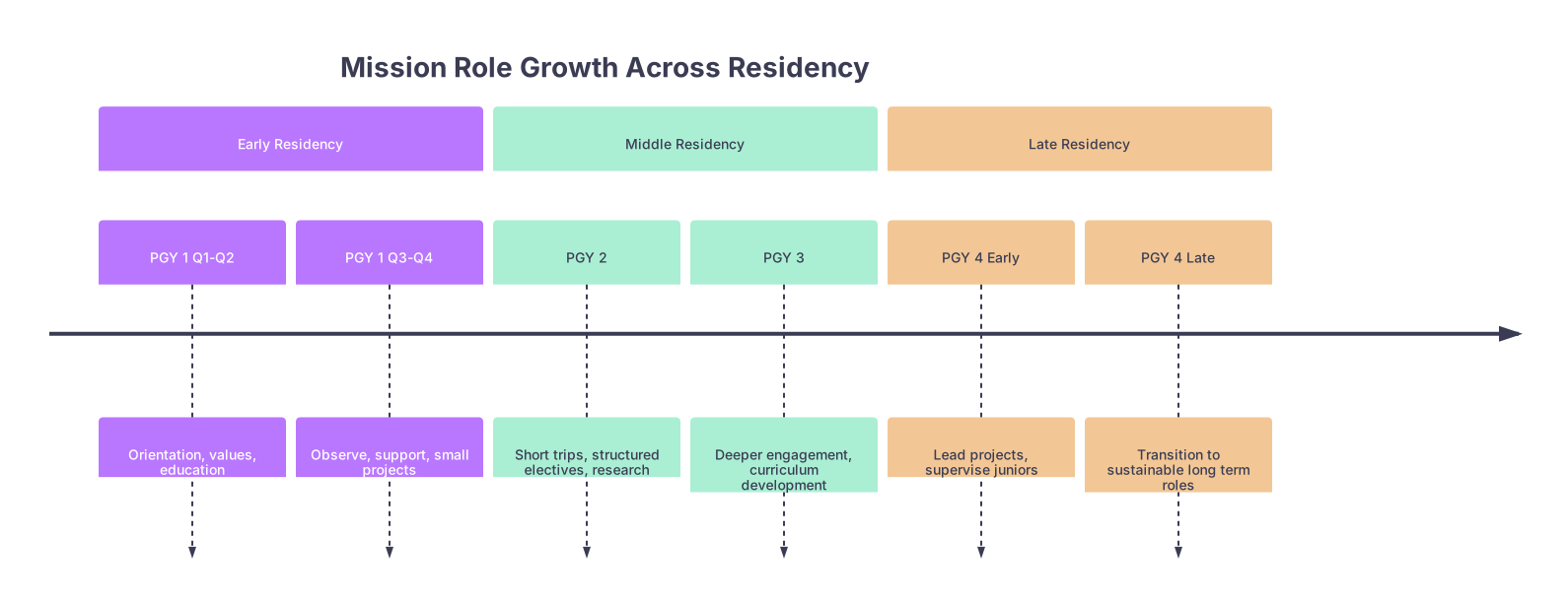
| Period | Event |
|---|---|
| Early Residency - PGY 1 Q1-Q2 | Orientation, values, education |
| Early Residency - PGY 1 Q3-Q4 | Observe, support, small projects |
| Middle Residency - PGY 2 | Short trips, structured electives, research |
| Middle Residency - PGY 3 | Deeper engagement, curriculum development |
| Late Residency - PGY 4 Early | Lead projects, supervise juniors |
| Late Residency - PGY 4 Late | Transition to sustainable long term roles |
At each stage you should be shifting:
- From “this sounds cool” → to “is this ethical and needed?”
- From tourist volunteer → to accountable partner
- From extra pair of hands → to teacher, builder, and advocate
To keep it concrete, I am going to split between PGY‑1 and PGY‑4, then break each into specific time blocks and checklists.
PGY‑1: Build your ethical foundation and credibility
PGY‑1 Months 1–3: Stop. Learn before you “go help”
At this point you should not be booking a two‑week “medical brigade” to “give back” between your first ICU and your first wards block. You are barely safe in your own system.
Your focus this quarter:
Clarify your mission “why” (not the Instagram version)
Take one evening. No phone. Ask yourself in writing:- Why do I think I want to do medical missions?
- Am I chasing adventure, a savior narrative, or long‑term service?
- What injustices actually bother me enough to study them?
Your answers here will shape what you say yes to later.
Get basic ethics and history under your belt
In Q1, you should schedule 3–4 concrete learning activities:- Read one solid book or report on global health ethics (not blog posts). Examples:
- Reimagining Global Health (Farmer et al.)
- When Helping Hurts (if you are in faith‑based circles; read critically)
- Watch 1–2 recorded lectures on:
- Short‑term medical missions harms
- Task‑shifting, local capacity building
- Attend your hospital’s global health or ethics conference if it exists.
The goal: by end of Month 3, you can articulate at least three ways short‑term missions can cause harm. Out loud. To someone else.
- Read one solid book or report on global health ethics (not blog posts). Examples:
Map local mentors and structures
By the end of Month 3 you should know:
- Who in your department leads global health / missions (by name).
- Which attendings have actual long‑term partnerships, not just yearly photo trips.
- What your program’s policies are on international electives.
Send three emails. Something like:
“I am a PGY‑1 in internal medicine with long‑term interest in ethical global health. I am not looking to travel yet. I am hoping to learn what our department is already doing and how residents can engage meaningfully over time. Could we schedule a 20‑minute meeting?”
You are signaling maturity. Leaders remember that.
PGY‑1 Months 4–6: Learn systems, not just stories
Once you have survived your first winter block and know how to run a team without drowning, you can start to connect your day job to global inequities.
At this point you should:
Attach to existing work, quietly
Pick one of the following “low‑ego, high‑learning” roles:
- Help a senior resident or faculty member with data cleaning or chart review for a global health project.
- Join a global health journal club. Volunteer to present once.
- Help maintain a shared folder of protocols or guidelines for an existing partner site.
The rule: you are not leading anything yet. You are a motivated assistant.
Track your skill growth against what missions actually need
Quick reality check: many mission settings need:
- Strong bedside ultrasound skills
- Bread‑and‑butter inpatient management without CT/MRI
- Comfort with limited formulary meds
- Reliable teaching of nurses and junior staff
You should create a simple 2‑column list:
| Mission Need | Your PGY-1 Status |
|---|---|
| Manage sepsis with limited labs | Just learning protocols |
| Perform basic ultrasound | Rarely using it |
| Teach structured short topics | Not confident yet |
| Work without subspecialists | Still relying heavily |
| Handle cultural/language gaps | Minimal exposure |
By Month 6, if that right column is mostly “just learning” and “not confident,” you have your answer: you are not yet an asset overseas. That is fine. You have time.
Establish your ethical red lines now
Decide early what you will not do, no matter how “underserved” the setting:
- Perform procedures you are not credentialed for at home.
- Prescribe drugs you do not understand just because “that is what they use there.”
- Work in settings with no local oversight or continuity.
Write those down. Revisit every 6 months. If an attending pressures you to cross one later, you will already know your answer.
PGY‑1 Months 7–12: Local missions, small projects, no heroics
Now you are a bit less dangerous clinically. You have opinions. You know where the bathrooms are. Time to move from passive learning to small, concrete actions—mostly local.
At this point you should aim for one small project you can complete in 6 months that aligns with mission ethics:
Shift from “global” to “glocal”
Instead of flying 8,000 miles to “serve the poor,” look 3 miles from your hospital:
- Free clinics for uninsured or undocumented patients
- Outreach to migrant farmworkers, refugee clinics, or homeless shelters
- Telehealth or remote consult support programs tied to an international partner
One evening per month is enough to start. Your presence once a month, consistently, beats a flashy 10‑day brigade.
Pick a mission‑aligned micro‑project
Examples I have seen PGY‑1s do well:
- Translate (with native speakers) a simple discharge instruction handout into the three most common non‑English languages your clinic sees.
- Help standardize one chronic disease flow sheet (e.g., diabetes) for a partner clinic.
- Assist in creating a 15‑minute teaching module for nurses at a local FQHC on a topic you know well (e.g., recognizing early sepsis).
Scope rule: You should be able to describe the entire project in two sentences and finish it by the end of PGY‑1.
If you absolutely insist on a short overseas trip…
I do not recommend it in PGY‑1. But if your program has a structured, faculty‑supervised elective, these must be true for it to be ethical for you:
- There is a long‑term institutional partnership (5+ years).
- Your role is observational and supportive, not primary surgeon or “the only doctor.”
- There is a clear educational curriculum for you, not just a vacation disguised as work.
- Your absence from your home program is actually covered (no screwing colleagues).
You should refuse:
- Trips organized by non‑medical churches or NGOs that want you to “see patients” with zero local oversight.
- Teams that brag about “doing 300 surgeries in 5 days.”
PGY‑4: From eager helper to accountable leader
Fast‑forward. You are now a PGY‑4. You have codes under your belt, you have run teams, maybe you are chief. Younger residents look to you.
If your mission involvement still looks like “I sign up for trips when convenient,” you have wasted three years.
By PGY‑4, your mission timeline should be about ownership, continuity, and mentorship.
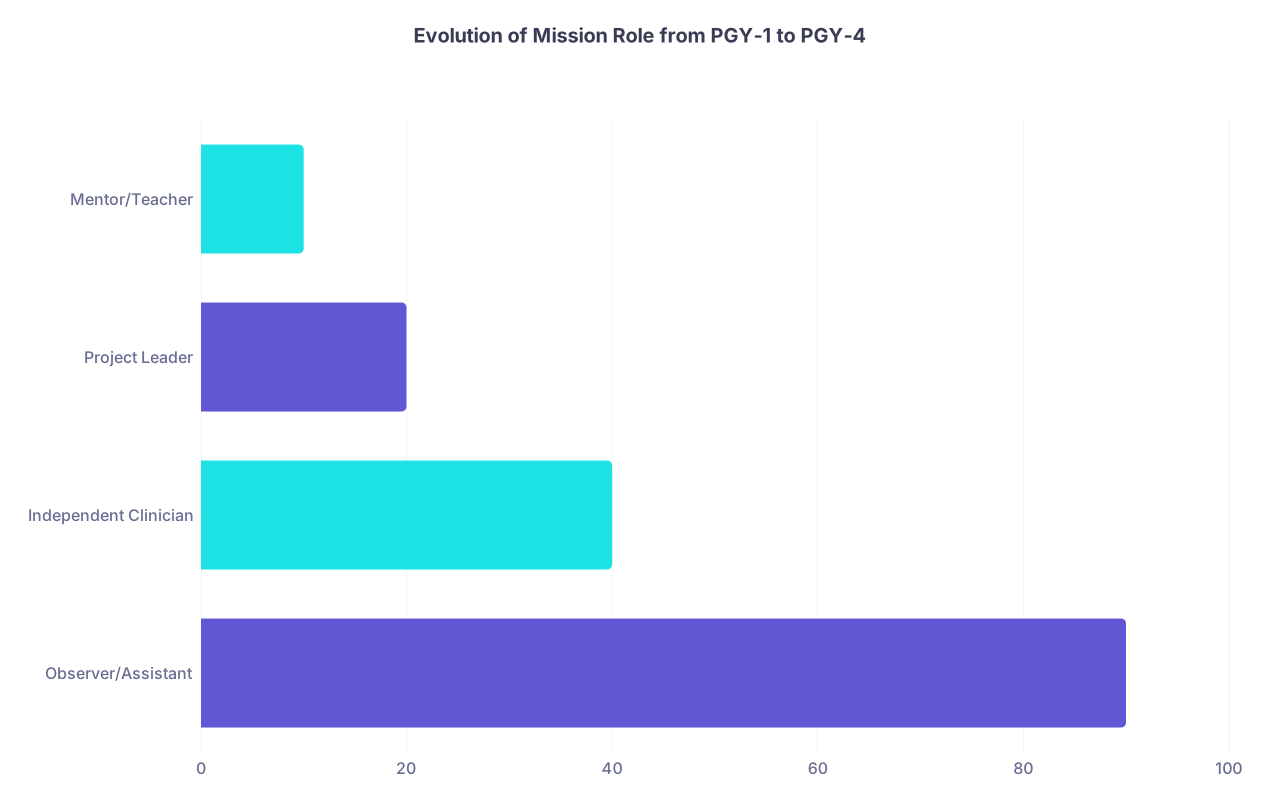
| Category | Value |
|---|---|
| Observer/Assistant | 90 |
| Independent Clinician | 40 |
| Project Leader | 20 |
| Mentor/Teacher | 10 |
(Interpretation: As PGY‑1 you are 90% observer/assistant; by PGY‑4 the balance should shift heavily toward leadership and teaching.)
PGY‑4 Months 1–3: Choose your lane and commit
At this point you should say no to most new shiny projects.
Instead:
Pick 1–2 long‑term partnerships to pour into
Ask yourself:
- Which site / project have I engaged with for at least 1–2 years already?
- Where do I have actual relationships with local staff, not just emails?
- Which team has demonstrated they listen to local priorities?
Your answer might be:
- A long‑standing partnership ICU rotation in Haiti.
- A family medicine exchange program in rural India.
- A local refugee clinic where you have volunteered regularly.
You should now treat this site like a second residency—one you will stay connected with beyond graduation.
Define your PGY‑4 role very specifically
You are no longer just “helping out”. By Month 3, your job description for the mission setting should be in writing and should include at least two of:
- Curriculum development (for residents, nurses, or CHWs).
- Quality improvement or data project with defined metrics.
- Mentorship of PGY‑1/2 residents who are just entering this work.
- Bridging communication between your institution and the partner site.
Example:
“Over PGY‑4, I will co‑lead a project to improve sepsis recognition at our partner hospital in Kenya, including developing a simple triage tool, training nurses with 4 modules, and tracking 30‑day mortality and time‑to‑antibiotics.”
That is a PGY‑4‑appropriate mission role.
Align mission work with your post‑residency job
You should also start asking:
- Does my planned fellowship or attending job allow time for ongoing partnership?
- Is there institutional support or will this be “nights and weekends” forever?
- Do I need an MPH or global health diploma, or is that just CV padding?
Harsh truth: a one‑off PGY‑4 trip that you never repeat is sentimental, not ethical service. The communities you visit deserve continuity.
PGY‑4 Months 4–9: Execute, teach, and build systems
This is your prime productivity window. You know enough to be useful and you are not yet drowning in attending life.
At this point you should be doing these three things in parallel:
Lead one major, well‑scoped project
Think 6–12 months, not 4 weeks. Examples I have seen work:
Clinical systems
- Implementing a simple, context‑appropriate sepsis bundle with local champions.
- Standardizing handoff tools between local clinic and your visiting team.
Education
- Designing a 10‑session curriculum (recorded or in‑person) for interns at partner site.
- Creating simulation cases that can be run with minimal equipment.
Research / QI
- Joint audit on antibiotic usage trends before and after guideline introduction.
- Study on impact of a low‑cost intervention (e.g., early mobilization protocol).
For PGY‑4, “major project” does not mean “complex.” It means:
- Co‑created with local staff.
- Has a measurable outcome.
- Someone local can own it after you leave.
Structure your on‑site time like a senior, not a tourist
If you go in person (1–8 weeks), your daily pattern should look different from PGY‑1.
A typical 10‑day onsite schedule for a PGY‑4 might look like:
| Day | AM Focus | PM Focus |
|---|---|---|
| 1 | Orientation, meet local leads | Observe clinical flow |
| 2 | Joint rounds (local in lead) | Teach 1 targeted topic |
| 3 | Data/QI review with local team | Bedside teaching |
| 4 | Co-manage complex cases | Debrief, adjust plans |
| 5 | Nurse/staff workshop | Project work, protocol edits |
| 6 | Local staff in lead on rounds | You observe, give feedback |
| 7 | Focused clinics or procedures | Simulation / case discussions |
| 8 | Handover training to local lead | Document outcomes with team |
| 9 | Planning next 6–12 months | Record teaching materials |
| 10 | Final debrief, commitments | Travel home |
Notice:
- You are not the heroic solo doctor.
- You are constantly pushing leadership back to local staff.
- You are thinking about what happens after you fly out.
Actively mentor juniors into better ethics than you had
You should:
- Run one session for interns on “Ethical Global Health 101” using your own mistakes.
- Review PGY‑1/2 applications for mission electives and push back on red flags.
- Debrief with them after their experiences, focusing on power, equity, and harm.
If a PGY‑1 excitedly tells you they “did 20 C‑sections on their trip,” you should not be impressed. You should be asking how that happened, whether that would ever be allowed here, and what that means ethically.
PGY‑4 Months 10–12: Hand off, document, and lock in continuity
End‑of‑residency is where most mission work quietly dies. The senior leaves, the project evaporates, the partner site is left holding a half‑finished guideline and a sense of déjà vu.
Do not be that senior.
At this point you should complete three very specific tasks:
Create a written continuity plan
Literally a 4–6 page document that includes:
- Background of the partnership and your role.
- Current status of projects (what is done, what is pending).
- Key local partners (names, WhatsApp, email).
- Key home‑institution champions (faculty, admin).
- Clear next steps for the next 12 months with suggested owners.
Hand this to:
- Your global health director.
- The PGY‑2/3 who will inherit your role.
- The local site lead.
Close the loop with local partners
Before graduating you should:
- Have one joint call or meeting focused only on: “What did we do that helped? What did we do that did not? What do you actually want from future residents?”
- Ask them if they want you to stay involved as you become faculty. Accept their answer.
This is where you shift from “we had a great experience” to they had or did not have a good experience with your program.
Decide your next 3‑year mission plan as an attending/fellow
No vague hopes. Actual decisions:
- Will you commit to visiting the same site at a regular interval?
- Will you integrate this work into your scholarly focus?
- Will you keep mentoring residents in this lane?
If your answer is “no, I cannot realistically continue,” then your final job as PGY‑4 is to build a solid bridge for someone else to continue. Not to keep your name on a dead project.
How your mindset should shift: PGY‑1 vs PGY‑4
Summarizing the evolution helps you figure out if you are on track.
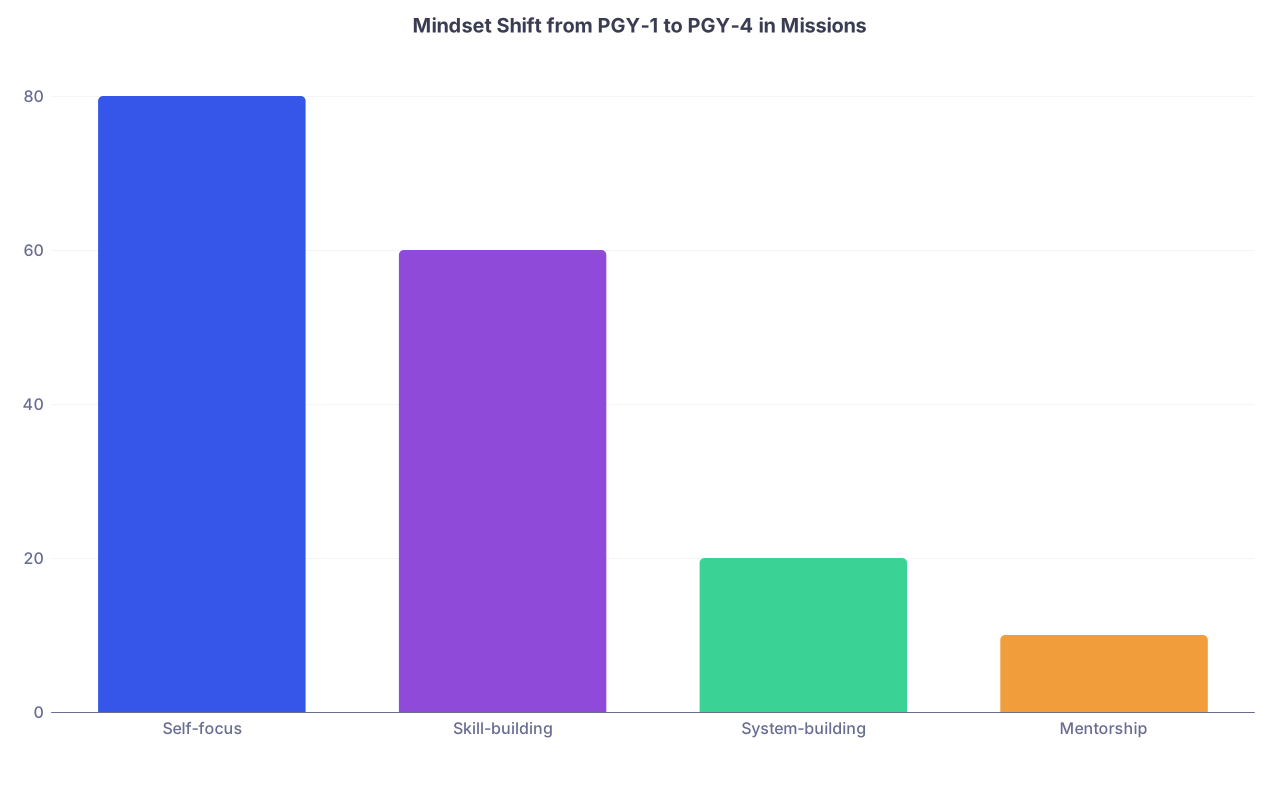
| Category | Value |
|---|---|
| Self-focus | 80 |
| Skill-building | 60 |
| System-building | 20 |
| Mentorship | 10 |
Think of PGY‑1 vs PGY‑4 this way:
PGY‑1
- Primary questions:
- “What do I not know?”
- “How can I avoid harm?”
- Acceptable roles: learner, assistant, local volunteer.
- Core tasks: educate yourself, find mentors, do one tiny project well.
- Primary questions:
PGY‑4
- Primary questions:
- “How can I strengthen existing systems?”
- “How will this work continue after I leave?”
- Acceptable roles: co‑leader, teacher, project owner, mentor.
- Core tasks: focus, lead 1–2 meaningful projects, ensure continuity.
- Primary questions:
If your PGY‑4 self is still mainly asking “Where can I go this year?” instead of “How can I deepen this partnership for the next decade?”, you have some recalibration to do.
A simple today task, wherever you are in residency
Do one concrete thing today. Not someday. Today.
Open a blank page and write two headings:
- “What I think medical missions are right now”
- “What I want my role to be by the end of residency”
Under each, write three bullet points. Then send a short email to one faculty member involved in global health at your institution with those six bullet points pasted in and ask:
“Could we meet for 20 minutes sometime in the next month? I want to make sure my plans for mission work over residency are ethical, realistic, and actually useful.”
That one email sets your entire PGY‑1 to PGY‑4 mission timeline on a better track than most residents ever manage.


