
Mission culture in medicine quietly punishes people who say “no,” and you know it.
You see the posts: residents in remote conflict zones, med students in unstable regions, smiling group photos with “life-changing experience” captions. Nobody posts the part where they were terrified. Nobody posts, “I declined this because I didn’t feel safe.” So you’re sitting there thinking:
“If I don’t go on this risky mission… am I basically telling everyone I’m weak, uncommitted, not ‘global health material’?”
Let me say this very clearly: declining a mission because of genuine security concerns will not end your career. But the pressure to say yes can absolutely screw up your safety, your mental health, and honestly, your ethics if you’re not careful.
Let’s pull this apart, worst-case scenarios and all.
The Fear Underneath the Fear: “If I Say No, I’m Done”
You’re probably not just worried about safety. You’re worried about the story people will tell themselves about you.
- “She’s not dedicated enough.”
- “He’s not tough.”
- “She’s too anxious for global health.”
- “He’s just a tourist-do-gooder, not serious.”
I’ve seen residents spiral over this. One IM resident I knew was offered a 4-week rotation in a country with recent political unrest and sporadic kidnappings of foreigners (nothing “current enough” to cancel the trip, but recent enough to make your stomach drop). When he hesitated, his brain went right to:
“Great, now my program director will think I only care about cushy US medicine.”
Here’s what actually happened:
He asked for a meeting, brought up specific security reports from the State Department, the travel medicine clinic’s concerns, and his family situation. The program director said, almost word-for-word:
“You’re allowed to prioritize your safety. We have other ways to show global health commitment that don’t involve this kind of risk.”
He matched into a solid fellowship. Nobody blacklisted him. The world did not end.
The people who will secretly judge you for not going into a high-risk setting?
Those are not the people you want shaping your career or ethics anyway.
The Ugly Truth: Some Missions Are Not Safe Enough. Period.
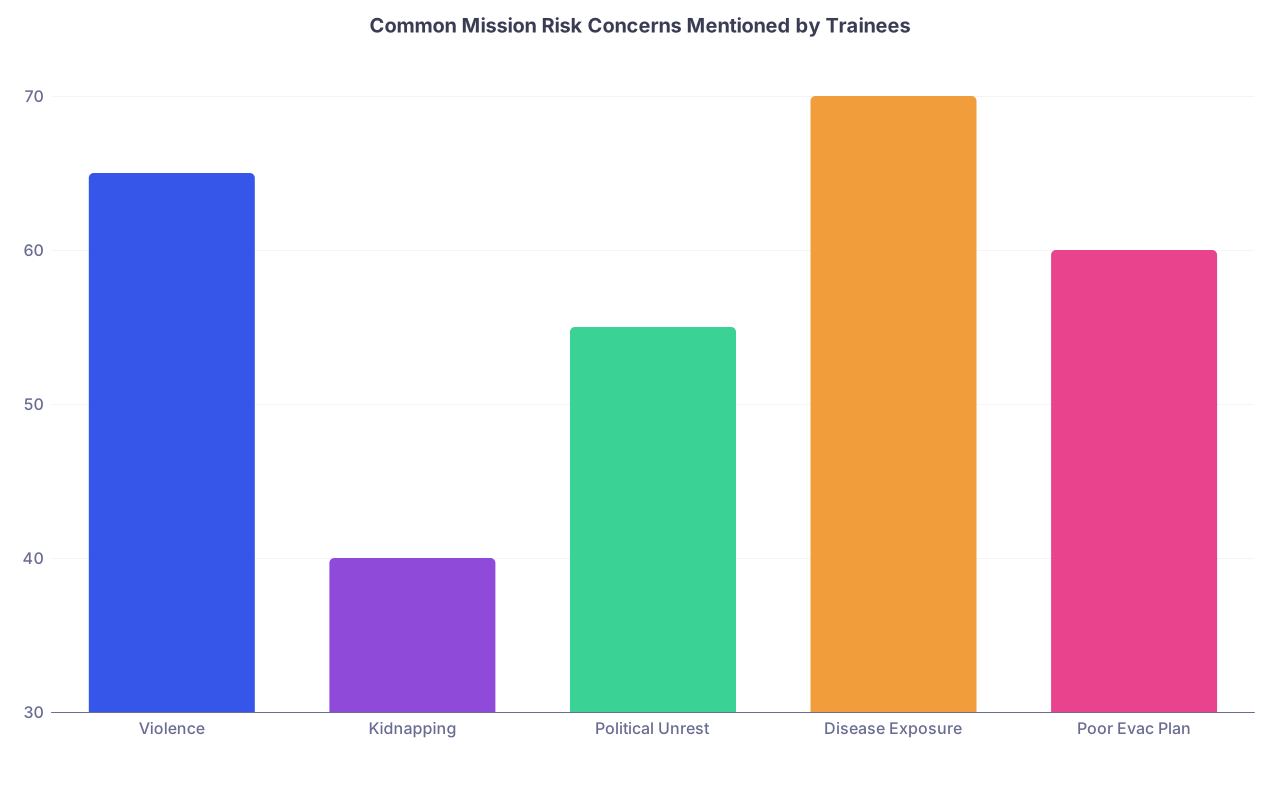
| Category | Value |
|---|---|
| Violence | 65 |
| Kidnapping | 40 |
| Political Unrest | 55 |
| Disease Exposure | 70 |
| Poor Evac Plan | 60 |
Here’s the part we gloss over in the glossy brochures:
Some “medical missions” or “global health trips” have:
- No real security protocol beyond “don’t go out alone”
- No evacuation insurance or concrete plan if things go bad
- Vague assurances like “It’s usually fine” or “We’ve never had a serious issue”
- Leadership who dismiss your concerns as “overreacting”
If you’re reading State Department warnings, watching news of unrest, hearing local partners quietly say, “Tensions have been rising,” and the response from your team is basically “Yeah but flights are booked”… that’s not bravery. That’s negligence.
You’re not crazy for being afraid of:
- Kidnapping or targeted violence
- Being trapped in-country if borders close
- Unpredictable protests, riots, or armed conflict
- Being the “obvious foreigner” in a place where foreigners are increasingly seen as targets
- Getting sick somewhere with limited evacuation options
Those aren’t dramatic movie scenarios. Those are documented realities in global health work.
And the ethical piece: your duty to yourself isn’t optional. You are not morally obligated to gamble with your life to prove your commitment to underserved communities.
Will Saying No Actually Hurt Your Career?
Short answer: not if you handle it like an adult with a brain and a spine.
The people reading your application or evaluating you for future roles care less about “Did you say yes to every mission?” and more about:
- Do you think critically about risk?
- Do you respect local partners and contexts?
- Do you have a long-term, sustainable interest in global health, not just adrenaline tourism?
- Do you have boundaries and judgment?
If you say no to a risky mission and then your CV shows:
- Longitudinal involvement in refugee clinics
- Local underserved work
- Research or QI projects in global health
- Safer, well-structured global experiences
…it will be obvious you didn’t bail because you don’t care. You chose how to care.
Where you can get into trouble is if:
- You say yes, go somewhere unsafe, it goes badly, and you’re traumatized or injured.
- You say yes, freeze in fear there, and become a liability to the team.
- You say yes resentfully, burn out, and swear off global health forever.
That’s the irony: forcing yourself into something that feels deeply wrong to you can be more damaging to your long-term global health trajectory than saying no thoughtfully.
How to Say No Without Painting Yourself as “The Problem”
This is the part everyone obsesses over: not the “no” itself, but the fallout.
You don’t want to sound flaky. Or whiny. Or like you didn’t “do your research.”
Here’s one way to ground it:
- Get specific information.
- Frame your decision around responsibility, not fear.
- Offer an alternative.
Some language you can literally steal:
- “I’ve reviewed the State Department travel advisory and recent security updates, and I’m not comfortable with the level of risk at this time.”
- “I’ve spoken with family and mentors, and given the security situation and my personal risk tolerance, I need to decline this trip.”
- “I’m still very committed to global health work. I’d like to explore opportunities in [safer region / domestic global health / telehealth collaboration] instead.”
You’re not saying: “I’m scared of everything.”
You’re saying: “Here is a level of risk I cannot ethically accept for myself.”
That’s what adults in high-risk fields do. Surgeons refuse cases they’re not trained for. Pilots refuse to fly in unsafe conditions. Global health workers can refuse placements that are too volatile.
You’re not a bad candidate for acting like a responsible human.
Red Flags: When a Mission’s Reaction to Your Hesitation Tells You Everything
Sometimes the way they respond to your concerns is the clearest signal you’ll ever get.
Watch out for:
- “We’ve never had a problem before” used to shut down the conversation.
- “If you’re scared, maybe this isn’t for you” said with condescension.
- No written security plan, just vibes.
- No clear point person for emergencies.
- Shrugging off government or NGO security warnings.
- Guilt-based pressure: “The community needs you” used as leverage, not information.
If they can’t respect:
- your legitimate concerns,
- your right to decline,
- your need for info and transparency,
then they’re showing you how they’ll treat you if something actually goes wrong there.
That’s not a group you want to be trapped with in a crisis.
You Can Still Be “Serious About Global Health” Without Going into Danger Zones
This is the part people never say out loud: you do not need to go to a high-risk conflict, disaster, or unstable region to prove your character.
There are so many other ways to build a real, credible global health portfolio:
| Option | What It Shows About You |
|---|---|
| Local refugee/immigrant clinics | Cultural humility, continuity |
| Telehealth with partner sites | Collaboration, consistency |
| Research with global partners | Long-term, systems-level thinking |
| Rotations in stable low-resource areas | Practical skills, adaptability |
| Policy/advocacy work | Understanding structural issues |
None of these scream “coward.” They scream “person who understands global health isn’t just about going where the news cameras are.”
If in an interview someone asks, “Have you worked in high-risk settings?” it’s completely fine to say:
“My focus has been on sustainable, ethically grounded work in settings where safety and continuity for both providers and patients could be maintained. I’ve intentionally avoided conflict zones due to safety and ethical concerns, and I’ve instead invested in [X, Y, Z].”
That’s not just acceptable. It’s mature.
The Ethical Piece Nobody Talks About: Your Safety Is Not Optional
There’s this unspoken martyr narrative in medicine and missions.
“Patients first. Always.”
Even if that means you: sleep 2 hours, skip meals, ignore your own health, or accept real physical danger.
That logic collapses in global health if taken literally. Because if providers keep burning out, getting traumatized, or getting harmed, nobody’s left to help anyone.
Ethically:
- You are not a disposable tool.
- You are not morally superior because you ignore risk signals.
- You are not morally inferior because you protect yourself.
An overlooked part of “do no harm” is “don’t endanger yourself so much that you become another casualty the system has to absorb.” Needing rescue, evacuation, or medical care because of avoidable security risks isn’t noble. It drains already-limited resources.
Saying, “This risk is too high for me” isn’t selfish. It’s an acknowledgment that your life also has value.
How to Calm the “What If They Secretly Hate Me?” Loop
You’re probably still thinking: “Okay, but what if this ruins how they see me?”
Let’s walk through the worst-case story your brain is feeding you:
- You say no.
- Someone rolls their eyes.
- Word spreads you’re “not cut out” for certain work.
- You never get another global health opportunity.
- Fellowship and job programs see you as soft.
- Career over.
Now reality:
- You say no.
- A few people might not get it. One might be judgmental.
- The decent people respect your choice.
- You seek out mentors who actually align with your boundaries.
- You build a track record of safe, thoughtful, ethical involvement in global or underserved care.
- You end up in environments that fit who you really are and what risks you’re actually willing to take.
And if someone straight up says, “We only want people who never say no to high-risk deployments”? Good. They’ve self-identified as people you probably shouldn’t trust with your safety or sanity.
You’re not trying to impress everyone. You’re trying to find the people who take ethics and security as seriously as you do.
A Simple Framework: Should I Say Yes or No to This Mission?
You don’t need a full-blown existential crisis every time. Use this as a quick gut-check.

| Step | Description |
|---|---|
| Step 1 | Offered Mission |
| Step 2 | Check security info |
| Step 3 | Consider other factors |
| Step 4 | Assess risk tolerance |
| Step 5 | Reasonable to say yes |
| Step 6 | Ask for more support |
| Step 7 | Prepare to go |
| Step 8 | Decline and seek alternative |
| Step 9 | High or unstable risk? |
| Step 10 | Good supervision and structure? |
| Step 11 | Comfortable with risk? |
| Step 12 | Concerns addressed? |
If you land repeatedly on “Nope, risk is too high for me,” that’s not a personal failing. That’s your internal ethics and safety system doing its job.
Protecting Your Future Self Too
Last point, and it’s not a small one.
If you push yourself into a setting where you feel unsafe every second:
- You can come back with trauma that affects future work.
- You can develop anxiety, hypervigilance, or moral injury.
- You can associate “global health” with fear, chaos, and burnout.
I’ve seen people go once, get in a terrifying or morally compromising situation, and then swear off any kind of global or underserved work forever. Not because they’re shallow. Because they were pushed past what they could psychologically hold at that time.
Saying no now might be what lets you stay in this space long-term, sanely.
Key Takeaways
- Saying no to a mission because of real security concerns does not kill your career. It shows judgment, not weakness.
- You can build a strong, credible global health profile through safer, sustainable work that doesn’t require accepting extreme personal risk.
- Any mission or mentor that shames you for protecting your safety is showing you a red flag, not a standard you have to live up to.
FAQ (Exactly 6 Questions)
1. Will program directors or fellowship committees see me as less committed if I say no to a risky mission?
Not if the rest of your record shows consistent commitment to underserved or global populations. They look at patterns, not one decision. If you can say, “I chose not to go to that specific setting due to security concerns, but here’s the work I’ve consistently done in safer but still under-resourced settings,” most reasonable people will respect that.
2. Should I tell them I’m scared, or make up another excuse like ‘schedule conflict’?
Don’t lie. You don’t need to pour out your deepest anxiety, but you can say, “After reviewing the security situation and talking with mentors/family, I’m not comfortable with this level of risk.” That’s honest, simple, and mature. If you hide behind fake excuses, you undermine your own boundaries and miss the chance to model healthy decision-making.
3. What if everyone else on the team is going and I’m the only one who says no?
Then you’re the only one whose risk tolerance and situation look like yours. You don’t know what pressures, obligations, or thresholds other people have. Being the only person to say no is uncomfortable, but it doesn’t make you wrong. If anything, it takes more backbone to hold your line when nobody else is doing it.
4. Can I still call it ‘global health experience’ if I avoid high-risk areas and only work in more stable countries or local refugee settings?
Yes. Global health isn’t defined by danger level. It’s about equity, systems, context, and partnership. Clinics in your own city serving refugees, telemedicine with international partners, research with institutions abroad—these all count. You don’t get extra moral credit just because a place is on the news for violence.
5. How do I know if a mission’s security plan is adequate or just hand-wavy reassurance?
Look for specifics: written safety protocols, designated security officer, clear communication plans, evacuation insurance and logistics, local partner input, and alignment with recognized security advice (e.g., US State Department, major NGOs). If your questions are brushed off or answered with clichés like “we always manage” instead of concrete plans, that’s a problem.
6. Will talking about my safety concerns in an interview make me look anxious or high-maintenance?
Not if you frame it well. Something like: “I think safety and ethics are inseparable in global health work. I’ve declined one opportunity where the security situation felt too volatile, and I’ve focused instead on more stable but still resource-limited settings where I can be effective and safe.” That sounds thoughtful, not fragile. The right programs will hear that and think, “Good. This person has judgment.”


