
It’s your second year of med school (or early residency), and you’re staring at two emails.
Email #1: a faculty member offering a spot on a global health research project—data analysis, manuscript potential, maybe a poster at CUGH.
Email #2: a church/NGO trip to Honduras or Uganda for a 10‑day “medical mission,” photos of smiling kids, promises of “life-changing” experience.
You can’t do both well. Time is limited. Your CV’s empty on global health. And the question in your head is brutal and simple:
“Should I prioritize research or medical missions if I want a serious global health career?”
Here’s the direct answer:
If your goal is a sustainable, respected career in global health, prioritize research and long-term, collaborative field work over short-term mission trips. Short-term missions can be valuable, but only if:
- They’re embedded in long-standing local partnerships
- You’re mostly observing/learning, not “being the hero”
- They push you toward more ethical, long-term engagement
Let’s unpack that properly.
First: What Kind of “Global Health Career” Are You Actually Talking About?
You can’t choose well until you’re clear on your endgame. “Global health” is vague. These are very different lives:
- Academic global health physician (university-based, research, grants, teaching, some field work)
- Policy/global health leadership (WHO, CDC, NGOs, ministries of health)
- Long-term clinician abroad (mission hospital, MSF, rural government hospital)
- Domestic safety-net / refugee / migrant health with a global focus
Each path values research and field work differently.
Here’s the blunt summary:
| Career Type | Research Value | Field/Mission Experience Value |
|---|---|---|
| Academic global health physician | Very High | High (if longitudinal) |
| Policy / international org roles | High | Medium–High |
| Long-term clinician abroad | Medium | Very High |
| Domestic safety-net / refugee care | Medium | Medium |
If you want a university global health job, research is non-negotiable. If you want 20 years at a rural mission hospital, field experience, language skills, and system-level grit matter more—but research still helps with funding and credibility.
So your prioritization isn’t abstract. It should match the life you’re actually aiming for, not the Instagram version.
What “Research” Really Buys You in Global Health
Let me be blunt: People who control money, policy, and positions in global health respect data, publications, and grants. Period.
Research does three big things for you:
Gives you credibility
When a ministry of health official, WHO consultant, or NGO director hears “I led a project that looked at TB treatment outcomes in X region, published in [real journal],” that lands differently than “I went on several medical missions.”Teaches you how to ask good questions
Global health is mostly about systems: supply chains, human resources, policy, financing. Research training teaches you to move from “That clinic seems chaotic” to:- “What’s the patient wait time distribution?”
- “What’s the stock-out rate for essential meds?”
- “How did the new triage system change mortality?”
Opens doors you don’t even see yet
- Fellowships (Fogarty, HEAL, GH equity fellowships)
- Academic global health tracks in residencies
- K-awards, NIH/Fogarty programs, foundation grants
Short version: If you want to be at the table where global health decisions are made, you need research or at least evaluation skills.
Here’s how the trade-off often feels during training:
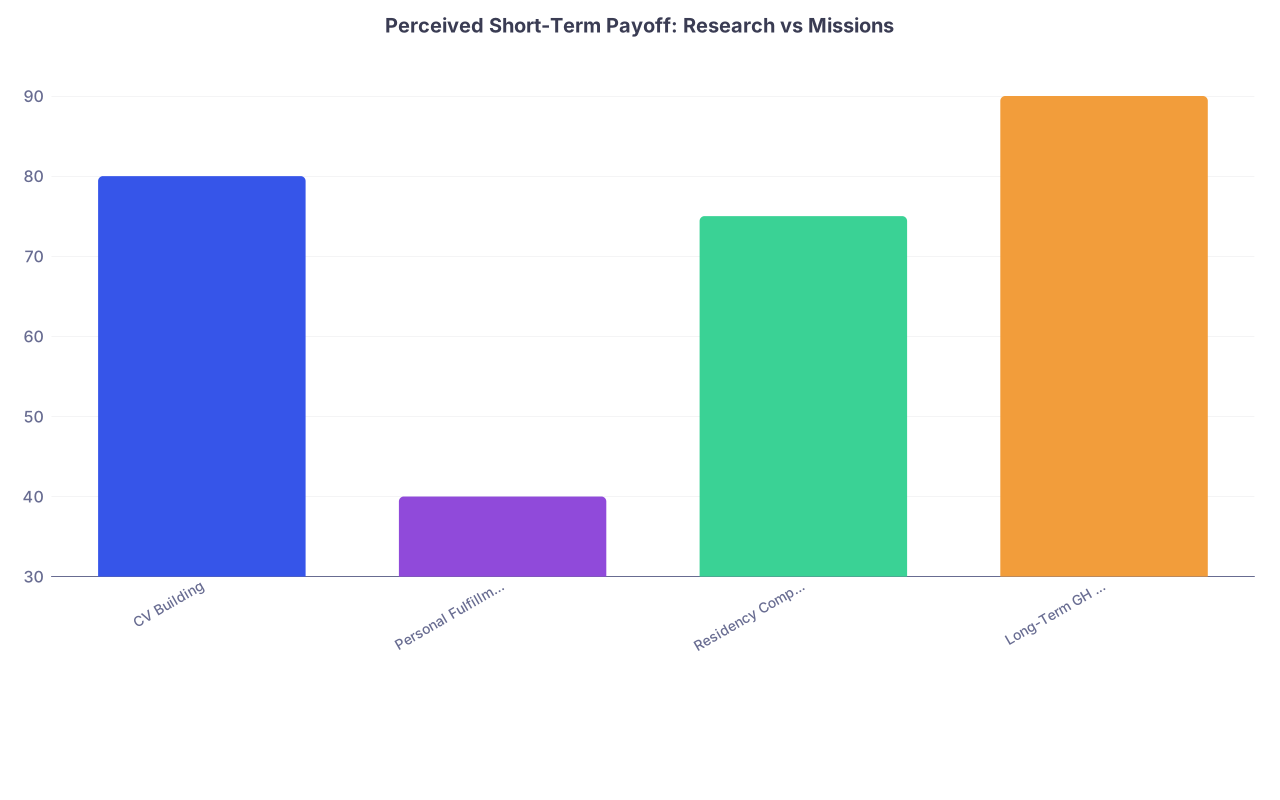
| Category | Value |
|---|---|
| CV Building | 80 |
| Personal Fulfillment | 40 |
| Residency Competitiveness | 75 |
| Long-Term GH Career Impact | 90 |
Most students feel more fulfilled by missions in the moment. But the long-term career payoff heavily favors research, especially for academic or leadership roles.
The Ethical Reality of Medical Missions (Short-Term Trips)
Now the uncomfortable part.
Most short-term medical missions as currently done are ethically shaky. Some are downright harmful. That doesn’t mean you must avoid them forever. It means you must be picky and clear-eyed.
Common problems I’ve actually seen:
- Scope creep: Students doing things they’re not trained for because “no one else is here.”
- Disruption: Local clinics paused or patients diverted because “the Americans are in town.”
- Zero continuity: No follow-up, no medical records integration, no long-term plan.
- Savior complex: Trips centered around the visitors’ experience and photos, not local priorities.
Ethically serious global health people—including in Christian medical mission circles—have been saying the same thing for years: fly-in, fly-out trips are overrated and often problematic.
The ethical question you’re supposed to be asking yourself is not “Will I feel useful?” It’s:
- Who asked for this mission?
- Who defines the priorities?
- Who’s there when I’m gone?
- Who’s accountable when something goes wrong?
A mission trip that’s actually defensible usually looks like this:
- It’s part of a 10+ year local partnership
- You’re plugged into existing local health systems, not bypassing them
- You mostly observe, assist, and learn as a trainee, not lead care
- The host organization or local clinicians explicitly want you there
If that’s not the case, treat the trip as ethically questionable. Not automatically evil, but not obviously “good” just because it’s in a poor country.
So Which Should You Prioritize Right Now?
Let me answer for three common profiles. One of these is probably you.
1. MS1–MS3, early, no strong direction yet
Prioritize: At least one solid research experience, then a careful mission or field experience.
Order I’d recommend:
Join a global health–related research project
- Could be outcomes research, implementation science, epidemiology, qualitative work with refugee communities, etc.
- Get on something that has a real chance of abstract/poster/publication.
Use your first substantive time abroad as learning, not “service”
- That could be a 4–8 week rotation with an academic partner site.
- Or a carefully chosen mission trip that’s clearly local-partner-led.
You want: one clear research line plus one serious, reflective field exposure before residency apps.
2. Applying to residency, wants global health track / competitive specialty
Prioritize: Tangible research output plus at least one credible, not-gimmicky field experience.
For residency selection committees:
- Research = signal of seriousness, perseverance, and academic alignment.
- Short-term missions = neutral to slightly positive unless the essay screams savior complex.
If you have to choose and you want something like EM, IM with GH track, peds, surgery with GH interest:
- Choose the research and write about it well.
- If you do a mission, pick one with clear supervision and reflection (and preferably aligned with a faculty mentor who can speak to it).
3. Already sure: “I want to live and work long-term abroad”
Prioritize: Longitudinal field exposure plus some research/evaluation skill.
If your vision is a career at places like Kijabe (Kenya), Tenwek (Kenya), rural Nepal, or MSF-style work:
- You need:
- Clinical excellence in a broad specialty (IM, FM, EM, peds, gen surg, OB, anesthesia).
- Cross-cultural competence and humility.
- Ability to engage local systems and eventually mentor/train.
Research for you is fuel, not identity. Basic ability to evaluate programs, write grants, and collect outcomes data massively increases your impact and sustainability.
So in that case: do both, but lean field-heavy—with research literacy as a tool.
How to Evaluate a Specific Opportunity: A Simple Decision Flow
Use this for any “mission trip vs research” choice. Don’t overthink it. Just run it:

| Step | Description |
|---|---|
| Step 1 | New Opportunity |
| Step 2 | Strong choice |
| Step 3 | Maybe - ask about global links |
| Step 4 | Likely low yield |
| Step 5 | Better - consider logistics |
| Step 6 | Ethically shaky - reconsider |
| Step 7 | Is it research? |
| Step 8 | Mentor aligned with global health? |
| Step 9 | Is it short term clinical mission? |
| Step 10 | Long term local partnership? |
If it’s research with a global health mentor → almost always yes, if you have time.
If it’s short-term clinical work with no long-term local partner → probably no, unless you can clearly see who benefits and how continuity is maintained.
Practical Strategy: How to Build a Credible Global Health Profile
Let’s get tactical. Here’s what a strong early global health trajectory tends to include.
1. At least one serious research project
Not just “helped collect surveys.” I mean:
- You understand the research question.
- You’re involved in data, analysis, or manuscript writing.
- There’s a realistic plan for an abstract or paper.
Example path:
- MS1–2: Join a project studying maternal mortality near a partner hospital in Malawi.
- Role: Data cleaning and analysis; later help draft intro and methods.
- Output: Poster at CUGH or a regional meeting + maybe a co-author publication.
That single experience is better than three superficial mission trips for residency and future fellowships.
2. Thoughtful, not-touristic field exposure
You don’t need five trips. You need one or two meaningful ones you processed deeply.
Red flags for field experiences:
- No clear role for you besides “shadow everything.”
- No post-trip debrief or reflection.
- No local physician or partner organization clearly in charge.
Green flags:
- Pre-departure orientation including ethics, history, power dynamics.
- Written partnership agreement between your institution and the host site.
- Emphasis on observation and humility for trainees.
3. Mentorship from someone who actually does global health
This matters more than you think.
Look for mentors who:
- Have either long-term field experience or ongoing partnerships.
- Talk about local leadership, not just their own “impact.”
- Are honest about the limits and harms of missions.
Ask them directly:
“If I only have time for one major thing this year, should I join your research project or go on this mission trip?”
Then listen carefully. Their priorities will tell you a lot.
Common Myths You Should Ignore
Let me kill a few bad ideas that float around med school hallways.
“Missions show you care more than research does.”
Wrong. You show you care by what you commit to for years, not by a 10‑day photo set.“Research is just for people who want to stay in academia.”
Also wrong. Basic research/evaluation skills make you better at literally any global health role, including field clinician.“Programs love to see lots of mission trips on your CV.”
Meh. Most serious global health programs care more about depth, reflection, and trajectories than trip counts.“If I skip missions now, I’ll never get to do them.”
No. You can do field work later. Once you’ve built skills so that you’re actually useful.
A Simple Way to Decide for Yourself
If you’re still stuck, use this brutally simple test.
Write down:
- Top 3 programs/fellowships/jobs you think you’d want after training (e.g., “GH fellowship at UCSF,” “MSF field physician,” “CDC’s Epidemic Intelligence Service,” “hospital-based mission organization in Kenya”).
Now ask a cold, practical question:
“If the selection committee saw only this one thing on my CV—this research project or this mission trip—which would they value more?”
Most of the time, the answer will be the research.
If your dream is long-term mission hospital work, the answer might be a longitudinal, partner-led field engagement—and that usually still connects to data or evaluation.
Quick Comparison: What You Actually Gain
| Dimension | Research Project | Short-Term Medical Mission |
|---|---|---|
| CV impact | High (if abstract/paper) | Low–Medium |
| Skill development | Data, critical thinking, writing | Cultural exposure, clinical adaptability |
| Ethical risk | Usually low | Variable; can be high |
| Networking | Strong with faculty and institutions | Variable; often weak beyond your group |
| Long-term GH career | Very strong foundation | Helpful only if well-structured and reflective |
And yes, you can do both across your training years. You just shouldn’t try to do everything at once and end up doing all of it badly.
FAQs
1. If I can only do one during med school, should I pick research or a mission trip?
Choose research, especially if it’s well-mentored and has clear output. You can get global field exposure later (residency electives, fellowships, early attending years). A serious research project pays off for residency apps, global health fellowships, and your long-term credibility.
2. Are all short-term medical missions bad?
No, but many are poorly designed. Look for trips that are explicitly requested by local partners, integrated into existing health systems, supervised by local clinicians, and focused on continuity and capacity-building. If it feels like a “poverty safari” or photo op, skip it.
3. Does research have to be in another country to “count” for global health?
Not at all. Work with refugee populations, migrant farmworkers, Native communities, or safety-net hospitals absolutely qualifies as global health–relevant. Funders and programs know that global health includes local underserved populations.
4. What if I hate statistics and the idea of “research” bores me?
You don’t need to become a biostatistician. You do need basic literacy in research methods and program evaluation. Try qualitative research, implementation science, or quality improvement in a global or underserved setting. Those often feel more grounded and less math-heavy.
5. How many mission trips or global electives do I need for a global health career?
You don’t need a pile. One or two substantial, well-structured experiences—ideally in the same place or with the same partner—plus ongoing research or advocacy is more than enough to position you for global health tracks, fellowships, or long-term field work.
Key takeaways:
First, if you’re serious about a global health career, anchor yourself in research/evaluation skills and long-term relationships, not short-term “hero” trips. Second, if you do missions, choose them carefully—local-partner-led, ethically grounded, and preferably longitudinal.


