
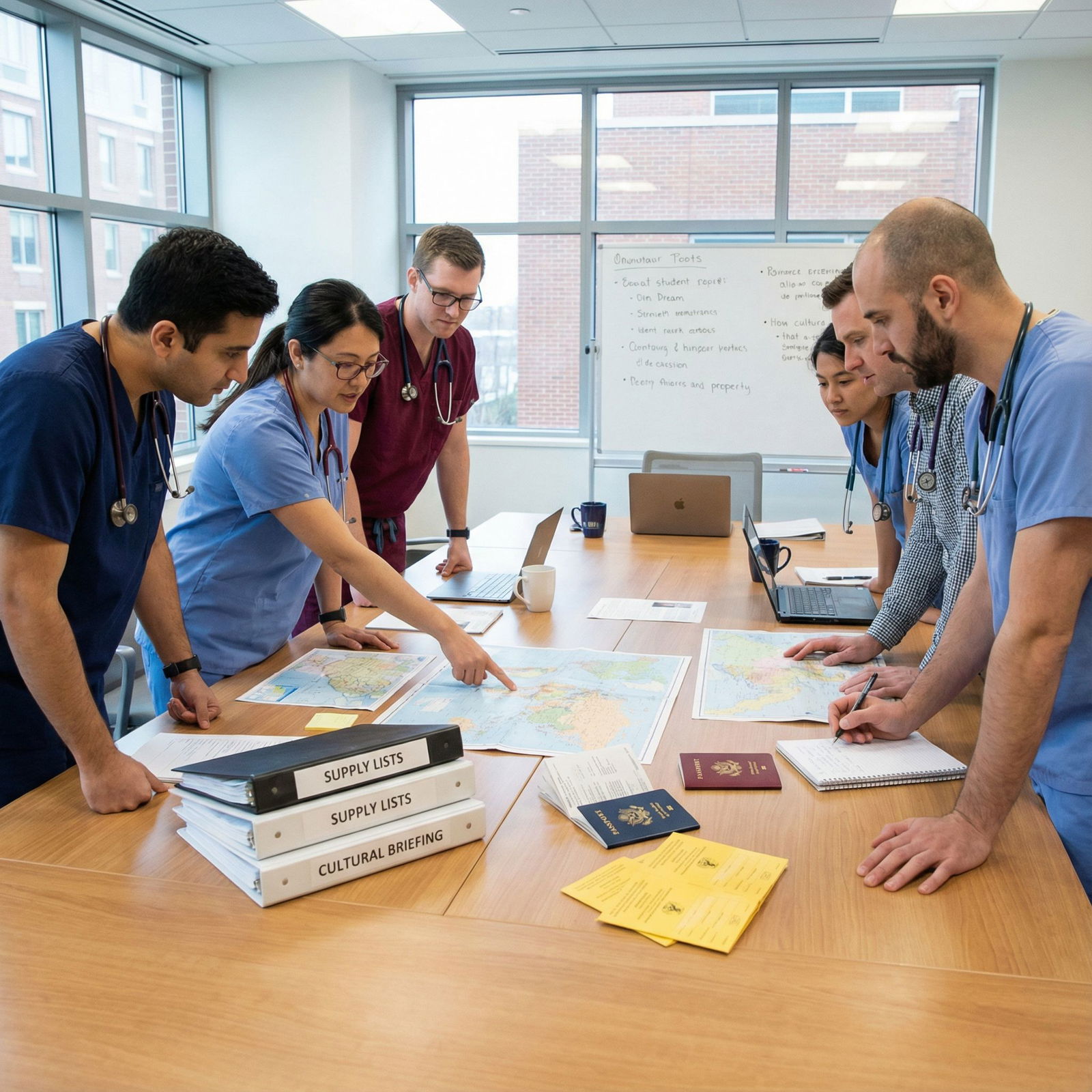
You’re standing in a hot, overcrowded clinic somewhere far from home. There’s one otoscope for three rooms, the “pharmacy” is a plastic bin on a folding table, and someone just handed you a stethoscope like it’s a magic wand.
You’re a student. Or a resident. Or a fresh attending. And you’re wondering:
“What exactly should I be doing here—and what shouldn’t I be doing?”
Let’s answer that clearly.
Big Picture: What Roles Are Actually Appropriate?
Here’s the blunt version:
- Students: You’re there to learn, support, and extend capacity under tight supervision. You are not there to do independent doctor work.
- Residents: You’re there to provide real clinical care, but still within your existing scope and training, with attending oversight and local clinician partnership.
- Attendings: You’re there to provide care and to protect everyone else from overreaching—yourself included. Clinical care, teaching, systems support, and saying “no” when things are unsafe.
The ethical standard:
You should not be doing anything abroad that would be illegal, inappropriate, or wildly out of scope for you at home.
If you wouldn’t do it in your own hospital without supervision, you don’t suddenly get a free pass because you’re in another country.
Core Roles by Level: Student vs Resident vs Attending
| Level | Core Clinical Role | Main Focus | Supervision Level |
|---|---|---|---|
| Student | Assistant / Observer | Learning, support | Constant / Direct |
| Resident | Frontline clinician | Supervised care | Indirect / Available |
| Attending | Lead clinician | Oversight, systems | Collaborative / Peer |
Medical Students: What You Can and Should Do
You’re not the doctor. You’re not the NP. You’re not the PA. You’re the learner with useful hands and a brain that can help.
Appropriate roles for students:
History and basic exams
- Take thorough histories (with interpreter support if needed).
- Do basic physical exams you’re already taught and checked off on.
- Present cases to a resident/attending like you would on wards at home.
- Example: In a mobile clinic in Guatemala, MS3s rotate through “intake” and “exam” stations, then present every patient before any orders are written.
Patient education and counseling (with guidance)
- Explain chronic disease basics: diabetes, hypertension, asthma.
- Demonstrate inhaler technique, wound care, medication schedules.
- Always confirm content with the supervising clinician or local staff.
Procedures you’ve already been supervised on at home
- Simple wound care, dressing changes, vitals, point-of-care tests.
- Maybe simple phlebotomy or basic injections if you’ve already done them on real patients under supervision in your own system.
- Always under direct onsite supervision the first several times in that setting.
Logistic and systems support
- Organize the pharmacy.
- Help with triage forms.
- Data collection and QI projects (with IRB/ethical oversight if research).
- This sounds “less glamorous” but often does far more good than letting you fumble through complex clinical calls.
Observation of advanced procedures
- You can watch C-sections, endoscopies, more complex surgeries.
- You don’t “get to do a C-section” because you flew 5 hours and paid a program fee.
Roles that are not appropriate for students:
- Independently diagnosing and treating serious conditions.
- Performing procedures you haven’t mastered at home (e.g., suturing major wounds, delivering babies, placing central lines).
- Making disposition decisions alone (admit vs discharge, surgery vs no surgery).
- “Being the doctor” because no one else is there. That’s a systems failure, not your opportunity.
If a short-term mission relies on you functioning as the only provider, that’s a red flag. Walk away.
Residents: Where the Line Really Moves—And Where It Doesn’t
You’re actually useful now. You can and should do real work. But your scope abroad should still mirror your scope at home.
Residents can safely and ethically:
Be frontline clinicians—with backup
- Run clinic visits, place orders (within local system), adjust meds, interpret basic labs.
- Lead family discussions, do typical inpatient admits if that’s your normal life.
- Example: A PGY-2 IM resident in a district hospital managing uncomplicated pneumonia, heart failure, diabetes—same stuff they handle on wards daily.
Perform procedures in your usual scope
- If you’re a surgery resident who routinely closes incisions at home, you can do that there—with appropriate attending presence.
- If you’re EM and place central lines regularly, you can do that—with local approval and supplies.
- If you’ve never done something at home, don’t “learn it on a mission patient” unless:
- It’s low-risk,
- You’re directly supervised by someone who routinely does it,
- And this is exactly how you would learn it at your own institution (e.g., first few chest tubes as PGY-2 under attending elbow-to-elbow).
Teach students and local trainees
- Bedside teaching of physical exam.
- Teaching basic procedural skills under attending oversight.
- Running short teaching sessions on bread-and-butter topics (UTIs, pneumonia, OB emergencies) tailored to the local reality.
Contribute to system-level improvement (modestly)
- Help implement basic protocols: triage forms, sepsis screening, handoff tools.
- But always with local leadership buy-in, not “we’re from the US, here’s the right way.”
What’s not appropriate for residents:
- Acting as attending surgeon/obstetrician/pediatrician for things you’re not cleared to do independently at home.
- Being the only decision-maker in high-risk scenarios (e.g., whether to operate now vs transfer).
- Bringing in “fancy” approaches that the system can’t maintain (complex chemo regimens, devices without local servicing, meds not on local formulary).
- Using local patients as training ground for high-risk first-time procedures (first intubation, first LP in a crashing neonate, first C-section).
Your litmus test:
“If this went bad and I had to explain my role to my program director and a malpractice board at home, would it sound reasonable?”
If the answer is no, don’t do it.
Attendings: You’re Not Just a Big Resident With More Freedom
As an attending on a mission, your job is not to show off your skills in an environment with fewer rules. It’s to raise the floor on safety, ethics, and actual usefulness.
Proper attending roles:
Clinical leadership with humility
- Provide higher-level decision-making and backup for residents and students.
- Choose conservative options when follow-up is uncertain.
- Say “we are not equipped to safely manage this here” and pursue referral or palliative paths rather than cowboy surgery.
Teach—your team and local staff
- Case-based teaching for residents/students.
- Skills workshops requested by local partners (e.g., POCUS basics, neonatal resuscitation, ECLAMPSIA protocols).
- Resist the urge to bring in niche subspecialty practices that don’t fit the local context.
System and partnership building
- Work with local leadership on sustainable improvements, not performative fixes.
- Support longitudinal efforts: tele-mentoring, protocol co-development, help with local training programs.
- Example: An anesthesiologist helping create a simple safe-sedation checklist that the hospital actually uses after you leave.
Boundary enforcement
- Tell students and residents “no, you’re not doing that here,” even when they’re excited.
- Push back on local expectations of “the visiting expert” when they ask you to do something unsafe, outside your expertise, or unsustainable.
- Own complications. No disappearing act after a risky one-off operation.
What attendings shouldn’t be doing:
- Practicing way outside their lane because “no one else is available.”
- Doing huge complex surgeries with no reliable ICU/stepdown/post-op follow-up in place.
- Introducing treatments or medications that the system cannot continue once you leave.
- Using the site for research without proper ethical review and local collaboration.
Matching Roles to Reality: A Simple Decision Framework
Here’s a quick way to sanity-check your role on a mission.

| Step | Description |
|---|---|
| Step 1 | Start |
| Step 2 | What is my training level |
| Step 3 | Student |
| Step 4 | Resident |
| Step 5 | Attending |
| Step 6 | Observe or assist only |
| Step 7 | Do with close supervision |
| Step 8 | Do with backup available |
| Step 9 | Decline or find expert |
| Step 10 | Proceed with local input |
| Step 11 | Do I do this at home with supervision |
| Step 12 | Do I do this at home in my role |
| Step 13 | Do I do this at home safely |
Another angle: think in terms of risk and supervision.
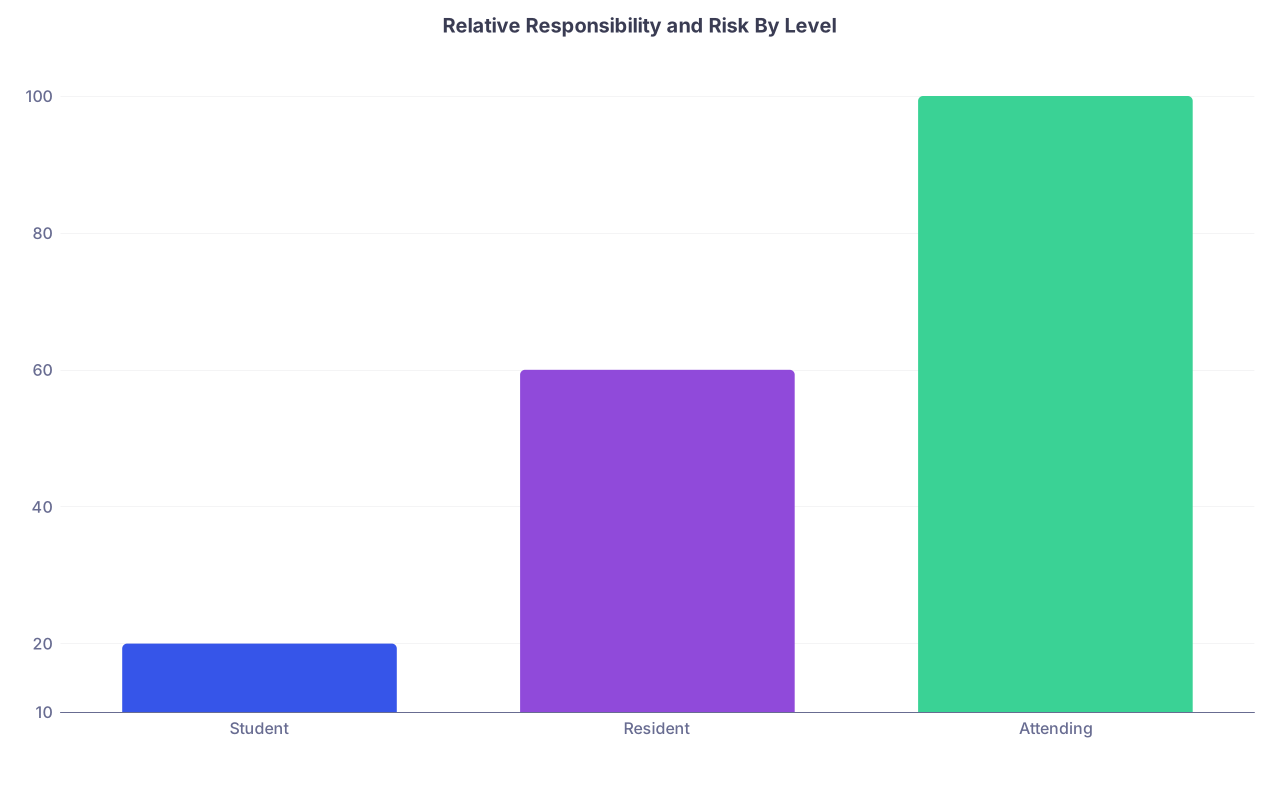
| Category | Value |
|---|---|
| Student | 20 |
| Resident | 60 |
| Attending | 100 |
That number isn’t scientific; it’s conceptual. As responsibility goes up, your tolerance for improvisation should go down, not up.
Common Scenarios: What’s Appropriate for Whom?
Let’s walk through a few typical mission scenarios.
Scenario 1: Busy Primary Care Clinic
- Student:
- Take history, full ROS, basic exam.
- Present to resident/attending; help with counseling and documentation.
- Resident:
- Finalize assessment and plan for routine cases.
- Ask attending for complex patients (oncology, unclear neuro, high-risk pregnancy).
- Attending:
- See red-flag cases directly.
- Oversee complex management changes (e.g., stopping insulin with no refrigeration, switching BP regimens to locally available meds).
Scenario 2: Minor Procedures Day
Think wound care, basic suturing, simple I&D, joint injections.
- Student:
- Assist, set up sterile field, help with closure under direct supervision if they’ve done it at home.
- Resident:
- Perform procedures they’re already competent in at home.
- Supervise students for very low-risk parts (e.g., simple interrupted sutures on a well-anesthetized, low-tension wound).
- Attending:
- Do higher-risk procedures (e.g., deep I&D near vital structures).
- Step in when complications arise, and actively decide which cases are not appropriate for the setting.
Scenario 3: C-Section in a Resource-Limited Hospital
- Student:
- Observe, assist with minor tasks (blotting, suction, cutting sutures).
- Resident:
- OB resident who routinely does C-sections at home:
- Can first-assist or even be primary surgeon depending on program and local norms, but with a real OB attending available.
- Non-OB resident (IM, EM, surgery early years):
- Assist only. Not your lane.
- OB resident who routinely does C-sections at home:
- Attending:
- Only an experienced OB/gyn surgeon who does these regularly at home should be primary surgeon.
- Everyone else? Help, but don’t pretend you’re suddenly an obstetrician.
How to Say “No” Without Being a Jerk
You’ll be asked to do things that feel wrong. First time I saw it was a student being asked to “just pull that tooth, it’s easy,” with zero dental training. Hard pass.
Here’s language that works:
For students:
- “I’m not trained to do that safely. I can assist or observe if someone qualified is doing it.”
For residents:
- “At my level, I don’t do that independently at home. I’d be uncomfortable doing it here without someone who does this regularly.”
For attendings:
- “This is outside my usual scope of practice. I’d rather not attempt something I can’t safely manage especially if complications occur. Let’s discuss alternative options.”
If the program culture punishes that kind of answer, find a different program. There are plenty of ethical ones out there.
Quick Comparison: Appropriate vs Inappropriate Roles
| Level | Appropriate Example | Inappropriate Example |
|---|---|---|
| Student | Taking histories, basic exams | Running clinic solo |
| Resident | Managing routine ward patients | Acting as attending surgeon |
| Attending | Leading complex cases in your specialty | Operating far outside your field |
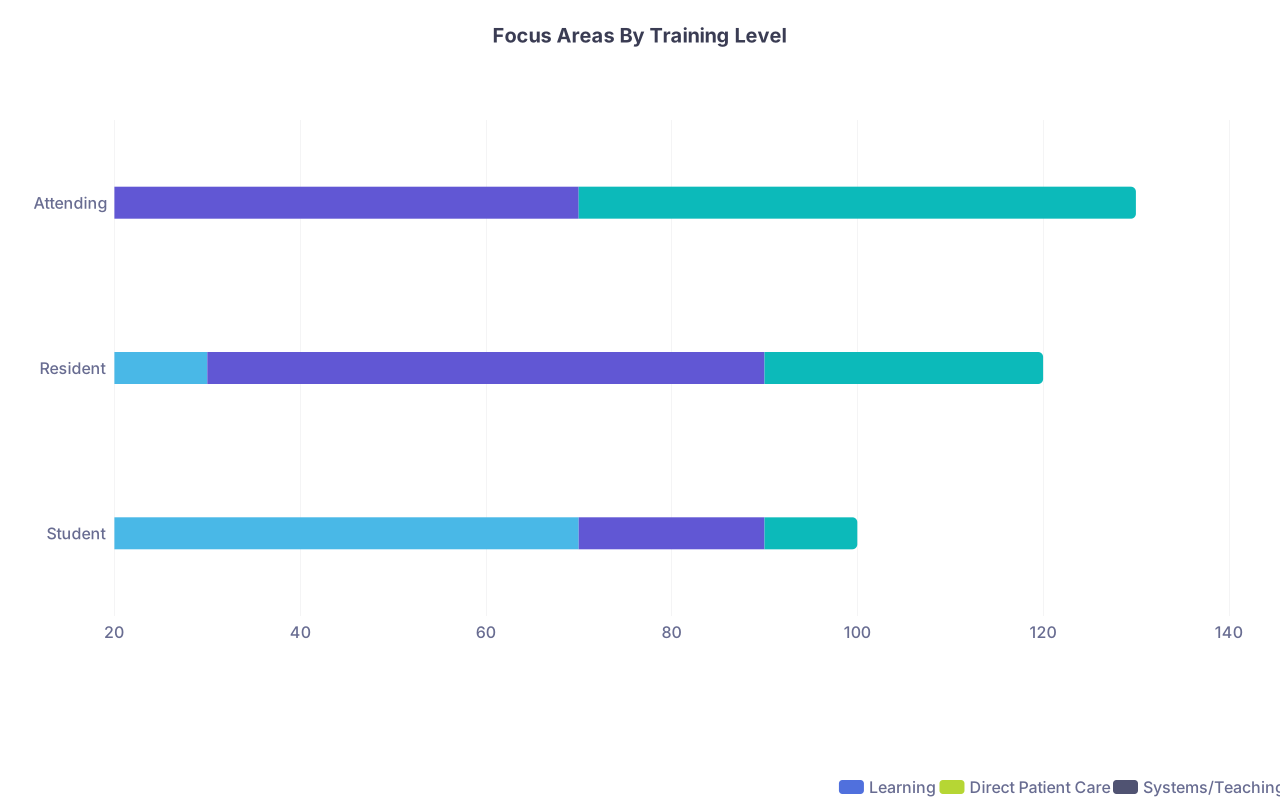
| Category | Learning | Direct Patient Care | Systems/Teaching |
|---|---|---|---|
| Student | 70 | 20 | 10 |
| Resident | 30 | 60 | 30 |
| Attending | 20 | 50 | 60 |
Choosing a Mission Program That Respects Roles
Before you sign up, ask these questions:
- Will there always be a supervising attending on site when students/residents are seeing patients?
- Who decides what procedures and surgeries get done? Is there a local partner with real authority?
- Do you have clear written role descriptions by training level?
- What happens if someone feels uncomfortable with a task—does the culture support declining?
If the answers are vague, that’s your warning.

| Step | Description |
|---|---|
| Step 1 | Considering a mission |
| Step 2 | Ask about supervision |
| Step 3 | Do not go |
| Step 4 | Ask about local partner |
| Step 5 | Review scope of practice |
| Step 6 | Reasonable to join |
| Step 7 | Clear roles by level |
| Step 8 | Local leadership involved |
| Step 9 | Aligned with home practice |

FAQs
1. Can a medical student ever “be the doctor” in a mission clinic?
No. If you’re functioning as the sole, unsupervised provider, that’s exploitation of both you and the patients. You can help a lot—history, exam, education—but you do not carry independent responsibility for diagnosis and treatment.
2. I’m a PGY-1. Can I do procedures abroad that I haven’t done at home yet?
Only in the same way you’d learn them at home: low-risk, under close supervision, with someone right there who is expert and shares responsibility. You don’t use mission patients for high-risk practice reps you’re not ready for.
3. I’m an attending outside my specialty (e.g., radiology). Can I do general medicine there?
You can help with very basic, low-risk issues if you’re comfortable and honest about your limitations, but you should not function as a full-scope internist/surgeon/OB if that’s not your normal work. Better to teach, support, and assist than pretend you’re something you’re not.
4. What if local staff want me to do more than I feel qualified for?
You still say no. Their desperation doesn’t expand your competence. You can help in other ways—stabilize, support transfer, assist someone more skilled, or offer conservative management—without faking expertise you don’t have.
5. Are there any situations where stretched roles are acceptable in emergencies?
True life-or-death emergencies in settings with absolutely no alternative can force uncomfortable decisions. Even then, use this hierarchy: do the least invasive thing that might save the patient, stick as close as possible to your training, and document everything. But don’t build a mission model on constant “emergency exceptions.”
Key takeaways:
- Your scope on a mission should mirror your scope at home—no magical promotions because you crossed a border.
- Students support and learn, residents provide care within training, attendings lead with humility and enforce boundaries.
- If the mission setup needs you to work dangerously outside your level to function, it’s not an ethical mission.


