

The myth that international medical missions impress program directors more than domestic work is wrong.
If you’re asking, “Domestic vs international missions: which do PDs value more?” here’s the actual answer:
Program directors don’t primarily care where you went. They care what you did, what you learned, and how honestly you can talk about it.
Let’s break that down so you can make a smart choice instead of chasing some imagined checkbox.
What Program Directors Actually Care About
Forget the Instagram photos of suturing in a village clinic. When PDs look at “missions” on your application, they’re silently asking three questions:
- Did you actually do something meaningful and appropriate to your level?
- Did the experience change how you see patients, systems, and your role as a physician?
- Can you talk about it without sounding performative, paternalistic, or clueless about ethics?
That’s it. Not: “Was it international?” Not: “Did you go to [insert country name]?” Not: “Do you have a picture with kids in colorful clothes?”
They’re evaluating whether this experience:
- Shows sustained commitment and follow-through
- Demonstrates cultural humility and ethical awareness
- Is relevant to the population and specialty you claim to care about
- Fits with your personal and professional story
And here’s the kicker: all of that can come from either domestic or international missions. Or neither, if you did it badly.
Domestic Missions: Underestimated and Extremely Relevant
Domestic missions are wildly underrated by applicants and very appreciated by PDs—especially in primary care, psychiatry, EM, family med, pediatrics, and any program that serves underserved communities (which is most).
What counts as “domestic missions”? Things like:
- Free clinics for uninsured or underinsured patients
- Mobile clinics in rural areas
- Street medicine teams for people experiencing homelessness
- Migrant farmworker clinics
- Native American reservation health work
- Longitudinal outreach to refugee or low-income communities in your own city
Why PDs like these:
Continuity is easier. You can show up every week for a year. That screams reliability and real commitment, not “voluntourism week.”
Directly relevant to residency. Most US training programs serve Medicaid patients, non-English speakers, people with mental illness, addiction, unstable housing. Domestic work in those environments gives you usable, real-world skills.
Systems thinking. You see US insurance madness, fragmented care, access problems, social work coordination. PDs want residents who understand this mess, because they’ll be practicing in it.
Less ethical baggage. You’re usually working under clearer legal and professional boundaries. Less risk of medical tourism optics.
If you do domestic work well, you can talk about:
- Learning to work with interpreters professionally
- Negotiating care plans when patients can’t afford meds
- Seeing how trauma, poverty, and racism show up in clinic everyday
- Building trust with patients who’ve been burned by the system
That’s catnip for PDs.
International Missions: Potentially Powerful, Often Misused
International missions are not inherently better. They’re just higher risk–higher reward from a PD’s perspective.
Done well, they can show:
- Serious interest in global health or health equity
- Comfort with resource-limited settings
- Adaptability and resilience
- Thoughtful reflection about power, colonialism, and sustainability
Done badly, they scream:
- “I flew in for a week to ‘help’ people I don’t understand”
- Scope-of-practice issues (“I did procedures I’d never be allowed to do at home”)
- White savior complex
- No understanding of local systems or long-term impact
Program directors have seen every version of the “I went to [country] and it changed my life” essay. Most are shallow. They don’t want that.
If you choose international missions, you need to be able to say things like:
- “I worked under close local supervision and stayed within my training level.”
- “Our team was supporting a long-standing local program, not dropping in independently.”
- “It challenged my assumptions about what ‘good care’ looks like when resources are different.”
- “I came home and stayed involved in global health/immigrant health/advocacy, not just the trip.”
So is international “worth more”? Only if:
- It’s clearly structured and ethical
- You can articulate what you learned beyond clichés
- It connects to your ongoing work and future plans
Otherwise, it’s just a passport stamp.
Side-by-Side: How PDs Actually See These Experiences
| Factor | Domestic Missions | International Missions |
|---|---|---|
| Continuity potential | High | Usually low |
| Relevance to US care | Very high | Variable |
| Ethical risk | Lower | Higher |
| “Wow” factor on paper | Lower at first glance | Higher at first glance |
| Substance potential | Very high | High but more variable |
So which does a PD value more? The one that has real depth.
If you worked in a local free clinic for 2 years, built relationships, did QI projects, and can talk through ethical gray zones—most PDs will value that well above a one-week international trip, no contest.
If you did a well-structured, long-term global health program with pre-departure training, supervision, and follow-up scholarly work—many PDs will rate that extremely highly, especially in programs that care about global health.
It’s not either/or. It’s depth vs “look at my photo.”
The Ethical Layer You Can’t Ignore
This is the part a lot of students skip and PDs absolutely do not.
They are gauging your ethical maturity. Especially under “Personal Development and Medical Ethics,” you’re being evaluated on:
- Do you understand scope of practice?
- Do you recognize power imbalances?
- Are you using people’s suffering as a backdrop for your personal growth story?
If you brag in your application or interviews about:
- Doing procedures you weren’t trained or licensed to do
- Making independent medical decisions as a preclinical student
- “Teaching” local providers with minimal training yourself
You’re not impressive. You’re a red flag.
Instead, you want to be able to say things like:
- “I realized how tempting it is to overstep when supervision is loose, and I learned to push back and stay within my lane.”
- “I wrestled with the question of whether our short-term presence was helpful, and it pushed me to focus on capacity-building and local priorities.”
- “The experience made me question my own assumptions about ‘best’ practice and recognize the arrogance baked into some global health work.”
That’s what ethical growth looks like when you talk about missions.
Here’s a simple way to visualize what mature vs immature mission involvement looks like:

| Step | Description |
|---|---|
| Step 1 | Mission Experience |
| Step 2 | Focus on self hero narrative |
| Step 3 | Focus on patients and systems |
| Step 4 | Brag about procedures and hardship |
| Step 5 | Discuss limits and ethical tensions |
| Step 6 | Connect to future practice and advocacy |
| Step 7 | How do you present it |
PDs are listening for whether you land on the immature or mature side of that chart.
How to Choose: Domestic vs International for YOUR Application
If you’re deciding where to spend your time, use this framework. It’s brutally practical.
Ask yourself:
Can I commit long-term?
If yes → domestic is often the better foundation.
If no → be very cautious about international; short-term trips are the most ethically fraught.Is there real supervision?
- Who’s responsible for patient care?
- Are there attending physicians actually present?
- Is there a long-standing local partner?
What will I actually be doing?
- Will you be mostly shadowing, or truly participating at your level?
- Are you replacing local workers (bad) or supporting them (better)?
Does it connect to what I say I care about?
Example: Applying to psychiatry and you’ve spent 2 years in a street medicine mental health outreach team? Strong.
Applied to EM and did a well-run trauma-focused project abroad plus ED shifts at a US safety net hospital? Also strong.
If you’re early in your training, a smart path might look like:
- Build a domestic longitudinal base: free clinic, shelter clinic, refugee health, etc.
- Layer in one carefully chosen, supervised international experience if global health genuinely interests you.
- Keep working with related populations at home after you return.
That signals to PDs: “This isn’t a photo-op. It’s a throughline in my life.”
Here’s a quick sense of how PDs might react emotionally to different profiles:
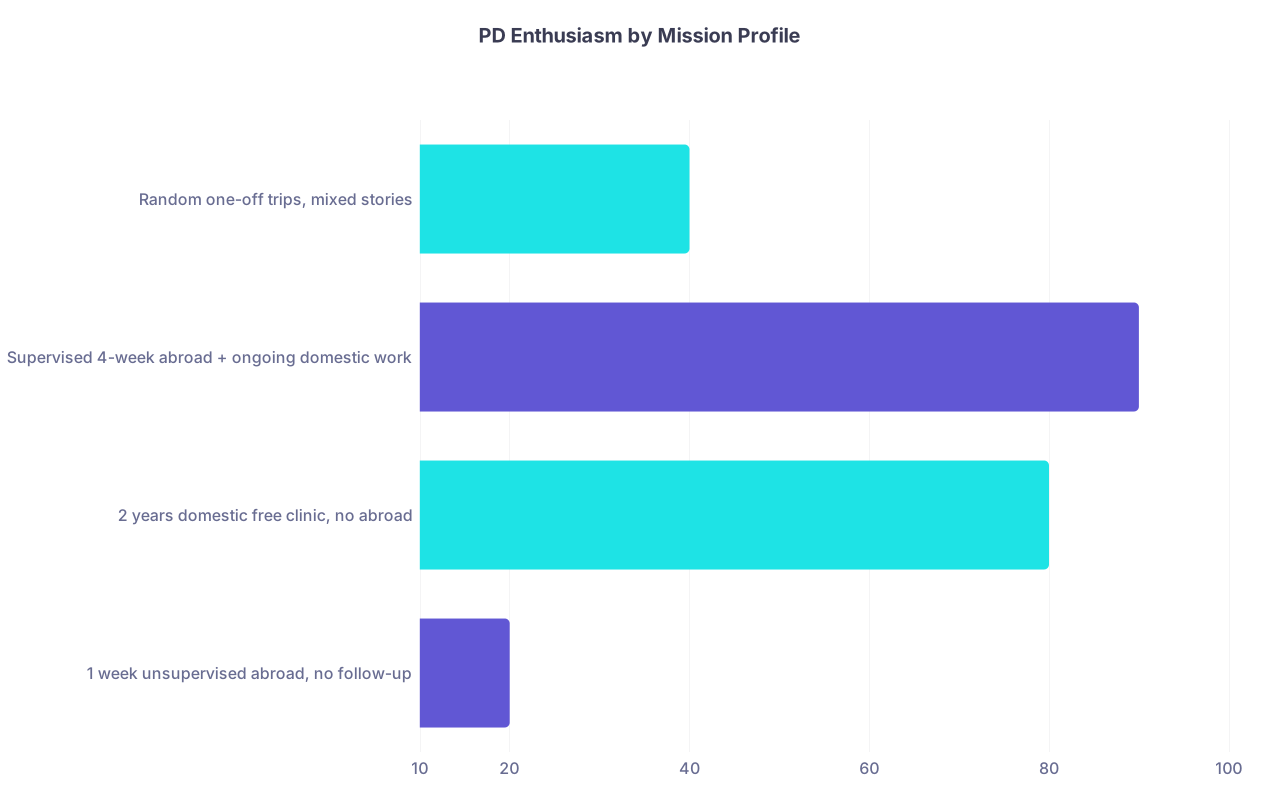
| Category | Value |
|---|---|
| 1 week unsupervised abroad, no follow-up | 20 |
| 2 years domestic free clinic, no abroad | 80 |
| Supervised 4-week abroad + ongoing domestic work | 90 |
| Random one-off trips, mixed stories | 40 |
Obviously that’s stylized, but the point stands: depth and continuity beat distance and novelty.
How to Talk About Missions in Applications and Interviews
You can ruin a good experience by talking about it badly. Here’s how to not do that.
Emphasize:
- Specific patients or situations that changed how you think (without trauma porn and without “saving” someone).
- What you did differently after the experience—in your behavior, choices, or advocacy.
- Tension and uncertainty, not just “I learned to appreciate what I have.” That line is overused and shallow.
Avoid:
- Saying “third-world,” “those people,” or anything that sounds like you’re narrating a charity documentary.
- Overclaiming impact. You did not “dramatically improve healthcare in [country].”
- Making yourself the hero of every story.
A good litmus test: Could you say this in front of a patient from that community, or a physician from that country, and not feel like a jerk? If not, rewrite it.
Quick Scenarios: Who Has the Stronger Application?
Scenario 1:
Student A: 3 spring-break trips to different countries, each 7–10 days, vague supervision, lots of proud talk about “doing procedures.”
Student B: 18 months volunteering weekly at a local free clinic, plus a quality improvement project on hypertension control.
Stronger for most PDs? Student B. Easily.
Scenario 2:
Student C: 4 weeks in a well-established global health program with local partners, pre-departure training, did a small research project, now works in a domestic immigrant health clinic using similar skills.
Student D: 2 hours/month at a local clinic for 6 months, mostly taking blood pressures and leaving early.
Stronger? Student C, by a lot. Because the work is structured, integrated, and has continuity.
So again—it’s not domestic vs international. It’s lightweight vs real.
FAQs
1. Do program directors prefer international missions over domestic ones?
No. They prefer substantive, ethical, and sustained work—wherever it happens. Many PDs actually view superficial international trips with suspicion. A 1–2 year domestic commitment to underserved patients is often more impressive than a short international trip.
2. Is a one-week medical mission trip even worth putting on my application?
Only if you can talk about it with real ethical reflection and it isn’t your only experience with underserved care. If it’s your sole “service” item and sounds like voluntourism, it can hurt more than it helps. Pair it with ongoing domestic work or deeper service.
3. Can international missions ever be a major strength of my application?
Yes—if they’re well-structured (supervision, local partners, clear scope), longer in duration, and clearly connected to your ongoing interests (global health, immigrant health, health systems). Bonus if you did scholarship (poster, QI, research) attached to it and kept working on related issues at home.
4. How do I show ethical awareness about missions in my personal statement?
Talk about situations that made you uncomfortable or forced you to confront limits: wanting to do more than you should; realizing the program’s limitations; seeing the tension between short-term help and long-term sustainability. Show that you questioned things and changed your behavior or career goals because of it. Avoid feel-good “I learned to be grateful” stories.
5. If I have limited time, should I prioritize domestic or international work?
Prioritize domestic, longitudinal work almost every time. You’ll get more continuity, more relevant skills for US residency, and fewer ethical landmines. If global health is a real interest and you can later add one solid, structured international experience, great—but don’t skip local work chasing a stamp in your passport.
6. What are red flags for PDs when they hear about mission work?
Big red flags: bragging about doing things beyond your training; describing yourself as “saving” people; talking more about your hardship than the patients’; using outdated or disrespectful language about communities; doing multiple random short trips with no follow-up or depth; and having zero related service outside those trips. Those signal poor judgment and weak ethical grounding.
Key takeaways:
- PDs care less about where you went and more about what you did, what you learned, and how you talk about it.
- Long-term, ethical, supervised work with underserved patients—domestic or international—will always beat flashy, shallow experiences.


