
You’re sitting on a plastic chair in a hot guesthouse, debriefing after a long clinic day. One of your teammates is talking excitedly about “coming back here every year and really investing,” while another is already listing other countries they want to visit next summer. You’re tired, sunburned, and honest enough to admit you’re asking yourself a selfish question:
For my own growth, skills, and ethics—and for what’s actually best for patients—is it better to keep returning to the same site over and over, or to do missions in lots of different places?
Let me be direct: if you care about ethical medical missions and real impact, you should default to going deep at one site (or a very small number), not collecting stamps across the globe.
But there are nuances. You can do both over a career. You can absolutely overstay in a place where you’re no longer helpful. And there are moments when broad exposure matters.
Let’s unpack this without sugarcoating it.
The Core Question: Depth vs Breadth
Strip away the romance and the photos. Ethically, the main question is this:
Are you building something that outlasts you, or are you dropping care and leaving?
Returning to one site repeatedly tends to support:
- Continuity of care
- Trust and relationship with local partners
- Real capacity building (training, systems, not just prescriptions)
Jumping around to many sites tends to support:
- Your personal exposure and learning
- Understanding of varied health systems and contexts
- Broad perspective on global health realities
Both have value, but they’re not equal from a patient-ethics standpoint. Longitudinal partnership almost always serves patients better.
What Returning to One Site Actually Changes
People romanticize “relationship-based missions” without being concrete. Let’s be concrete.
1. Continuity of care – the most obvious ethical advantage
If you see a child with epilepsy in Peru once, adjust their meds, then never show again, that’s not heroic. That’s risky.
If you go back every year for five years:
- You learn whether the regimen worked
- You and the local clinicians refine what’s reasonable and affordable long term
- You start thinking in years, not days
You stop practicing “expedition medicine” and start practicing actual medicine with follow-up, feedback, and accountability.
I’ve seen teams come back to the same rural Honduran town and realize their first-year hypertension protocols were unrealistic because patients couldn’t get refills locally. Year two and three, they adjusted: simpler regimens, better handoff to the local nurse, and stocking meds that would actually be there when the team left.
That course correction only happened because they came back and saw the consequences of their initial decisions.
2. Trust and honest feedback
Local partners rarely tell first-time foreign teams, “Your system is chaotic and you’re exhausting our staff.” They smile, say thank you, and recover after you leave.
By year three or four, if you’ve built real relationship, you start hearing:
- “Your patient flow is clogging our usual clinic days”
- “We actually need more training in obstetrics, not dermatology”
- “Sending all those patients to the capital is impossible; they can’t afford transport”
That feedback is gold. It shifts you from “We came to help” to “We’re part of a shared, negotiated plan.” Return visits create the conditions for honest critique, which is the foundation of ethical collaboration.
3. Real capacity building instead of heroics
One-off trips are structurally biased toward doing, not teaching. You swoop in, see huge numbers of patients, feel productive, and leave.
When you know you’ll be back:
- You design teaching sessions that build year on year
- You can track who you’ve mentored and what they’re actually using
- You might move from “I do it” to “I supervise you doing it” to “You do it without me”
That’s the trajectory that actually moves the needle.
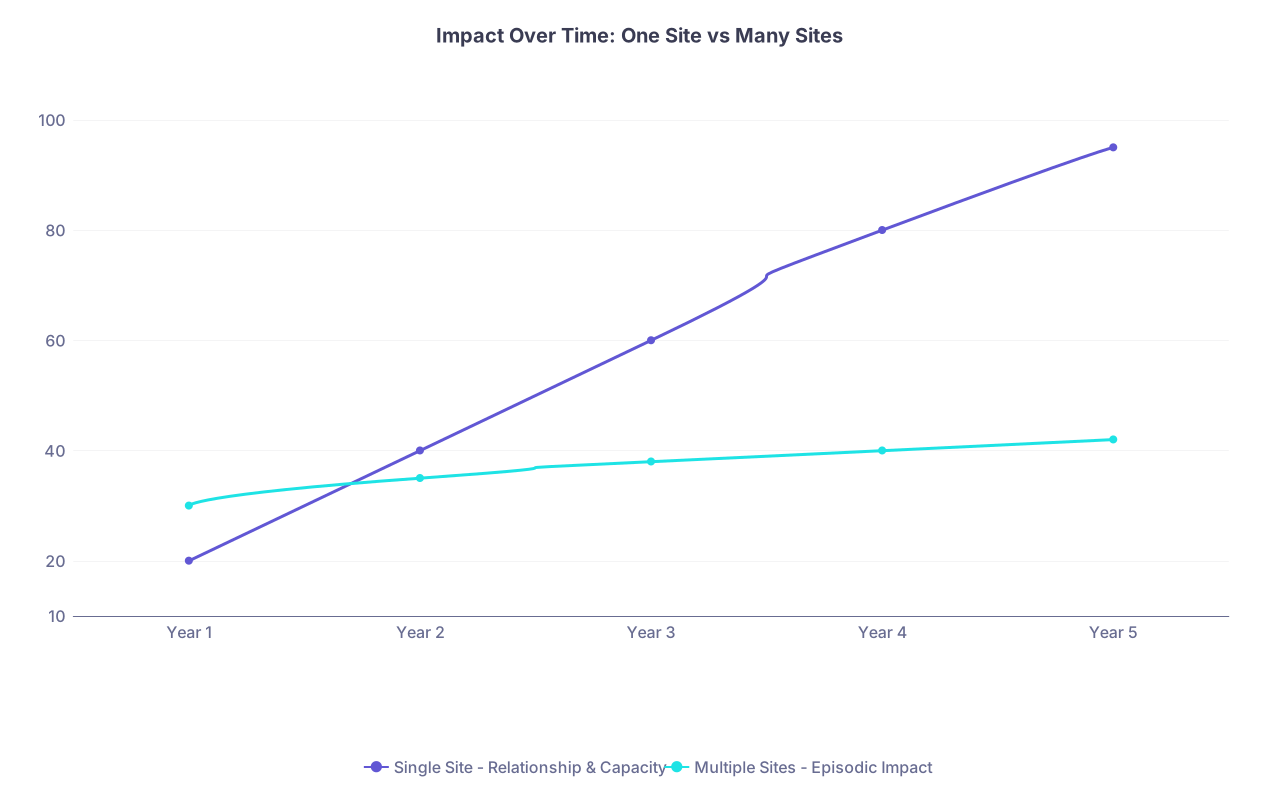
| Category | Single Site - Relationship & Capacity | Multiple Sites - Episodic Impact |
|---|---|---|
| Year 1 | 20 | 30 |
| Year 2 | 40 | 35 |
| Year 3 | 60 | 38 |
| Year 4 | 80 | 40 |
| Year 5 | 95 | 42 |
The first-year curve looks better for multiple sites (you touch a lot of people), but by year five the long-term partnership wins.
4. Humility and realism
Going back to the same place forces you to live with the limits of what you can do.
- The woman with advanced breast cancer you couldn’t cure
- The diabetic whose foot you amputated who’s now struggling with prosthetics and employment
- The malnourished child whose family you got to know
That kind of longitudinal exposure is uncomfortable—but it’s where ethical maturity grows. You stop believing in quick fixes. You start asking better questions about systems, finance, politics, and sustainability.
The Case for Visiting Many Sites (And When It Makes Sense)
Now, I’m not saying “never visit more than one site” or “stay married to your first trip location forever.” That’s simplistic.
There are real arguments for moving around—especially early in your training or career.
1. Early phase: you don’t know what you don’t know
If you’re a student or early resident:
- You probably don’t yet know which region, language, or clinical focus you want to commit to
- Sampling 2–3 different settings can help you realize, for example, “I fit in rural primary care in East Africa much more than in short surgical campaigns in Central America”
That exploration is legitimate. Just don’t disguise personal exploration as “sustainable partnership” in your language or your application essays. Be honest with yourself and your hosts about what this actually is: exposure and learning.
2. Broader understanding of global health realities
Working in:
- A post-conflict setting in South Sudan
- A refugee camp in Greece
- A stable but under-resourced district hospital in Malawi
…will teach you different things about ethics, systems, and limits. Seeing multiple models can sharpen your thinking and prevent you from assuming that one country’s solution is universal.
Good global health leaders often have some breadth early, then depth later.
3. Responding to real needs and invitations
Sometimes you’re not just chasing novelty. You’re responding to:
- A partner organization that asks for help in a new region
- An acute crisis (earthquake, epidemic, conflict displacement)
Short-term teams in new settings can be ethical if:
- They plug into existing, locally led structures
- They’re humble about what they offer
- They understand they’re guests in someone else’s long game
But hopping endlessly without ever building long-term accountability? That’s where the ethical ground starts to crumble.
Ethical Trade-offs: What Each Model Gets Right and Wrong
Here’s the tension laid out side-by-side.
| Dimension | Return to One Site | Visit Many Sites |
|---|---|---|
| Continuity of care | Strong | Weak |
| Local trust | Deepens over time | Stays superficial |
| Capacity building | High potential | Limited |
| Personal exposure | Narrower but deeper | Broader but shallower |
| Flexibility | Less (you’re committed) | More (you can pivot often) |
| Risk of “savior” role | Decreases over time | Stays higher |
From a patient-centered medical ethics perspective, continuity, trust, and capacity building matter more than your personal variety of experiences. That’s why, all else equal, I lean hard toward returning.
How This Affects Your Personal Development
Let’s talk selfishly for a minute. Your growth matters too, and it actually intertwines with your ethical trajectory.
What you gain by going deep at one site
Clinical sophistication in that context
You stop thinking “global health” in vague terms and start thinking “hypertension management under this country’s formulary and economic reality.” That’s actual skill.Leadership and systems thinking
Long-term partners end up wrestling with:
- Referral patterns
- Task shifting
- Local politics
- Budgeting for realistic care
You learn things no ICU elective at home is ever going to show you.
- Character formation
Being accountable to the same community over years changes your reflexes. You think more about downstream effects. You become slower to promise, faster to listen.
What you gain by visiting multiple sites
Range of environments
You’ll see how much context changes everything: same disease, wildly different constraints and culture.Discovering your best fit
Sometimes you only realize, for example, that francophone West Africa energizes you more than Latin America after being in both.Flexibility and adaptability
Dropping into a new system forces you to observe quickly, ask better questions, and suspend assumptions. That’s a good muscle—if it’s not the only one you train.
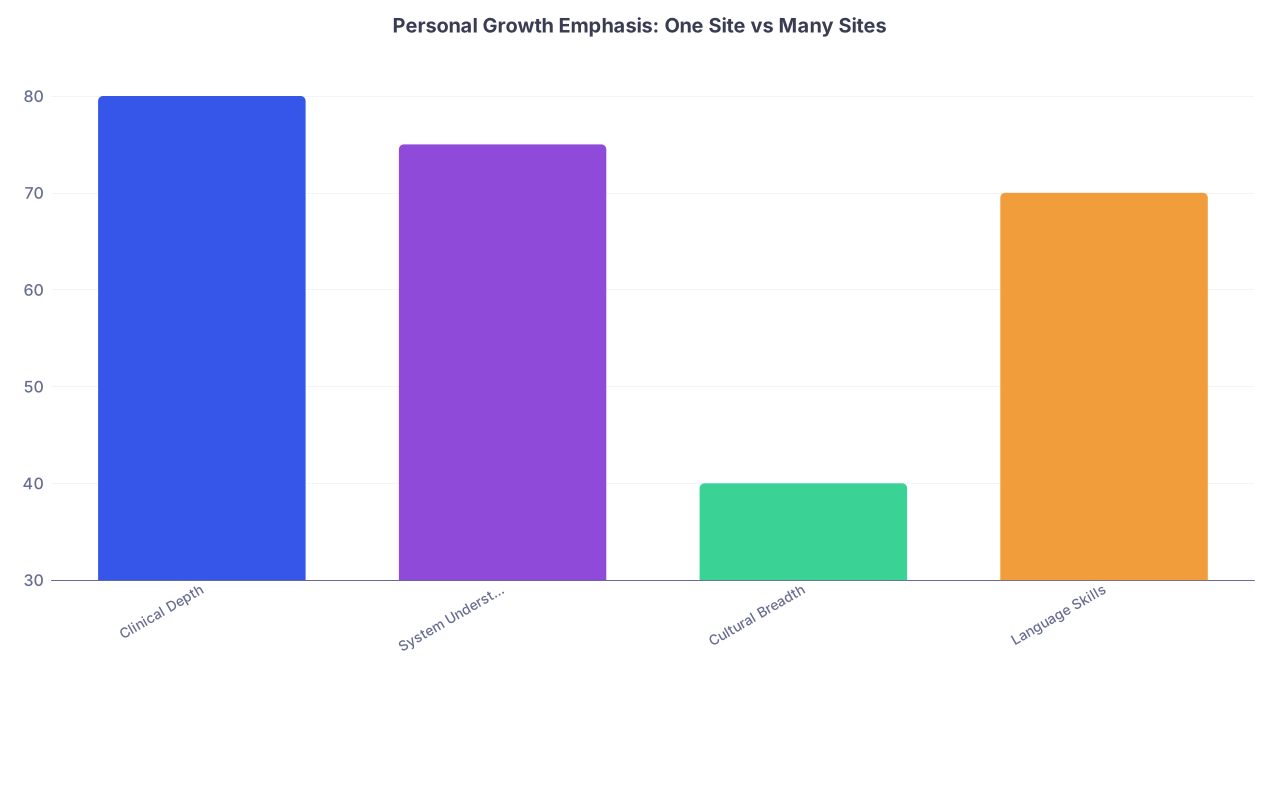
| Category | Value |
|---|---|
| Clinical Depth | 80 |
| System Understanding | 75 |
| Cultural Breadth | 40 |
| Language Skills | 70 |
(Think of those values as rough “strength” for a long-term single-site commitment. For multiple sites, flip it: higher cultural breadth, lower depth.)
Common Misconceptions—and Straight Answers
Let me cut through a few myths I hear constantly on medical missions.
“If I stay in one place, I’m limiting my impact.”
Backwards. If you’re not building local capacity and continuity, your impact is mostly emotional—for you. The most effective people I know in global health can name specific nurses, clinical officers, and systems they’ve helped strengthen over 5–10 years in one region.
“Local partners want us to keep coming back; that creates dependency.”
It can. If you:
- Undermine local clinicians
- Bring free meds that destroy the local pharmacy’s model
- Refuse to adjust your role over time
But long-term doesn’t equal dependency. Poorly designed long-term equals dependency. A good long-term partnership steadily moves you from “frontline provider” to “consultant/teacher” to “distant supporter who’s barely needed.”

| Step | Description |
|---|---|
| Step 1 | Year 1 - High hands on care |
| Step 2 | Years 2-3 - Shared care and training |
| Step 3 | Years 4-5 - Supervision and systems support |
| Step 4 | Year 6+ - Local ownership, limited external role |
Your goal is to move right on that diagram. If after 7 years you’re still running the same foreign-led clinic week with no local ownership, that’s not partnership. That’s a hobby.
“Rotating to new sites shows I care about global health broadly.”
Or it shows you like travel.
If you’re doing multiple short-term trips in different countries, be honest about your primary goal: learning and exposure. That’s not evil. But do not sell it to yourself or others as “sustainable impact.” It’s not.
How to Decide: A Simple Framework
You don’t need a PhD to make this call. Ask yourself these questions:
What phase am I in?
- Student / early trainee: 1–2 exploratory trips in different settings can make sense
- Late trainee / early attending: time to start committing to 1 main partner or region
- Mid-career: if you’re still scattered across 6 countries, something’s off
Where is there an actual invitation and local leadership?
You follow local leaders, not your bucket list. If one site has a strong, organized local partner and another is basically a foreign group “planting a flag,” choose the first.Can I realistically return?
If your life circumstances, job, finances, or family situation make it impossible to return consistently to a particular distant site, don’t pretend. Maybe your “home” focus becomes a region that’s reachable yearly, and you do rare, one-off crisis work elsewhere when appropriate.Is my role evolving?
If you’ve been going to the same site 5+ times and your role is identical every trip, haven’t learned the language, and have no idea what the local health strategic plan is, you’re not in a real partnership. Either deepen or rethink.
A Hybrid Model That Actually Works
Most ethically serious global health people I know end up with a hybrid:
- One primary site or region where they invest deeply, build relationships, and return regularly
- Occasional shorter engagements elsewhere for specific reasons: teaching, crisis response, or collaboration through their institution
The anchor is the long-term partnership. The other trips orbit around it.
Bottom Line
If you skimmed everything, here is what matters:
From a medical ethics and patient-care standpoint, returning to one site (or a small number) and building long-term, accountable partnership is better than hopping between many for short bursts.
Early in your career, some breadth is reasonable for learning—but don’t kid yourself that scattered, one-off trips are “sustainable impact.”
The goal isn’t “go everywhere”; it’s “become deeply useful somewhere,” in a way that strengthens local systems and makes your presence less necessary over time.


