
The mission you planned for months just got canceled. Not postponed. Canceled. Because of political unrest or sudden travel disruption. Here’s the blunt truth: how you respond in the next 72 hours will tell me more about your ethics than anything you would’ve done on that trip.
You cannot control coups, protests, or grounded flights. You can control whether you become one more “voluntourist” story locals roll their eyes at—or someone they’d be willing to work with again.
This is the playbook.
Step 1: Stop, Breathe, and Get the Facts (Not the Group Chat Version)
Your first job is not to fix anything. It’s to understand reality.
You’ll probably hear about the disruption in one of three ways:
- Airline or embassy alert: flights canceled, “do not travel” advisory
- Host NGO or local partner emails: “We recommend suspending all activities”
- Group chat panic: screenshots of Twitter, dramatic headlines, half-truths
Do this immediately:
Confirm the official status of:
- Your flights (airline app/website, not just email)
- Your destination’s security advisory (U.S. State Dept, Foreign Office, etc.)
- Any in-country restrictions (curfews, airport closures, roadblocks)
Get one clear statement from your team lead or sponsoring organization:
- Are we canceled? Postponed? On hold for 24–48 hours?
- Who is the final decision-maker: hospital, NGO, med school, church, or global health office?
If your program leadership is hedging—“We’ll see,” “Let’s wait one more day”—you still treat today as canceled. You shift into contingency mode. If they reverse later, fine. But you plan for cancellation, not hope.
And one more thing: do not rely on WhatsApp rumors from “a friend of a friend who’s there now.” I’ve seen teams show up in-country because a student’s cousin said “it’s actually fine here” while the local hospital director was emailing “do NOT come.”
Trust the partners who actually host you. Not the adrenaline in your veins.
Step 2: Accept That Backing Out Can Be the Ethically Right Move
There’s a very specific guilt that comes with pulling out of a mission trip. You’re thinking:
- “Patients were counting on us.”
- “We raised money for this.”
- “If we don’t go, no one will help them.”
Here’s the hard correction: if local partners say “do not come,” then going is unethical. Full stop.
Why?
- You divert local capacity. In unrest or disaster, locals need to manage their own families, communities, and systems. Babysitting foreign volunteers is not a priority.
- You become a security liability. One foreigner injured, kidnapped, or killed pulls resources away from the population you claim to care about.
- You undermine trust. Showing you’re willing to put “experience” ahead of local judgment will destroy long-term relationships.
I’ve seen students push back: “But we’re doctors, they need us.” No. In acute political unrest, they need stability, not you. If you really believe global health is about partnership, you honor local risk assessments—especially when they cancel the thing you wanted most.
Repeat this to yourself: “Backing out when locals advise it is an act of respect, not abandonment.”
Step 3: Contact the Right People in the Right Order
Once the trip is officially called off—or realistically non-viable—you move into communication mode. And you do it in a sequence.
Local/Host Partners (through the official channel)
You probably won’t email the local hospital director directly if you’re a student; you go through your faculty lead or NGO contact. But insist that some communication goes out that:- Expresses solidarity (not pity, not savior energy)
- Makes it clear you respect their safety assessment
- Leaves the door open for future collaboration on their terms
Your home institution/program leadership
- Global health office / Dean’s office
- Residency program director or clerkship director if rotations are affected
- Risk management office if your institution has one
Your message: brief, factual, calm. “Due to [X advisory / canceled flights / guidance from our partners], the trip is not proceeding. I want to discuss academic, financial, and professional implications.”
Funders and donors
We’ll go deeper on this later, but you notify:- Any grant programs
- Churches or community organizations that supported you
- Individual donors
Family or close contacts
Let them know you’re safe, not traveling, and what your new plan is. Saves you 15 anxious phone calls later.
The people you do not need to update right now: your entire social media following. You can post something thoughtful later. Right now, your priority is the people who share responsibility and risk with you.
Step 4: Ethically Handle Money, Supplies, and Promises
This is where people either keep their integrity or quietly hope no one asks too many questions.
If you raised funds “for the mission”
You cannot just treat that money as your personal travel voucher now.
Ask yourself honestly:
- Did I explicitly say funds were for “this specific trip on these dates”?
- Or did I say “for ongoing support of this clinic/program/community”?
Then:
Talk to your sponsoring organization:
- Does policy allow funds to be held for a rescheduled trip?
- Can money be redirected to support the local partners directly?
- What’s their timeline and reporting requirement?
Decide on a default plan that respects donor intent:
- Option A: Refund offered
“You gave toward this trip. It was canceled. You can either:- Get a full refund, or
- Allow us to redirect your gift to [specific alternative].”
- Option B: Hold and roll over
If a new date is already planned with partners’ approval.
- Option A: Refund offered
Where people go wrong: staying vague. “We’ll use the funds somehow” is not acceptable if people gave to a specific mission.
Physical supplies and medications
If you’ve already purchased or collected supplies (BP cuffs, gauze, suture, etc.):
- Do not ship them blindly into a volatile context. Logistics and customs might be in chaos.
- Ask the host organization: “What is actually useful now?” Sometimes cash to a trusted partner is worth more than half-expired supplies gathering dust in a U.S. closet.
If your med school or hospital funded supplies, involve them in the reallocation plan. You’re a steward, not the owner.
Step 5: Support Your Hosts Even When You’re Not There
One of the most ethical moves you can make in this whole mess is this: you show you care even when you’re not physically present.
Ask your host (through the official lead), very specifically:
- “What do you need most right now that we can realistically provide from afar?”
- “Would unrestricted funds help your staff or security situation?”
- “Is there any remote support (case discussions, tele-education) that would actually be helpful, or would it just drain your time?”
Sometimes the answer will be: “We need you to leave us alone for a while.” Respect that.
Other times, they may say:
- “We need funds to pay local staff hazard pay.”
- “We need help covering fuel costs so ambulances can run.”
- “We’d appreciate online teaching for our residents while things are shut down.”
Do not invent remote projects because you’re bored and disappointed. Only offer what they ask for or confirm as welcome.
Step 6: Deal with Your Own Disappointment Without Making It About You
You’re allowed to grieve this. You spent money, time, emotional energy. You studied the local language. You were ready to work hard. Losing that is real.
What’s not okay is centering your disappointment in your communication with hosts or donors.
Bad email example to host:
“We’re all devastated; we were so looking forward to working with your lovely people and bringing them care.”
Better:
“We’re sorry we won’t be able to work alongside you as planned. We respect your decision and your safety priorities. Please let us know if and when future collaboration would be helpful—on your terms and timeline.”
With donors, you can be more human:
“I’m disappointed, of course—I’d been preparing for this for months—but I’m also relieved our partners are prioritizing safety. Here’s how we’re handling the funds you gave…”
Personally, you should:
- Debrief with your team. Name the loss and frustration.
- Acknowledge any sense of “I’ve lost this on my CV.” It’s shallow, but it’s real. Then move past it.
- Talk to a mentor who has done real global health work. Ask them how they’ve handled canceled trips or dangerous contexts. You’ll hear versions of, “If you do this long enough, things will get canceled.”
The ethical muscle you’re building here is this: your desire to help does not trump other people’s reality.
Step 7: Protect Your Training, Career, and Time—But Do It Cleanly
You still have to deal with the practical fallout:
- Lost elective or rotation credit
- Gap in your schedule
- Money sunk into flights, vaccines, visas
Here’s the order:
Academic credit / rotation replacement
- Talk to your med school or residency about converting the time:
- Domestic elective (underserved clinic, refugee health, community health center)
- Research elective focused on global health, ethics, or health systems
- Quality improvement project tied to global health themes
You make it easy for them: propose 1–2 concrete options, not “What can you do for me?”
- Talk to your med school or residency about converting the time:
Financial recovery
- Contact the airline about refunds or credits, using the exact wording they respond to: “significant schedule change,” “travel advisory,” etc.
- If your institution booked the travel, let them handle negotiations.
- If a grant funded you, ask: can we reallocate for a future trip or related project?
Future applications (residency, fellowships) You do not hide this story. You use it—properly.
Wrong way in an application:
“I planned a trip to [country] but due to unrest was unable to go.”Better: “I spent 6 months planning a clinical elective with partners in [country]. Days before departure, political unrest made the trip unsafe. Our team chose not to travel based on local guidance, redirected funds to support local staff, and I completed a domestic rotation in refugee health instead. That experience forced me to confront the difference between my desire to help and what actually serves partner communities.”
That’s maturity. Programs notice that.
Step 8: Learn the Ethical Lessons You Were Supposed to Learn There—Here Instead
You were hoping to learn:
- Humility in a resource-limited setting
- Cross-cultural communication
- Ethical complexity of working in someone else’s system
Bad news: you do not get those exact experiences. Good news: the cancellation itself is an advanced ethics case study if you treat it like one.
Sit down and actually dissect it:
- Power: Who got to decide the trip was canceled? Your dean? The NGO? The embassy? The local hospital? How did those power dynamics shape the outcome?
- Risk: How was risk distributed? Who would have borne the worst consequences if you went anyway?
- Narrative: Were you more upset about “patients not getting care” or about “me losing this opportunity”? Be honest. That honesty will make you a better physician.
You can turn this into:
- A reflection piece for your global health course
- A small ethics presentation in your residency
- A personal journal entry you revisit when you’re tempted later to push unsafe boundaries “for the experience”
I’ve watched plenty of people treat canceled missions like a logistical headache and move on. The better clinicians treat it like a mirror.
Step 9: Prepare Differently Next Time (So You Don’t Repeat the Same Mistakes)
Assume this will not be your last attempt at global work. Use this experience to shape how you design the next mission or elective.
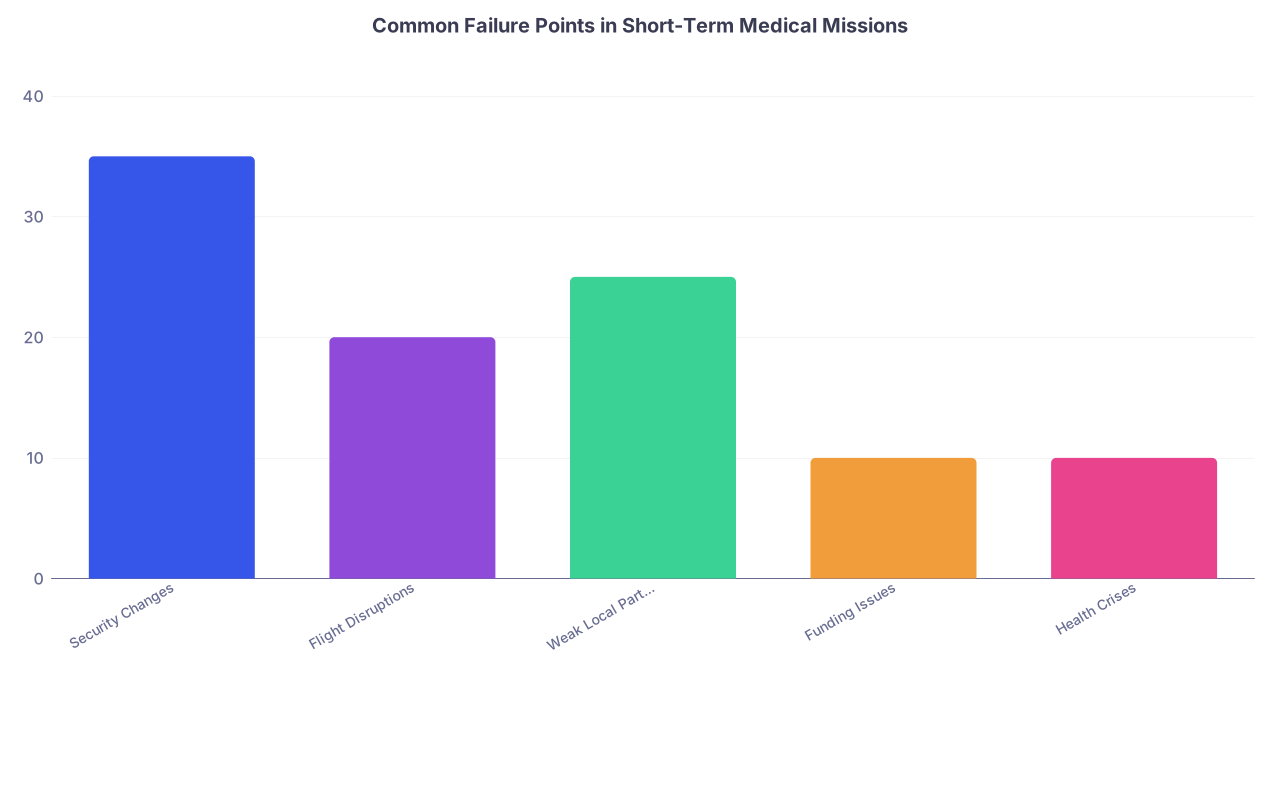
| Category | Value |
|---|---|
| Security Changes | 35 |
| Flight Disruptions | 20 |
| Weak Local Partnerships | 25 |
| Funding Issues | 10 |
| Health Crises | 10 |
Next time, build in:
Clear cancellation criteria agreed on with hosts in writing: “If there is a Level 3 or 4 advisory from X country, if internal security team advises, if hospital director requests, we cancel.”
Ethical fundraising language that already includes: “Funds may be redirected, in consultation with our partners, to support local health initiatives if travel becomes impossible.”
Alternatives for your own learning: Before you even buy a ticket, know what domestic or remote work you’ll pivot to if the trip dies. That protects your training and decreases the temptation to push unsafe travel out of desperation.
Real backup plans for partners: Ask your hosts during planning: “If we can’t come, is there anything we can set up in advance that would still be useful—like remote teaching modules, funded local CME, or emergency reserve funds?”
Plan your ethics before you plan your packing list.
Step 10: Do a Proper Team Debrief, Not a Group Pity Party
Most groups skip this or reduce it to “Well, that sucked. Anyway…”
Do a structured debrief. One hour. Cameras on if virtual.
Include:
- The faculty or organizational lead
- Representative of the host organization if they’re willing (and if safe)
- All team members
Basic agenda:
- What happened (facts only, no adjectives)
- How we each felt about it, including conflicted stuff (anger, frustration, relief)
- What we did well in our response
- What we’d do differently in future planning
- Concrete commitments:
- How we’re supporting the hosts now (if at all)
- How we’re using this experience ethically (reflection, education, policy changes)
If your team lead doesn’t propose this, you can. You’re allowed to say, “I think we need to process this as a group.”

| Step | Description |
|---|---|
| Step 1 | Trip Canceled |
| Step 2 | Gather Facts |
| Step 3 | Respect Local Decision |
| Step 4 | Communicate with Stakeholders |
| Step 5 | Handle Funds and Supplies |
| Step 6 | Support Hosts Remotely |
| Step 7 | Protect Training and Time |
| Step 8 | Reflect on Ethics |
| Step 9 | Plan Better for Next Time |
| Step 10 | Team Debrief |
A Quick Word on Political Unrest Specifically
Political unrest isn’t just “it might be unsafe outside the hotel.” It can change:
- Who controls your clinic site from one week to the next
- Whether your presence is seen as aligned with one faction
- How locals perceive foreigners in general (“with us or against us”)
If your partners are hesitant or vague, take that seriously. They may not be able to put sensitive details in writing. A short line like “this is not a good time for foreign volunteers” often carries a world of unsaid risk.
Never, ever say:
- “But news says it’s mostly peaceful protests.”
- “We won’t go near the trouble areas.”
- “We’ll stay in the compound the whole time.”
If you need to build your procedural logbook that badly, do it at home.
Put This Into Action Today
If your mission was just canceled—or is wobbling on the brink—do this before the day ends:
Open your email and draft three messages:
- To your team lead, asking for a clear, written statement of the trip’s status and next steps.
- To yourself: a half-page reflection on what you’re actually grieving (be honest).
- A template for donors explaining what happened and how their support will be handled ethically.
Those three drafts will force you to get factual, get honest, and get ethical—right now, while it still matters.


