

The worst reapplicant advice for older career changers is “just improve your stats and try again.” That is how people waste 2–3 years and thousands of dollars.
You are not a 21-year-old biology major who can casually tack on another gap year. Your time, income, family obligations, and energy curve are different. So your reapplicant strategy has to be different. Ruthless. Targeted. And honest.
Let me break this down specifically for you—the 28–45-year-old career changer who already applied, already got burned, and is now deciding whether and how to go back in.
1. First, Diagnose Exactly Why You Did Not Get In
Most reapplicants never do a real autopsy of their prior cycle. They hand-wave and say “probably my MCAT” or “I applied late.” That is lazy. You cannot afford lazy.
You need to convert “I did not get in” into a precise problem list.
Step 1: Pull your application apart like a reviewer
Recreate your prior application on paper:
- GPA breakdown: overall, science, postbac (if any)
- MCAT section and total scores, with dates
- School list, with:
- Median MCAT/GPA vs yours
- Public vs private
- In-state vs out-of-state friendliness
- Timing:
- Primary submission date
- Date primaries were verified
- When secondaries were returned
- Outcomes:
- Number of secondaries received
- Number completed
- Interviews offered
- Waitlists / rejections
Then, brutally categorize what level of screen you failed at.
| Failure Point | What It Looks Like | Main Suspects |
|---|---|---|
| Pre-secondary | Few/no secondaries | GPA/MCAT/school list/timing |
| Post-secondary, pre-interview | Many secondaries, zero interviews | Essays, narrative, alignment |
| Post-interview | Several interviews, no acceptances | Interview performance, red flags, fit |
If you are an older career changer, one additional layer applies: age bias and narrative coherence. Adcoms are not going to say it in the rejection letter, but I have heard this verbatim behind closed doors:
- “I am not sure they understand the day-to-day reality.”
- “Feels like a midlife crisis pivot.”
- “Why medicine now, and why should we believe they will last 30 years in this?”
If you did not address those questions clearly and repeatedly in your materials, assume it hurt you.
Step 2: Read your old materials with “adcom eyes”
You are not allowed to think “this was pretty good.” That mindset failed already.
Print your personal statement, activities, and secondaries. Then read them with four questions in your head:
- Do I sound like I understand what physicians actually do all day, not just “help people”?
- Do I explain why now in a way that is credible for someone in their 30s or 40s?
- Do I show sustained commitment, or does it look like a sudden romantic idea?
- Is there any concrete evidence that I can handle heavy science and long hours at this stage of life?
If the answer to any of those is “not really,” then narrative—not just stats—was a problem.
2. Decide If You Should Reapply At All (Hard But Necessary)
Reapplying as a 20-year-old is cheap: time is abundant. Reapplying as a 38-year-old with a mortgage and 2 kids is a completely different calculation.
You need an explicit decision framework, not vibes.
Look at the numbers like an adult, not a dreamer
Here is the brutal truth: some profiles are salvageable with 1–2 targeted years of work. Some are not.
Ask yourself:
- Is my GPA trend upward, stable, or downward?
- Do I have at least one region (state or region) where I am a competitive in-state or mission-fit applicant?
- Is my MCAT within 3–4 points of the median of at least some schools, or am I 7–10+ points below almost everywhere?
If you are consistently 0.2+ GPA and 6–8 MCAT points below most schools on your list, with no strong in-state advantage, then we are talking about a multi-year academic rebuild, not a tune-up. That is a different conversation.
This is where being older matters. A 31-year-old willing to grind 2–3 years of postbac + MCAT retake + stronger clinical, then 4 years of med school + 3–7 years of residency? Possible. A 44-year-old starting that same runway? You must be very clear-eyed about the timeline and lifestyle that await you.
I am not telling you “too old.” I am telling you “do the math honestly.”
Check your life infrastructure
You cannot reapply effectively if your life is on fire. Common scenarios I have seen:
- Full-time job + 3 kids + trying to do postbac + MCAT + heavy volunteering in 1 year → everything is mediocre.
- Spouse/partner is not genuinely on board; undermines study time and costs.
- Financial runway is fantasy-level optimistic.
Ask yourself:
- Can I realistically free up 15–20 hours/week for 12–18 months for academics, MCAT, and clinical work?
- Do I have explicit, not assumed, buy-in from partner/family?
- Can I financially survive:
- Upfront MCAT cost
- 30–60 secondaries
- Lost overtime/bonuses from cutting back work
- Potential relocation for school?
If the answer to these is mostly “no,” step one is not “reapply.” Step one is “stabilize my life so a reapplication actually has a chance.”
3. Rebuilding Your Academic Profile as an Older Applicant
This is where I see the worst advice. People love to say “do more classes.” That is like telling someone with heart failure to “drink more water.”
You need targeted academic repair.
Figure out which bucket you are in
There are three main academic buckets for older career changers:
- True career changer with minimal science
- Example: 35-year-old teacher with BA in English, 3.4 GPA, only basic bio/chem.
- You need a structured postbac or equivalent course set.
- Prior science exposure but weak execution
- Example: 30-year-old with 3.0 in an old biology degree, scattered Cs in core sciences.
- You need a formal academic reinvention (SMP or focused upper-division sciences).
- Decent GPA but “too old” or stale
- Example: 38-year-old with 3.6 from 15 years ago, limited recent coursework.
- You need a short, high-caliber recent academic track record to show current ability.
Do not treat these as interchangeable. Programs look at them differently.
Postbac vs SMP vs DIY – for your situation
Let’s be specific.
Classic career changer (non-science, little to no prereqs):
- Best route: Formal postbac (or very well-planned DIY) with:
- Gen chem, orgo, physics, bio, biochem, stats.
- You must:
- Crush these: think 3.7+ in recent BCPM.
- Take them in a rigorous environment, not just low-effort online classes.
- Stay away from “minimum effort to check the box” mentality. It shows.
Low GPA / old science GPA that drags you down:
- Consider:
- A structured academic enhancer or SMP (with a record of med school linkages).
- Or 30+ credits of upper-division sciences at a 4-year institution with ~3.7+.
- You are trying to prove: “I am not my 22-year-old self; here is my new data.”
Good old GPA but long time gap:
- Take 12–20 credits of recent, relevant sciences:
- Biochemistry, physiology, cell biology, genetics.
- Do it while working, if possible, to mirror med school’s “no one is going to slow this down for you” energy.
- Your message: “Yes, I graduated in 2008, but here is recent proof that my brain still works at high speed.”
Do not scatter 1–2 classes at a time across multiple community colleges over years. It looks unfocused. You are older; show you can execute on a deliberate plan.
4. MCAT Strategy for Reapplicants Over 30
Older applicants get wrecked on the MCAT for predictable reasons: rusty basic science, cognitive fatigue after full workdays, and trying to study “like a college kid” while parenting.
You need to treat the MCAT like a part-time job, not a hobby.
Be honest about your prior score
If you are sitting on:
- 495–503: This is a foundational problem. You likely need:
- 6–9 months.
- Concept-heavy review, not just more questions.
- Possibly content courses in physics/chem before retaking.
- 504–508: You are on the border. Targeted strategy can work:
- Fix timing, passage strategy, and high-yield content gaps.
- 509–512 but still no love: The issue is probably not purely MCAT. Do not waste another year chasing a 517 because Reddit says so. Fix the rest of your profile.
The most common mistake older career changers make is retaking the MCAT within 3–4 months “to show improvement” without changing their life structure. Same job, same hours, same childcare load, same fatigue. Then they get a 1–2 point bump at best. Useless.
Structure your MCAT prep around your actual life
Two non-negotiables:
- Protected study blocks that are realistic:
- For full-time workers with family: 2–3 hours on weekdays, 6–8 hours each weekend day.
- That means cutting something: overtime, social life, Netflix, side gigs. Not sleep.
- Longitudinal schedule (at least 4–6 months):
- Older brains are fine. They just need more warm-up time and more repetition.
Do not rely solely on content videos. You need:
- Active recall (Anki or similar).
- Spaced repetition.
- Regular AAMC practice and full-lengths, scheduled like appointments.
And track your data like an adult:
- Record FL scores by section and date.
- If you are plateauing, do not keep pounding full-lengths without changing strategy. That is just self-harm.
5. Rewriting Your Story as a Reapplicant and Career Changer
You cannot just tweak a few sentences and call it a day. Adcoms will pull your old file. They will see what you wrote last time. You must show evolution.
You have to answer three specific questions clearly
For older career changers, your narrative must solve these:
- Why medicine, not just “helping” or “science”?
- Tie directly to longitudinal clinical exposure, not a one-time epiphany.
- Why now, and why so late?
- Frame your prior career as an asset (leadership, resilience, communication), not as “I wasted 10 years.”
- Why should we trust you will get through training at this age?
- Show evidence: managing long hours, handling stress, returning to academics successfully, family support.
If your prior application read like a generic 22-year-old “I want to help people” essay with some older-age garnish, that is a problem.
How your reapplicant personal statement must differ
You cannot resubmit a lightly edited version. That signals stagnation.
Your new personal statement should:
- Explicitly acknowledge the reapplication, but briefly.
- One or two lines: “Since my previous application, I have…” then move on.
- Focus heavily on what changed:
- New clinical roles, increased responsibility.
- Academic improvements.
- Deeper, more realistic understanding of physician life.
- Use concrete examples from your non-medical career:
- Managing a team through crisis.
- Handling high-stakes decisions.
- Training and mentoring others. These are gold for older applicants. Lean into them.
And stop writing like you are apologizing for being older. Programs do not want a martyr. They want someone who knows exactly what they are signing up for and still wants it.
Activities and secondaries: remove fluff, add trajectory
Older career changers tend to have:
- Long lists of random jobs and volunteer stints.
- Vague “leadership” like “was in charge of several initiatives.”
You need to:
- Prioritize recency and relevance over sheer volume.
- Show progression:
- From shadowing → clinical volunteering → paid clinical role → more responsibility.
- Be specific in descriptions:
- “Led a team of 8 nurses and techs during weekend shifts, handling bed assignments and patient flow” is stronger than “demonstrated leadership and teamwork.”
Secondaries must clearly tie you to each school based on:
- Regional ties.
- Mission fit: underserved, primary care, research, nontraditional support, etc.
- Concrete programs or tracks relevant to your background (rural health, evening clinics, etc.).
Generic “I love your commitment to diversity” paragraphs are instantly forgettable.
6. Fixing the Non-Academic Side: Clinical, Shadowing, and Life Proof
As an older reapplicant, you cannot rely on “I shadowed a doctor for 30 hours” and some volunteer checkboxes.
The question you are answering is: “Can this person really tolerate what medicine is, not the Instagram version?”
Your clinical experiences need to reflect reality, not fantasy
You want at least one role where you:
- Touch actual patients or have direct responsibility:
- EMT, CNA, medical assistant, scribe, ER tech, hospice volunteer, etc.
- See what physicians actually do:
- Documentation burden.
- Indirect patient time.
- System frustrations.
Then your writing should show it:
- Not “I learned the importance of empathy.”
- Instead: “After watching a hospitalist spend more time in the EHR than at the bedside during a 12‑hour shift, I had to confront whether I still wanted this life. I did. Here is why.”
That kind of line tells an adcom you are not delusional.
Letters of recommendation for older reapplicants
You need a different mix than undergrads.
Aim for:
- One or two strong science letters from recent coursework (postbac, upper-level science).
- One clinical supervisor letter:
- Who has seen you with patients, seen your work ethic and resilience.
- Optionally, one from prior career:
- Only if they can speak to qualities that matter in medicine: handling pressure, leadership, communication, ethics.
And do not reuse the exact same letters if they were weak or generic. If the best your boss can write about you is “reliable and hardworking,” that is not enough.
7. School List Strategy That Actually Fits Older Reapplicants
Last cycle, your school list was probably aspirational and sloppy. This cycle, it needs to be engineered.
You must filter schools by how they treat older and nontraditional students
This means more than checking “accepts out-of-state” or “holistic review” on MSAR.
You want to know:
- Do they have visible nontraditional students in their class photos and student groups?
- Do they mention support for students with families? Childcare info? Flexible support?
- Are there pipeline programs or linkages for career changers?
Red flag: All the photos and stories on their site are 22-year-olds who went straight through. Not an automatic no, but be realistic.
Build a tiered list with clear rationale
You should have:
- A strong core of in-state public schools, if they exist.
- A cluster of mid-range private schools with history of accepting nontrads.
- A selective but not delusional set of reaches.
And you should remove:
- Places where your stats are drastically below the 10th percentile and there is no mission fit.
- Places with highly research-heavy profiles if you have zero research and cannot realistically get any.
This is where older applicants often shoot themselves in the foot. They apply heavily to big-name schools they have heard of from TV, even when those schools have 0–1 clearly nontraditional students in a class of 150.
Use your time and money strategically. You are not playing a lottery; you are building a targeted list.
8. Timing Your Reapplication: Do Not Rush the Second Attempt
This one is simple: if your application will look mostly the same as last time, do not reapply this year. You are only branding yourself as a two-time reject.
You should reapply when you can clearly say:
- My academic profile is meaningfully better:
- New coursework.
- Better MCAT or at least stronger academic narrative.
- My clinical exposure is deeper:
- New role.
- Higher responsibility.
- My narrative is sharper:
- I can articulate a credible, mature reason for this career change and why I am ready now.
For many older reapplicants, that means skipping one full cycle. It feels painful. It usually saves time in the long run.
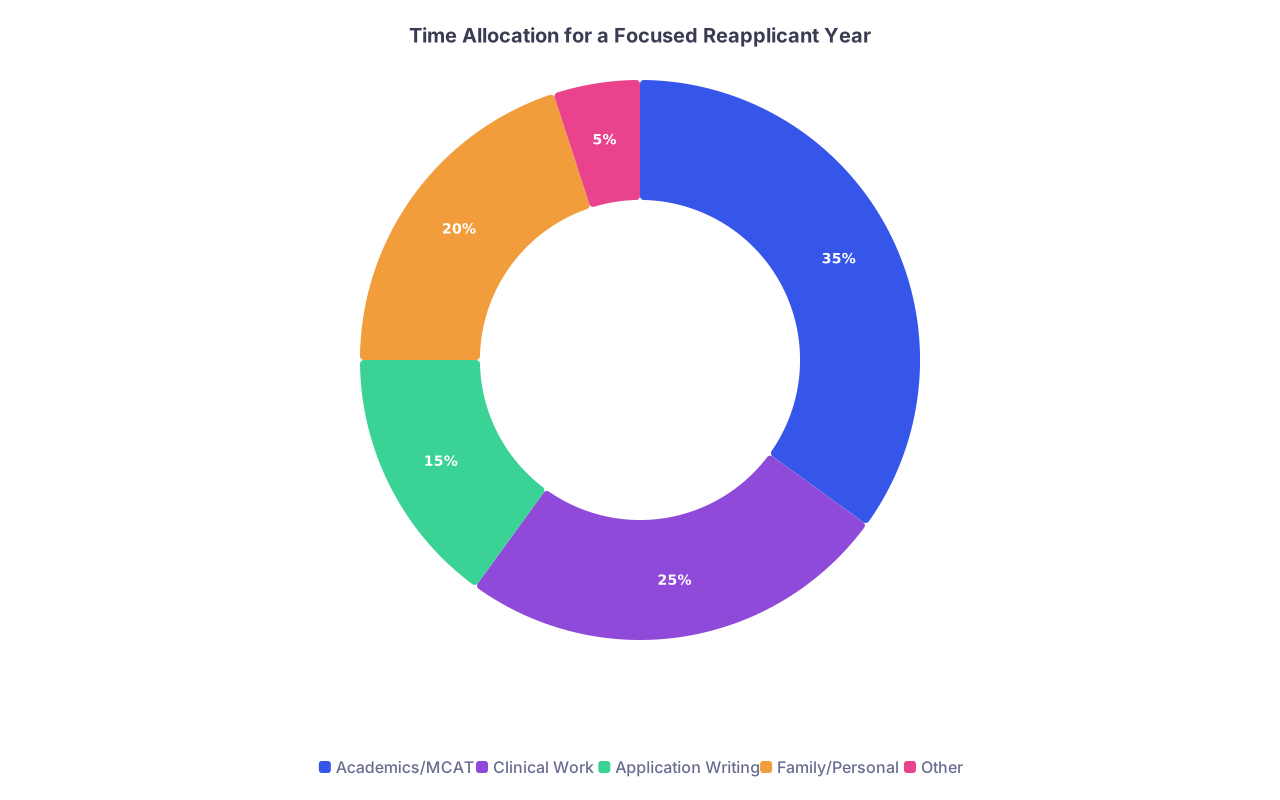
| Category | Value |
|---|---|
| Academics/MCAT | 35 |
| Clinical Work | 25 |
| Application Writing | 15 |
| Family/Personal | 20 |
| Other | 5 |
9. Building a One-Year Reapplicant Plan (Sample Framework)
Let’s be practical. Assume you are 34, working full-time, with one prior unsuccessful cycle. Here is a skeleton of what a deliberate reapplicant year can look like.
January–March:
- Enroll in 2 upper-level science courses.
- Lock in 8–12 hours/week of clinical work or volunteering.
- Start MCAT prep with slow, concept-heavy review.
- Begin school list research with nontrad lens.
April–June:
- Ramp MCAT practice questions.
- Add 1–2 new shadowing experiences with different specialties.
- Start drafting new personal statement from scratch.
- Meet with at least one admissions advisor or experienced mentor for file review.
July–September:
- Take MCAT in this window with at least 3–4 full-lengths scored where you want to land.
- Finish core essays and activity rewrites.
- Finalize letters of recommendation.
- Submit primaries early in the cycle (June) if MCAT is done or scheduled realistically.
October–January:
- Turn around secondaries in 1–7 days.
- Continue clinical and work responsibilities.
- Practice interview skills, specifically for older/nontrad questions:
- “Why now?”
- “How will you handle the training demands at your age?”
- “Tell me about your previous career and how it fits into your path.”
You adapt this depending on where your deficits are, but the key point is: each quarter has a theme and clear deliverables.
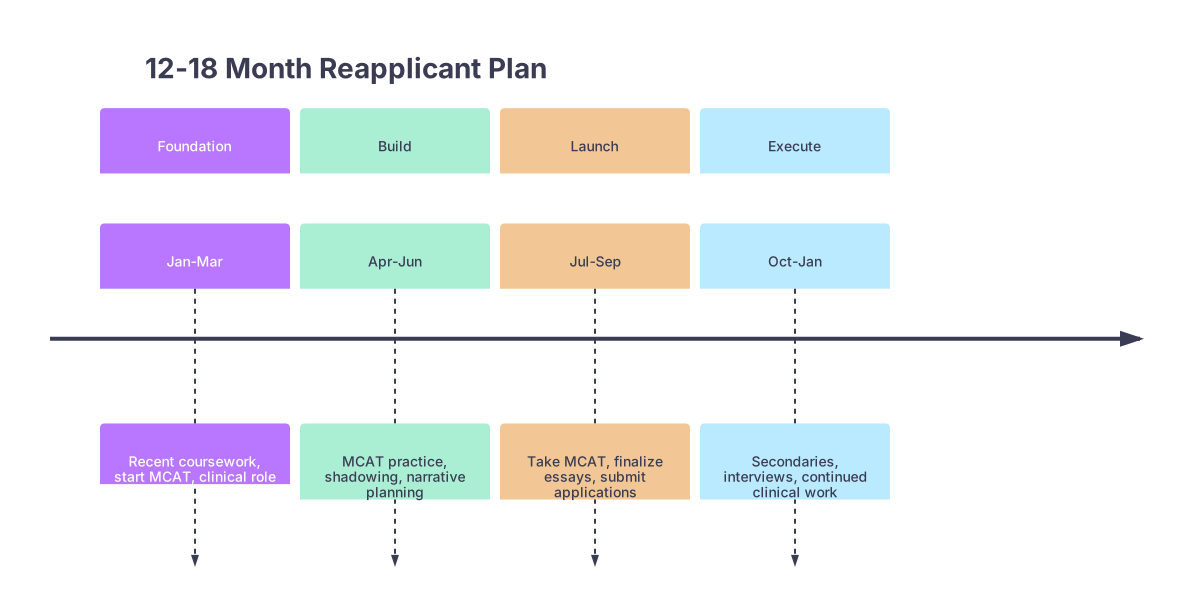
| Period | Event |
|---|---|
| Foundation - Jan-Mar | Recent coursework, start MCAT, clinical role |
| Build - Apr-Jun | MCAT practice, shadowing, narrative planning |
| Launch - Jul-Sep | Take MCAT, finalize essays, submit applications |
| Execute - Oct-Jan | Secondaries, interviews, continued clinical work |
Key Takeaways
- Reapplying as an older career changer is not “try again and hope.” It is a deliberate reconstruction of your academic record, MCAT performance, clinical depth, and narrative coherence, evaluated through the lens of age and life stage.
- You should not reapply until your new application is materially stronger—on paper and in substance—than your prior one. A 1–2 point MCAT bump and a few extra shadowing hours do not qualify.
- Your greatest asset is not pretending to be a traditional applicant. Your advantage is your experience, maturity, and clear-eyed understanding of what you are choosing. If you can translate that into a smart plan and a sharp application, being an older reapplicant can shift from liability to differentiator.
FAQ (Exactly 5 Questions)
1. Am I too old to reapply if I will be 40 when I start medical school?
No hard cutoff exists, but you need to be clinically and personally realistic. Many programs have students starting in their late 30s and early 40s, especially in DO schools and some mission-driven MD programs. What matters is your health, support system, financial planning, and demonstrated capacity to handle the physical and cognitive demands of training. Age alone does not disqualify you, but it raises questions you must answer convincingly.
2. Should I apply DO as a reapplicant if I only applied MD before?
If you previously limited yourself to MD programs and got no traction, adding DO schools is often rational, especially if your stats are midrange. DO schools tend to be more open to nontraditional and older applicants, and many graduates match into solid residencies. This is not “settling”; it is expanding a strategy to fit reality. You still need a serious reapplicant overhaul, not just a longer school list.
3. How different does my personal statement need to be as a reapplicant?
Substantially different. Adcoms can and do compare prior cycles. Reusing the same narrative signals lack of growth. Your new statement should reflect the concrete changes you made: new experiences, refined understanding of medicine, academic improvements, and more mature reflection on your career change. The core “why medicine” may be similar, but the framing, evidence, and depth should show clear evolution.
4. Is it better to cut work to part-time for one year to focus on MCAT and coursework?
If you can afford it and your support system allows it, shifting to part-time for 6–12 months can dramatically improve MCAT and coursework outcomes, particularly for older applicants who cannot routinely push 70–80 hour weeks without burning out. However, you must use that extra time with discipline: structured study schedules, deliberate clinical involvement, and consistent academic performance. Dropping hours and then drifting is worse than staying full-time and executing well.
5. Do I need formal postbac or SMP, or can I do DIY classes at a community college?
It depends on your deficit. For pure career changers with no science background, a structured postbac at a 4-year institution is often ideal. If your issue is a low or old science GPA, an SMP or rigorous upper-level sciences at a university carry more weight than scattered community college courses. Community college can be acceptable for some prerequisites if that is your only access point, but for significant academic repair, adcoms usually want to see strong performance in a setting closer to medical school rigor.


