
It’s 10:47 p.m. Your Outlook calendar is still pinging, your deal team or litigation partner is “circle back?”-ing you on Slack, and you’re staring at yet another redlined document wondering how this became your life. You catch yourself scrolling residency program websites or SDN threads between edits. You close the doc, and the thought hits you full force:
“I can’t keep doing this. I want to do something that actually matters. Can I still go to med school? Or did I miss my shot?”
You’re not a 20-year-old undergrad with bio labs and free afternoons. You’re a 29-year-old associate at a big firm, or a VP in banking, or a senior analyst at a hedge fund. You have a resume that screams “billable hours” or “P&L,” not “shadowing” and “organic chemistry.”
Here’s the blunt truth: yes, you can pivot from law or finance into medicine. People do it. I’ve watched former BigLaw associates show up in anatomy lab and ex-investment bankers match into competitive specialities. But it’s not a weekend project. It’s a multi‑year, high‑friction pivot that you need to treat like a serious transaction, not a romantic impulse.
Let’s walk it like a deal. Step by step.
Step 1: Get Clear on Whether You Want Medicine or You Just Hate Your Job
First thing: sort out whether you’re running toward medicine or just running away from your current misery.
I’ve seen too many burned‑out corporate folks romanticize medicine because it feels like the opposite of what they’re doing now: “I’ll help people, I’ll be respected, I won’t have partners screaming about hours.” Then they hit third‑year surgery rotation at 4:30 a.m. and realize they swapped one demanding, hierarchical system for another.
Ask yourself some cutthroat questions:
- If medicine paid like a mid‑level teacher and carried less prestige, would you still want it?
- Are you okay starting over as a student while your peers make partner / MD / director?
- Can you handle delayed gratification: 2–3 years of pre‑reqs + 4 years med school + 3–7 years residency?
- When you shadowed or volunteered (if you have), did the chaos and bodily fluids bother you, or did you feel oddly at home?
If you haven’t been around real clinical work recently, stop everything and fix that.
You need at least:
- 20–40 hours of true shadowing (varied settings: clinic, hospital, possibly ER)
- 50–100+ hours of in‑the‑trenches clinical exposure (scribing, EMT, medical assistant, hospice volunteering, free clinic, etc.)
Not “administrative volunteering in a hospital gift shop.” Actual patient proximity. People crying, codes being called, elderly patients confused and angry, families asking hard questions.
If you can’t stand those environments? That’s your answer. Better to find out now than after dropping six figures.
Step 2: Do a Brutal Inventory of Your Academic Past
Your law or finance career impresses partners and managing directors. Medical schools? They care more about your ability to handle physiology than to model a DCF.
You need to know:
- Your undergrad GPA (overall and science, if any).
- What science courses (if any) you’ve already taken, when, and your grades.
- Whether you’ve ever bombed a semester.
Pull your transcript. No nostalgia, no stories about “but I had a tough semester because of X.” Just the numbers.
Here’s how med schools tend to read you as a non‑trad from law/finance:
| Profile Type | Undergrad GPA | Science Background | Initial Read |
|---|---|---|---|
| Strong | 3.6+ | Some As in science | Very viable with solid MCAT |
| Mixed | 3.2–3.5 | Little/no science | Viable with strong post‑bac and MCAT |
| Weak | <3.2 | Weak or no science | Needs a very strong reinvention record |
If you’re in the “mixed” or “weak” group, this isn’t fatal. But you do not get to just “explain” this in a personal statement. You fix it with new, recent, hard science coursework and high grades. No way around that.
Step 3: Map the Actual Academic Gap
Medicine requires pre‑requisites. You do not get a waiver because you’ve reviewed merger agreements or built LBO models.
Standard pre‑med prerequisites (vary slightly by school):
- 2 semesters of general chemistry with lab
- 2 semesters of organic chemistry with lab (sometimes 1 orgo + 1 biochem is okay)
- 2 semesters of biology with lab
- 2 semesters of physics with lab
- 2 semesters of English or writing
- 1–2 semesters of calculus and/or statistics
- Often: 1 semester of biochemistry
- Often recommended: psychology and sociology
Pull your transcript and literally check off what you have. Most law and finance folks have:
- English / writing: done
- Math: often some calculus / stats
- Sciences: basically nothing, or a single “rocks for jocks” class
So you’re realistically looking at 1.5–2 years of hard science, minimum.
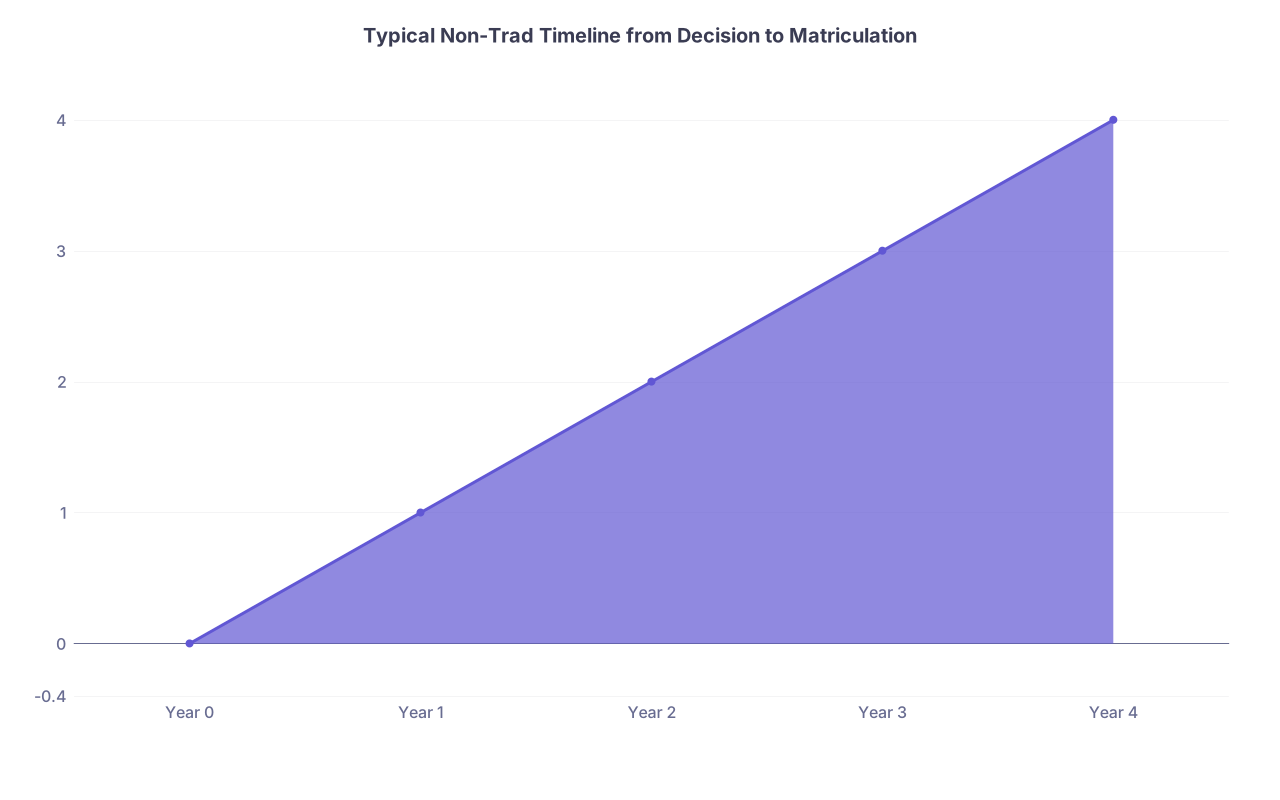
Here’s what realistic looks like for someone still working full‑time:
| Category | Value |
|---|---|
| Year 0 | 0 |
| Year 1 | 1 |
| Year 2 | 2 |
| Year 3 | 3 |
| Year 4 | 4 |
That “4” on the right? That’s often when you actually start med school after deciding to pivot. Not a typo.
Year 0: Decide + explore + start shadowing
Year 1–2: Take pre‑reqs
Year 2–3: MCAT + application cycle
Year 4: Matriculate
If you’re thinking, “That’s too long, I want it faster,” you’re still in fantasy mode. You’re not cramming this between quarterly earnings calls.
Step 4: Decide Your Education Route – DIY vs. Formal Post‑Bacc
This is one of the few truly strategic choices you make early on.
Option 1: Formal Career‑Changer Post‑Bacc
These are structured programs specifically for people like you: smart, no science background, older.
Pros:
- Cohort of similar students (lots of former lawyers, bankers, consultants)
- Built‑in advising, committee letter, prereqs sequenced correctly
- Sometimes have linkage agreements to med schools (conditional early admission)
- Easier to convince yourself to commit hard if you leave your job for it
Cons:
- Expensive. Often $30k–$50k+ tuition, not counting living expenses.
- Usually full‑time. Hard to combine with BigLaw or banking.
- You’re locked into their schedule and pace.
Option 2: DIY Post‑Bacc (Local University or State School)
You enroll as a non‑degree or second‑degree student and piece together the prereqs.
Pros:
- Cheaper, especially at public universities
- Maximum flexibility (can take 1–2 classes while working, ramp up when able)
- Can show grit by pulling strong grades while holding a demanding job
Cons:
- You’re your own advisor. Easy to sequence things badly.
- No guaranteed committee letter; letters depend on individual professors.
- Can feel isolating, surrounded by 19‑year‑olds stressed about dorm drama.
Here’s when I’d recommend each:
| Situation | Better Option | Why |
|---|---|---|
| You can quit or drastically downshift work | Formal post-bacc | Faster, structured, maximizes GPA repair |
| You must keep earning a strong income for 1–2 years | DIY | Flexibility, lower cost |
| Your GPA is <3.2 and needs serious rehab | Lean formal | Structure + support may matter more |
| Your GPA is solid and you just lack prereqs | Either | Choose based on cost and lifestyle |
If you’re still billing 2200+ hours or running live deals every week, you’re not taking orgo and physics at the same time. You’ll break. Scale the job down or scale the timeline out.
Step 5: Build a Realistic Work–School–Life Plan
This is where law/finance folks mess up. They treat this like another “sprint” they can dominate with sheer will and 60‑hour weeks. That’s how you burned out in the first place.
You need an explicit, written plan that answers:
- How many hours/week can you reliably dedicate to class + study?
- What’s your exit or downshift plan from your current role?
- What’s your financial runway?
As a rough rule of thumb:
- Each 4‑credit hard science class → ~10–15 hours/week (class + study).
- Two of those while working 50+ hours? Possible for short bursts. Miserable long‑term.
Typical sustainable combos I’ve seen work:
- BigLaw or high‑finance with 1 science class at a time.
- Reduced‑hours legal/finance job (30–40 hrs) with 2 classes.
- Full‑time post‑bacc, no substantial job beyond maybe weekend tutoring or similar.
If your current job is unpredictable (deals, trials, closings), be honest: will you really tell a senior partner you can’t hop on a late-night call because you have a physics midterm? I know how that conversation will go.
Many people end up:
- Moving from BigLaw to government, in‑house, or small firm
- Moving from banking to corporate dev, FP&A, or a quieter shop
- Going part‑time or freelance, if possible
Is it a pay cut? Yes. But you’re buying the time you need to become a competitive applicant. That’s the trade.
Step 6: Plan the MCAT Like a Major Transaction
From law/finance to medicine, your MCAT score will be heavily scrutinized. It’s the single cleanest “yes, I can handle this” signal med schools get from you.
Do not treat the MCAT as an afterthought wedged between board meetings.
Here’s a simple breakdown of what I’ve seen work for professionals:
| Weekly Free Time | Typical Duration | Comments |
|---|---|---|
| 10 hrs/week | 10–12 months | Very slow but doable with intense jobs |
| 15–20 hrs/week | 6–9 months | Common sweet spot for working adults |
| 25+ hrs/week | 3–5 months | Usually requires reduced work hours |
Core strategy:
- Do content review after you’ve done the core prereqs (gen chem, orgo, bio, physics). Don’t cram MCAT orgo while learning orgo for the first time.
- Invest in a serious set of prep resources (AAMC materials are non‑negotiable; supplement with a major company’s books/Qbanks).
- Build a weekly schedule that lives in your calendar like meetings. Non‑negotiable blocks.
- Plan for at least 6–8 full‑length practice exams, ideally in the final 2–3 months before test day.
You’ve done bar prep or CFA levels. You already know how to grind for a high‑stakes exam. Use that muscle. Just don’t assume the MCAT is easier. It’s not. It’s weirder and more stamina‑based.
Step 7: Build the Rest of the Application Around Your Story
Admissions committees don’t want a generic “I like science and helping people” essay from a 32‑year‑old ex‑litigator.
They want to see:
- A coherent narrative: What was missing in law/finance that medicine actually addresses?
- Evidence that you didn’t make this decision impulsively.
- Sustained commitment in clinical and service activities.
- Humility about starting over.
You need four pillars besides grades/MCAT:
- Clinical experience: scribing, MA, EMT, free clinic, hospice, hospital volunteering
- Non‑clinical service: consistent, community‑oriented work (tutoring underserved students, homelessness outreach, etc.)
- Shadowing: varied specialties, including primary care
- Letters of recommendation: recent science faculty, plus maybe one strong professional letter that actually knows you
Do not over‑index on your corporate prestige. The fact that you worked at Cravath or Goldman is a nice bullet, not your personality.
The key is to show a pattern: you kept showing up for patients, for service, for science, over months and years, despite an already demanding career. That’s compelling.
Step 8: Money, Loans, and Hard Numbers
You’re probably used to six‑figure comp or at least a strong income trajectory. Medicine will absolutely nuke that for a while.
Med school tuition alone:
- Public schools: ~$40–60k/year
- Private schools: ~$60–70k+/year
Plus living expenses.
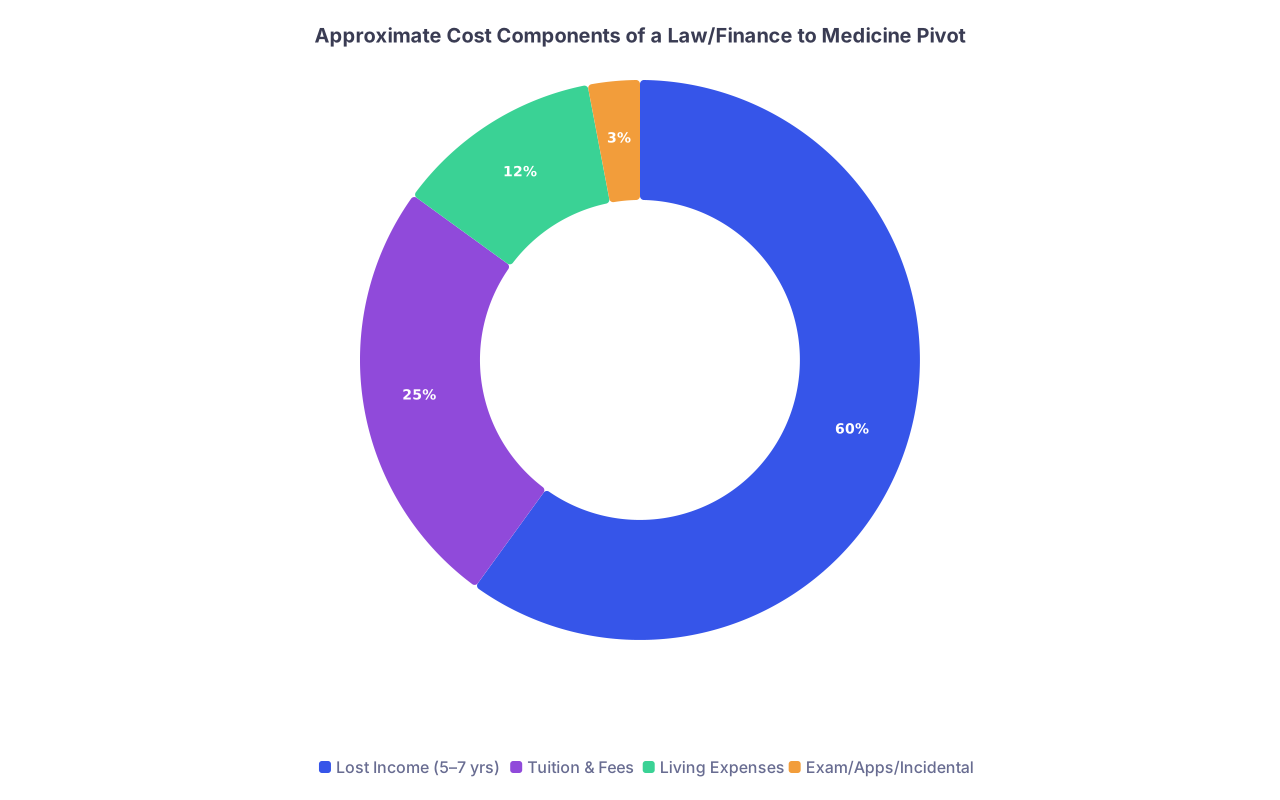
Let’s put rough numbers on the total cost of a career change:
| Category | Value |
|---|---|
| Lost Income (5–7 yrs) | 60 |
| Tuition & Fees | 25 |
| Living Expenses | 12 |
| Exam/Apps/Incidental | 3 |
That “lost income” slice? It’s the big one. If you were on track to make partner or MD, the opportunity cost is enormous. You don’t need a perfect NPV calculation, but you do need to be sober about it.
Action items:
- Run a 10–15 year projection: current path vs. medicine, even back‑of‑the‑envelope.
- Factor in federal loan options (including income‑driven repayment and PSLF if you do academic/VA/non‑profit work later).
- Decide now how much lifestyle deflation you’re willing to tolerate: smaller apartment, no car upgrade, fewer trips.
If your spouse or partner is involved, this isn’t a solo decision. Have the uncomfortable conversation early. “How do we feel about living on one income while I reset my career?” is not a thing to spring on someone after you’ve already enrolled in orgo.
Step 9: Handling Age, Identity, and Ego
You might be 30, 35, 40. You’ll be in class with people who were in high school when you were grinding 100‑page deals.
Common fears I hear:
- “I’ll be too old when I finish.”
- “Will programs even want me?”
- “I’m used to being senior. Can I tolerate being a first‑year anything again?”
Reality check:
- Mid‑30s matriculants are not rare. Early 40s is less common, but still happens.
- Many schools appreciate non‑traditional students who bring maturity and different skill sets.
- You’ll absolutely feel weird the first semester. Then you’ll get over it.
Your job is to:
- Own your prior career without arrogance. “I learned X skills, but I realized I want Y type of impact.”
- Show you understand the real sacrifices and day‑to‑day of medicine, not just the Instagram version.
- Demonstrate you can take feedback, be a learner again, and not pull rank with “well, in my previous career…”
You also need to grieve a little. Grieve the partner track, the title, the income curve, the identity you’ve been building. That’s normal. Just don’t let nostalgia trap you in a life you already know is wrong for you.
Step 10: Put It All Into a Concrete 3–5 Year Plan
If you’re used to transactions, think of this as your deal timeline. With contingencies.
Example for a 30‑year‑old BigLaw associate with minimal science:
Year 0 (Now – Next 6 Months)
- Shadow 2–3 physicians (primary care + one specialty)
- Start weekly clinical volunteering (e.g., free clinic, hospice)
- Take one evening intro bio or chem class to test the waters
- Explore post‑bacc options; talk to at least 2 non‑trad med students
Year 1
- Move from BigLaw to in‑house/government/smaller firm or cut hours
- Commit to 2 science courses per term (bio + chem)
- Maintain clinical and service work (2–4 hours/week steady)
Year 2
- Finish remaining prereqs (orgo, physics, biochem if needed)
- Ramp up MCAT prep over 6–9 months
- Take MCAT mid‑year
- Start application prep (personal statement, school list, letters)
Year 3
- Apply in June (early)
- Secondary essays in summer, interviews fall–winter
- Keep working/volunteering until matriculation
Year 4
- Start medical school
You adjust the years based on your situation. But you do put dates on a page. Vague dreams never survive busy seasons and quarter‑ends.
When You Should Probably Not Do This
Let me be direct about red flags I’ve seen blow up later:
- You have zero tolerance for financial insecurity or lifestyle downgrade.
- You can’t imagine missing multiple major life events (weddings, trips, even some kid milestones) due to training.
- You want medicine to “fix” your unhappiness without doing deeper work on why you’re burned out.
- You’re more excited about the idea of being “Doctor [Name]” than the daily grind of caring for sick, messy humans.
If that list stings a bit, sit with it. Talk to a therapist. Talk to physicians who are 10+ years out of training, not just glowing MS1s.
Two or Three Things to Actually Remember
You’ve read a lot. Let’s boil it down.
Treat this as a serious, multi‑year project. Not an escape hatch. Get real clinical exposure, map your academic gaps, and plan your finances before you leap.
Your prior career is an asset only if paired with humility and fresh evidence. New A’s in hard science, a strong MCAT, and months or years of consistent patient‑facing work matter more than the firm on your resume.
You’re not too old. But you are too experienced to lie to yourself. If you choose medicine, do it with your eyes open, a calendar in front of you, and a plan you’d be proud to defend in a boardroom.