

It's February 3rd. You’re 34, staring at an Excel sheet with MCAT dates, AMCAS deadlines… and your age at each training milestone. The math is not subtle: if you start med school at 36, you finish residency at 43–45. You want kids. Not “maybe.” Definitely.
Here’s the tension: biology plays one timeline, medical training plays another, and they do not care about each other. You have to.
I’m going to walk you through it chronologically: premed prep, application year, med school years 1–4, and early residency. At each point: what to decide, what to line up medically and financially, and where pregnancy/parenthood realistically fits (and where it’s a terrible idea).
0–12 Months Before Applying: Reality Check + Baseline Planning
At this point you should be brutally honest with yourself and your timeline.
1. Map your ages vs. training years
Grab a sheet. Write this out:
- Current age
- Projected age:
- When you start med school
- When you graduate
- When you finish residency (by specialty)
| Stage | Start Age | End Age |
|---|---|---|
| Premed coursework | 34 | 35 |
| Med school (4 years) | 36 | 40 |
| IM residency (3 years) | 40 | 43 |
| Fellowship (optional, 3) | 43 | 46 |
Now overlay your desired child timeline:
- “Must be pregnant by X” or “Want first child by X”
- Number of children you think you want
This isn’t about perfection. It’s about seeing if “I’ll just wait until after residency” actually means “I’m trying for my first kid at 43.”
2. Get a fertility and health baseline right now
This is the part late-career folks skip until it’s a crisis. Do not.
At this point you should:
- Book with:
- An OB‑GYN for:
- Preconception counseling
- Pap/HPV up to date
- Vaccines: MMR, varicella, Tdap, maybe Hep B, flu, COVID
- A reproductive endocrinologist (REI) if:
- You’re >32 and want to delay children
- You’ve had irregular cycles, endometriosis, prior miscarriages
- You’re contemplating single parenthood by choice
- An OB‑GYN for:
Ask specifically for:
- Ovarian reserve assessment:
- AMH
- Day‑3 FSH/LH/E2
- Antral follicle count (ultrasound)
- Preconception labs:
- Thyroid, A1c if risk factors, rubella/varicella immunity
Do not overinterpret AMH as destiny, but do use it as input for strategy.
3. Decide your broad child‑timing strategy
You don’t need perfect answers, but you do need a working hypothesis:
- “Aim for pregnancy during premed / gap year”
- “Freeze eggs or embryos now and plan kids during residency”
- “Try for first kid during M3–M4”
- “No kids until attending (with backup fertility plan)”
If you’re in your mid/late 30s and want >1 child, “I’ll wait until after training” is usually fantasy. You plan kids during training or you plan for fertility treatment later. Those are the real options.
4. Build financial runway specifically for pregnancy/parenthood
At this point you should:
- Target 6–12 months of living expenses saved before you start med school if:
- You think pregnancy is likely during M1–M2
- You’re single or your partner’s income is unstable
- Get clear on:
- Your health insurance now (fertility coverage? IVF? egg freezing?)
- Potential med schools’ insurance and leave policies later (you’ll research this during application year)
Rough planning number: a pregnancy with complications + unpaid leave + childcare start-up can easily hit $10–20k out-of-pocket in the U.S. You can’t loan your way out of all of that smoothly.
6–18 Months Before Matriculation: Application Year Strategy
Let’s say you’re entering your application cycle now or soon.
At this point you should decide: Am I trying to be pregnant during applications, during interviews, or not at all this year?
1. If you’re considering pregnancy during the application year
Break it down by trimesters overlapping these phases:
- MCAT + primary apps: spring/summer
- Secondaries: late summer
- Interviews: fall/winter
Roughly:
- First trimester during MCAT/primaries:
- Risk: nausea, fatigue, miscarriage anxiety
- Advantage: you might not be visibly pregnant during interviews
- Second trimester during interviews:
- Physically often the “best” time
- You may be visibly pregnant on interview day
- Third trimester during interviews:
- Risky. Travel restrictions, preterm labor risk, miserable flights
- Also: if you deliver mid‑interview season, you could miss offers
If you choose this route:
At this point you should:
- Schedule MCAT earlier, not later:
- Aim for taking it at least 2–3 months before trying to conceive, if possible
- Front‑load:
- Letters
- Personal statement
- Activities section describing nontraditional background
- And mentally accept:
- You might need to cancel some interviews
- You’ll be choosing schools with family‑friendly reputations (not just prestige)
2. Egg or embryo freezing during the application year
If you’re older (say 35–40) and not ready for pregnancy yet:
At this point you should:
- Schedule a consult with REI as soon as your MCAT is done
- Plan a 2–3 month window (a lull in the heaviest application work) for:
- Stimulation cycle(s)
- Retrieval
- Follow-up
Egg/embryo freezing is physically and emotionally taxing. Layering it on top of hardcore MCAT prep is masochistic. Put it in a relative “valley” in your timeline.
The “When Should I Actually Be Pregnant?” Overview
Let me zoom you out for a minute. Here’s the honest, high-level rating of timing options.
| Timing | Workload Level | Flexibility | Career Disruption | Overall Feasibility (Late-Career) |
|---|---|---|---|---|
| Before med school | Low–medium | High | Minimal | Excellent |
| M1–M2 | Medium | Moderate | Manageable | Good if planned |
| M3–M4 | High | Low | Significant | Hard, but doable |
| Residency intern year | Brutal | Very low | Very high | I strongly discourage |
| PGY2+ residency | High | Low–mod | Moderate–high | Possible with support |
That “Excellent / Good / Hard / Brutal” is me not sugarcoating. I’ve watched people do each of these.
Now we go year by year.
Year 0 (Premed / Gap Before Matriculation): Best Window to Intentionally Conceive
If you’re late‑career and want at least one kid before 40, this is prime time.
Month-by-month for an intentional “pregnant pre-matric” plan (12–18 months out)
12–9 months before school starts
At this point you should:
- Finish MCAT
- Submit primaries and secondaries
- Get your fertility baseline (if you didn’t already)
- Clean up:
- Medications (teratogens? switch now)
- Supplements
- Smoking/alcohol
If you’re trying to conceive, you can start now with this rule: assume 6–12 months to get pregnant is normal, especially mid‑30s+. Do not “wait for the perfect moment.” It doesn’t exist.
9–6 months before school starts
- Ideally you’re:
- Pregnant in first–second trimester
- Interview season is wrapping up or done
- Start researching:
- Med schools’ parental leave policies
- Part‑time options
- Deferral policies (critical)
At this point you should:
- Email or call admissions after acceptance (not before) and ask:
- “Do you allow 1-year deferrals for childbirth?”
- “How do students handle maternity/paternity leave during M1–M2?”
- Talk to current students with kids at those schools. Don’t rely on brochures.
6–0 months before school starts
Two main scenarios:
You deliver before M1 starts
- Pro: You start school with a newborn, not while pregnant
- Con: Newborn plus M1 is brutal; childcare must be ironclad
You’re pregnant and due during M1
- Pro: You can time a leave during didactics (more flexibility than clerkships)
- Con: You may need to shift to a 5‑year track or take a term off
At this point you should:
- Decide:
- Start on time with leave?
- Request deferral and start the following year?
- Lock in:
- Partner support schedule
- Childcare options or family help
- Housing near campus and childcare
M1–M2: If Pregnancy Happens During Preclinical Years
This is the second‑best window. Still hard, but structurally more forgiving than clerkships or intern year.
Planning by semester
Before M1 starts
At this point you should:
- Clarify:
- Attendance policies (mandatory vs. recorded lectures)
- Exam schedules (can they be shifted?)
- Accommodations process (pregnancy is protected under Title IX)
- Make a “leave tree”:
- If due date = mid‑semester → what is the school’s usual solution?
- If complications → who do you call? Dean of students? Course director?
First semester (M1)
If you’re trying to conceive:
- Try to avoid:
- First trimester hitting your heaviest adjustment period to med school, if you can
- But if it happens:
- Meet with:
- Student health
- Dean of students
- Disability/Title IX office (for accommodations)
- Meet with:
Practical adjustments:
- Exam scheduling: cluster vs. spread depending on nausea/fatigue patterns
- Lab sessions: negotiate standing/sitting, exposure protections, absences
Second semester (M1) / M2
If you’re already pregnant:
At this point you should:
- Decide with administration:
- Will you:
- Take a defined leave around delivery (4–12 weeks)?
- Shift to a 5‑year track?
- Will you:
- Put in writing:
- Exact dates for:
- Last day before leave
- Expected return
- How incomplete courses will be finished
- Exact dates for:
Do not rely on verbal “we’ll work it out.” Administrations change.
M3–M4: Pregnancy in the Thick of Clinical Work
This is where things get real. Not impossible, but high-friction.
M3: Rotations + Pregnancy
At this point you should calibrate your expectations:
- You cannot:
- Night float + call Q3 + third-trimester exhaustion without something breaking
- You can:
- Restructure your year if your school is flexible and you’re proactive
Ideal if you can choose:
- Put:
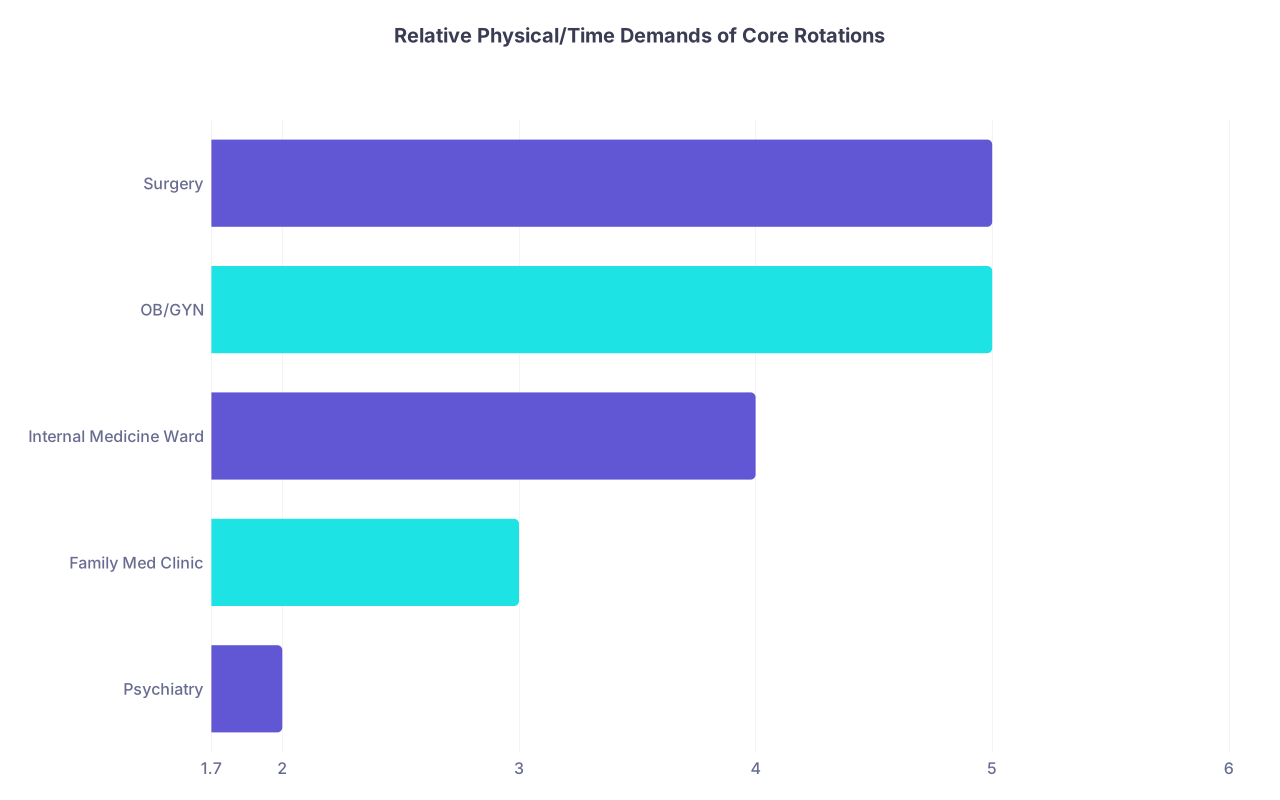
- Less physically demanding rotations (psych, FM clinic, neuro) in the late second/third trimester
- Heavy services (surgery, OB, ICU) earlier if safe
| Category | Value |
|---|---|
| Psychiatry | 2 |
| Family Med Clinic | 3 |
| Internal Medicine Ward | 4 |
| OB/GYN | 5 |
| Surgery | 5 |
Scale: 1 = light, 5 = brutal.
At this point you should:
- Tell your clerkship director early you’re pregnant (once you’re comfortable medically)
- Request:
- Limits on overnight call in late pregnancy (often supported as accommodation)
- Bathroom and snack breaks (you’d be shocked how hard this is unless you state it clearly)
- Plan prenatal care:
- Who covers your appointments?
- How do you handle missed time?
M4: Some breathing room, some traps
M4 has more electives, interviews, and Step 2 timing.
If you’re planning pregnancy:
- Consider:
- Try for conception early M4 → second trimester during lighter electives
- Or delivery just after graduation, before intern year
At this point you should:
- Avoid:
- Third trimester overlapping peak residency interview travel if you can
- Strategize for Step 2:
- Take it either:
- Before pregnancy
- Or earlier in pregnancy, not deep in third trimester exhaustion
- Take it either:
Residency: The Harshest Collision of Biology and Training
Residency is where a lot of late-career parents slam into reality.
Choosing specialty with parenthood in mind
You’re allowed to be pragmatic. It’s not “selling out” to notice lifestyle differences.
| Category | Value |
|---|---|
| Psych | 55 |
| Peds | 60 |
| IM | 65 |
| OB/GYN | 70 |
| Gen Surg | 80 |
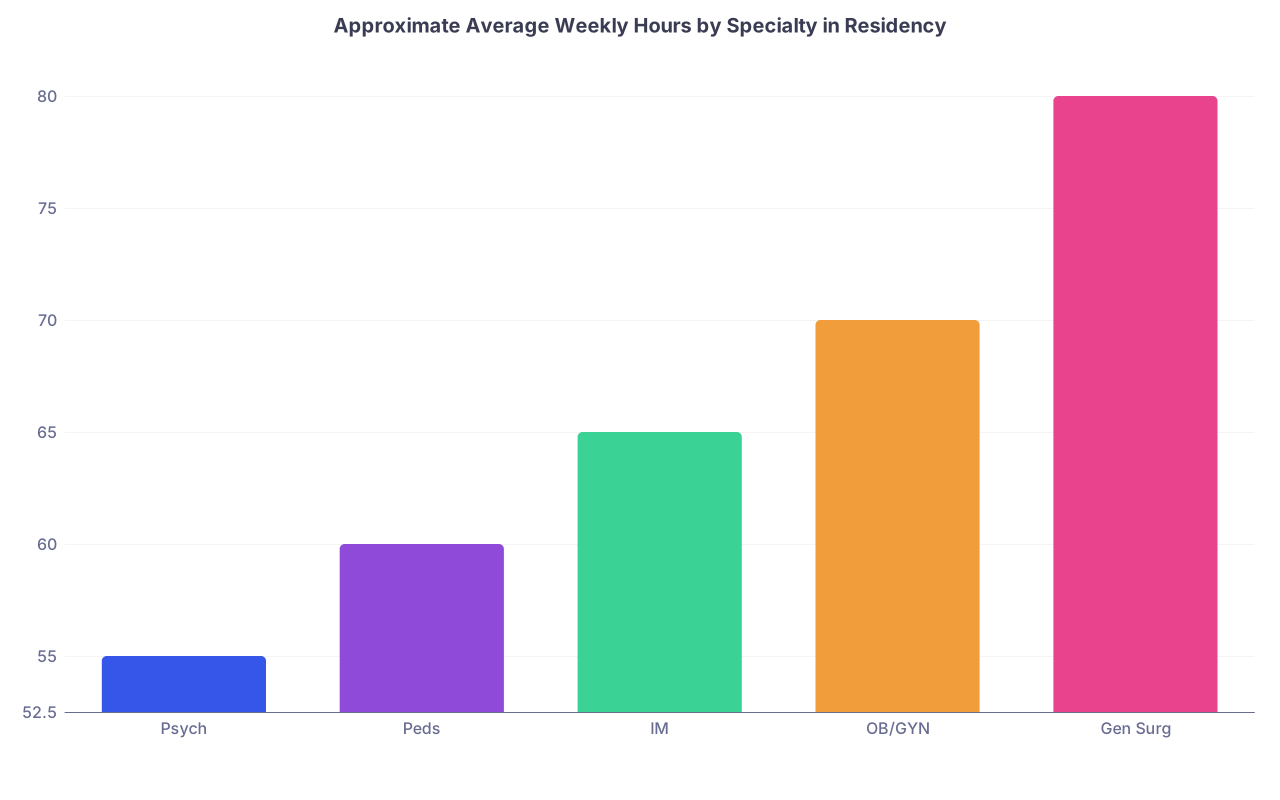
If you see yourself having a newborn at 39–42, there’s a huge difference between 55 and 80 hours a week. Ignore people who pretend otherwise.
Intern year pregnancy: why I strongly discourage it
Intern year is:
- New EHR
- New hospital
- Constant evaluation
- Least control of schedule
- Usually the heaviest call burden
Add first-trimester nausea or third-trimester limitations and you’re in “self-sacrifice Olympics” territory. I’ve watched it. It’s rough.
If biology forces the issue, you do what you need to. But if you’re planning, at this point you should bias strongly toward:
- Pregnancy in:
- PGY2–3 (with co-residents you know)
- Or before residency
- And you should ask in interviews (carefully, but firmly) about:
- Parental leave specifics (not “we’re supportive,” but:
- How many weeks?
- Paid vs unpaid?
- Does time count toward training?
- Schedule accommodations
- Parental leave specifics (not “we’re supportive,” but:
Parallel Track: If You’re Not Ready for Kids But Don’t Want to Lose Options
You may be 35, single, and not ready for kids—yet you also don’t want biology closing the door.
At this point (before or early in med school) you should consider:
1. Fertility preservation timeline
Egg/embryo freezing takes:
- 1 cycle:
- ~2 weeks of injections + monitoring
- 1 procedural day for retrieval
- Often repeated 1–3 times for adequate numbers, especially >37
This fits best:
- After MCAT, before full-time pre-reqs or job
- During a dedicated premed gap year
- During a scheduled med school break (summer between M1–M2) if your school has ~8–10 weeks off
2. Evaluate coverage and cost early
At this point you should:
- Check:
- Current employer insurance (if you’re still working)
- State mandates (some states require infertility coverage)
- Plan a savings goal:
- Egg freezing cycle: often $8–15k + meds
- Storage: $500–$1000/year
It’s expensive. But for some late-career folks, it’s the only way to align medicine’s marathon with their desire for kids.
Putting It All Together: A Sample Integrated Timeline
Here’s a concrete example for a 34‑year‑old career changer aiming to start med school at 36 and have 2 kids.

| Period | Event |
|---|---|
| Premed (34-35) - 34.0 | Finish prereqs, take MCAT |
| Premed (34-35) - 34.3 | Fertility consult, baseline labs |
| Premed (34-35) - 34.5 | Apply to med school |
| Premed (34-35) - 34.7 | Attempt egg freezing cycle |
| Application Year (35-36) - 35.0 | Begin trying to conceive |
| Application Year (35-36) - 35.3 | Interview season |
| Application Year (35-36) - 35.5 | Pregnant, second trimester |
| Application Year (35-36) - 35.8 | Deliver first child |
| Med School (36-40) - 36.0 | Start M1 with infant, strong childcare in place |
| Med School (36-40) - 37.0 | M2, no pregnancy attempts |
| Med School (36-40) - 38.0 | Early M3, consider TTC for second child |
| Med School (36-40) - 38.8 | Late M3 / early M4, second pregnancy |
| Med School (36-40) - 39.3 | Take Step 2, light electives |
| Med School (36-40) - 39.5 | Deliver second child |
| Residency (40+) - 40.0 | Start residency with two kids, no planned pregnancy |
Is this “clean”? Not remotely. But it’s intentional. The chaos is at least choreographed.
FAQ (Exactly 3 Questions)
1. Should I delay applying to medical school to have a baby first if I’m already 35+?
If you’re 35+ and very sure you want kids, delaying one year to have a baby can make sense—especially if your fertility workup suggests you shouldn’t wait. But do the math. If a 1‑year delay means:
- Starting med school at 37 instead of 36
- Finishing residency at 44 instead of 43
that’s rarely the factor that breaks your career. The bigger risk is assuming you’ll easily conceive “after residency” at 42. I’d rather see you accept a 1‑year delay than roll the dice on biology with no backup plan.
2. How do I talk about pregnancy or plans for kids in interviews without hurting my chances?
Do not lead with “I plan to be pregnant in M2.” You’re not obligated to disclose future pregnancy plans. What you can do is ask neutral, policy‑focused questions: “How do students with caregiving responsibilities fare here?” “What is your formal parental leave policy for students?” You can ask current students more direct questions on second looks or via email. Save explicit personal details for after you have an offer, when you negotiate deferral or leave structures.
3. Is it selfish or irresponsible to have kids during med school or residency?
No. What’s irresponsible is pretending you’re superhuman and then collapsing under the load. Having kids during training is common; doing it late‑career just compresses the stakes. It becomes responsible when you:
- Have a concrete support plan (partner, family, paid help)
- Understand the impact on your schedule and learning
- Protect your own health instead of martyring yourself Your patients don’t benefit from you sacrificing your entire life timeline to an idealized, child‑free training path that may never realistically align with your fertility window.
Key points:
- Map your age against training years early; don’t hand-wave the math.
- Get a fertility and health baseline before you start the application treadmill.
- Choose one or two realistic windows for pregnancy (premed, M1–M2, or PGY2+), and design your academic and financial plans around those windows on purpose—not by accident.


