
The biggest lie about MD–PhD training is that it’s only for “geniuses.”
You’re not crazy for thinking, “What if I’m just not smart enough for a PhD on top of medicine?” I’ve watched a lot of very normal, very non-superhuman people get MD–PhDs, and I’ve also watched some terrifyingly brilliant people burn out and leave with just an MD. So the fear? Real. The story your brain is telling you about what “smart enough” means? Pretty distorted.
Let’s unpack this without the sugar-coating, because I know that’s not what your anxiety wants. Your anxiety wants details, worst-case scenarios, comparisons, numbers, and a sense of: “Will I actually survive this or am I about to ruin my life?”
What “Smart Enough for a PhD” Actually Means (And What It Doesn’t)
The cartoon version in your head goes something like this: MD–PhD people breeze through biochem, reference papers from memory, get 270+ on Step 2, and casually publish Nature papers before breakfast. You, meanwhile, needed Anki, three passes through First Aid, and a quiet cry during pharmacology.
That gap feels enormous. It isn’t.
In real life, “smart enough” for a PhD in the context of being a physician-scientist usually boils down to something way less glamorous and way more uncomfortable:
- You can tolerate being confused for long stretches without completely shutting down.
- You can handle slow progress without interpreting it as “I’m stupid.”
- You can ask “dumb” questions out loud in front of people who seem smarter than you.
- You can keep showing up even when your project is a smoking crater.
That’s it. Notice what’s missing: perfect MCAT, 4.0 GPA, “natural genius,” or always understanding the paper on first read.
I’ve seen MD–PhD students who:
- Failed their first organic chemistry midterm.
- Got 510-ish MCAT scores.
- Had zero first-author publications when they started.
- Needed a tutor for stats.
And they still finished their PhDs, defended their theses, and are now faculty or fellows.
Your brain is doing this unhelpful thing where “struggling = not smart enough = doomed.” In PhD land, struggling is the default setting. The people who look calm are just better at tolerating it, not better at avoiding it.
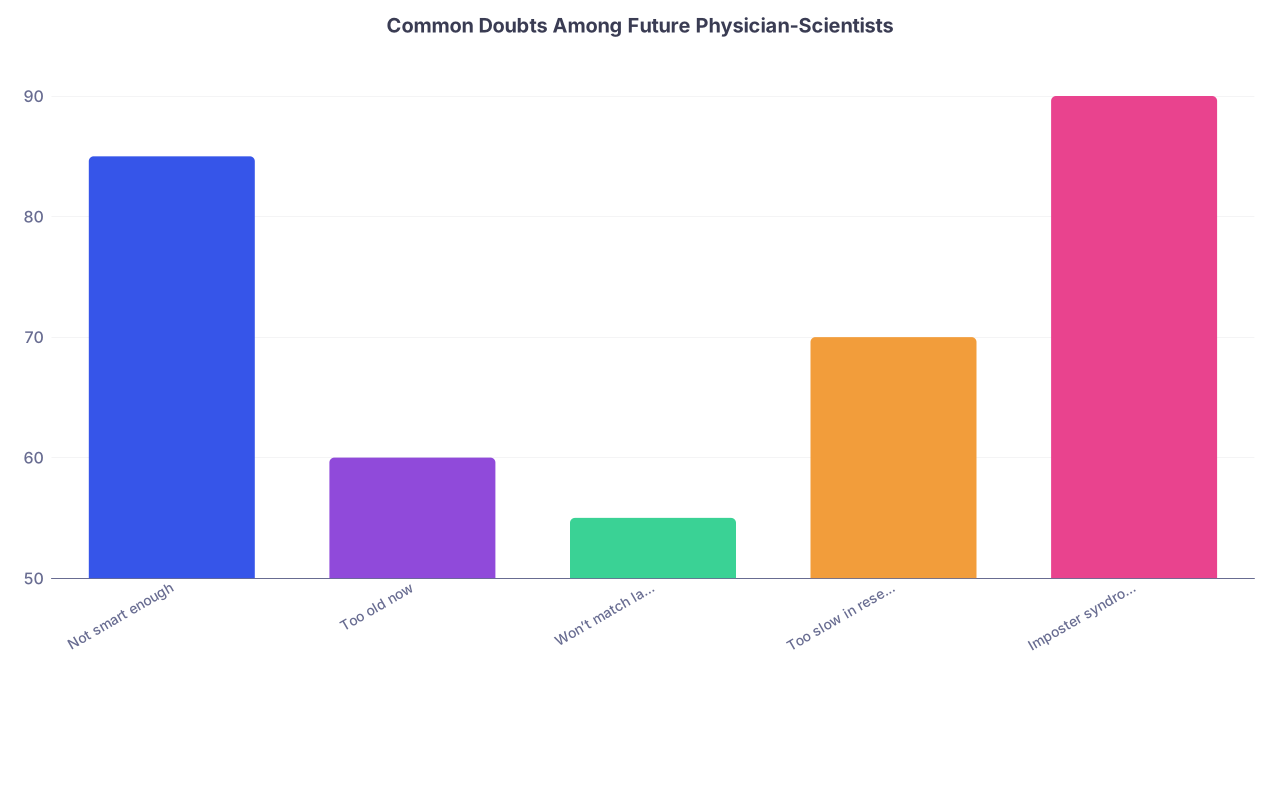
| Category | Value |
|---|---|
| Not smart enough | 85 |
| Too old now | 60 |
| Won’t match later | 55 |
| Too slow in research | 70 |
| Imposter syndrome | 90 |
MD vs MD–PhD: The Fears You’re Not Saying Out Loud
There’s the “I’m not smart enough” line you say to other people, and then there’s the real stuff under that:
- “What if I start a PhD and they figure out I’m actually not that good?”
- “What if I slow myself down by 3–5+ years and then regret it?”
- “What if everyone else in the lab is effortlessly brilliant and I’m the weak link?”
- “What if I tank my chances at competitive residency because I wasn’t good enough at either path?”
Let me be direct: those are rational concerns. This isn’t deciding whether to join a pottery club. It’s years of your life and a very different training path.
But “rational concern” doesn’t mean “you’re not capable.” It means you need to be brutally honest about what you actually want your day-to-day life to look like.
Here’s the ugly truth nobody puts on the brochure: MD–PhD training doesn’t select for “peak IQ.” It selects for people who can tolerate:
- Uncertainty
- Rejection (papers, grants, revisions)
- Projects failing after months of work
- Feedback that stings
- Watching classmates move ahead in their careers while you’re still pipetting at 10 pm
If your core fear is “I’m not a genius,” then you’re fighting the wrong battle. If your core fear is “I can’t handle that environment emotionally,” that’s the battle you actually need to think about.
What MD–PhD Programs Actually Look At (vs What You’re Panicking About)
Your anxiety probably zooms in on numbers: MCAT, GPA, board scores, publications. Let’s put that against reality.
| Area | What You Think Matters | What Programs Actually Care About |
|---|---|---|
| Intelligence | Genius-level IQ, never struggle | Problem-solving, persistence, curiosity |
| Grades/Scores | Perfect 4.0 and 520+ | Solid academics that show you can handle it |
| Research Output | Multiple first-author big papers | Real engagement, letters, understanding |
| Personality | Always confident, never anxious | Coachable, resilient, asks for help |
Yes, scores and grades matter. If you’re barely scraping by in every science course, that’s a problem. But the bar you’re imagining—effortless dominance in everything—is fantasy.
I’ve watched admissions committees skim over minor grade blips and then get very, very interested when they see:
- A strong letter from a PI saying, “This student thinks like a scientist.”
- A personal statement that shows you understand the reality of research, not just the glamour.
- Consistent research engagement over time, even if the output is modest.
They’re not looking for 22-year-old Nobel Prize winners. They’re looking for people who can survive and finish an MD–PhD.
Worst-Case Scenarios (Because I Know That’s Where Your Brain Goes)
Let’s actually walk through the nightmare situations your brain keeps replaying:
Nightmare 1: “I start a PhD and realize I really am not smart enough.”
What this usually looks like in real life:
You’re slower than others at learning certain methods. You need more help with stats. Your PI points out gaps in your understanding. You’re not the star of the lab.
That’s not “not smart enough.” That’s “a normal trainee.”
Truly catastrophic cases—where someone absolutely cannot keep up intellectually—are rare. Almost always, what’s going wrong is:
- Bad mentorship
- Toxic lab culture
- Poor project fit
- Zero training in skills you’re suddenly expected to just “have” (like coding, advanced stats, etc.)
- Unmanaged mental health issues (depression, anxiety, ADHD) that make everything feel impossible
Those things are fixable. Painful, yes. But fixable. Most people who leave PhD tracks aren’t ejected for being “too dumb.” They leave because the cost to their sanity or life priorities got too high.
Nightmare 2: “I waste 4–5 years and end up with just an MD anyway.”
This one stings. Because it does happen.
But “waste” is doing a lot of work there. I know people who started PhDs, switched back to MD-only, and:
- Matched into great residencies
- Still do research as clinicians
- Use the skills they picked up (critical appraisal, study design, coding, etc.) daily
It’s not like leaving the PhD track erases all that. You don’t get a scarlet L on your file. Programs mostly want to know: did you handle it professionally, and can you explain what you learned and where you’re headed now?
Nightmare 3: “I’m mediocre at both—too slow for PhD, not impressive enough for residency.”
Here’s the uncomfortable reality: you’re not competing against some imaginary perfect MD–PhD who did groundbreaking science and scored 270 on Step 2. You’re competing in specific specialties, at specific programs, with human selection committees who care about a combination of:
- Clinical performance
- Letters
- Board scores
- Research (for some fields)
- How you come across in person
People with very average stats but strong research and narrative do perfectly fine. People with stellar academics but scattered, superficial research often don’t.
A PhD can absolutely be an asset. It can also be an emotional and time burden. But “mediocre at both” is usually just anxiety labeling any non-perfect profile as failure.
How to Test If You’re Actually a Good Fit for a PhD (Without Commitment)
Don’t decide this in your own head with no external data. That’s how you end up catastrophizing yourself into paralysis.
You can pressure-test this idea now:
Look at your actual research behavior, not your fantasy version.
When you were in the lab or doing a project:- Did you ever find yourself thinking about the project outside of required hours?
- Did you enjoy the process of figuring out why an experiment failed, not just rushing to fix it?
- Did you read papers because you had to, or because you were genuinely curious where the field was going?
If the answer is “honestly, I kind of liked it once I got over the fear,” that’s meaningful.
Ask your PI/mentor a very direct question.
Something like: “I’m seriously considering MD–PhD training, but I’m worried I might not be strong enough as a researcher. What do you honestly see as my strengths and limits right now?”If they say, “You’re brilliant, do it,” that’s nice but not enough. You want comments like:
- “You ask good questions.”
- “You’re persistent.”
- “You take feedback and improve.”
Those are PhD traits.
Notice how you respond to not understanding something.
When you read a dense paper or attend a talk and understand 20% of it, do you:- Spiral into “I’m too dumb”?
- Or feel a bit uncomfortable, then curious enough to Google a few terms and accept that you’re early in the learning curve?
PhD life is 80% “I don’t fully get this yet.” If you cannot psychologically tolerate that, the problem isn’t intelligence. It’s your relationship with not-knowing.

| Step | Description |
|---|---|
| Step 1 | Interested in research |
| Step 2 | MD only likely better fit |
| Step 3 | Do MD with research electives |
| Step 4 | Consider research-heavy MD path |
| Step 5 | MD PhD is reasonable to pursue |
| Step 6 | Enjoy problem solving |
| Step 7 | Tolerate uncertainty |
| Step 8 | Need research as core career |
You Don’t Have to Be a “Capital-R Researcher” To Have Impact
Another anxiety trap: “If I don’t do MD–PhD, I’m just giving up on doing meaningful research forever.”
That’s false. Lots of MD-only physicians:
- Lead clinical trials
- Run outcomes or QI research programs
- Collaborate with PhDs on translational work
- Hold grants (yes, even major ones)
The PhD mainly buys you deeper training, time, and credibility in certain circles. It does not magically make you “the kind of person who can do research.” You can build that through:
- Research fellowships during residency/fellowship
- Masters programs (MPH, MS in Clinical Research, etc.)
- Strong mentorship and good projects later in training
If your main fear is “I’ll close doors without a PhD,” that’s anxiety talking in absolutes. You close some doors, open others (time, earlier attending salary, less training fatigue). It’s a trade, not a binary failure.
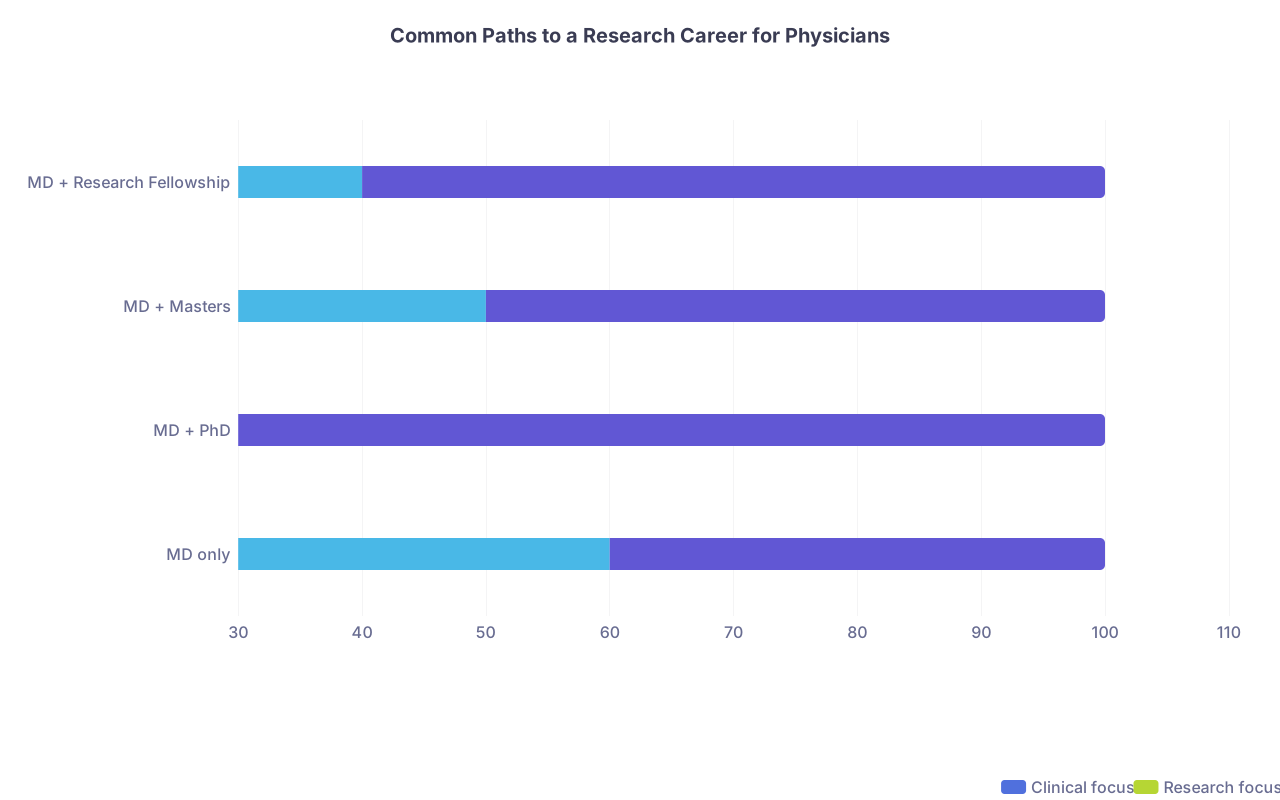
| Category | Clinical focus | Research focus |
|---|---|---|
| MD only | 60 | 40 |
| MD + PhD | 30 | 70 |
| MD + Masters | 50 | 50 |
| MD + Research Fellowship | 40 | 60 |
How to Tell If It’s Real Concern vs Anxiety Lying to You
Here’s the litmus test I use:
You’re probably dealing with realistic self-assessment if you’re thinking:
- “I’ve tried research for a sustained time and I truly don’t enjoy the process.”
- “I find myself dreading lab/analysis in a way that’s qualitatively different from other hard things.”
- “My mentors, unprompted, have gently nudged me away from long-term research as a main career.”
You’re probably dealing with anxiety if you’re thinking:
- “If I’m not the best in the room, I shouldn’t be here at all.”
- “If I need help learning this, I’m clearly not cut out for it.”
- “If I can’t see myself as a top-tier NIH-funded PI right now, I shouldn’t even start.”
The first set is about data. Lived experience. External feedback.
The second set is about perfectionism. Catastrophizing. All-or-nothing thinking.
Both need to be heard. Only one should make the actual decision.
One More Hard Truth: You Will Never Feel Smart Enough
If you’re the kind of person reading an article with this title, you’re probably never going to wake up one day and think, “Yes, I’m definitely PhD material, zero doubts.” That’s just not your brain’s brand.
MD–PhD trainees with 99th percentile everything still feel like imposters when:
- Their experiment fails for the 5th time.
- A committee member destroys their proposal.
- They attend a conference and realize there are 50 people who know more about their topic than they do.
You’re waiting for a feeling that doesn’t exist: “certified smart enough.” At some point, the decision isn’t “Am I definitely capable?” It’s “Am I willing to be the kind of person who struggles publicly and keeps going anyway?”
If the answer is yes, then you’re already more “PhD material” than half the people you’re putting on a pedestal.
Open a blank document right now and write one paragraph answering this question: “If fear of not being smart enough disappeared for 24 hours, what training path would I actually choose?” Don’t edit, don’t justify, just write it. That’s the version of you I’d trust more than the anxious one.