
The belief that a prelim year is just a “stepping stone” with no impact on your ultimate match is wrong. The data say otherwise.
If you are comparing a preliminary year plus later reapplication versus direct categorical entry, you are not choosing between equal paths. On average, you are trading probability, control, and stability for a second shot. Sometimes that trade is necessary. But you should understand the numbers cold before you make it.
This is a data-heavy breakdown of match outcomes for applicants who enter residency via:
A preliminary year (often medicine, surgery, or transitional) with intent to transition into:
- advanced specialties (e.g., anesthesia, radiology, derm, ophtho, PM&R, neuro)
- or a different categorical program after not matching
Direct categorical entry (e.g., categorical IM, categorical GS, FM, peds, etc.)
Where possible, I will anchor to NRMP data and typical institutional statistics. Exact figures vary year by year and by specialty, but the relative patterns are consistent.
Defining the Paths: Prelim vs Categorical
You cannot compare match outcomes without first being precise about what type of match we are talking about.
Categorical position: You match directly into a full program (e.g., Internal Medicine PGY1–3, General Surgery PGY1–5). No second match required. You have a defined path to board eligibility.
Advanced position: You match for PGY2+ (e.g., Anesthesiology, Diagnostic Radiology, PM&R, Neurology in some institutions). You still need a separate PGY1 (prelim or transitional) year.
Preliminary position: One year (sometimes two) of training without a guaranteed continuation in that specialty or institution. Commonly:
- Preliminary Internal Medicine
- Preliminary Surgery
- Transitional Year (broad exposure, often cushier)
From an outcome perspective, prelim pathways split into three broad groups:
- Those who matched an advanced position already (secured PGY2+ plus a prelim PGY1).
- Those using a prelim as a bridge after not matching or withdrawing (reapplicants).
- Those who start prelim with vague “I’ll figure it out” plans (high risk group).
Group 1 behaves much closer to categorical in stability. Groups 2 and 3 are where outcomes diverge sharply.
Big-Picture Match Probabilities: Direct vs “Second-Chance”
Let’s start with macro-level probabilities from NRMP data (aggregated patterns, not one-off anecdotes).
Among U.S. MD seniors (most favorable group):
- Overall match rate to a PGY1 spot: roughly 92–94% in recent years.
- Match rate to preferred specialty on first try: lower, often around 70–80% depending on competitiveness.
Among prior-year graduates / reapplicants (i.e., people who are coming back after a previous attempt, many of whom have done a prelim or some form of PGY1):
- Match rates drop, often into the 50–70% range depending on specialty and applicant type.
- For highly competitive specialties (derm, ortho, plastics, ENT, neurosurg), reapplicant match rates are consistently lower than first-time senior rates.
Do prelim-year applicants “recover”? Often yes, but not to the level of a strong first-time senior.
The harsh truth: The best time to match into your preferred specialty is the first time you apply. Preliminary pathways are damage control, not optimization.
Where Prelim Helps vs Where It Does Not
There are two different questions people mix up:
- Does doing a prelim increase my chance of matching into something later compared with doing nothing post-grad?
- Does doing a prelim equalize my chance of matching into my dream specialty compared with going categorical directly?
The data and program behavior say:
For question 1: Yes. A strong prelim year is better than an empty year. It shows you can function in a hospital, get U.S. clinical experience, and secure updated letters.
For question 2: No. It rarely brings you back on par with a competitive first-time senior. In some fields, it does not even come close.
Direct Categorical Entrants: Baseline Outcomes
Direct categorical entry is straightforward:
- If you match categorical IM, FM, peds, psych, etc. as a U.S. senior, your probability of graduating and becoming board eligible is extremely high (>90% completion in most fields, excluding personal issues/attrition).
- Your odds of needing to re-enter the Match at the PGY-2+ level are small, and usually driven by:
- Switching specialties
- Program closure / catastrophic issues
- Disciplinary or performance problems
We can think of direct categorical entry as having two stages of probability:
- P(Match categorical on first attempt)
- P(Complete residency once matched)
For a typical U.S. senior into a less competitive specialty, this combined probability is around 0.9 × 0.9+ ≈ 80–85% or higher.
For prelim-based recovery, the path adds extra conditional steps.
Probabilistic Pathways: Prelim + Later Match vs Direct
Let’s frame this with conditional probabilities. Think like a data analyst, not like someone clinging to hope.
Scenario A: Direct Categorical Entry
You apply to Internal Medicine categorical as a U.S. senior.
- Approximate numbers (illustrative, not exact for every year):
- IM categorical U.S. MD senior match rate: ~95%
- Completion rate for those who start: ~90–95%
Your overall probability of becoming an IM attending via this route is roughly:
P(Match categorical IM) × P(Complete training | Matched) ≈ 0.95 × 0.93 ≈ 0.88, or 88%
Order of magnitude: Your odds are very good.
Scenario B: Did Not Match IM, Take a Prelim IM Year, Reapply
Now you did not match categorical IM the first cycle. You scramble/SoAP into a prelim IM spot.
Let us break the path:
- P(Secure prelim spot after not matching): high, but not guaranteed; let’s say 0.7–0.9 depending on your profile and year.
- P(Perform well enough to get strong letters and no red flags): maybe 0.8–0.9 for reasonably capable people.
- P(Match categorical IM as a prior grad with prelim experience): NRMP data suggest reapplicants in IM often have match rates around 70–80% if they are U.S. grads with reasonable applications, but it can be significantly lower for IMGs or for those with major red flags.
Concrete approximation for a U.S. MD with otherwise decent metrics:
- P(Prelim) ≈ 0.8
- P(Good performance) ≈ 0.9
- P(Match categorical IM next cycle) ≈ 0.75
- P(Complete residency afterward) ≈ 0.93
Compound probability: 0.8 × 0.9 × 0.75 × 0.93 ≈ 0.50, or 50%
Compare that to the original ~88% via direct categorical. You have taken a massive hit in integrated probability, even though each conditional step individually might look “not too bad.”
For IMGs, the numbers can be much worse (e.g., P(Match categorical on reapplication) dropping into the 30–50% range for some groups).
Specialty-Specific Outcomes: Where Prelim Is Almost Required
There is one domain where prelim years are not a “plan B” but a built-in part of the process: specialties that require an advanced match with separate PGY1.
Radiology, anesthesiology, PM&R, neurology (in many institutions), and some others often have this structure:
- You match into an advanced position (PGY2+).
- You also match (or later obtain) a prelim/TY year.
For these applicants, the outcome driver is the advanced match, not the prelim itself.
| Specialty | Typical Entry Type | Prelim Common? | Direct Categorical Often Available? |
|---|---|---|---|
| Internal Medicine | Categorical | Optional | Yes |
| General Surgery | Categorical | Yes (prelim) | Yes |
| Anesthesiology | Advanced/Categorical | Yes | Sometimes |
| Diagnostic Radiology | Advanced/Categorical | Yes | Sometimes |
| PM&R | Advanced/Categorical | Yes | Sometimes |
For anesthesia and radiology, match outcome differences look like this:
Applicant who matches advanced + prelim at the same time:
- Stability and outcome probability are closer to categorical.
- The prelim year is not a high-risk “waiting room”; it is just required PGY1 training.
Applicant who did a prelim year after failing to match advanced and is now reapplying:
- This is a different population.
- Data show reapplicants in these specialties have lower match rates than first-time seniors, especially without a significantly improved application (USMLE, research, etc.).
You cannot treat all prelim years as equivalent. A prelim year with a secured advanced spot is fundamentally not the same as a prelim year used as a patch after not matching.
General Surgery: Prelim vs Categorical Outcomes
General Surgery is where the prelim vs categorical divide is most brutal.
Direct categorical GS positions:
- U.S. MD senior match rate into categorical GS: roughly 75–85% (varies by year).
- Completion rate can be lower than IM due to attrition, but still, the majority finish.
Prelim GS positions:
- Large fraction of prelim GS residents will never transition into a categorical GS spot.
- Transition rates to categorical surgery (either in the same or different program) are often in the 10–30% range, depending on program, year, and the resident’s strength.
I have seen programs where:
- Out of 6 prelim surgery interns, 1 might find a categorical spot in GS.
- Another 1–2 may transition to categorical in another specialty (IM, anesthesia, etc.).
- The rest either complete the prelim year and leave clinical training or pursue non-surgical specialties later with mixed success.
If you think a prelim surgery year guarantees “I will eventually become a surgeon,” you are ignoring the denominator. The data show that most prelim GS residents do not become board-certified surgeons.
Programs are candid behind closed doors: prelim surgery spots are often service positions to keep the call schedule functional. A few outstanding residents will be picked up; most will not.
IMG vs US Grad: Prelim Pathways Diverge Even More
For international medical graduates (IMGs), the difference between prelim and categorical outcomes is even more skewed.
Broad patterns:
- Categorical IM for IMGs: match rates can range from 40–60% depending on scores, YOG, and visa needs.
- Prelim IM for IMGs: easier to obtain than categorical, but:
- Transition to categorical later is far from guaranteed.
- If you finish a prelim year and do not secure a categorical spot, you are often stuck: no board eligibility, no clear career path.
I have seen multiple cycles where IMGs piled into prelim IM or prelim surgery assuming “step in the door” logic. Three years later, many of them were working as research fellows, hospital scribes, or in completely unrelated jobs because they never secured a categorical transition.
Data point: In NRMP’s reports, IMGs reapplying after prior US training still show lower match rates than U.S. grads across almost all specialties. A prelim year does not erase the fundamental disadvantage; it may slightly mitigate it if backed by strong performance and connections.
Why Programs Treat Prelim and Categorical Applicants Differently
Programs do not evaluate a prelim-year applicant the same way they evaluate a fourth-year medical student.
Here is what tends to show up in internal committee conversations:
For direct categorical applicants (MS4s):
- They are a “clean slate.” No prior residency baggage.
- Faculty and PDs project potential over several years.
- The bar is high, but the narrative is simpler.
For prelim/reapplicants:
- The file already has a history: did not match before, or dropped out, or switched.
- Committees immediately ask: “Why did they not match first time?” “Any red flags?”
- Even a benign reason (overreached on specialty, late application) still creates a comparative disadvantage.
This is why the reapplicant match rate is structurally lower, even among strong candidates. There is signal in being a reapplicant, and committees know it.
Quantifying Risk: Direct vs Prelim Route in Practical Terms
Let me put this bluntly.
If you are deciding between:
- Ranking a mid-tier categorical IM program highly and possibly matching there this year, versus
- Ranking no categorical IM at all, aiming only for prelim or nothing, hoping to reapply next year “stronger”
Your expected outcome, in raw probability terms, almost always favors taking the categorical seat now.
The exceptions are rare and usually involve:
- Extreme misalignment with the specialty (e.g., you know you will be miserable in IM).
- Catastrophic step failure that you plan to correct with a retake (where allowed).
- A clearly realistic path to a dramatically more competitive application (new degree, major research output, visa status changes, etc.).
For 90%+ of applicants, giving up a solid categorical option for a speculative prelim + reapply strategy is mathematically irrational once you map out the probabilities.
Financial and Life-Course Consequences
We are not only dealing with “match vs no match.” There are downstream effects.
Prelim → later match route often means:
- Extra 1–2 years of training with resident-level pay instead of attending income.
- Greater chance of ending up with no board-eligible specialty, which crushes long-term earning potential.
- More geographic and personal instability (moving multiple times, visa complications, family strain).
You can approximate opportunity cost:
- If you delay becoming an attending by 2 years at $250k/year potential income vs $65k resident salary, you are losing ~$370k in gross compensation during that window.
- That is before discounting, taxes, and compounding.
If those extra years genuinely buy you a much more desirable specialty with a significantly higher lifetime earning potential or better lifestyle, the math may still favor the delay. But that is a real cost, and many people ignore it when they romanticize “I’ll reapply next year.”
Visualizing Pathways: Direct vs Prelim Route

| Step | Description |
|---|---|
| Step 1 | MS4 Applicant |
| Step 2 | Start Categorical PGY1 |
| Step 3 | Complete Residency |
| Step 4 | Board Eligible Attending |
| Step 5 | Prelim PGY1 |
| Step 6 | Reapply to Match |
| Step 7 | Start Categorical PGY2 |
| Step 8 | No Categorical Spot |
| Step 9 | Match? |
| Step 10 | Strong Performance |
| Step 11 | Match Categorical? |
Notice how many more failure nodes exist in the prelim path.
Data-Based Heuristics: When a Prelim Year Makes Sense
Prelim years are not universally bad. They are just often misused. The data support them in specific contexts:
You already matched an advanced position.
- Prelim or TY is mandatory. Outcome risk is mostly in the advanced spot, not the prelim year.
You completely failed to match anything and have no acceptable nonclinical gap-year plan.
- A prelim in IM or TY can be better than inactivity, especially if you can realistically see yourself in IM/FM/etc. as a backup.
You are an IMG needing U.S. clinical experience, and the prelim year is in a place with:
- Strong advocacy from faculty
- A track record of moving prelims into categorical slots somewhere
But even in these scenarios, you should quantify your personal risk:
- What is this program’s actual historical prelim-to-categorical conversion rate?
- Are there objective data (even informal: “in the last 3 years, 3 of 10 prelims got categorical IM here or elsewhere”)?
If a program cannot or will not give you approximate numbers, that is a red flag.
Simple Comparative Outcomes Table
Here is a simplified comparison for a U.S. MD applicant with average-strong metrics, aiming for Internal Medicine or General Surgery. These are example ranges, not guaranteed numbers, but they capture typical relationships.
| Pathway | Chance of Becoming Board-Certified in Target Field |
|---|---|
| Direct Categorical IM (first-time senior) | ~80–90% |
| Prelim IM → Reapply to IM | ~40–60% |
| Direct Categorical GS (first-time senior) | ~60–75% (accounting for attrition) |
| Prelim GS → Try to move into GS categorical | ~10–30% |
| Prelim GS → Eventually board-certified in any field | ~30–50% |
Pattern is clear: direct categorical is usually the higher-probability route to board certification.
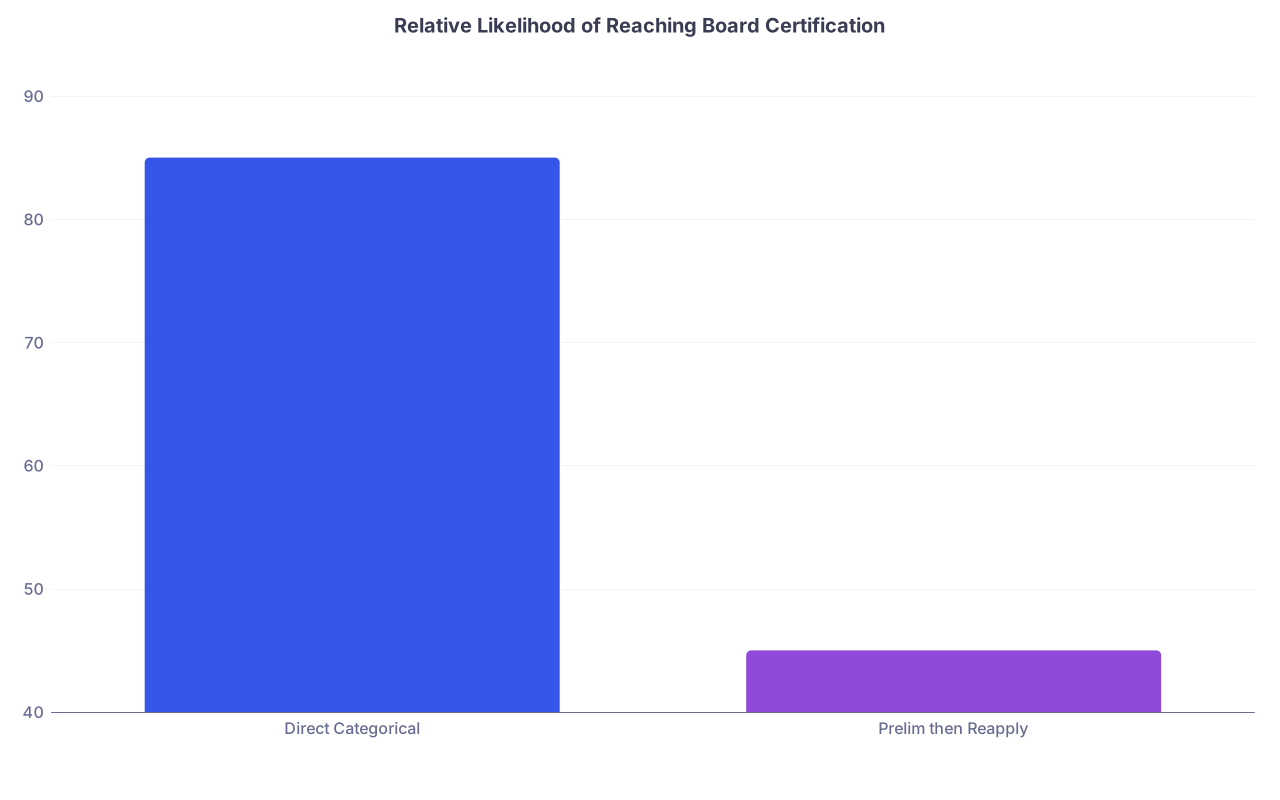
| Category | Value |
|---|---|
| Direct Categorical | 85 |
| Prelim then Reapply | 45 |
Interpretation: In a generic internal medicine–type scenario, direct categorical paths cluster near an 80–90% success rate; prelim-then-reapply routes often sit around 40–50% for similar baseline applicants.
That is not a small difference. That is a coin flip vs near-certainty.
FAQs
1. Does a strong prelim year “erase” a weak Step score or failed first match?
No. A strong prelim year can help, but Step scores and prior match history remain visible. Programs may be more comfortable with you clinically, but they still benchmark you against MS4s with clean records. You might move from “no chance” to “some chance,” but you rarely reach parity with similar MS4s who had those strong metrics from the start.
2. If I hate my prelim specialty, can I easily switch to another field?
Not easily. You are competing as a prior grad or current resident against MS4s who are the primary recruitment target. Some people do successfully switch (e.g., prelim surgery → anesthesia, IM → neuro), but the transition depends heavily on:
- Open PGY2+ spots
- Strong advocacy from your PD
- Your underlying test scores and prior record
Treat switching as a moderate-probability plan only if you have concrete program-level opportunities, not just vague intentions.
3. Is a transitional year better than a prelim medicine or prelim surgery year for future matching?
For many advanced specialties (anesthesia, rads, derm, ophtho), a well-regarded transitional year can be very attractive because it signals broad training and usually less malignant schedules for research and studying. For IM or GS categorical reapplications, prelim IM or GS may be more directly relevant. The best year is the one where:
- You can excel clinically
- You get strong letters from known faculty
- The program has a track record of helping trainees move on to good positions
Look at concrete outcomes, not just the label “transitional” vs “prelim.”
Key points:
- Direct categorical entry almost always offers a higher integrated probability of becoming board-certified than using a prelim year as a recovery strategy.
- Prelim years work best when tied to an already-secured advanced position or a realistic, data-backed pathway—not as a vague safety net.
- If you are considering giving up a categorical spot to “roll the dice” on a prelim + reapply route, run the numbers carefully. The data show that most people lose that gamble.